Published On:
August 10, 2026
Updated On:
August 10, 2026
A Mumbai couple's search for a ₹1 lakh-a-month apartment took an unexpected turn when the housing society demanded a marriage certificate, sparking a nationwide debate on tenant privacy. This incident highlights the growing friction between cooperative housing society bye-laws, property owner rights, and the legal limits of tenant verification in Maharashtra.
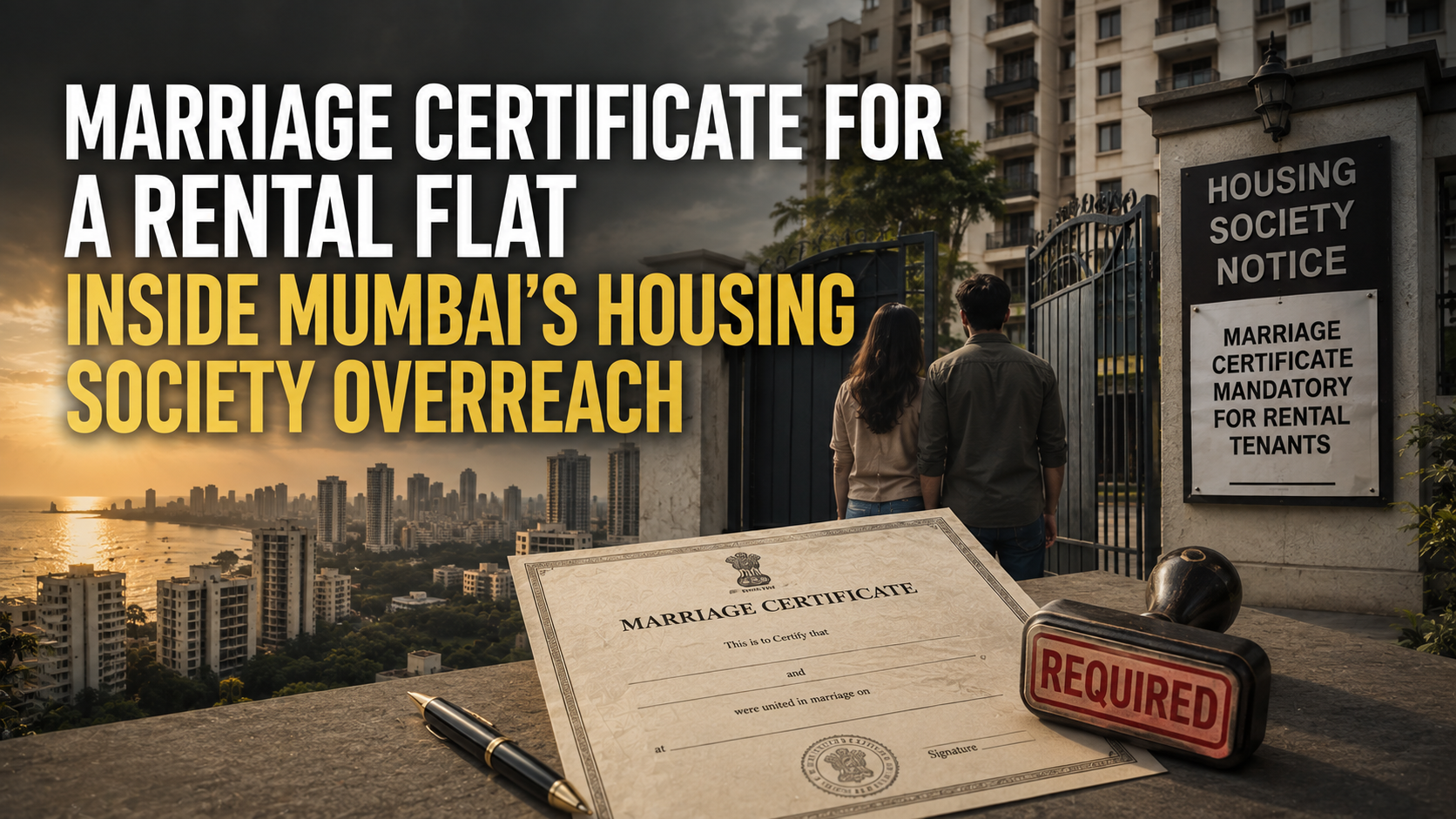
Finding a rental apartment in Mumbai is notoriously challenging. Beyond the staggering security deposits, the relentless broker negotiations, and the sky-high monthly rents, prospective tenants often face an entirely different hurdle: the cooperative housing society managing committee. Recently, the city's real estate market witnessed an incident that perfectly encapsulates this struggle. A married couple, armed with a robust monthly rental budget of nearly one lakh rupees, found themselves stonewalled not by finances, but by a demand for their marriage certificate.
This unexpected request, which quickly went viral across social media platforms, has reignited a fierce, long-standing debate. It brings into sharp focus the precarious balance between a housing society's need for security and a tenant's fundamental right to privacy. More importantly, it raises critical legal questions regarding the extent of power wielded by managing committees in Maharashtra. When renting a flat in Mumbai involves handing over government IDs and undergoing mandatory police verification, does demanding proof of marital status cross the line into unwarranted moral policing?
The ordeal began like any typical house-hunting journey in the financial capital. After spending nearly ten days scouring the western suburbs of Mumbai, the couple believed they had finally secured their ideal three-bedroom apartment. The flat ticked all their boxes, and they were ready to sign the standard leave-and-licence agreement. However, as is customary in many metropolitan residential complexes, the real estate broker facilitated a meeting between the prospective tenants and the housing society’s managing committee prior to finalizing the paperwork.
It was during this routine introduction that the situation took an intrusive turn. Instead of standard questions regarding their professional backgrounds or adherence to society rules, the committee’s primary concern was the couple's relationship status. The members explicitly asked the couple to produce a marriage certificate to prove they were legally wed.
For a couple willing to pay a premium rent of one lakh rupees per month, this level of scrutiny felt entirely disproportionate. The incident, once shared online, struck a chord with countless urban renters who have faced similar interrogations. It highlighted a stark reality: in Mumbai's real estate landscape, financial capability does not always guarantee a smooth rental process, and the final hurdle often involves navigating the arbitrary, unwritten rules of a residential community.
The viral social media post quickly polarized public opinion, drawing reactions from frustrated tenants, property owners, and society committee members alike. The debate essentially fractured into two distinct camps: those advocating for strict tenant privacy and those defending a society's right to rigorously vet its residents.
A significant portion of the internet heavily criticized the housing society's approach. The prevailing argument was that if prospective tenants are already submitting robust, government-issued identity documents such as Aadhaar and PAN cards, and are legally required to undergo a comprehensive police verification process, any further demands are redundant. Many viewed the request for a marriage certificate as a blatant invasion of privacy. They argued that a person's marital status has no bearing on their ability to pay rent on time or their capacity to be a responsible, peaceful neighbor.
Conversely, there were voices defending the actions of the managing committee. Supporters of strict tenant verification norms argued that housing societies have a collective responsibility to maintain a secure and harmonious living environment. From their perspective, verifying marital status helps societies minimize future domestic disputes or complaints that could disturb other residents. In complexes that unofficially brand themselves as strictly family-oriented, verifying a marriage is seen as a way to maintain the community's desired demographic.
The conversation also brought to light the intense difficulties faced by unmarried couples, bachelors, and live-in partners who search for rental homes. Despite Mumbai being heralded as a progressive, cosmopolitan metropolis, these demographics are routinely subjected to extreme scrutiny, moral judgments, and outright rejection by housing societies, underscoring a deep-rooted societal conservatism that continues to dictate urban housing trends.
While the demand for a marriage certificate might seem extreme to some, real estate consultants indicate that such rigorous vetting is rapidly becoming standard operating procedure across large housing societies in metropolitan cities. The process of tenant verification has evolved far beyond simple identity checks.
Today, managing committees are digging deeper into the personal and professional lives of prospective renters. It is no longer uncommon for societies or even individual homeowners to request a slew of additional documentation before granting approval. Beyond standard government IDs, tenants are frequently asked to provide office identity cards, corporate visiting cards, and salary slips. Some committees have even modernized their background checks by requesting links to a prospective tenant's LinkedIn profile to verify their employment history and professional standing.
The specific demand for a marriage certificate often arises from bureaucratic discrepancies. Real estate brokers note that when a couple's surnames do not match on their primary identification documents, managing committees immediately raise red flags. In an attempt to ensure that the individuals moving in are indeed a married family unit and not an unmarried couple posing as one, the society demands official marital documentation.
This escalating level of scrutiny transforms the simple act of renting a home into a grueling, multi-step interview process. While property consultants acknowledge that there is no legal mandate for a homeowner to obtain a society's explicit permission to lease their flat, the reality on the ground is quite different. The informal introduction meetings often act as a secondary vetting layer, where the managing committee exercises its soft power to approve or reject tenants based on subjective, locally enforced criteria.
To truly understand the dynamics of this conflict, it is essential to look past the unwritten societal norms and examine the actual legal framework governing these residential complexes. In Maharashtra, housing societies are regulated by the Maharashtra Co-operative Societies Act, 1960, and operate under a set of Model Bye-laws approved by the state government.
When it comes to renting a flat in Mumbai, the law is unequivocally clear: property ownership grants a member the fundamental right to use, lease, or license their apartment. A housing society cannot impose a blanket prohibition on rentals, nor can it dictate to whom a flat owner is allowed to rent their property.
Under the cooperative housing society bye-laws, specifically Model Bye-Law 43 and related tenant approval rules, the obligations of a property owner are strictly procedural. An owner is required to provide prior written intimation to the society about their intention to rent the flat. Following this, they must submit a copy of the registered leave-and-licence agreement and ensure that the mandatory police verification of the tenant is completed and submitted to the society's office.
Crucially, the law does not empower the managing committee to conduct interviews, demand marriage certificates, or act as an ultimate approving authority for a tenancy. The society's role is administrative—it exists to maintain records for security purposes and to ensure that the legally required documentation is in place. Furthermore, the government has capped non-occupancy charges at ten percent of the regular service charges, explicitly prohibiting societies from demanding exorbitant tenant approval fees or illegal deposits from flat owners or renters.
Despite these clear legal parameters, many managing committees continue to draft their own localized rules, often passing internal resolutions that directly contradict the state's cooperative housing laws. This creates a challenging environment where flat owners and tenants must choose between fighting a prolonged legal battle or simply submitting to the society's arbitrary demands.
The demand for a marriage certificate is just one facet of a broader issue concerning housing discrimination in urban India. Across Mumbai, Thane, and Navi Mumbai, there are countless instances where prospective tenants are denied accommodation based on their religion, caste, dietary habits, or marital status.
It is not uncommon to find housing societies that explicitly ban non-vegetarians, single men, single women, or individuals belonging to certain minority communities. However, from a legal standpoint, such discriminatory practices are entirely invalid. The Indian Constitution guarantees citizens the right to reside anywhere in the country without facing discrimination. The courts have repeatedly criticized and struck down arbitrary housing society resolutions that attempt to restrict tenancies based on food preferences or marital status.
A society cannot deny a No Objection Certificate to a flat owner without a highly valid, legally sound reason. Moral judgments regarding whether a couple is married or living together hold no legal weight. When societies attempt to enforce these biases, they overstep their administrative mandate and infringe upon the fundamental rights of both the property owner, who is prevented from monetizing their asset, and the tenant, who is denied fair access to housing. Flat owners who find their rights violated often have to seek intervention from the Registrar of Cooperative Societies, the Cooperative Court, or even the Bombay High Court to have these illegal restrictions nullified.
The tension between housing societies and prospective tenants is ultimately a clash between collective security and individual privacy. It is undeniable that managing committees bear a significant responsibility. In vast, densely populated residential complexes, maintaining accurate records of occupants is crucial for the safety and smooth administration of the community. Background checks and verification processes are essential tools to prevent unauthorized occupations and ensure a peaceful living environment.
However, security measures must remain proportional and relevant to tenancy. A well-defined, legally compliant tenant verification policy can eliminate the friction that currently plagues the rental market. Societies should clearly outline which specific government documents are required and focus their vetting purely on identity verification and legal compliance.
Delving into the personal relationship dynamics of adult tenants is an overreach that damages the cosmopolitan fabric of a city like Mumbai. As the real estate market continues to evolve and the urban workforce becomes more diverse, housing societies must modernize their approach. By respecting the legal rights of property owners and the personal privacy of tenants, communities can foster safe, inclusive environments without resorting to intrusive moral policing. Renting a home should be a transaction based on legal agreements and mutual respect, not a trial of one's personal life choices.
