Published On:
September 6, 2026
Updated On:
September 6, 2026
A recent MahaRERA ruling clarifies that developers cannot be forced to buy back an apartment post-possession due to water seepage, highlighting the critical need for expert technical evidence and a clear understanding of the five-year Defect Liability Period to resolve construction flaws.
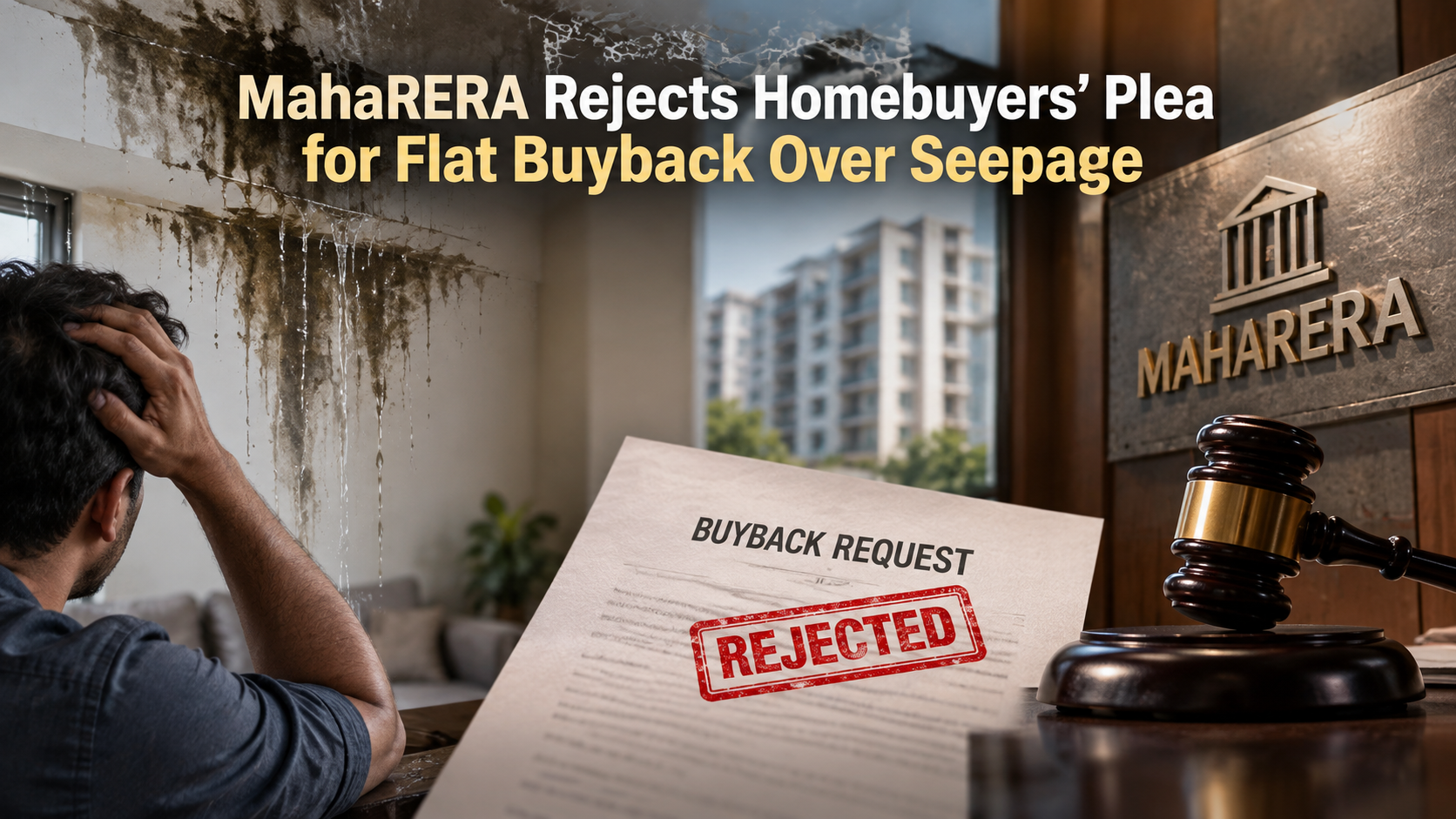
Moving into a brand-new home is meant to be a joyous and fulfilling milestone. You invest your hard-earned money, endure the exhaustive process of loan approvals and property registration, and finally receive the keys to your dream apartment. However, for many homebuyers, the initial excitement rapidly deteriorates when structural flaws begin to surface. Water seepage, aggressive dampness, and cracked plaster are among the most frequent and devastating nightmare scenarios in newly constructed high-rise buildings across India.
When a buyer in the Mumbai Metropolitan Region found themselves facing exactly these severe issues, they took their grievances to the Maharashtra Real Estate Regulatory Authority. The buyer demanded that the developer not only fix the issues but completely take the flat back and refund the entire purchase amount along with bank interest.
The regulatory body recently dismissed this ambitious plea. This verdict is a massive learning curve for property investors, end-users, and real estate professionals. It draws a very distinct legal line between what constitutes a resolvable structural defect and what actually warrants the absolute cancellation of a property transaction after possession has been handed over. It also sheds light on the precise steps buyers must take when dealing with poor construction quality to ensure the law works in their favor.
The core of this dispute revolved around an affordable housing unit located near Mumbai, which was purchased for approximately thirty lakh rupees. The homebuyer successfully took physical possession of the property at the end of June 2021. For the first few months, things seemed normal, but eventually, the buyer alleged that the apartment was severely compromised by persistent construction defects.
The walls and ceilings were reportedly plagued by continuous water seepage and heavy dampness. The homeowner also pointed out visible cracks in the plaster, overall poor finishing across the rooms, and highly inadequate waterproofing work. Anyone who has lived in a coastal or heavy-rainfall region like Mumbai knows exactly how rapidly dampness can destroy expensive interior woodwork, ruin custom furniture, and create a highly unhealthy, mold-prone living environment.
Driven by immense frustration over the deteriorating condition of the brand-new apartment, the buyer approached the regulatory authority with a specific and heavy set of demands. In addition to asking for an immediate official inspection, necessary structural repairs, and a strict timeline for executing waterproofing work, the buyer made a much larger demand. They requested that the developer be directed to completely buy back the flat. The buyer wanted their entire investment refunded, alongside compensation for the interest they were actively paying to their bank for the home loan. To back up these claims, the buyer submitted a series of photographs showcasing the damp, ruined, and water-affected portions of the apartment, asserting that the developer had been repeatedly notified of the grim situation.
In real estate disputes, the actual source of water leakage is notoriously difficult to pinpoint without invasive technical checks. The developer strongly contested the buyer's allegations of substandard construction and structural defects. According to their official defence, the seepage in the complainant’s apartment was not due to poor waterproofing of the building's exterior or faulty structural engineering. Instead, they claimed it was a localized issue stemming entirely from the flat directly above the complainant's unit.
The developer attributed the damp walls to bathroom leakage and the excessive accumulation of rainwater in the balcony of the upper-floor apartment. They argued forcefully that they had not ignored the buyer’s complaints at any point. Instead, they claimed to have carried out physical inspections and undertaken civil rectification work in both the complainant’s flat and the apartment above it.
To strengthen their position and prove their responsiveness, the developer presented maintenance job cards and internal email communications to the authority. These documents were meant to prove that repair teams had been dispatched multiple times to address the issue. They also brought forward an interesting procedural argument, claiming that the buyer was specifically requested to coordinate and resolve the upper-floor access issue directly with the neighbor, but the buyer allegedly failed to take the necessary steps to facilitate this. Furthermore, the developer alleged that during the official conciliation proceedings—a forum designed to settle disputes amicably—the homebuyer did not cooperate in allowing the necessary civil works to be carried out inside their home.
When the regulatory authority evaluated the evidence presented by both the homebuyer and the developer, several critical legal gaps in the homebuyer's case became glaringly apparent.
The first major hurdle was the timeline of events. The buyer took possession of the flat in June 2021, but the very first official complaint regarding the leakage was not formally raised until September 2022. While this timeline still falls comfortably within the legal warranty period for new homes, the delay of over a year in reporting the issue slightly weakened the argument that the flat was inherently defective from the very first day of possession.
The most significant and ultimately fatal blow to the buyer's case, however, was the absolute lack of independent technical evidence. The authority noted that while photographs of damp walls and peeling paint were submitted, pictures alone do not establish the root cause of the structural damage. Without a formal inspection report, a technical assessment, or a detailed expert opinion from a certified structural engineer, there was absolutely no concrete proof that the seepage resulted from the developer's faulty workmanship or use of substandard materials.
Acknowledging the job cards and emails provided by the builder, the authority accepted that rectification efforts had indeed been initiated. Taking all this into account, along with the undeniable fact that the buyer continued to physically occupy the flat, the authority concluded that the circumstances simply did not justify a complete refund or a forced property buyback.
The regulatory body made it entirely clear that forcing a real estate developer to buy back a property after possession has been handed over and accepted falls entirely outside the purview of the reliefs they are empowered to grant under the current real estate regulatory framework. Consequently, the complaint was dismissed, with no order made regarding the costs of the proceedings.
To fully understand why this ruling makes legal sense, one must look closely at how real estate laws in India are structured to balance the rights of both buyers and builders. Before possession is handed over, the law is heavily skewed toward buyer protection regarding refunds. If a project is severely delayed beyond the promised date, or if a developer alters the sanctioned layout without the explicit written consent of the buyers, the law provides a very clear exit route. Under such circumstances, buyers can legally demand a full refund with interest, and developers are obligated to pay.
However, the legal landscape changes the moment a buyer accepts possession, registers the property deed, and moves in. A completed sale transaction is a legally binding contract. Reversing it requires absolute, undeniable proof of severe structural failure that renders the property entirely uninhabitable or dangerous to human life. Routine seepage, plaster cracks, or finishing issues—while incredibly frustrating and damaging—are legally classified as rectifiable defects rather than grounds for terminating a finalized sale deed.
The regulatory authority acts as a judicial facilitator within the strict bounds of the parliamentary act. They can order developers to fix issues, pay heavy compensation for delays, or hand over promised amenities. But they cannot invent penalties that do not exist in the rulebook. Since the act does not contain a provision for post-possession buybacks for regular wear-and-tear or repairable leaks, the authority rightly ruled that such a demand exceeded their legal jurisdiction.
This case brings massive attention to one of the most powerful, yet vastly misunderstood, legal tools available to property owners today: the Defect Liability Period. Real estate regulations across the country mandate that developers remain legally responsible for the structural integrity and overall quality of their buildings for a period of exactly five years from the date of handing over possession.
If a buyer discovers any structural defect, poor workmanship, use of inferior building materials, or serious deficiencies in plumbing and electrical services within this five-year window, they have the fundamental right to bring it to the developer's notice. The law dictates that the developer must rectify these issues within thirty days, completely free of charge to the homeowner.
If the developer ignores the complaint, applies a cheap temporary fix, or fails to resolve the issue adequately within the stipulated time, the buyer is then legally entitled to claim financial compensation. Regulatory tribunals regularly award monetary compensation to buyers to cover the exact cost of hiring independent third-party civil contractors to fix the defects, often throwing in additional compensation for the mental agony and inconvenience caused.
In this specific Mumbai case, the buyer's strategic mistake was aiming for a complete transaction reversal rather than actively utilizing the defect liability clause to demand professional, long-lasting repairs or equivalent financial compensation to hire their own waterproofing experts.
A major takeaway from this ruling is understanding exactly how regulatory tribunals evaluate evidence. Buyers often assume that snapping a few smartphone pictures of a peeling ceiling or a waterlogged balcony is enough to win a legal dispute against a massive construction firm. This ruling shatters that assumption entirely.
Photographs only prove that a symptom exists; they do not diagnose the underlying disease. Water travels in highly unpredictable ways through modern concrete structures. A damp patch on a living room wall could be caused by a poorly sealed exterior facade, a cracked internal plumbing pipe concealed in the brickwork, or even a neighbor who left their bathroom tap running overnight.
To hold a developer legally accountable, a buyer must establish attribution. This means proving beyond a reasonable doubt that the defect is a direct, undeniable result of the builder's negligence or use of substandard materials during the construction phase. The only way to prove this in a legal tribunal is through a certified technical report.
If you are facing similar issues in your property, your very first step should be to hire an independent structural engineer, a certified architect, or a professional waterproofing consultancy. These experts utilize modern tools like thermal imaging cameras, digital moisture meters, and structural analysis to pinpoint the exact origin of the leak. A detailed, signed, and stamped report from a registered technical professional carries immense legal weight and leaves the developer with very little room to make excuses or shift the blame.
Another crucial aspect homebuyers must be aware of is how interior modifications impact the Defect Liability Period. When buyers take possession of a bare-shell flat, they often hire their own interior designers and contractors to install false ceilings, change flooring tiles, or reroute plumbing for luxury bathroom fittings.
Developers frequently use these modifications as a legal loophole to void their warranty. If you complain about seepage after redoing your bathroom, the builder will almost certainly argue that your interior contractor damaged the waterproofing membrane during the renovation, thereby absolving the builder of any liability.
To protect yourself, always ensure that your interior contractors do not tamper with the core structural waterproofing. Document the condition of the flat meticulously before starting any interior work, and if possible, get a sign-off from the builder’s facility management team confirming that your proposed interior changes do not violate the terms of the defect liability clause.
Handling a developer who delivers a subpar apartment requires a mix of legal strategy, patience, and meticulous documentation. If you find yourself staring at damp spots on your new walls, keep the following steps in mind to protect your massive financial investment.
Do not wait a year to file a formal complaint. The moment you notice the very first sign of seepage, a crack, or dampness, take high-resolution photos with clear date and time stamps. Send a formal, written email to the developer's customer care and estate management departments. Casual WhatsApp messages to the site engineer are rarely considered solid legal evidence in a tribunal. You need an official paper trail that clearly shows exactly when the issue started and how many times you requested professional assistance.
If the developer sends a civil team to inspect or repair the damage, do not block their access. As seen vividly in the Mumbai case, non-cooperation can and will be used against you in a legal setting. Allow them to do their work, but document exactly what they did. If they simply scrape and paint over a damp patch without breaking the wall to fix the underlying leaking pipe, note it down. Demand a job card or a service report detailing the exact nature of the repair work undertaken before signing off on it.
If the builder's temporary fixes fail and the dampness returns next monsoon, it is time to bring in your own experts. Get a comprehensive structural audit done. Once you have a technical report diagnosing a core construction flaw, send a formal legal notice to the developer attaching the expert findings. Give them the legally mandated thirty days to fix the structural root cause, not just the cosmetic symptoms on the surface.
When approaching the regulatory authority, ensure your demands align with what the law actually permits. Asking for a buyback after possession will likely get your case dismissed or tied up in endless delays. Instead, frame your prayer entirely around the defect liability clause. Ask the authority to compel the builder to execute the repairs exactly as recommended by your independent technical report, or ask for direct monetary compensation equivalent to the cost of fixing the apartment yourself.
The dream of owning a home is often the single biggest financial commitment an individual makes in their entire lifetime. Discovering that the final delivered product is compromised by poor workmanship is a bitter pill to swallow. However, the legal system is intentionally designed to offer remedies, provided buyers know exactly how to navigate those laws correctly.
The dismissal of the buyback plea by the regulatory authority should not be viewed as a defeat for consumer rights, but rather as a strict clarification of the rules of engagement. It underscores the harsh reality that multi-lakh property transactions cannot be easily unwound over maintainable, repairable defects.
Instead of seeking an impossible exit route, a homebuyer's focus must shift entirely toward demanding strict accountability through the proper legal channels. Armed with undeniable technical proof, an airtight paper trail, and a clear understanding of the five-year defect liability window, homebuyers can ensure that developers deliver on their promises and build homes that truly stand the test of time.
