Published On:
March 28, 2026
Updated On:
March 30, 2026
The Indian real estate market is witnessing a major paradigm shift in 2026, with smart money heavily favoring luxury properties for high capital appreciation and premium lifestyle features, while affordable housing remains a steady foundation for entry-level buyers and Tier-2 cities. Investors are increasingly balancing their portfolios between high-growth premium assets and stable affordable projects to maximize wealth creation and manage risk.
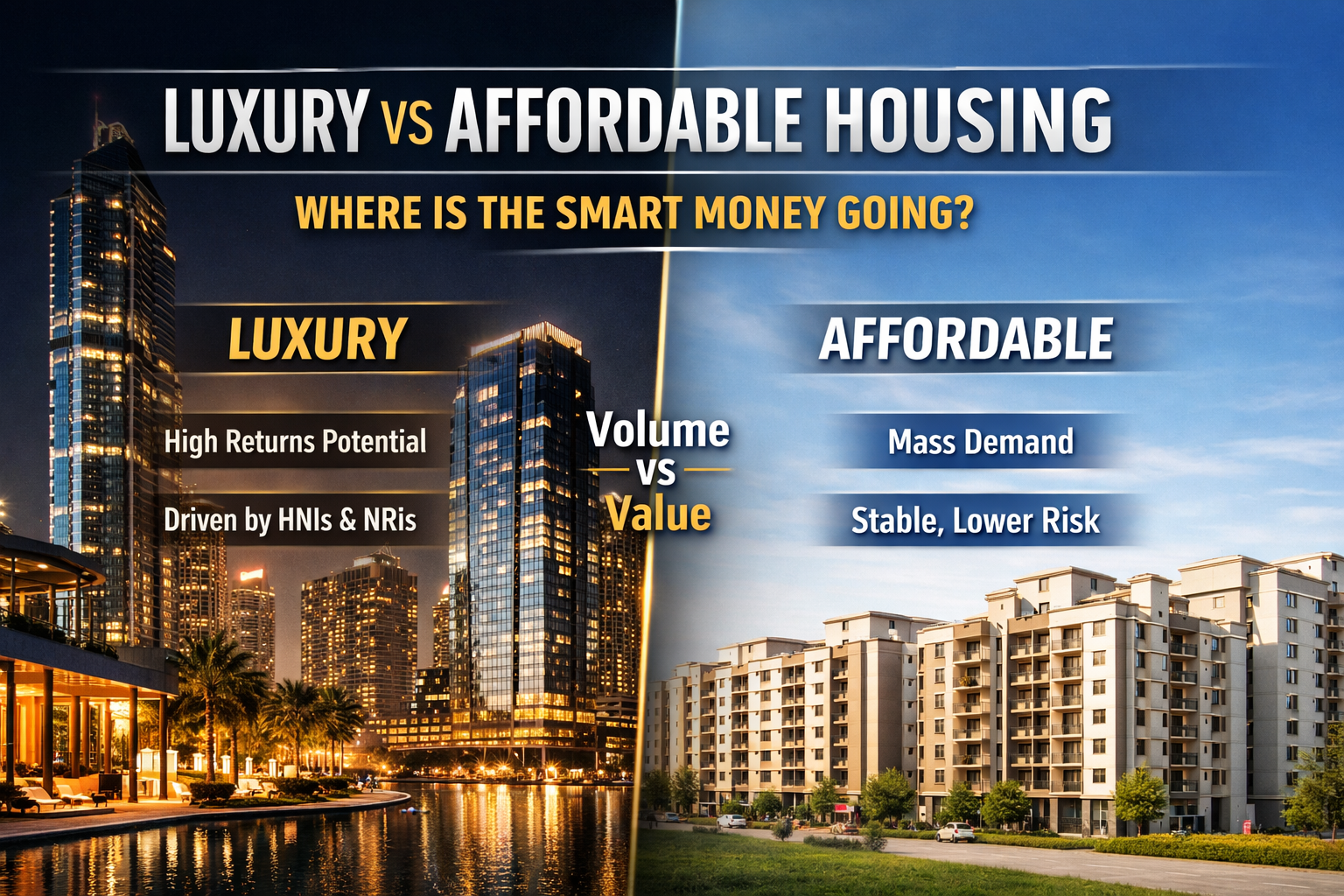
A decade ago, purchasing property in India was largely viewed through a lens of absolute necessity. Buyers entered the market to secure a fundamental need: a roof over their heads. Today, the Indian real estate landscape has evolved into a highly sophisticated ecosystem where property ownership is a potent combination of lifestyle aspiration, status signaling, and aggressive wealth creation.
As we navigate through 2026, a critical question dominates the minds of seasoned investors, first-time homebuyers, and industry experts alike: Should you channel your capital into luxury housing or rely on the traditional stability of affordable housing? More importantly, where is the "smart money" actually flowing in today's dynamic market? To navigate this choice, it is essential to look beyond surface-level trends and deeply analyze market performance, shifting buyer demographics, and the realistic returns each segment offers.
For decades, affordable housing has served as the unquestioned backbone of the Indian real estate sector. Designed to cater to the nation's vast middle and lower-income demographic, these properties are priced to be accessible through standard home loans, government subsidies, and broader financial inclusion schemes. Driven by initiatives aimed at providing "Housing for All," this segment has historically driven massive transaction volumes across the country.
The enduring appeal of affordable housing is rooted in its straightforward practicality. For first-time buyers, the low entry cost barrier is highly attractive. From an investment standpoint, the sheer scale of demand ensures that these properties remain highly liquid assets. In densely populated urban peripheries, affordable housing provides a stable, predictable stream of rental income. For years, conservative investors viewed this segment as the ultimate safe haven—a place to park capital with minimal risk and guaranteed, albeit modest, returns.
However, safety often comes at the cost of rapid growth. The most significant limitation of affordable housing is its restricted potential for capital appreciation. Properties within this bracket typically experience a slow, incremental rise in value rather than the explosive price multipliers seen in premium segments. For investors whose primary goal is accelerated wealth creation, this sluggish growth can be a major deterrent.
Furthermore, affordable projects are frequently built with very tight margins, which means they often compromise on premium amenities, highly sought-after central locations, and strong developer brand positioning. Over a long-term holding period, these missing elements can significantly cap both the property's resale value and its ability to attract higher-paying tenants.
In stark contrast, luxury housing is experiencing an unprecedented boom, transforming from a highly niche market reserved for the ultra-wealthy into a rapidly expanding sector embracing upper-middle-class buyers and aggressive aspirational investors. In major metropolitan areas—and increasingly in high-growth corridors like the National Capital Region (NCR), specifically the Noida and Greater Noida belts—luxury real estate is redefining urban living.
Today, luxury is no longer defined simply by massive square footage or imported marble floors. The definition has fundamentally shifted towards experiential living. A modern premium property is characterized by smart home automation, expansive wellness-centric amenities like private spas and vast green spaces, impenetrable multi-tier security in gated communities, and cutting-edge architectural design. It is about acquiring a highly curated quality of life.
The explosion of the luxury housing market is not a random market anomaly; it is the result of several powerful, converging socioeconomic factors:
Rising Disposable Incomes: India’s robust economic trajectory has dramatically increased disposable incomes among corporate professionals, entrepreneurs, and business owners. As financial capacity expands, buyer expectations upgrade correspondingly.
The Post-Pandemic Lifestyle Re-evaluation: The global pandemic permanently altered the relationship between individuals and their homes. A residence is no longer just a place to return to after work; it is an integrated workspace, a fitness center, and a personal sanctuary. This profound shift has triggered a massive demand for larger layouts, enhanced ventilation, and premium in-house amenities that only the luxury segment can adequately provide.
Globalized Aspirations: Today's buyers are highly connected and deeply influenced by global living standards. Owning a premium home in a well-planned, infrastructure-rich corridor has become a definitive symbol of personal and professional success.
The Influx of HNI and NRI Capital: High-Net-Worth Individuals (HNIs) and Non-Resident Indians (NRIs) are aggressively injecting capital into the Indian real estate market, showing a massive preference for luxury assets. Their participation not only drives up demand but also instills strong momentum and confidence in the premium sector.
In financial terms, "smart money" refers to capital deployed by institutional investors, market insiders, and highly experienced individuals who understand long-term cycles, risk-adjusted returns, and macroeconomic indicators. In 2026, the data indicates a decisive tilt of smart money toward luxury and premium housing.
The rationale behind this capital migration is multi-faceted. First and foremost is the promise of superior capital appreciation. Luxury properties, particularly those situated in prime locations or emerging aerotropolis zones with limited land availability, benefit from the simple economics of scarcity. As demand outstrips the highly restricted supply of premium land parcels and high-end projects, property values surge. Investors recognize that while affordable housing preserves capital, luxury housing actively multiplies it.
This dynamic is especially visible in the plotted development space within premium corridors. Strategic investments in land and plots in high-growth areas, such as the regions surrounding upcoming mega-infrastructure projects, are yielding extraordinary returns. These land parcels offer the ultimate luxury: the flexibility to build custom, high-end independent residences in rapidly appreciating neighborhoods.
Furthermore, the rental yields in the luxury segment consistently outperform broader market expectations. Premium homes attract a highly desirable tenant demographic, including corporate executives, expatriates, and successful business owners. This translates to significantly higher monthly rental incomes, lower tenant turnover, and much better overall maintenance of the physical asset.
Finally, luxury projects are overwhelmingly dominated by Grade-A developers with proven track records. This developer credibility drastically reduces execution risks, legal hurdles, and delivery delays, making the investment significantly more secure compared to projects by smaller, unorganized builders in the affordable space.
Despite the massive influx of capital into the luxury sector, it would be a severe miscalculation to write off affordable housing. It remains an absolutely critical component of India's real estate ecosystem.
Affordable housing continues to dominate in Tier-2 and Tier-3 cities, where rapid urbanization is creating massive baseline demand. It remains the only viable entry point for millions of first-time homebuyers and budget-conscious investors. In industrial and manufacturing hubs, affordable housing guarantees exceptionally strong and consistent rental demand from the local workforce. Supported by ongoing government policies and infrastructure development, this segment will continue to provide steady, low-risk returns.
For the modern investor, the choice between luxury and affordable housing is not a zero-sum game. Experienced market players in 2026 are increasingly adopting a highly strategic, hybrid approach to real estate investment.
A well-calibrated property portfolio often leverages affordable housing for its inherent stability, high liquidity, and consistent baseline rental income. Simultaneously, it allocates significant capital toward luxury properties—including premium apartments and strategically located land plots—to capture aggressive long-term appreciation and execute serious wealth creation. This balanced diversification allows an investor to effectively manage downside risk while maximizing upside potential.
As we look beyond 2026, several key trends are actively blurring the lines between these two segments and shaping the future of property investment:
The Premiumization of the Mid-Market: Developers are increasingly injecting luxury elements—such as basic smart home features and upgraded clubhouses—into mid-range and affordable projects, creating a new "affordable luxury" category that appeals to aspirational buyers on a budget.
The Standardization of Smart Technology: Home automation, energy-efficient designs, and integrated security systems are rapidly transitioning from being exclusive luxury perks to standard baseline expectations across all new developments.
Geographic Expansion: The demand for premium living is aggressively expanding beyond traditional Tier-1 metropolitan boundaries. Emerging urban centers, particularly those driven by massive new infrastructure projects like international airports and high-speed rail corridors, are seeing a massive surge in luxury residential demand.
The Indian real estate market has officially transitioned from a necessity-driven utility to an aspiration-driven asset class. Buyers are actively seeking comprehensive lifestyle upgrades, and luxury housing is perfectly positioned to capture this demand. It offers an unparalleled combination of comfort, exclusivity, and long-term financial value that is highly attractive to both end-users and aggressive investors.
Simultaneously, affordable housing retains its vital role as the market's stabilizer, ensuring that property ownership remains inclusive and the overall ecosystem remains deeply rooted in steady, volume-based growth.
Ultimately, smart money does not chase fleeting trends; it identifies and capitalizes on structural opportunities. The most successful investors in 2026 are those who deeply understand their own financial risk appetite, recognize the unique growth drivers of both the luxury and affordable segments, and strategically position their capital to capture the best of both worlds. Whether you are looking to secure a stable rental yield or generate massive capital appreciation, the future of real estate investment requires vision, precise timing, and a highly diversified strategy.
