Published On:
November 1, 2025
Updated On:
November 1, 2025
When measured by yield, liquidity, or mobility, luxury real estate remains the slowest — and dumbest — flex of modern India
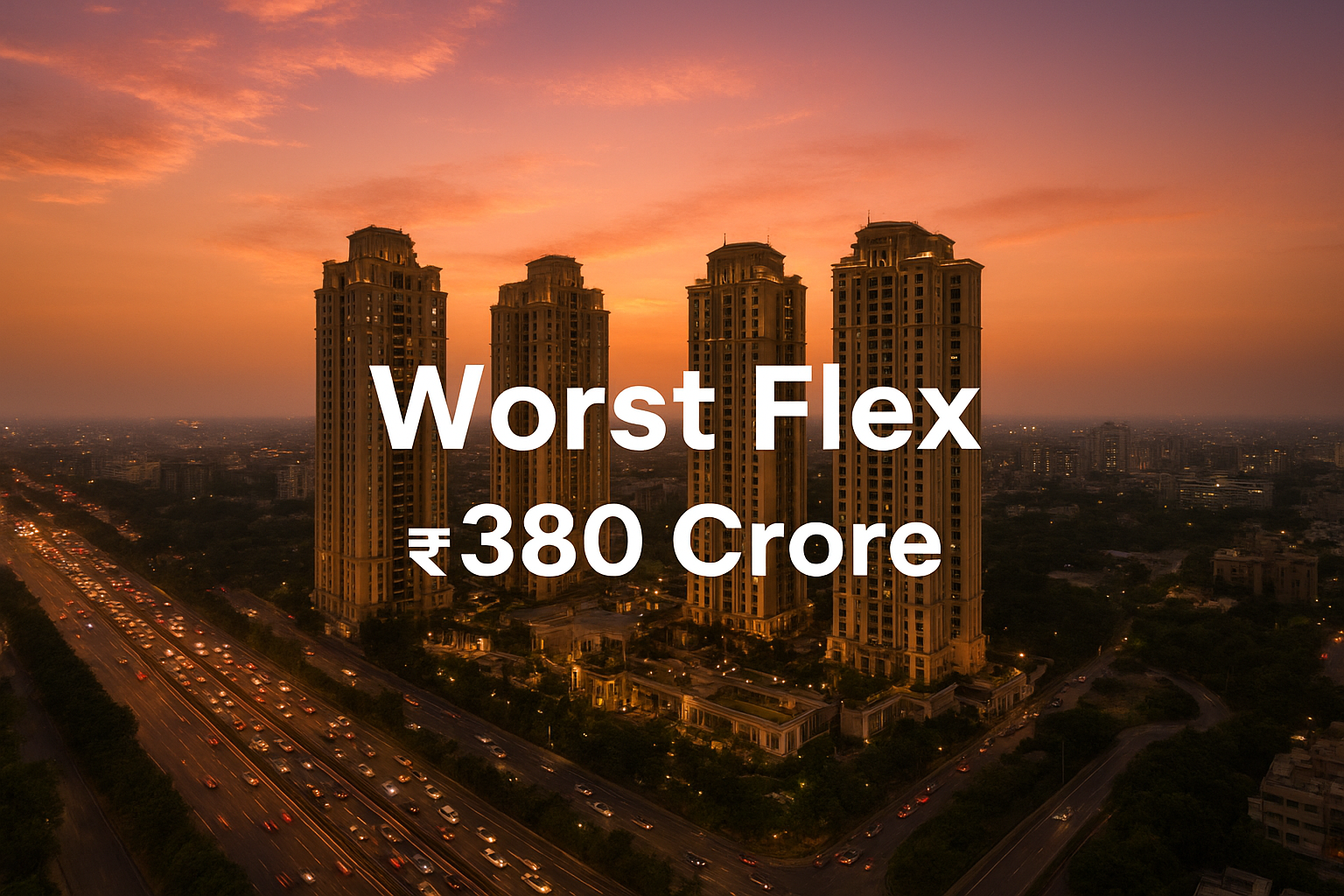
A Delhi business family just spent ₹380 crore on four bare-shell, under-construction flats at DLF The Dahlias, Gurugram — about 35,000 sq. ft in total, with possession due in 2026.
Each apartment costs roughly ₹90–95 crore, and that’s before interiors — which will easily add another ₹10–20 crore per unit. Add in annual maintenance and property taxes of ₹50–75 lakh, and you’re paying luxury taxes just to breathe the same toxic NCR air as everyone else.
It sounds exclusive, but once you look at the math — it’s absurd.
DLF’s ultra-premium projects — The Camellias, The Magnolias, The Arbour, and now The Dahlias — have become the Indian equivalent of a Mayfair postcode. They offer exclusivity by proximity: not just a home, but a curated neighborhood of tycoons, bankers, and celebrities.
But here’s the catch — they offer no alpha. You get brand association and privacy, but financially, you’re paying top rupee for the slowest-growing asset class in India’s high-end market.
Let’s look at actual performance:
Even mid-tier farmland in Jewar or Yamuna Expressway zones has outperformed every luxury tower in Gurugram — with lower holding costs and better liquidity.
And that’s before you consider liquidity risk — selling a ₹90-crore apartment can take months or years, often with 10–15% discounts in private resale deals.
So what are you really buying?
A marble-wrapped liability.
Despite the branding, Gurugram’s luxury corridor still faces chronic flooding, toxic AQI, and daily traffic gridlock.
Golf Course Extension Road routinely floods every monsoon. AQI crosses 400+ most winter mornings. Even ₹100-crore buyers deal with the same civic decay — potholes, sewage backups, and erratic power cuts.
A ₹90-crore tower doesn’t buy immunity from the ecosystem — just altitude.
If the goal is prestige, there are far more liquid, mobile, and globally recognized ways to flex.
DLF Golf & Country Club – ₹20–25 lakh (one-time)
Access to India’s finest golf courses, private coaching, and networking with CEOs and diplomats. The platinum tier costs 0.02% of a Dahlias flat but opens doors to more power circles.
The Quorum Club – ₹10–15 lakh joining + ₹3–5 lakh annual
India’s version of Soho House — a blend of workspace, dining, and social capital. Members include unicorn founders, CXOs, and diplomats.
The Chambers at The Oberoi – ₹10+ lakh
Global concierge access and cross-membership with Oberoi properties worldwide. One of the most exclusive hospitality memberships in the country.
The Circle (Huda City Centre) – ₹5–8 lakh/year
An invite-only entrepreneurial community hosting wellness sessions, investor dinners, and curated events.
For under ₹30 lakh, you can be part of multiple exclusive ecosystems — something no DLF tower guarantees.
Latvia Golden Visa – ₹50 lakh
Gives Schengen access and EU residency rights in under six months.
Portugal Golden Visa – ₹4 crore
Permanent residency and eventual EU citizenship, often with minimal stay requirements.
Dubai Residency – ₹3–5 lakh per year
Zero tax, full mobility, and luxury infrastructure that actually works.
U.S. Green Card (EB-5) – ₹8–9 crore
Direct path to permanent U.S. residency via job-creating investment.
Monaco or Malta Residency – ₹9–10 crore
Ultimate global prestige, tax efficiency, and access to elite financial systems.
Each of these costs less — and delivers more global access, safety, and diversification than a domestic luxury flat.
Fractional Jet Ownership – ₹2–5 crore share (JetSetGo, Club One Air)
Guaranteed flight hours without owning the jet outright. Control your schedule and your privacy — the real rich-person currency.
Entry-Level Private Jet – ₹7–8 crore (Cessna Citation Mustang)
Full ownership and control, cheaper than one-tenth of a Dahlias unit.
Private Helipads (Gwal Pahari, Sohna, Manesar)
Farmhouses with helipad access, letting you commute across NCR in minutes — not hours.
Luxury Cars & Collectibles
Appreciating collectibles with tangible value — and genuine admiration.
Luxury Watches
Patek Philippe, Audemars Piguet, Richard Mille (₹50 lakh–₹5 crore each) — often appreciating faster than real estate.
Art Investments
Owning pieces by Tyeb Mehta, S.H. Raza, or Subodh Gupta (₹1–10 crore+) isn’t just aesthetic — it’s diversification with cultural capital.
Wine & Collectibles
Penthouses now feature ₹50-lakh+ temperature-controlled cellars — a luxury that speaks quietly but distinctly.
Fine Dining
Le Cirque at The Leela Palace — ₹50,000 for dinner for two with pairings.
Indian Accent, CyberHub — the benchmark of Indian fine dining.
Private Chef Clubs
Residents at Camellias often bring Michelin-star chefs for curated dinners.
Cigar Lounges & Whisky Rooms
At The Quorum and Taj City Centre — memberships that signify taste, not just wealth.
Personal Charity or Foundation
₹1–2 crore annually can fund a school, healthcare wing, or art program — delivering both legacy and influence.
Farmhouses & Nature Retreats
Buy 5 acres in Gwal Pahari or Sohna for ₹3–5 crore, build solar-powered villas, stables, and organic farms.
That’s lifestyle, autonomy, and tax efficiency — at 1/20th the cost of a single Gurugram tower unit.
In modern India, the richest no longer need to prove they can buy square footage. They prove they can buy control, access, and invisibility.
The new status is mobility, diversification, and quiet influence — not a balcony overlooking a jammed highway.
DLF The Dahlias represents static luxury — a marble symbol of achievement that doesn’t move, earn, or evolve.
Meanwhile, the smart money is buying land, jets, passports, and equity — assets that compound, travel, and influence.
So, if ₹380 crore can buy you global residency, private aviation, fine art, a foundation, and financial independence —
why spend it on a postcode that still floods every monsoon?
Because no matter how shiny it looks,
real estate remains the slowest flex of all.
