Published On:
March 2, 2026
Updated On:
March 2, 2026
As digital-first investors and institutional capital reshape the 2026 property landscape, the traditional focus on premium pin codes is giving way to a new priority: exit visibility. The ability to easily liquidate an asset through fractional ownership, SM REITs, and blockchain technology is now considered just as critical to a property's value as its physical location.
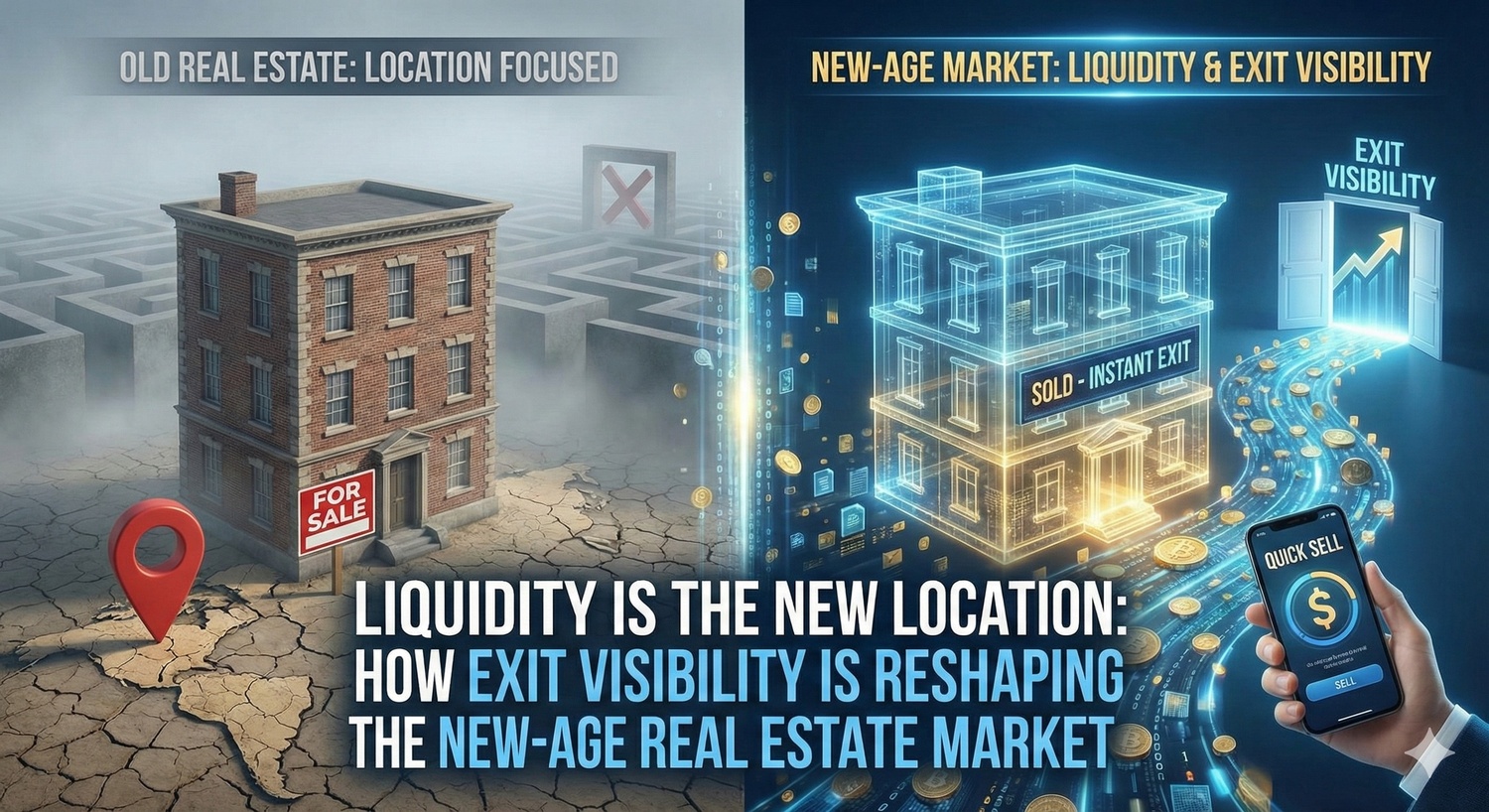
For several decades, the golden rule of real estate investment was universally understood and rarely challenged: location, location, location. The underlying philosophy was incredibly simple. Because land is an inherently finite resource, acquiring property in highly coveted, high-demand pin codes—think Nariman Point in South Mumbai or the Lutyens zone in Delhi—guaranteed long-term value appreciation. Scarcity naturally drove prices up, and investors were more than willing to lock their capital away in prestigious physical assets, confident that time would multiply their wealth.
However, as we navigate the first quarter of 2026, the structural foundation of property acquisition in India is undergoing a profound and permanent transformation. The traditional "buy-and-hold" model, while still relevant, is rapidly being supplemented by a far more dynamic approach. Today’s property buyers, driven heavily by a new generation of digital-first retail investors and sophisticated institutional capital, are prioritizing exit clarity just as much as neighborhood prestige. We have officially entered an era where liquidity is becoming the new location.
To understand why this massive shift is happening right now, one must look at the broader financial environment. Investors today are deeply accustomed to high-frequency trading, real-time portfolio tracking, and rapid equity settlements. In this fast-paced ecosystem, capital is expected to be highly agile.
Physical real estate, historically, is the exact opposite of agile. It has always been categorized as an inherently illiquid asset class. While property valuations might look fantastic on paper—often supported by robust housing price indices showing steady annual growth—those gains remain purely theoretical until a formal sale is successfully concluded.
The exit friction in the traditional Indian property market is notorious and deeply documented. Selling a high-value physical asset typically involves a grueling three-to-nine-month lag. This extended timeframe is consumed by finding the right buyer, negotiating terms, navigating complex legal verifications, and waiting for mortgage approvals. For a modern investor looking to reallocate capital quickly to capture emerging market opportunities, this extended exit timeline is no longer just a minor inconvenience; it is viewed as a severe functional constraint.
A key driver of this paradigm shift is the profound change in the Indian investor's demographic profile. By late 2025 and early 2026, data from national depository systems highlighted that unique demat accounts in India had surged past the 19-crore mark. This staggering figure represents a fundamental financialization of domestic savings.
An entire generation has grown up trading equities, mutual funds, and digital assets with a simple swipe on their smartphones. When these retail investors eventually pivot toward real estate to diversify their portfolios, they bring their rigid equity-market expectations with them. They are deeply uncomfortable with the opaque, slow-moving nature of traditional property transactions. For this demographic, wealth that cannot be accessed swiftly during an emergency, or reallocated when a better opportunity arises, is inefficient capital. They are demanding that real estate function more like a standardized financial instrument and less like a static family heirloom.
The turning point for real estate liquidity arrived with significant regulatory interventions aimed at modernizing the market. Over the last couple of years, market regulators have taken decisive steps to formalize the framework for Small and Medium REITs (Real Estate Investment Trusts).
This regulatory blessing has acted as a massive catalyst. It took the concept of property unitization out of a regulatory grey area and transformed it into a standardized, highly regulated financial structure. The rapid growth of Indian REITs, which recently reached market capitalizations exceeding ₹1.63 lakh crore, sends a very clear message: there is an immense, pent-up demand for structured property investment.
Through these frameworks, retail and institutional participants can now own fractions of premium, income-generating properties. This model perfectly addresses the historic divisibility problem of real estate. Investors can buy, hold, and sell smaller units of high-grade commercial real estate without dealing with the colossal friction of transferring entire physical deeds.
One of the most revolutionary concepts taking root in the 2026 market is incremental liquidity. In the past, the indivisibility of physical assets meant that if a business owner or a family faced a sudden financial shortfall—perhaps requiring just 10% or 15% of their total property portfolio's value in cash—they were cornered. They had to either take on high-interest loans against the property or sell the entire asset, often settling for a distressed price if the timeline was extremely tight.
The current market architecture, powered by digital platforms and fractional ownership models, has permanently solved this. Investors can now divest precise portions of a holding. If you own fractional shares in a Grade-A commercial tower, you can sell exactly the number of units required to meet your immediate capital requirements. The rest of your investment remains entirely intact, continuing to generate stable rental yields and capital appreciation. This precision capital management offers a brilliant mechanism to access funds without forcing a complete exit from a highly lucrative position.
While regulatory frameworks laid the necessary groundwork, modern technology is the engine actively driving this newfound liquidity. The transition from dusty, physical sale deeds to streamlined, digital ownership records is perhaps the most significant operational leap the sector has made in a century.
One of the biggest hurdles in property transactions has always been accurate price discovery. In traditional real estate, valuations are often opaque, relying on hearsay, outdated government circle rates, or highly subjective broker estimations. Today, specialized digital marketplaces are bringing equity-market transparency to real estate. These platforms provide a Last Traded Price for specific units within a commercial building, eliminating the guesswork and allowing investors to understand the exact, real-time market value of their holdings.
Moreover, technology is systematically dismantling the legal delays associated with property transfers. Legal verification and title disputes have historically been the primary culprits behind stalled transactions. The integration of centralized management and blockchain-verified ownership records is directly addressing this bottleneck. When a property title's history is mathematically secure and pre-verified on a digital ledger, the due diligence process drops from months to mere days, drastically accelerating the ability to exit an investment.
The intense demand for liquidity is also being heavily fueled by broader macroeconomic and employment trends. Over the last decade, high-ticket residential and commercial real estate demand in top-tier cities was massively driven by the booming IT sector. However, the landscape of white-collar employment is undergoing a structural transition.
With global tech uncertainty, slower corporate hiring mandates, and the increasing integration of artificial intelligence driving unprecedented operational efficiencies, the assumption of perpetual, linear income growth is being challenged. Salaried professionals and corporate investors are becoming highly cautious about locking massive amounts of capital into illiquid assets while taking on heavily leveraged mortgages.
If job markets become unpredictable, holding an illiquid asset that requires high monthly servicing becomes a massive financial liability. Consequently, buyers are heavily leaning toward investments where the exit strategy is visible and actionable. The profound peace of mind that comes from knowing an asset can be liquidated swiftly on a digital platform is far outweighing the traditional prestige of owning a standalone property that might sit on the market for a year during an economic downturn.
It isn't just retail investors who are demanding better exit visibility; massive pools of institutional capital are also fundamentally altering their deployment strategies. Cumulative institutional inflows into Indian real estate have topped $25 billion over the last five years. However, this capital is highly sophisticated, strictly governed, and fundamentally yield-focused.
Global pension funds and domestic alternative investment funds are moving aggressively away from speculative, high-risk residential development projects. Instead, they are heavily favoring yield-focused, income-generating assets. The focus has decisively shifted from aggressive internal rate of return targeting to income durability, downside protection, and capital recycling discipline.
This explains the massive surge of capital into Grade-A commercial real estate, logistics parks, and organized co-living spaces. Grade-A commercial properties currently showcase highly attractive annual yields ranging from 7% to 10%, supported by the continuous expansion of multinational corporations and global capability centers. More importantly, these commercial assets offer significantly higher liquidity metrics than prestigious but low-yield luxury residential floors.
Institutional allocators now meticulously assess the exit viability before they commit their first dollar. If a developer or a project cannot offer a clear, structured path to liquidation—backed by operational excellence and clean governance—it will struggle to attract serious capital, regardless of how prime the physical location might be.
As we analyze the 2026 real estate landscape, it is abundantly clear that the criteria for evaluating property have permanently expanded. Location will never be entirely irrelevant; a property must still be situated in an area with strong economic fundamentals, robust infrastructure connectivity, and high demographic demand to hold intrinsic value.
However, a high-prestige address is increasingly being viewed as a structurally flawed asset if it lacks a clear, viable path to liquidation. Modern investors are simply no longer content with paper wealth that remains trapped behind months of bureaucratic red tape and market friction.
By aggressively embracing fractionalization, digital marketplaces, and robust regulatory frameworks, the real estate market is successfully finding a middle ground. It is finally marrying the tangible stability and capital appreciation of physical property with the liquidity and agility typically associated with the equities market.
For the modern homebuyer, the commercial investor, and the institutional fund manager, the primary question has evolved. The first thought is no longer just about where the property is located, but rather, how easily and transparently the capital can be retrieved. In this new hierarchy of real estate value, the viability of the exit strategy is just as crucial as the pin code, firmly establishing liquidity as the ultimate modern amenity.
