Published On:
May 26, 2026
Updated On:
May 26, 2026
The Uttar Pradesh government is orchestrating a massive infrastructure upgrade by seamlessly linking the Yamuna Expressway with a vast high-speed network, including the Ganga, Bundelkhand, and Purvanchal expressways. Coupled with rapid rail transit and new highway corridors, this master plan will drastically cut travel times to the upcoming Noida International Airport, catalyze industrial growth, and transform the state into India's premier logistics hub.
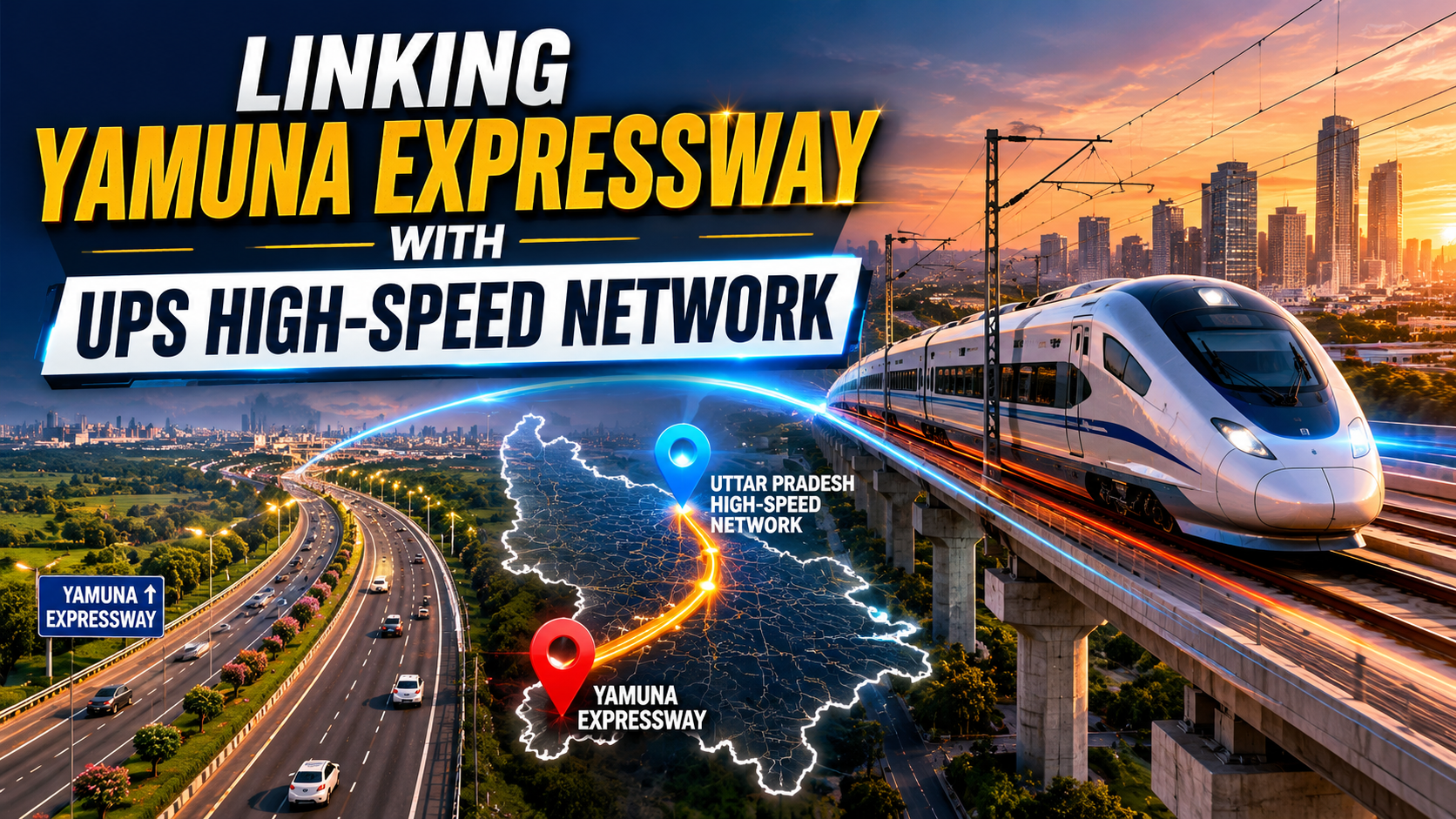
For over a decade, the Yamuna Expressway has stood as a symbol of modern infrastructure in northern India. Stretching 165.5 kilometers to connect Greater Noida with Agra, this six-lane access-controlled highway successfully reduced travel times, eased traffic congestion on the old Delhi-Agra route, and triggered a wave of real estate development. However, what was once a standalone marvel is now evolving into something much more monumental.
The Uttar Pradesh government, spearheaded by the Yamuna Expressway Industrial Development Authority (YEIDA), is rolling out an ambitious blueprint to integrate this vital corridor with an expansive, state-wide high-speed network. This master plan aims to weave together the state’s scattered highway arteries, high-speed rail systems, and massive industrial zones into one cohesive web of seamless connectivity. Whether it is passenger cars looking for a smooth cross-state drive or heavy freight trucks transporting manufactured goods, the upcoming linkages are set to redefine mobility, trade, and real estate dynamics across Uttar Pradesh and the National Capital Region.
The most prominent feature of this grand plan is the physical integration of the Yamuna Expressway with the broader expressway network sprawling across Uttar Pradesh and beyond. Until recently, expressways operated as isolated stretches, requiring commuters to exit onto congested state highways or local roads to transition from one high-speed corridor to another.
To resolve this, the Yamuna Expressway is actively being linked to the Ganga Expressway, the Bundelkhand Expressway, the Purvanchal Expressway, and the highly anticipated Delhi-Mumbai Expressway. This means a traveler starting their journey in Delhi or Noida could theoretically drive uninterrupted all the way to eastern Uttar Pradesh, the remote districts of Bundelkhand, or even journey straight down to Mumbai without ever navigating through crowded city bottlenecks.
By tying these mega-corridors together, the state is effectively bridging the gap between western and eastern UP. Logistics companies, which heavily rely on predictable transit times, will experience a massive reduction in operational costs. Transporting agricultural produce, raw materials, and finished goods will become faster, fundamentally upgrading the supply chain efficiency across northern India.
One of the most critical missing links in this highway integration is the direct connection between the Yamuna Expressway and the under-construction Ganga Expressway. To bridge this gap, YEIDA has officially initiated the acquisition of approximately 740 acres of land in the Bulandshahr district to construct a dedicated link road.
Currently, heavy vehicles and passenger cars traveling between these two major corridors are forced to rely on a patchwork of district roads and village routes. This not only causes severe traffic bottlenecks in rural and semi-urban pockets but also significantly increases travel time and fuel consumption. The new Ganga-Yamuna link road is meticulously planned to bypass dense residential settlements, offering a direct, high-speed transit route for freight and commuters.
Once completed, this link road will allow traffic coming from western UP and the National Capital Region to smoothly merge onto the Ganga Expressway and head towards central and eastern parts of the state. Consequently, land values in the nearby villages and planned residential sectors are already witnessing a steady appreciation, anticipating the impending boom in logistics and commercial activities.
While highway connectivity forms the backbone of freight movement, the state is equally focused on ultra-fast passenger transit, primarily driven by the upcoming Noida International Airport at Jewar. Designed to be one of Asia’s largest aviation hubs and a major pressure-relief valve for Delhi’s Indira Gandhi International Airport, Jewar requires world-class ground transport to succeed.
To ensure travelers can reach the terminal swiftly, state authorities have cleared the Detailed Project Report for a state-of-the-art Regional Rapid Transit System. This RRTS corridor will directly connect Delhi to the Jewar airport. Furthermore, the master plan includes integrating a dedicated station for the proposed Delhi-Varanasi high-speed rail corridor right at the airport terminal. Once operational, this high-speed bullet train network is projected to slash the travel time between Delhi and the Noida International Airport to a staggering 21 minutes.
Simultaneously, the Ministry of Railways is actively preparing a comprehensive plan to connect the industrial sectors of the YEIDA region and the Jewar airport with the Chola-Sandhi rail line. This multi-modal approach guarantees that the airport will not operate in isolation but will be easily accessible via personal vehicles, rapid transit trains, and traditional rail networks.
Complementing the rapid rail projects is a brand new highway infrastructure project aimed at decongesting the wider NCR while providing direct airport access. Under the Bharatmala Pariyojana, a 31.425-kilometer fully access-controlled greenfield expressway is being constructed from Chandawali village in Faridabad to Dayanapur in Gautam Buddha Nagar.
This ₹2,360-crore project is an engineering marvel that will directly connect the Yamuna Expressway, the Eastern Peripheral Expressway, and the Delhi-Mumbai Expressway. For the average commuter, the benefits are immense. Traffic flowing in from northern Indian states like Punjab and Haryana will be able to access the Jewar airport using the Eastern Peripheral Expressway, entirely bypassing the notorious traffic snarls of Delhi. Similarly, residents of South Delhi, Faridabad, and Gurugram will enjoy a straight, uninterrupted drive to the airport terminal.
The project incorporates sustainable construction practices, utilizing over two lakh metric tonnes of inert material generated from bio-mining massive landfills, thereby reducing the reliance on natural borrow materials. It also features advanced architectural elements, including a 140-meter-long Network Arch Bridge and an eight-lane rail overbridge, showcasing a massive leap in modern bridge engineering.
Infrastructure rarely exists in a vacuum; it is the ultimate catalyst for economic growth. The comprehensive linking of the Yamuna Expressway to the state's high-speed network is turning the entire YEIDA region into an industrial powerhouse. Better roads attract businesses, and the authority is capitalizing on this by developing specialized industrial clusters.
The region is currently witnessing the development of massive, targeted parks, including a Medical Device Park, an Apparel Park, a Toy Park, a Handicraft Park, and sprawling MSME and Data center hubs. Most notably, the area will host the monumental HCL-Foxconn semiconductor chip manufacturing unit, which is expected to bring billions in foreign direct investment and create thousands of high-tech jobs.
To support this industrial explosion, YEIDA is also aggressively expanding its urban footprints. The authority is drafting a master plan to develop a massive urban city spanning over 4,700 acres in the Tappal-Bajna region. Additionally, an urban city is planned for Hathras, and the Yamuna Expressway itself is set to see extensions that will integrate deeper into Agra.
For the real estate sector, these developments are a goldmine. The seamless connectivity means that housing societies, commercial complexes, and retail spaces planned along the Yamuna Expressway are no longer viewed as distant suburbs of Noida, but rather as prime real estate located at the epicenter of a massive economic corridor. Investors are already securing land parcels for warehousing, logistics parks, and premium residential townships, banking on the assured long-term capital appreciation driven by the surrounding mega-projects.
A high-speed network is only successful if it is safe and efficiently managed. Recognizing the historical challenges of highway driving, authorities have completely overhauled the technological backbone of the Yamuna Expressway.
The corridor is now governed by an advanced Intelligent Traffic Management System. This includes the strategic placement of hundreds of CCTV cameras for continuous surveillance, variable message signs alerting drivers of weather conditions or road blocks, and sophisticated automatic number plate recognition cameras. This technology automatically issues digital challans to drivers violating speed limits or traffic rules, acting as a strong deterrent against reckless driving.
For regular commuters and tourists heading to cultural hotspots like Mathura, Vrindavan, and the Taj Mahal in Agra, the travel experience has been thoroughly modernized. The implementation of electronic toll collection via RFID-enabled FASTag lanes ensures that vehicles do not have to wait in endless queues at toll plazas. Coupled with environmental sensors monitoring real-time pollution levels and heavy-duty emergency call boxes, the entire stretch guarantees a fast, safe, and highly predictable journey.
The systematic linking of the Yamuna Expressway to Uttar Pradesh’s sprawling high-speed network is far more than just a road construction project. It is a strategic masterstroke designed to decentralize economic growth, moving it away from the saturated pockets of Delhi-NCR and spreading it deep into the heartland of the state.
By combining six-lane expressways, rapid transit rail systems, and a world-class international airport, the region is positioning itself as the undisputed logistics and industrial capital of northern India. For the everyday commuter, the days of navigating heavily potholed state highways and enduring hours of gridlock are rapidly coming to an end. As these grand plans transition from blueprints to asphalt, Uttar Pradesh is undoubtedly paving a fast, efficient, and highly prosperous road to the future.
