Published On:
November 25, 2025
Updated On:
February 3, 2026
The Lucknow Development Authority (LDA) is launching 10,000 residential plots in the 2660-acre UP IT City on Sultanpur Road in January 2026. The project used the Land Pooling Model, guaranteeing landowners 25% of their developed land, and features dedicated 400-acre IT/ITeS and 200-acre commercial zones. The allotment will prioritize original landowners in January 2026 before opening registration to the general public, aiming to house 1 lakh (100,000) people and establish a major tech hub.
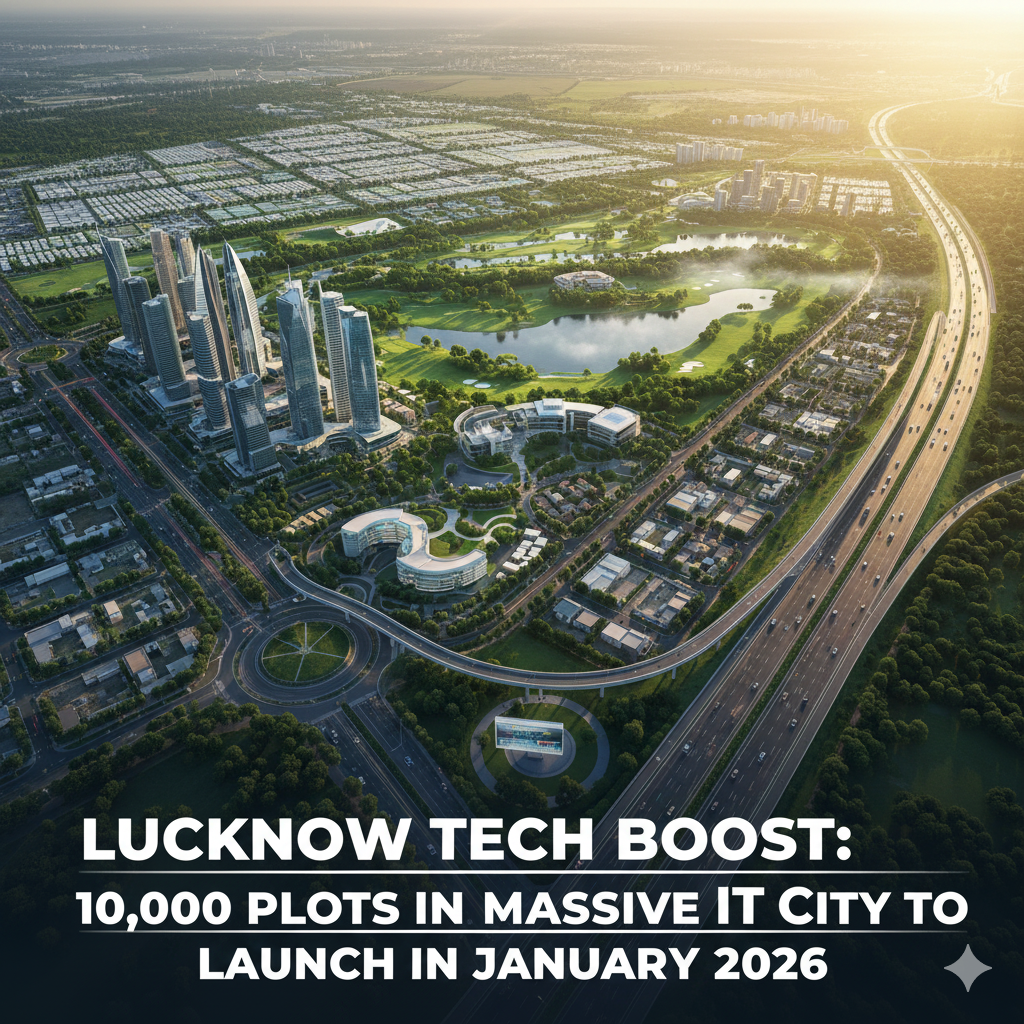
For decades, the real estate narrative of Lucknow was dominated by the expansion of Gomti Nagar. It was the gold standard of urban planning in Uttar Pradesh—a sprawling, well-connected grid that defined modern living in the City of Nawabs. However, as 2026 kicks off, the center of gravity is undeniably shifting. The Lucknow Development Authority (LDA) has signaled the beginning of a new era with the operational launch of its massive IT City Township on Sultanpur Road.
This is not merely another housing scheme; it is a structural reimagining of the city’s limits. Spanning an enormous 2,660 acres, this project is designed to be the residential engine that powers the state’s growing IT and industrial ambitions. For homebuyers and investors who watched the prices in Gomti Nagar Extension spiral out of reach, the Sultanpur Road corridor offers a second chance at entry-level premium inventory. The January 2026 announcement of 10,000 residential plots has sent a ripple of excitement through the North Indian real estate market, promising to turn the dusty tracts of Sultanpur Road into a vibrant, self-sustaining metropolis.
The numbers associated with this project are staggering. The LDA has carved out approximately 10,000 residential plots, ranging from compact 72-square-meter units for affordable housing to expansive 200-square-meter parcels for luxury villas. This variety addresses a critical gap in the Lucknow market: the lack of authorized, legally secure plotted developments.
In recent years, the market has been flooded with private "townships" that often lack proper approvals or infrastructure. By stepping in with a state-backed scheme of this magnitude, the LDA is effectively standardizing the corridor. The master plan divides the 2,660-acre township into sectors, much like the successful sectors of Noida or Chandigarh.
Beyond housing, the layout dedicates significant acreage to commercial and institutional use. The vision is to create a "walk-to-work" culture. With the HCL IT City already operational nearby, this new residential zone is expected to house the thousands of tech professionals, engineers, and support staff who currently commute long distances. The integration of 400 acres for industrial use and 200 acres for commercial hubs ensures that this will not just be a dormitory town, but an economic powerhouse in its own right.
Historically, large infrastructure projects in Uttar Pradesh have been plagued by land acquisition battles. Farmers, fearing the loss of their livelihood for meager compensation, have frequently stalled development through protests and litigation. The LDA’s IT City project, however, has circumvented this hurdle through the successful implementation of the "Land Pooling Policy."
Under this model, the government does not "buy" the land in the traditional sense. Instead, it invites farmers to become partners in the development. For every acre of land a farmer surrenders, they are guaranteed the return of 25% of the developed land in the form of residential or commercial plots.
This policy has flipped the script. Instead of resisting the bulldozers, farmers in villages like Bhatgaon, Bakkas, and Mastemau have been active participants, lining up to sign agreements. They understand the math: a raw agricultural acre is worth far less than 25% of a developed, road-facing commercial plot in an LDA township. This alignment of incentives has allowed the LDA to secure over 90% of the required land for the first phase without a single major protest, a feat that is being studied by development authorities across India.
For the buyer, this is crucial. A project built on land pooling is significantly less likely to face legal stays or farmer agitations down the line, ensuring that the title of the property is clean and the possession timeline remains intact.
To understand the potential of these 10,000 plots, one must understand the geography of Sultanpur Road. This artery is no longer just a highway leading to Sultanpur or Varanasi; it is the spine of "New Lucknow."
The Connectivity Nexus: The township sits at the intersection of strategic infrastructure.
The "Aerocity" Influence: While technically distinct, the development on Sultanpur Road benefits from the proposed Aerocity plans near the airport. As the airport expands its capacity, the demand for warehousing, hospitality, and corporate offices is spilling over onto the connecting ring roads. Sultanpur Road, with its wide lanes and availability of land, is absorbing the bulk of this spillover demand.
The LDA has faced criticism in the past for delays in internal development. However, for the IT City scheme, the authority is adopting an "infrastructure-first" approach. Before the first foundation stone of a house is laid, the road network is being finalized.
The plan features a massive 200-acre green belt. In an era where air quality is a primary concern for urban Indians, this "green lung" is a major selling point. The master plan also includes a 15-acre water body, designed not just for aesthetics but as a critical component of the township’s rainwater harvesting and groundwater recharge system.
The internal roads are designed on a grid system, with 45-meter and 30-meter wide arterial roads ensuring smooth traffic flow. Unlike the congested lanes of older Lucknow localities, this new township is being built for the car-owning demographic. Underground cabling for electricity and internet is standard, eliminating the visual clutter of overhead wires that plagues much of the city.
For investors, the January 2026 launch represents the "ground floor" opportunity. Real estate economics in Lucknow follows a predictable pattern: announcement, allotment, infrastructure development, and habitation. The sharpest appreciation happens between the announcement and the start of infrastructure work.
Price Arbitrage: Current property rates in established areas like Gomti Nagar Extension have crossed ₹6,000-₹7,000 per square foot in many sectors. In contrast, the allotment rates for the IT City plots are expected to be significantly lower, offering a lower entry point with a higher ceiling for growth. As the road network becomes visible and the first commercial buildings in the IT zone come up, the gap between Sultanpur Road prices and Gomti Nagar prices will narrow, generating substantial equity for early allottees.
The Rental Yield Potential: The "Student and Bachelor" economy is another driver. The area is already home to several large private universities and the existing IT hub. The influx of students and young professionals creates a robust rental market. Investors constructing floors on their plots can expect steady rental yields, a factor that is often missing in purely speculative outskirts.
The LDA has outlined a clear two-phase allotment process for January and March 2026.
The transparency of the lottery system, now managed digitally to prevent tampering, is a key confidence booster for the middle-class buyer who has often felt excluded from the opaque allotment processes of the past.
While the picture is rosy, challenges remain. The execution of the internal sewage and drainage systems will be the true test of the LDA’s capabilities. Sultanpur Road has faced waterlogging issues in the past during heavy monsoons, and the engineering of this new township must account for that. Furthermore, the pace of commercial development must match residential construction. A township without shops, schools, and hospitals quickly becomes a "ghost town." The LDA’s plan to auction commercial plots simultaneously with residential ones is a strategic move to avoid this trap.
By 2030, the view from Sultanpur Road will be unrecognizable. What is currently a landscape of active construction sites and mustard fields will transform into Lucknow’s sophisticated southern arm. The IT City scheme is not just about 10,000 plots; it is about providing a structured, legal, and modern urban alternative to the chaotic sprawl.
For the software engineer moving back to Lucknow, for the family looking to upgrade from the old city, and for the investor seeking the next growth wave, the LDA’s latest move is the green light they have been waiting for. The gates to New Lucknow are open, and the rush has just begun.
