Published On:
April 14, 2026
Updated On:
April 14, 2026
The National Highways Authority of India (NHAI) has officially approved a detailed project report to construct two loop flyovers at the Kalindi Kunj junction, making the notoriously congested Delhi-Noida border completely signal-free. This massive infrastructure upgrade will provide immediate traffic relief to millions of daily commuters traveling between Noida, Delhi, and Faridabad while ensuring seamless connectivity to the Mumbai Expressway.
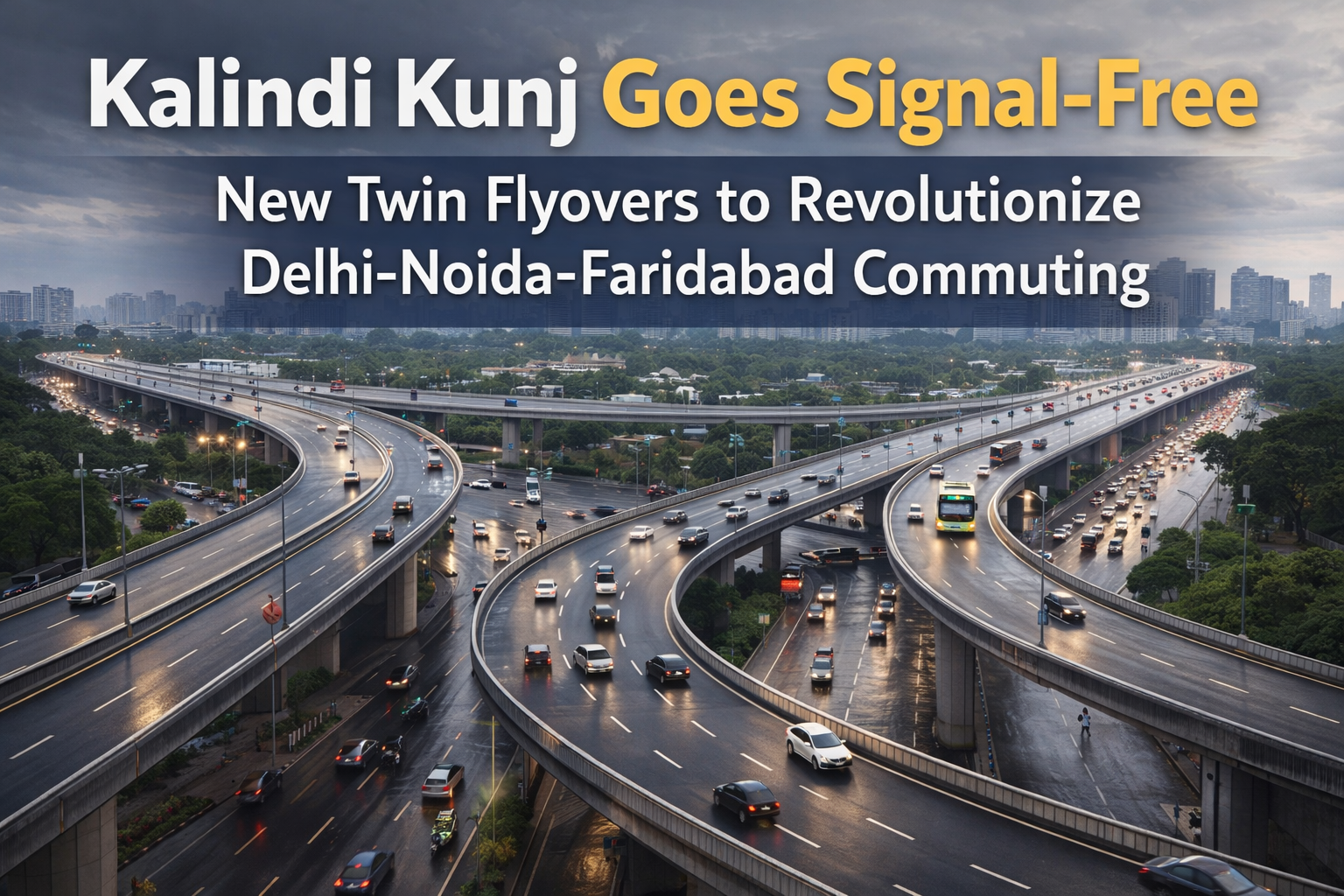
Anyone who has regularly navigated the regional traffic corridors of the National Capital Region understands the sheer test of patience that the Delhi-Noida border can present. For years, the daily commute across this critical boundary has been synonymous with endless queues of idling vehicles, blaring horns, and mounting frustration. However, a monumental shift in urban mobility is finally on the horizon. The National Highways Authority of India has officially given the green light to a highly anticipated infrastructure project that promises to make the Kalindi Kunj junction completely signal-free.
By approving the Detailed Project Report for the construction of two massive loop flyovers, the authorities have set the stage for one of the most significant traffic decongestion initiatives in recent times. This ambitious Kalindi Kunj flyover project is not merely a local road upgrade; it is a vital transformation of a major regional artery that seamlessly knits together South Delhi, Noida, and Faridabad. For the millions of office-goers, business owners, and freight operators who cross this choke point every day, the era of hour-long gridlocks is soon going to be a relic of the past. As we delve into the comprehensive details of this infrastructure overhaul, it becomes clear that this initiative is set to redefine the way we travel across the Delhi-NCR landscape.
To appreciate the magnitude of this upcoming transformation, one must first look at the current reality of the Kalindi Kunj intersection. Positioned strategically at the border of Delhi and Uttar Pradesh, this junction serves as the primary convergence point for traffic pouring in from multiple high-density zones. Vehicles from Noida, Faridabad, Badarpur, and the heavily populated Shaheen Bagh area all meet at this single crossroad. During peak morning and evening hours, the sheer volume of vehicles exceeds the carrying capacity of the surface-level roads, leading to massive traffic snarls that can trap commuters for hours.
The situation has only compounded in recent years due to the rapid urbanization of the surrounding regions and the subsequent surge in private vehicle ownership. Furthermore, the partial opening and increasing utilization of the Mumbai Expressway have fundamentally altered traffic patterns. Now, a massive influx of interstate and commercial traffic coming from Faridabad and Badarpur uses this route to enter Noida and other parts of eastern NCR. This added pressure turned an already stressed junction into an absolute nightmare for traffic management.
The cascading effect of this bottleneck is profound. A solitary jam at the Kalindi Kunj bridge routinely causes tailbacks that stretch deep into Noida’s inner sectors and paralyze traffic on the Delhi side towards Okhla and Sarita Vihar. The daily ordeal takes a severe toll on the mental health of commuters, diminishes workplace productivity due to unpredictable delays, and results in extensive wear and tear on vehicles. Recognizing that piecemeal solutions and traffic management tweaks were no longer sufficient, authorities realized that a complete structural bypass was the only sustainable answer. The proposal, initially conceptualized in late 2025 as an urgent infrastructure intervention, has now evolved into a robust master plan.
The core engineering solution approved by the national highway authorities revolves around the construction of two distinct, strategically aligned loop roads or flyovers. This design aims to segregate the conflicting streams of traffic, allowing vehicles to bypass the surface-level intersections entirely. Drawing inspiration from highly successful interchanges across the capital, the Kalindi Kunj project will elevate the heaviest traffic corridors to ensure uninterrupted movement.
The first flyover is dedicated to streamlining the movement of traffic traveling from Noida towards Faridabad and the newly developed expressway networks. Currently, vehicles descending from the Kalindi Kunj bridge into Delhi have to navigate through the complex intersection, waiting for multiple signal phases to take a left turn or proceed straight. Under the new plan, commuters heading towards the Mumbai Expressway and Faridabad will ascend a dedicated loop that veers left, completely avoiding the junction below. This means a continuous, unimpeded flow of vehicles, dramatically slashing travel time for inter-city commuters and heavy transport vehicles moving towards the western and southern parts of the country.
The complementary second flyover will cater to traffic flowing in the exact opposite direction. Vehicles originating from Faridabad and the Mumbai Expressway, destined for Noida, will utilize a separate elevated corridor. This flyover will seamlessly drop traffic directly onto the Okhla Barrage Road, pointing straight into Noida. By removing this massive volume of right-turning and straight-moving traffic from the ground-level signal, the risk of intersection collisions and gridlocks is virtually eliminated.
While the twin flyovers are the crown jewels of this project, the comprehensive plan also includes significant enhancements to the existing surface-level network. The ground intersection will not be shuttered; rather, it will remain fully functional but drastically less congested. Stripped of the heavy inter-city traffic, the local intersection will be widened and redesigned to facilitate signal-free movement for neighborhood commuters traveling between Okhla, Shaheen Bagh, and nearby local zones. Additionally, connecting nodes like the Khadar Puliya intersection will be integrated into the upgrade, ensuring that the transition between the elevated loops and the surface roads is incredibly smooth.
The transition to a signal-free Delhi-Noida traffic corridor at Kalindi Kunj is poised to deliver dividends that extend far beyond simply shaving minutes off a daily commute. Infrastructure developments of this scale trigger a positive ripple effect across various facets of urban living.
From an environmental standpoint, the reduction in traffic congestion is a massive victory for the region’s air quality. Idling engines at prolonged traffic signals are notorious contributors to the high levels of particulate matter and greenhouse gas emissions in Delhi-NCR. By enabling a continuous flow of vehicles, the new flyovers will significantly reduce vehicular emissions, directly contributing to a cleaner, more breathable environment. Furthermore, the enhanced fuel efficiency resulting from fewer stops and starts will save a tremendous amount of resources annually for the daily commuting public and logistics companies alike.
Economically, the project will act as a catalyst for growth in the surrounding real estate markets. Historically, regions plagued by severe traffic bottlenecks often see stagnant property valuations, as potential homebuyers and commercial investors shy away from inaccessible areas. With the promise of swift, signal-free connectivity to central Delhi, Faridabad, and the Mumbai Expressway, real estate micro-markets in Noida, Greater Noida, and South Delhi are expected to witness renewed interest. Seamless access translates directly into higher desirability for both residential and commercial real estate projects in these zones.
On a human level, the lifestyle benefits are perhaps the most impactful. Reclaiming valuable time lost to daily commutes allows individuals to invest more in their families, personal well-being, and careers. The elimination of the stress associated with unpredictable traffic jams fosters a healthier, more productive workforce, elevating the overall standard of living for the millions of residents who call this tri-city area home.
It is essential to view the Kalindi Kunj flyover project not in isolation, but as a crucial puzzle piece in a much broader, centralized strategy to untangle the complex web of NCR traffic. The central transport authorities have recently identified several major highway corridors passing through the capital that require immediate transformation into signal-free expressways.
Alongside the developments at the Delhi-Noida border, massive infrastructure upgrades are being planned and executed across other critical choke points. For instance, comprehensive plans are underway to make the entire stretch from Ashram to Badarpur mostly signal-free through a series of localized flyovers and underpasses. The synergy between the Ashram-Badarpur corridor improvements and the Kalindi Kunj interchange will create an extensive, high-speed regional network that effortlessly moves traffic across the southern and eastern borders of the capital.
Similarly, other vital stretches, such as the corridor connecting Mehrauli to Gurgaon and the western arterial route from Punjabi Bagh to the Tikri Border, are slated for high-capacity flyovers. The ultimate goal is to reduce travel times on these traditionally congested routes by massive margins, turning hour-long ordeals into brief, breezy drives. The approval of the Detailed Project Report for Kalindi Kunj is a clear indicator that the execution of this grand urban mobility vision is rapidly accelerating.
The journey from identifying a problem to breaking ground on a solution in urban infrastructure is notoriously complex. The Kalindi Kunj bottleneck was heavily flagged by traffic authorities last year, emphasizing that routine traffic management was collapsing under the sheer volume of vehicles. The swift drafting, comprehensive review, and subsequent approval of the project report by the national highway authorities highlight the critical priority assigned to this node.
Now that the master plan is officially approved and the project has moved firmly into the implementation and planning stage, the next immediate steps will involve tender allocations, contractor onboarding, and site preparation. While an exact timeline for the completion of the construction has yet to be publicly mandated, the urgency demonstrated thus far suggests that work will commence with aggressive deadlines.
One of the significant challenges the authorities will face in the coming months is managing the existing traffic flow while heavy construction is underway. Building elevated corridors over an active, hyper-congested intersection requires meticulous planning, temporary diversions, and phased execution to prevent absolute gridlock. Commuters can expect temporary traffic advisories and realigned routes during the peak construction phases. However, the short-term inconvenience of construction barricades will pale in comparison to the permanent relief that awaits at the finish line.
The approval of the twin flyovers at Kalindi Kunj marks a definitive turning point for urban mobility in the Delhi-NCR region. For too long, the economic and personal potential of millions has been restricted by the daily grind of crossing a paralyzed intersection. By designing an intelligent, signal-free interchange that respects the natural flow of inter-city traffic, the authorities are not just pouring concrete; they are building a bridge to a more efficient, less stressful future.
As the project transitions from blueprints to reality, the anticipation among daily commuters is palpable. The eventual completion of this ambitious infrastructure upgrade will seamlessly knit Delhi, Noida, and Faridabad closer together, solidifying the region's status as a well-connected, modern metropolitan hub. The days of the dreaded Kalindi Kunj traffic jam are finally numbered, paving the way for a faster, smoother, and vastly more productive commute for everyone.
