Published On:
March 18, 2026
Updated On:
March 18, 2026
The sudden collapse of a newly opened section of the Lucknow Green Corridor has triggered widespread anxiety among real estate investors, shifting market sentiment from aggressive buying to extreme caution as buyers question the structural integrity of riverfront infrastructure.
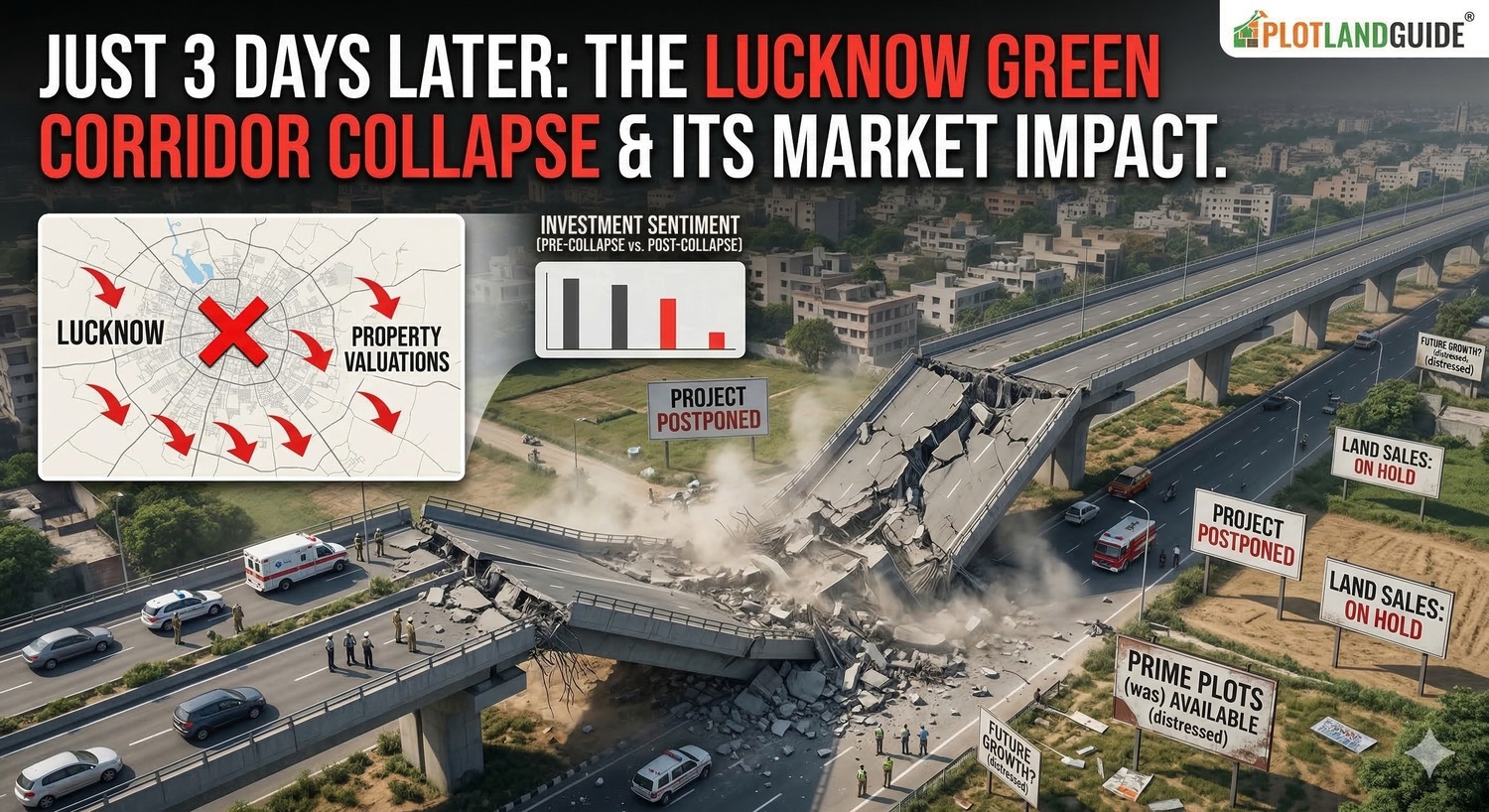
For years, the narrative surrounding the capital of Uttar Pradesh has been one of unstoppable urban expansion. The Lucknow property market has been on an absolute tear, driven heavily by massive government investments in road networks, expressways, and urban beautification. Real estate developers and investors alike have banked on the promise that world-class infrastructure would inevitably lead to world-class property valuations. At the very center of this grand urban vision was the Green Corridor, a project pitched as the ultimate solution to the city's notorious traffic bottlenecks. It was supposed to be the crown jewel of modern city planning, a scenic, high-speed route hugging the Gomti River that would not only slash commute times but also massively inflate the value of the real estate bordering it.
However, the reality that unfolded in mid-March 2026 delivered a harsh wake-up call to everyone banking on this infrastructural miracle. Just three days after a highly anticipated stretch of the corridor was finally opened to the public, a massive section of the brand-new tarmac simply gave way. A gaping sinkhole swallowed a portion of the road, creating a nightmare for city planners and a mountain of anxiety for property investors. This sudden, catastrophic failure has done much more than just disrupt traffic; it has fundamentally rattled the confidence of thousands of homebuyers and investors who viewed the areas surrounding the Green Corridor as the city's next big real estate goldmine.
To understand the magnitude of this collapse, one has to understand what the Green Corridor represented. The overarching project is a twenty-eight-kilometer, signal-free expressway designed to let the city breathe. By connecting the outskirts of the city directly to its bustling center without the constant interruption of traffic lights, the corridor was engineered to cut peak-hour travel times drastically. A journey from the Old City areas like Daliganj all the way to Gomti Nagar, which typically took upwards of forty minutes of bumper-to-bumper frustration, was supposed to be reduced to a breezy ten-minute drive.
Phase one of the project, stretching from IIM Road to Pakka Pul, had already been functional and was relatively well-received. All eyes, however, were on the highly delayed phase two. This crucial nearly ten-kilometer stretch, running from Hardinge Bridge to Pipraghat via Nishatganj, included massive structural upgrades like a new six-lane bridge at Kukrail. For months, commuters stared at the finished tarmac behind concrete barriers, waiting for the VIP inaugurations to conclude so they could finally use the road.
When the barriers finally moved in mid-March, the relief was palpable, but it was incredibly short-lived. Exactly seventy-two hours into its operational life, a severe structural failure occurred on Birbal Sahni Marg, right opposite the Khatu Shyam Mandir. The ground beneath the brand-new road subsided, tearing open a crater nearly seventeen feet deep. Instantly, the promise of a smooth, signal-free commute vanished. Traffic had to be aggressively diverted through narrow cuts near Hanuman Setu, throwing the entire Daliganj intersection into absolute chaos during peak hours. The road that was built to eliminate traffic jams became the very epicenter of one.
When a multi-crore infrastructure project falls apart in less than a week, the immediate question is how something like this could happen. As emergency repair crews rushed to the scene to fill the massive void, the underlying cause was quickly exposed, and it pointed directly to administrative negligence rather than an unavoidable natural accident.
Beneath the pristine new asphalt lay a fifteen-year-old sewer line that had been servicing the New Hyderabad area. According to local civic reports, this aging pipeline was already severely damaged and leaking well before the Green Corridor was paved over it. During the planning stages, proposals were reportedly made to replace this compromised underground infrastructure. However, citing budget constraints, the decision was made to simply build the new, heavy-duty road right on top of the leaking pipes.
The inevitable happened. The continuous leakage eroded the soil beneath the embankment. Once the road was opened to heavy vehicular traffic, the compromised earth simply could not support the weight, leading to a complete collapse. While utility teams were quickly deployed to dig out the area, replace the faulty pipes, and patch the road, the damage to the project's reputation was irreversible. It became painfully clear that surface-level aesthetics had been prioritized over foundational integrity, a realization that immediately sent shockwaves through the local real estate sector.
In real estate, infrastructure is the primary catalyst for price appreciation. When a new highway or metro line is announced, developers buy up the surrounding land, launch premium projects, and market them heavily based on the upcoming connectivity. Buyers willingly pay a premium, assuming their daily lives will be made vastly easier by the new civic amenities. But what happens when that central selling point literally crumbles?
The Green Corridor collapse has forced a massive psychological shift in the Lucknow property market. Prior to this event, the sentiment was driven by a fear of missing out. Investors were rushing to secure flats and plots along the Gomti riverbanks, assuming prices would skyrocket once the road was fully operational. Today, that aggressive buying behavior has been replaced by extreme caution. Local property brokers are reporting a distinct change in the nature of their client calls. Instead of asking for new project launches or the best available rates, prospective buyers are asking hard questions about soil stability, drainage management, and builder reliability.
The logic among homebuyers is straightforward and incredibly valid. If the city's top engineers and development authorities failed to secure the soil and drainage for a high-profile, flagship road project, how can buyers trust private developers to have done a better job on the foundations of a twenty-story residential tower built in the same vicinity? The physical damage of the sinkhole is localized to a small patch of road, but the fear factor it generated has spread rapidly across the entire city's investment landscape.
The cooling effect of this infrastructure failure is not uniform across the city. Different micro-markets are reacting based on their proximity to the river and their reliance on the Green Corridor for their valuations.
In Gomti Nagar Extension, the undisputed hub for high-rise luxury apartments in Lucknow, the market has hit a noticeable pause. Property rates here had aggressively climbed to the high brackets, comfortably sitting between six thousand and eight thousand rupees per square foot, entirely justified by the promise of seamless connectivity to the rest of the city. Following the road collapse, many investors who were on the fence have decided to hold off on their purchases. They are waiting to see if there are any further structural issues along the riverfront before committing massive amounts of capital to these high-altitude homes.
The sentiment is similarly cautious for premium riverfront enclaves and luxury villas situated near the Gomti banks. These properties, often priced anywhere from two and a half to four crore rupees, are marketed heavily on their scenic locations. However, the sinkhole incident has starkly highlighted the geological challenges of building near water bodies. Buyers looking at these ultra-luxury properties are now demanding comprehensive structural audits and absolute transparency regarding how the developers have handled underground water management and soil reinforcement.
Conversely, areas further away from the river are seeing a slightly different trend. The Sultanpur Road corridor, a massive hotspot for residential plots and sprawling integrated townships, continues to see steady demand. While the blind momentum has certainly cooled off, land buyers recognize that this area is less geologically sensitive than the immediate riverbanks. Plot prices here remain relatively stable, hovering between three thousand five hundred to nearly five thousand rupees per square foot.
Meanwhile, commercial real estate along the Amar Shaheed Path remains largely unaffected by the Green Corridor drama. Commercial investments are driven by current footfall and established highway connectivity rather than scenic river routes. Demand for premium office spaces and retail shops continues to be robust, proving that while residential buyers might be spooked, the core business infrastructure of the city is still highly valued by institutional investors.
Despite the embarrassing setback, the Green Corridor project is far from dead. In fact, the state government recently approved an additional funding injection of roughly one thousand crore rupees to fast-track the construction of phases three and four. This massive financial commitment underscores just how critical this road network is to the broader urban mobility plan of the city.
Phase three aims to extend the corridor another five kilometers from Pipraghat to Shaheed Path, specifically designed to ease the heavy traffic pressure moving from the Cantonment area toward the Ayodhya and Kanpur highways. This leg of the project involves highly complex engineering, including a massive new railway overbridge at the Pipraghat crossing and extensive landfilling operations to build the road up to the level of Shaheed Path. Phase four will further link the corridor to the G20 road, finally integrating the inner-city traffic with the outer ring road network.
However, the recent cave-in has fundamentally altered how these upcoming phases will be executed. The public and the press are now watching every move the development authorities make. There is an immense, undeniable pressure on the contractors to ensure that all landfilling, which is currently underway on the approach to the Army land drain, is completed meticulously and stabilized with proper stone pitching well before the monsoon season hits. The days of rushing a project to meet a political inauguration deadline while ignoring underlying civic issues like ancient sewer lines are over. The authorities know that another structural failure of this magnitude could permanently damage the investment viability of the entire corridor.
For anyone looking to buy property in Lucknow today, the rules of engagement have clearly changed. The market has not crashed, and the city's long-term growth trajectory remains incredibly strong. Lucknow is still expanding, bringing in massive commercial investments, and upgrading its public transport networks. However, the era of blind investment—buying property simply because a new road is drawn on a map—has officially ended.
The Green Corridor collapse serves as a crucial reminder that flashy infrastructure on the surface is completely worthless if the underground utilities are rotting away. As an investor or a homebuyer, your due diligence process must now go far beyond checking the floor plan and negotiating the price per square foot. It is imperative to research the developer's track record, especially their history of handling ground engineering in geographically sensitive areas. If you are buying near the riverfront, you must ask tough questions about deep foundations, basement waterproofing, and the local municipal drainage capacity.
Infrastructure is meant to be the backbone of real estate value. When that backbone proves to be fragile, it is only natural for the market to take a step back and reassess. The Lucknow property market will undoubtedly recover from this shock, and the Green Corridor will eventually be repaired and expanded to fulfill its original purpose. But for now, caution is the dominant currency. The buyers who will ultimately win in this market are those who prioritize long-term structural integrity over the short-term hype of a newly painted, but deeply flawed, piece of tarmac.
