Published On:
February 10, 2026
Updated On:
February 10, 2026
The Uttar Pradesh government has greenlit a new 115-km Jhansi Link Expressway that will connect Jhansi directly to the Bundelkhand Expressway, effectively cutting travel time to Delhi to just 5-6 hours. This project creates a seamless signal-free corridor from the National Capital to the historic city, promising a massive boom in real estate, tourism, and industrial development for the region.
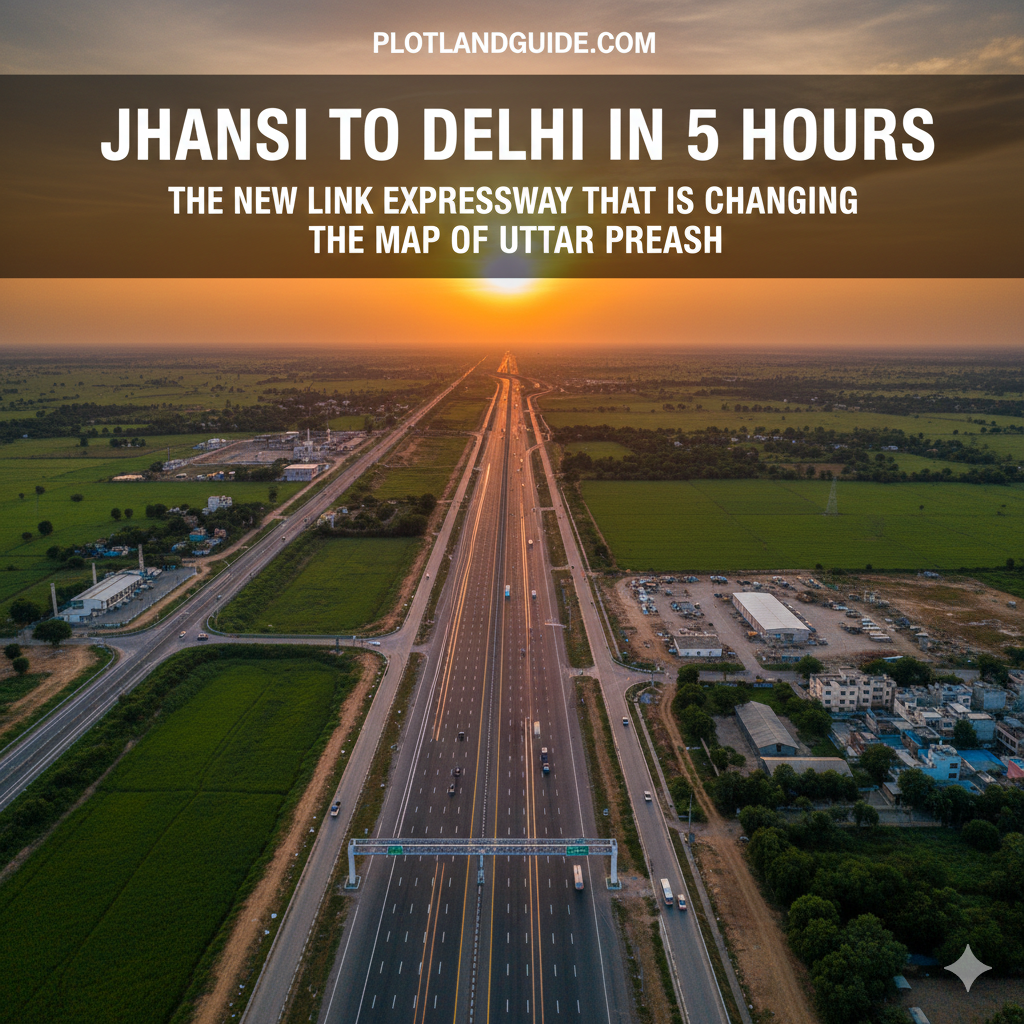
For decades, the journey from Delhi to the historic heartland of Bundelkhand—Jhansi—has been a test of patience. Despite the city’s strategic importance as a railway hub and a gateway to Madhya Pradesh, road connectivity has often lagged behind. A drive that should theoretically be a breeze often turns into a 10-to-12-hour marathon through congested state highways and single-lane roads. But the map of Uttar Pradesh is being redrawn at a blistering pace, and the latest stroke of the pen by the state administration promises to be the most transformative yet for this region.
The government has officially set the wheels in motion for the Jhansi Link Expressway, a dedicated high-speed corridor designed to plug Jhansi directly into the state’s rapidly expanding expressway network. This isn’t just another road; it is the final piece of a puzzle that creates a seamless, signal-free channel from the bustle of the National Capital Region (NCR) right to the doorstep of Bundelkhand.
For real estate investors, daily commuters, and the tourism sector, this announcement is nothing short of a revolution. Imagine having breakfast in South Delhi and reaching the forts of Jhansi or the palaces of Orchha by lunchtime. This blog dives deep into the details of this mega-project, analyzing its route, its timeline, and why it is poised to turn Jhansi into the next big economic powerhouse of North India.
At the core of this transformation is a 115-kilometer stretch of asphalt that will serve as the lifeline for the region. The Jhansi Link Expressway is being developed by the Uttar Pradesh Expressways Industrial Development Authority (UPEIDA), the same nodal agency responsible for the state’s other record-breaking infrastructure projects.
Key SpecificationsThe project is estimated to cost approximately Rs 1,300 crore. It is designed as a four-lane access-controlled expressway, with the foresight to be expandable to six lanes as traffic volume grows. The primary objective is simple but critical: to bridge the gap between Jhansi city and the existing Bundelkhand Expressway.
Currently, the Bundelkhand Expressway—which runs from Chitrakoot to Etawah—bypasses Jhansi by a significant distance. Commuters from Jhansi currently have to navigate slow-moving local roads to reach the nearest entry point of the expressway in the Jalaun district. This new link will eliminate that friction. It will start near Jalaun and cut through the hinterlands to terminate near Jhansi, effectively bringing the expressway network to the city's periphery.
The magic of the Jhansi Link Expressway lies in its integration with the wider grid. Once operational, it will complete a high-speed chain that connects multiple expressways into a single, fluid driving experience.
The Route to DelhiThe journey from Jhansi to Delhi will no longer be a series of stop-and-go navigations through small towns. Instead, the route will look like this:
Time SavingsThis interconnected web means a driver can maintain a consistent high speed from start to finish. The travel time, which currently fluctuates wildly between 10 to 12 hours depending on traffic conditions, is projected to stabilize at around 5 to 6 hours. For the logistics sector, this reduction is gold, allowing for same-day delivery loops that were previously impossible. For the common man, it means the National Capital is now a comfortable weekend drive away.
While the road itself is a headline, the real story is what is happening around the road. The Uttar Pradesh government is not just building a highway; they are building a new industrial city.
Bundelkhand Industrial Development Authority (BIDA)Parallel to the expressway planning, the state has established the Bundelkhand Industrial Development Authority (BIDA). The vision for BIDA is massive—comparable in scale to the early days of Noida. The government is in the process of acquiring and developing over 35,000 acres of land across 33 villages to create an industrial, commercial, and residential hub.
This new industrial city will be centered around the Jhansi Link Expressway. The logic is sound: industries need connectivity. By aligning the new city with the new road, the government is ensuring that factories, logistics parks, and IT hubs set up here have direct access to Delhi and Lucknow.
The Defense Corridor ConnectionJhansi is already a key node in the ambitious Uttar Pradesh Defense Industrial Corridor. The new expressway will serve as the logistical backbone for this corridor, facilitating the rapid movement of heavy equipment, raw materials, and finished defense goods. This strategic importance ensures that the project will likely see fast-tracked funding and execution, as it is a matter of national interest, not just local convenience.
For real estate investors who felt they missed the bus in Noida or Gurugram decades ago, Jhansi presents a "flashback" opportunity. The announcement of the link expressway has already triggered a flurry of activity in the local property market.
Land Price AppreciationThe expressway is slated to pass through four key tehsils: Garautha, Moth, Tahrauli, and Sadar. The 63 villages located along this alignment are witnessing an overnight re-evaluation of land prices. Agricultural land that was previously considered remote is now potential prime real estate for warehousing, highway amenities, and residential townships.
Residential DemandAs BIDA begins to take shape and industries set up shop, the demand for housing in Jhansi is expected to skyrocket. We are likely to see a shift from the traditional independent houses of Old Jhansi to modern, gated high-rise communities that cater to the new workforce. Early movers—both developers and individual investors—are already scouting for land parcels near the proposed entry and exit points of the expressway.
The logic of "infrastructure-led growth" is playing out in real time. Just as the Yamuna Expressway opened up the markets of Jewar and Greater Noida West, the Jhansi Link Expressway is poised to unlock the value of the Bundelkhand real estate market.
Tourism in this region has always punched below its weight due to connectivity issues. Jhansi, with its legendary fort and tales of Rani Lakshmi Bai, and the neighboring town of Orchha (in Madhya Pradesh), with its stunning cenotaphs and Ram Raja Temple, are world-class destinations. However, they have largely remained "long-weekend" destinations rather than quick getaways for Delhiites.
The new expressway changes the equation entirely. A 5-hour drive makes Jhansi and Orchha viable for a casual weekend trip from Delhi-NCR.
It is important for stakeholders to understand where the project stands today. The administration is moving with characteristic speed.
Survey and Land AcquisitionThe drone surveys to finalize the exact alignment of the road have been completed. This is a crucial step that defines exactly which land parcels will be acquired. The administration has already issued notices for land acquisition across the affected villages. The process is being digitized to ensure transparency, with farmers and landowners receiving direct communication regarding compensation.
Timeline TargetsWhile infrastructure projects of this magnitude are multi-year endeavors, the target is aggressive. Reports suggest that the government aims to complete the land acquisition rapidly and commence construction soon, with an eye on making the expressway operational by late 2026 or 2027. The urgency is driven by the broader goal of completing the industrial development of the BIDA region to attract global investors.
No project is without its hurdles. The acquisition of fertile agricultural land often leads to friction, although the state’s recent track record with the Bundelkhand and Ganga Expressways suggests a robust compensation model is in place. Furthermore, environmental clearances and the construction of bridges over local rivers and canals will require meticulous engineering and time.
However, the political will backing this project is unmistakable. The dual engine of the state and central government views Bundelkhand not as a backward region, but as a future engine of growth. The Jhansi Link Expressway is the physical manifestation of that vision.
The Jhansi Link Expressway is more than just concrete and tarmac; it is a symbol of integration. It signifies the end of isolation for a region that has historically been rich in culture but poor in connectivity.
For the resident of Jhansi, it means better access to the best hospitals and universities in the capital. For the farmer in Jalaun, it means faster access to markets. For the investor, it represents a ground-floor opportunity in a market that is just beginning to verticalize. And for the traveler, it promises the joy of a smooth drive through the heart of India, where the journey is finally as pleasant as the destination.
As the excavators roll in and the pillars rise, Jhansi is getting ready to welcome the world—and this time, the world will be able to get there in record time.
