Published On:
October 31, 2025
Updated On:
February 3, 2026
UP Govt approves ₹4,300/sqm compensation for 1,857 hectares across 14 villages in Jewar — unlocking Phases 3 & 4 of Noida International Airport. Over 16,000 families to be resettled across six new colonies as the airport expands to 11,750 acres and five runways. Real estate investors eye major gains as YEIDA’s next development wave begins.
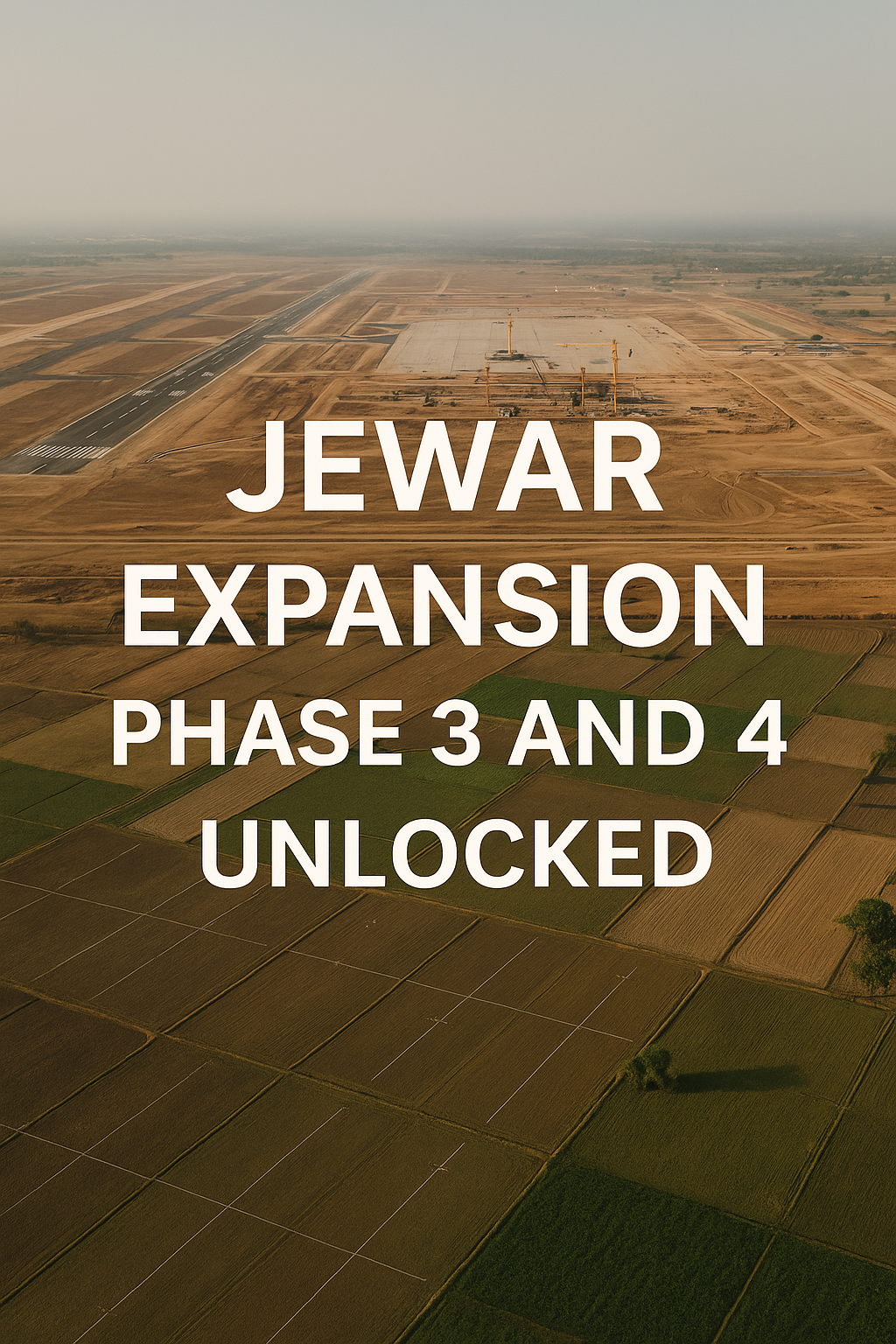
For months, the ambitious expansion plans for the Noida International Airport (NIA) in Jewar faced a silent but formidable wall: the resistance of local landowners. While the construction of Phase 1 moved at breakneck speed, the roadmap for the subsequent phases—critical for transforming this facility from a regional airport into a global aviation capital—hung in the balance. The farmers of the region, aware of the goldmine they sat upon, refused to part with their ancestral land at the old rates.
That standoff has effectively ended. In a decisive move to keep the project timeline intact, the Uttar Pradesh government has approved a significant hike in the land compensation rate, setting a new benchmark of ₹4,300 per square meter. This is not just a monetary update; it is the key that unlocks over 2,000 hectares of prime land required for Phases 3 and 4. For investors, developers, and urban planners, this signals that the "Jewar juggernaut" is back on track, bigger and faster than before.
This blog delves deep into the mechanics of this acquisition, the specific villages at the epicenter of this change, and why this rate hike is set to rewrite the property valuation rules of the entire National Capital Region (NCR).
To understand the significance of the new rate, one must look at the trajectory of land valuation in Jewar. When the airport was first announced, land was acquired at approximately ₹2,300 per square meter for Phase 1. As the project materialized—runways appeared, and test flights began—the market sentiment shifted dramatically. By Phase 2, the rate had nudged up to ₹3,100 per square meter.
However, as the authorities prepared to acquire the massive land banks needed for Phases 3 and 4, the ₹3,100 offer was met with stiff resistance. Farmers argued that the market rate outside the acquisition zone had skyrocketed, often trading at double or triple the government offer. The administration realized that sticking to the old numbers would mean years of litigation and protests, potentially derailing the Prime Minister’s vision of a logistics gateway for North India.
The revised rate of ₹4,300 per square meter represents a roughly 40% jump from the previous phase. This increase is a pragmatic acknowledgment of the ground reality: the airport has created value, and the original stakeholders (the farmers) demanded a fair share of that pie. Alongside the cash compensation, the rehabilitation and resettlement (R&R) package—which includes developed residential plots for displaced families—makes this one of the most lucrative land acquisition models in Indian infrastructure history.
With the compensation hurdle cleared, the focus shifts to the sheer scale of what comes next. Phases 3 and 4 are not merely about adding a few parking bays; they are about capacity dominance.
The Land RequirementThe acquisition targets a colossal 2,053 hectares. To put this in perspective, this is nearly double the size of the initial phase. Out of this, approximately 1,889 hectares are privately owned agricultural land, while the remainder is government land. Securing consent for such a vast contiguous tract is a logistical nightmare that has now been simplified by the new payout structure.
The Strategic PurposeWhile Phase 1 (opening late 2025) focuses on domestic and limited international passenger traffic, and Phase 2 is dedicated to establishing a Maintenance, Repair, and Overhaul (MRO) hub, Phases 3 and 4 are where the "International" in Noida International Airport truly comes alive.
The map of Jewar is being redrawn. Fourteen villages have been identified as the "core acquisition zone" for these expansion phases. For real estate watchers, these names are becoming increasingly familiar as the epicenter of development.
The Heavyweights
The Full ListThe other villages joining the aviation footprint include Kishorpur, Banwaribans, Parohi, Mukimpur Shivara, Sabauta, Ahmedpur Chauroli, Dayanatpur, Rohi, and Bankapur.
The administration has appointed specific "contact officers" for each village to fast-track the consent forms. Under the Land Acquisition Act, the project needs the consent of at least 70% of landowners to proceed. Before the rate hike, this number hovered at a worrying 37%. Post-announcement, officials expect to cross the 70% threshold within weeks, paving the way for the formal Section 11 notification (preliminary notification for land acquisition).
The decision to pay farmers ₹4,300 per square meter is an inflationary event for the local real estate market—in a good way for investors. There is a direct correlation between the cost of raw land acquisition and the final allotment rates of developed plots.
1. The Floor Price Has RisenIf the Yamuna Expressway Industrial Development Authority (YEIDA) buys land at a higher price, it must sell it at a higher price to remain solvent. We are already seeing proposals to hike allotment rates for residential, commercial, and industrial plots by significant margins (some reports suggest up to 30-40%). This means the "cheap entry point" into the Jewar market is closing fast.
2. Appreciation of Existing InventoryFor investors who already hold plots in YEIDA sectors (like Sector 18, 20, or 22D), this is excellent news. The market value of resale properties typically adjusts to match or slightly exceed the authority’s new allotment rates. If the authority launches a new scheme at ₹26,000/sqm because their acquisition cost went up, the resale market which might be hovering at ₹24,000/sqm will instantly correct upwards.
3. The "Flush" Farmer EffectThe injection of liquidity into these 14 villages cannot be overstated. Thousands of crores in compensation will flow into the bank accounts of local families. Historically, in North India, this "compensation capital" finds its way back into real estate. These farmers often reinvest in residential plots in nearby urban sectors, agricultural land in further districts, or commercial properties. This creates a secondary wave of demand that sustains the property market even when external investor sentiment cools.
The airport does not exist in a vacuum. The land acquisition unlock coincides with the aggressive execution of connectivity projects that form a "Golden Triangle" of logistics and speed.
The Bulandshahr Link ExpresswayThe government is fast-tracking a new expressway to connect the airport directly to the Ganga Expressway. This cuts travel time to potential hinterlands and effectively expands the catchment area of the airport. Land acquisition for this link is moving in tandem with the airport expansion.
Rapid Rail (RRTS) & MetroThe Ghaziabad-Jewar RRTS corridor is designed to bring passengers from Delhi to the airport terminal in under an hour. The increased land compensation sets a precedent for these linear projects as well, ensuring that farmers along the track alignments are less likely to litigate, reducing the risk of project delays.
While the rate hike is a masterstroke, the path is not entirely obstacle-free. The administration now faces the operational challenge of processing paperwork for nearly 16,000 families.
The Rehabilitation ChallengeMoney is one part of the equation; physical resettlement is the other. The government has earmarked over 400 hectares for R&R colonies. The promise is not just a check, but a "plot for a plot" (usually 50% of the land area subject to a cap, or a developed residential plot). Ensuring that these R&R colonies are developed with proper amenities (sewage, electricity, roads) before the farmers are asked to vacate is crucial to maintaining trust. Any delay in the R&R development could reignite protests.
The 70% SprintThe immediate goal is the 70% consent mark. While the leadership of the farmer unions has welcomed the move, individual sign-offs take time. The administration is running "consent camps" in villages to expedite this. The coming two months are critical; if the consent is secured before the next agricultural sowing season, the land can be taken over swiftly.
The decision to fix the compensation rate at ₹4,300 per square meter is a watershed moment for the Yamuna Expressway region. It is a signal that the government is willing to pay a premium to ensure speed and stability for its marquee infrastructure project.
For the aviation sector, it guarantees that the Noida International Airport will not be a constrained, single-runway facility but a sprawling aerotropolis capable of rivaling the best in the world. For the real estate investor, it solidifies the conviction that Jewar is not a speculative bubble but a structured, long-term growth story underpinned by massive capital infusion and state resolve.
As the bulldozers prepare to enter Phase 3 and 4 lands, the message is clear: The runway is clear for takeoff, and the region is ready to soar.
