Published On:
March 13, 2026
Updated On:
March 13, 2026
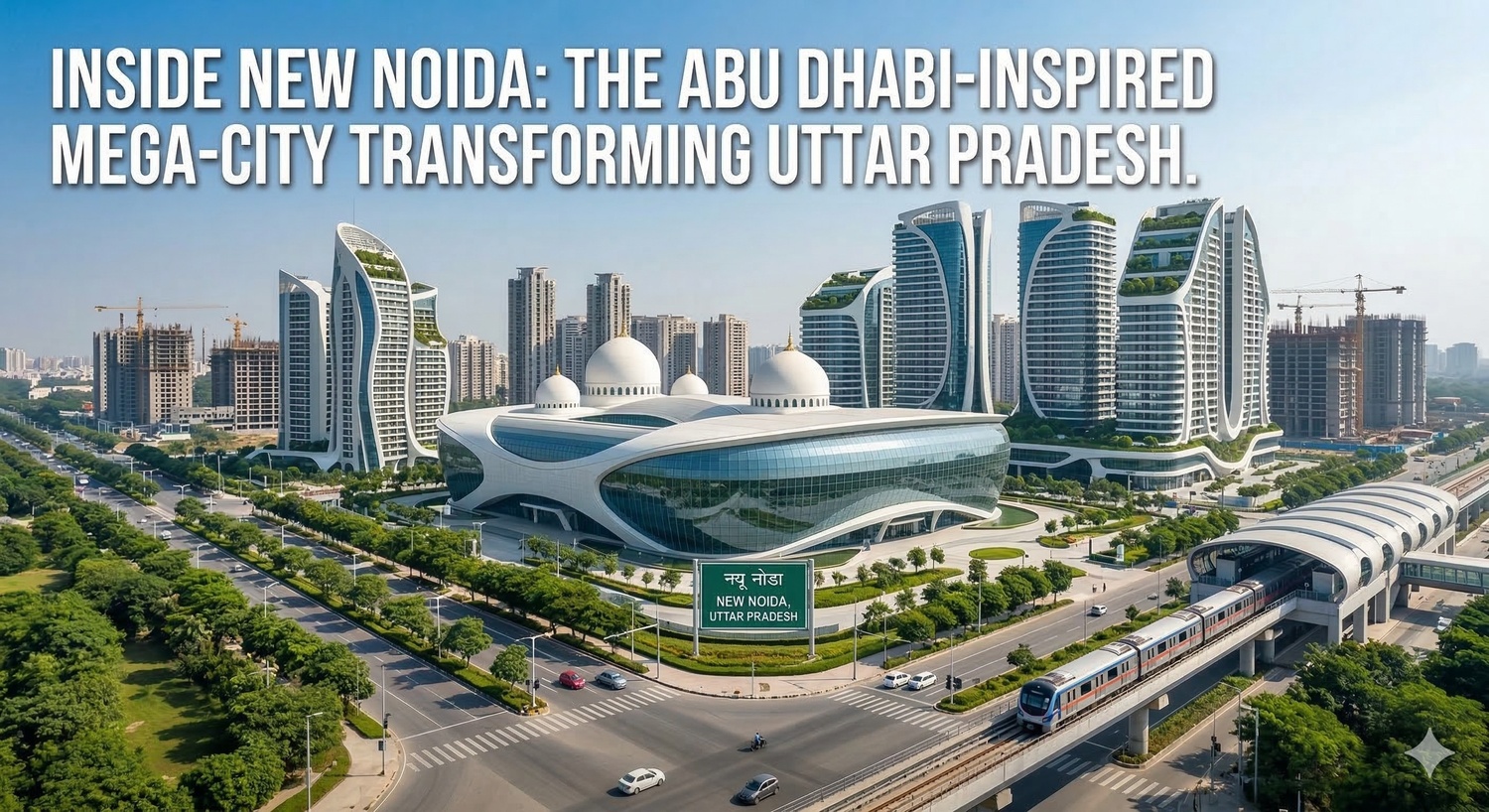
The DNGIR project, heavily inspired by Abu Dhabi's world-class industrial framework, is set to transform 21,000 hectares across 80 villages into 'New Noida'. Guided by the visionary Master Plan 2041, this mega-city perfectly integrates plug-and-play industrial zones, sustainable residential hubs, and seamless logistics to become the ultimate real estate and investment powerhouse of the National Capital Region.
The real estate and economic narrative of the National Capital Region is experiencing a massive, tectonic shift. While the towering skylines and bustling corporate parks of traditional metropolitan hubs have long dominated the landscape, aggressive urban saturation and crippling infrastructural bottlenecks have necessitated a bold, expansionist vision. The older pockets of the city are rapidly running out of contiguous land parcels required for mega-scale industrial and residential developments.
Enter the Dadri-Noida-Ghaziabad Investment Region (DNGIR), colloquially and powerfully known across investment circles as New Noida. This is not merely an incremental extension of the existing city limits; it is a complete, ground-up reimagining of modern urban planning. Taking direct, calculated inspiration from the hyper-efficient, futuristic industrial models of the Middle East, the Uttar Pradesh government is actively laying the groundwork for a massive mega-city. By seamlessly combining massive manufacturing capabilities with ultra-modern living standards, New Noida is poised to redefine commercial, industrial, and residential real estate investment in India for decades to come.
To truly grasp the monumental economic gravity of New Noida, one must first look at the sheer geographical footprint of the project. The recently finalized Master Plan 2041 outlines a sprawling, highly structured urban expanse covering approximately 21,000 hectares. This massive land bank is being meticulously curated by aggregating territory from around 80 specific villages, strategically straddling the high-potential, high-growth corridors of the Dadri and Bulandshahr regions.
Unlike older urban expansions in the country that grew organically, haphazardly, and often chaotically, New Noida is being birthed through a highly organized, inclusive land pooling scheme. This sophisticated model ensures that the agrarian communities providing the land become active, wealthy stakeholders in the region's modernization. By compensating local landowners with fully developed, high-value commercial and residential plots rather than just a one-time, rapidly depleting financial settlement, the administrative authorities are drastically reducing legacy acquisition disputes and significantly accelerating the pace of groundwork.
For savvy land investors, institutional funds, and large-scale developers, this transparent, litigation-free acquisition framework signals a secure, highly lucrative frontier ripe for early-stage capital deployment. It provides the absolute legal clarity that is often missing in emerging real estate markets.
The most striking and highly publicized aspect of the DNGIR project is its architectural and operational muse: the Abu Dhabi industrial model. But what exactly does this mean for the ground reality of New Noida, and why should investors care?
The Abu Dhabi model represents the absolute global pinnacle of integrated, sustainable, and high-tech industrial urbanization. It focuses heavily on creating dedicated, specialized economic clusters that operate with zero logistical friction, all while maintaining a pristine, luxury standard of living for the executives and workforce residing nearby.
Translating this to the Indian context, New Noida is explicitly designed to house around 3,000 cutting-edge industrial units. The overarching focus will not be on legacy, heavy-pollution manufacturing. Instead, the city is rolling out the red carpet for the industries of tomorrow—advanced electronics, semiconductor fabrication, electric vehicle assembly lines, massive hyper-scale data centers, and advanced automated logistics.
By allocating a staggering 8,811 hectares exclusively for industrial development, the master plan ensures that global manufacturing giants will have immediate access to sprawling, ready-to-build mega-plots. Furthermore, the Abu Dhabi influence brings the concept of "plug-and-play" infrastructure to Uttar Pradesh. Industrialists will not have to wait years for basic civic amenities; plots will be pre-equipped with heavy-duty power grids, dedicated industrial water supply lines, high-speed digital fiber infrastructure, and world-class waste management systems. This drastically reduces the setup time for multinational corporations, triggering a faster influx of foreign direct investment.
A booming industrial hub is only as successful as its inherent ability to attract, house, and retain top-tier human capital. Recognizing the massive failures of past industrial towns across India—which often lacked quality housing and social infrastructure, forcing executives into exhausting daily commutes from distant cities—Master Plan 2041 is taking a radically different approach.
The master plan dedicates a highly substantial 2,477 hectares strictly to residential real estate. This is precisely where the vision of a holistic, self-sustaining micro-city truly comes to life. The residential zoning is meticulously designed to accommodate an estimated future population of over six lakh residents, instantly creating a massive, captive consumer market for real estate developers, retail chains, and hospitality brands.
The housing strategy within New Noida is deeply inclusive, heavily promoting a walk-to-work culture that modern urbanites actively seek. The residential sectors will feature a highly structured mix of housing formats catering to every possible demographic and income level. The authorities have classified these massive residential zones into Type-1, Type-2, and Type-3 housing categories.
This ensures that the city provides vital Economically Weaker Section (EWS) and Low-Income Group (LIG) housing for the essential industrial workforce, while simultaneously offering premium Middle-Income Group (MIG) apartments and ultra-luxury High-Income Group (HIG) condominiums for corporate executives and business owners. By enforcing precise architectural guidelines, uniform aesthetics, and strict adherence to population density norms, the city guarantees that these new gated communities will offer a world-class living experience. For end-users and real estate investors, this means the rare opportunity to buy into impeccably planned neighborhoods that are entirely immune to the haphazard zoning issues that currently plague older NCR pockets.
In the high-stakes realm of real estate and industrial growth, property value is inextricably linked to logistical connectivity. New Noida is structurally engineered from the ground up to be a global logistical powerhouse. The master plan does not merely sketch out local streets; it reserves an absolutely massive 3,282 hectares entirely for high-speed transportation and complex road networks.
This staggering land allocation encompasses multi-lane, access-controlled arterial expressways, dedicated rapid transit corridors, and flawless integration with existing national highways. The strategic geographical positioning of the DNGIR project is, without a doubt, its greatest economic asset. By serving as the critical, physical junction between the bustling rail hubs of Dadri, the established corporate infrastructure of Greater Noida, and the rapidly appreciating zones of the Yamuna Expressway, New Noida forms the ultimate logistical golden triangle of North India.
Furthermore, its immediate proximity to monumental mega-infrastructure projects permanently alters its economic trajectory. The integration with the Eastern Peripheral Expressway allows commercial freight to completely bypass the notorious traffic chokeholds of central Delhi. More importantly, the city sits adjacent to the Dedicated Freight Corridor (DFC). The DFC’s Dadri node connects this region directly to the massive JNPT seaport in Mumbai, meaning goods manufactured in New Noida can reach the western coastline for global export in under twenty-four hours. Combine this with the frictionless, high-speed access to the upcoming Noida International Airport at Jewar, and it becomes glaringly obvious why logistics companies are aggressively targeting this zone. For commercial real estate investors focusing on automated warehousing, cold storage chains, and modern logistics parks, this web of unparalleled connectivity guarantees exceptionally high rental yields and near-zero vacancy rates.
A truly modern master plan is entirely incomplete without a rigorous, unshakeable commitment to environmental sustainability. The DNGIR project actively and aggressively combats the prevailing, negative narrative of urban NCR pollution by weaving ecological preservation directly into its structural DNA. The Abu Dhabi model places a heavy, non-negotiable premium on aesthetics, micro-climate control, and livability, and New Noida mirrors this philosophy by reserving vast tracts of prime land exclusively for environmental rejuvenation.
The groundbreaking urban blueprint includes the massive creation of artificial lakes spread across 58.96 hectares and a sprawling, highly engineered canal network spanning 91.75 hectares. These massive water bodies are not merely decorative afterthoughts; they serve as critical, highly functional mechanisms for deep groundwater recharge, natural micro-climate regulation, and sustainable urban drainage. They act as a powerful buffer, ensuring the city remains completely resilient against monsoon flooding.
Complementing this advanced blue infrastructure is an extensive, carefully mapped network of dense green belts, sprawling public recreational parks, and thick urban forests. By strictly prioritizing these wide open spaces, the city essentially guarantees a vastly superior Air Quality Index (AQI) and a tranquil, resort-like living environment for its millions of future residents. In the real estate market, properties that offer unobstructed views of massive lakes and manicured green belts command spectacular financial premiums. This commitment to green infrastructure directly and powerfully elevates the baseline capital value of all residential property within the city limits.
For the astutely analytical real estate investor, the writing is clearly on the wall. The traditional, heavily saturated property markets of the broader region have largely peaked in their rapid, early-stage appreciation cycles. The exponential, multi-bagger financial returns of the next two decades will invariably be forged in the meticulously planned, infrastructure-heavy sectors of New Noida.
The underlying economic fundamentals driving this micro-market are absolutely unshakeable. The establishment of 3,000 massive industrial units will trigger an unprecedented, historic employment boom. As hundreds of thousands of highly skilled professionals, engineers, and corporate executives migrate to the region to fill these lucrative roles, the localized demand for high-quality housing, sprawling commercial retail spaces, international schools, and multi-specialty healthcare facilities will absolutely skyrocket. This classic, highly predictable demand-supply mismatch in the early years of the city’s development presents a rare, generational wealth-creation window for early-stage investors who secure land and assets now.
Moreover, the government's unwavering, legally binding commitment to the Master Plan 2041 ensures strict, uncompromising regulatory oversight. The traditional pitfalls of unauthorized construction, shifting zoning laws, and chaotic land disputes are heavily mitigated by the overarching, powerful authority of the DNGIR framework. Investors can confidently deploy massive capital tranches into commercial plots, high-street retail arcades, and luxury residential projects with the absolute certainty that the surrounding physical and social infrastructure will materialize exactly as envisioned on the master blueprint.
The DNGIR project is far more than a simple geographical expansion; it is a powerful, undeniable statement of India’s rapidly evolving urban engineering capabilities. By seamlessly fusing the flawless industrial brilliance of the Abu Dhabi model with the massive demographic realities and economic ambitions of the National Capital Region, New Noida is perfectly poised to become a global benchmark for smart, sustainable, and highly profitable city planning.
As the heavy earth-moving machinery prepares to break ground and the two-dimensional blueprints rapidly transition into sprawling concrete reality, the 80 villages spanning Dadri and Bulandshahr are actively stepping into a hyper-modern, highly lucrative future. For those with the strategic foresight to recognize the massive economic gravity of Master Plan 2041, New Noida offers the ultimate financial canvas. It is a city meticulously designed for tomorrow, presenting the most compelling, structurally secure real estate and industrial investment opportunity of our time.
