Published On:
March 23, 2026
Updated On:
March 23, 2026
The Rs. 923-crore underground trumpet interchange on the Dwarka Expressway is fundamentally transforming Gurugram's real estate, drastically reducing commute times and driving a 3.5x surge in property values across emerging sectors and the upcoming Global City hub.
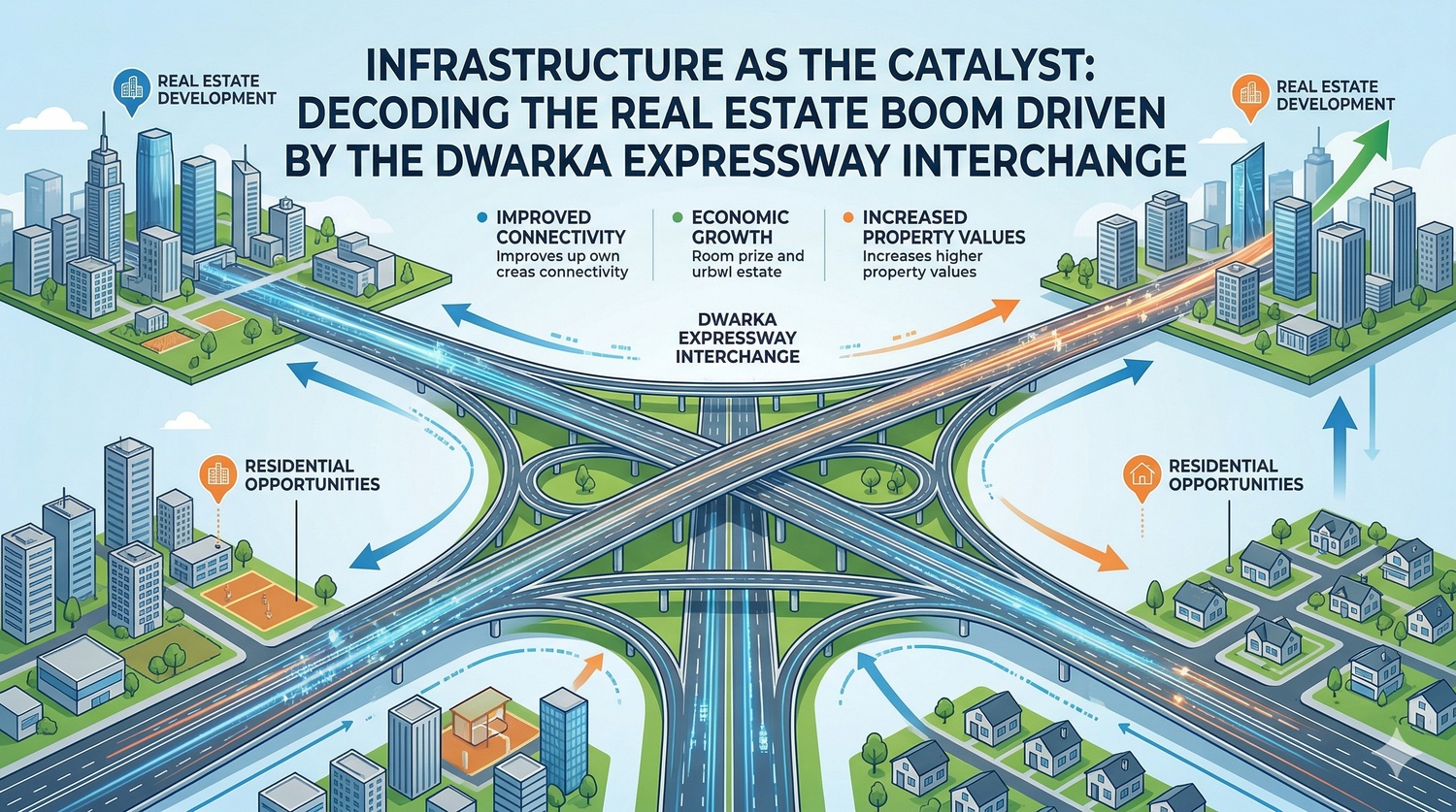
Real estate markets operate on a simple, universally acknowledged principle: where roads go, wealth inevitably follows. In the ever-evolving, fast-paced landscape of the National Capital Region, the narrative of growth has always been driven by the relentless march of physical connectivity. Today, we are witnessing a pivotal moment in urban development. The much-anticipated Rs. 923-crore underground trumpet interchange near the Pataudi Road junction on the Dwarka Expressway is no longer just an architectural blueprint. It is a concrete reality that is fundamentally rewriting the rules of property investment in Gurugram.
For years, the real estate sector in this region played a reactive game of catch-up. Developers would often wait for the government to lay down the basic physical foundation before launching their ambitious projects. However, the paradigm has completely shifted. Today, high-grade infrastructure is actively anticipating development rather than reacting to it. This monumental new interchange serves as the ultimate proof of this shift. It acts as a massive economic catalyst, instantly transforming peripheral land parcels into highly coveted, premium real estate hotspots and completely changing how investors and homebuyers evaluate the western frontier of the city.
To truly grasp the long-term impact of this development, one must look closely at the engineering scale. The proposed underground trumpet interchange is nothing short of a masterclass in modern urban planning. Featuring approximately 3.2 kilometres of meticulously designed ramps and approach roads, the entire structure is engineered with a singular goal: to eliminate the most frustrating aspect of daily urban life, which is the traffic bottleneck.
A trumpet interchange is specifically designed for complex T-intersections. It allows for a seamless, entirely signal-free loop where thousands of vehicles can merge, exit, and change directions without ever having to stop or cross opposing traffic lanes. Situated strategically at the crucial Pataudi Road junction, this underground configuration is built to handle a massive, continuous volume of vehicular movement with zero friction.
Historically, Pataudi Road has been a vital, albeit heavily congested, artery connecting the industrial zones of Haryana to the polished corporate hubs of Gurugram. By integrating it so fluidly with the Dwarka Expressway, urban planners have effectively erased the barrier between the old, congested transit routes and the new, high-speed future. The sheer financial scale of this Rs. 923-crore investment highlights a serious commitment to creating a world-class transit system that does much more than just move cars. It is designed to accelerate the local economy.
Urban planners and real estate strategists often discuss the concept of the mental map, which is how residents instinctively perceive the layout, safety, and accessibility of their city. In modern metropolises, physical distance in kilometres is rarely as important as the time it takes to traverse that distance. What the Dwarka Expressway interchange achieves is incredibly subtle yet remarkably powerful: it completely redraws the mental map of Gurugram.
When road access becomes continuous, completely uninterrupted by the frustration of traffic lights, toll plazas, and narrow local bottlenecks, a location that once felt entirely disconnected suddenly begins to behave like a central, accessible node. This is precisely where physical infrastructure stops being mere background noise and morphs into a massive, undeniable market signal.
If you spend time conversing with real estate professionals and site managers operating around the emerging sectors of the expressway, you will immediately notice a distinct shift in their daily vocabulary. Distances are no longer measured in kilometres. The standard sales pitch has evolved dramatically, and claiming that a luxury property is merely twenty minutes away from the Indira Gandhi International Airport has become the new industry baseline. This transition from measuring distance to measuring time is the clearest indicator that a micro-market is maturing. When the perception of distance collapses, property valuations inevitably skyrocket to reflect that newly discovered convenience.
The strategic placement of this massive trumpet interchange is far from a coincidence. It is deliberately designed to sit at the absolute epicenter of multiple intersecting, multi-billion-dollar growth stories. While the Dwarka Expressway provides the high-speed spine, and the Pataudi Road corridor offers the deep local arterial reach, the true endgame of this infrastructure is the seamless integration of massive upcoming employment zones.
The most prominent of these is the highly anticipated Global City development. Spread across a sprawling expanse of roughly 1,000 acres, Global City is officially envisioned as a futuristic, self-sustaining central business district. It is slated to feature state-of-the-art commercial towers, massive international exhibition spaces, ultra-luxury residential complexes, and dedicated institutional and retail zones. Linking this colossal economic engine directly to a major expressway via a signal-free underground corridor guarantees a steady, unhindered flow of highly paid professionals, logistics, and international capital.
Furthermore, this unparalleled connectivity extends to other ambitious regional projects like Vision City, creating a massive, interconnected employment and residential ecosystem. The presence of these mega-projects ensures that the demand for high-quality housing in the immediate vicinity will not be a temporary, speculative spike, but rather a sustained, long-term requirement. Modern professionals want to live in luxury spaces close to where they work. If they can commute to a world-class business hub in under ten minutes without facing a single red light, they are more than willing to pay a premium for that lifestyle.
The ripple effects of the underground interchange are already being heavily felt in the surrounding micro-markets. Tier-one developers, always possessing a keen eye for future growth corridors, had already marked this specific belt out long before the first construction equipment arrived. Over the past few years, massive tracts of land were quietly and aggressively assembled around specific strategic nodes, most notably Sectors 36, 37, and 88A, along with premium residential zones stretching further west.
These specific sectors are the direct, immediate beneficiaries of the underground trumpet interchange. Sector 37, for instance, has rapidly transitioned from being a dusty, speculative outpost to a bustling, highly active hub of premium residential and commercial activity. The land parcels here that were being negotiated just a couple of years ago at relatively modest valuations are today trading at staggering numbers. These current valuations assume that a fully functional, mature urban ecosystem is already in place.
The early movers who secured land banks in these sectors are now capitalizing on their foresight. For end-users and wealthy homebuyers, these sectors currently offer the perfect, elusive blend of high-end luxury living integrated with unparalleled connectivity. This specific combination is becoming increasingly rare and expensive in the older, highly saturated parts of central Gurugram.
In the business of real estate investment, the numbers ultimately tell the truest, most unbiased story. The current mood in the Gurugram market has been exceptionally buoyant, and recent data completely validates this aggressive optimism. Over the past five years, as the infrastructure development shifted from a vague political promise to tangible, visible construction, property values across the belt have experienced a truly meteoric rise.
According to recent comprehensive market reports, average property rates in this specific corridor hovered around a modest Rs 6,300 per square foot back in 2020. Fast forward to 2025, and those exact same locations are now commanding premium prices ranging between Rs 21,700 and Rs 24,000 per square foot. This represents an astonishing 3.5 times multiplication in asset value over a remarkably short five-year period. Such aggressive capital appreciation is rarely seen outside of highly volatile equity markets, yet here it is securely backed by solid brick, mortar, and state-of-the-art asphalt.
What makes this financial surge even more fascinating is the rapidly changing demographic of the buyers who are actually driving it. Historically, the Dwarka Expressway belt was heavily dominated by speculative investors from Delhi—individuals simply parking their surplus capital in the dirt in hopes of future, long-term gains. Today, that trend has completely inverted. A highly noticeable, dominant share of the buyer enquiries is now coming directly from genuine end-users.
These are affluent, highly paid corporate professionals working in the established cyber-city and golf course extension clusters who are purposefully looking westwards. They are exhausted by the cramped living conditions, high pollution, and daily gridlock of central Gurugram, and they are actively seeking out larger luxury homes, better community amenities, and superior road access. This vital transition from an investor-driven speculative market to an end-user-driven lifestyle market is the ultimate hallmark of a sustainable, long-lasting real estate boom.
To fully appreciate the magnitude of the current boom, one must acknowledge the complicated history of the Dwarka Expressway itself. Spanning exactly 27.6 kilometres, this massive stretch of elevated and surface road runs from Mahipalpur in Delhi directly to Kherki Daula in Gurugram. For many years, the project was severely plagued by complex land acquisition hurdles, political delays, and endless litigation, earning it an unfortunate reputation as a perpetually delayed dream.
However, the relentless government push to complete it has finally paid off in spectacular fashion. It now effectively forms an ultra-wide, high-speed alternate spine connecting the national capital to its most prosperous satellite city, entirely bypassing the notoriously choked NH-48.
The expressway alone, however, is just a fast road. What transforms a concrete highway into a fully functioning, wealth-generating urban system are its entry and exit points. Interchanges exactly like the one at the Pataudi Road junction are the crucial, final pieces of the puzzle. They act as the vital valves that regulate the flow of urban life, ensuring that the high-speed connectivity of the expressway actually bleeds into and benefits the local residential and commercial sectors. Without these seamless integrations, an expressway simply bypasses a region; with them, it fuels explosive local growth.
The remarkable story currently unfolding around the Dwarka Expressway is part of a much larger, rapidly evolving narrative in Indian urban planning. Historically, infrastructure in Indian cities always followed development. Neighborhoods would organically crop up, local roads would become completely choked with traffic, and only then would the municipal authorities step in years later to build a reactive flyover or widen a street. We saw this play out painfully in the early, chaotic days of Gurugram's initial IT boom.
However, the city's geography is now being actively shaped by proactive, visionary engineering. If we look back at the development of the NH-48 corridor in the early 2000s, or the massive economic impact of the Sohna elevated road more recently, the pattern of infrastructure driving wealth is clear. But the Dwarka Expressway interchange takes this concept to an entirely new level.
The infrastructure here is being laid down entirely in anticipation of future development. It is specifically designed to handle the massive future capacity of mega-projects like Global City long before the very first corporate residents even move into their offices. This forward-thinking approach provides immense, unshakeable confidence to major institutional real estate developers. Because the connectivity risk has been entirely removed by the government, these developers are now comfortably pouring thousands of crores into building ultra-luxury condominiums, integrated smart townships, and cutting-edge commercial spaces in the immediate vicinity.
As the Rs. 923-crore underground trumpet interchange rapidly nears its final stages of completion, the economic gravitational pull of the Dwarka Expressway corridor is becoming virtually impossible for serious investors to resist. For wealth builders and luxury homebuyers alike, the critical window to enter this highly lucrative market at a reasonable, high-upside price point is rapidly closing. The 3.5x price surge witnessed over the last five years is likely just the foundational beginning of a prolonged, decade-long upward trajectory.
The flawless integration of the high-speed expressway, the Pataudi Road arterial network, and the colossal upcoming employment hubs guarantees that the demand dynamics will remain incredibly robust for decades to come. Furthermore, as the physical infrastructure matures and stabilizes, the high-end social infrastructure—including premium international schools, multi-specialty hospitals, luxury retail malls, and fine dining entertainment districts—is already aggressively following suit to cater to the new, affluent demographic moving into the area.
The complete transformation of Gurugram's western frontier is a testament to the unparalleled power of targeted, high-quality urban infrastructure. The Dwarka Expressway is no longer just a peripheral alternative route used to bypass traffic; it has confidently become the primary destination itself. For those looking to secure their financial future through high-yield capital appreciation, or families seeking a premium, uncompromised lifestyle free from the daily constraints of city traffic, the developments surrounding this new interchange represent one of the most compelling, undeniable real estate opportunities of our generation. The smart institutional money has already firmly positioned itself in this corridor, and as the signal-free loops become fully operational, the rest of the retail market will undoubtedly follow.
