Published On:
February 5, 2026
Updated On:
February 5, 2026
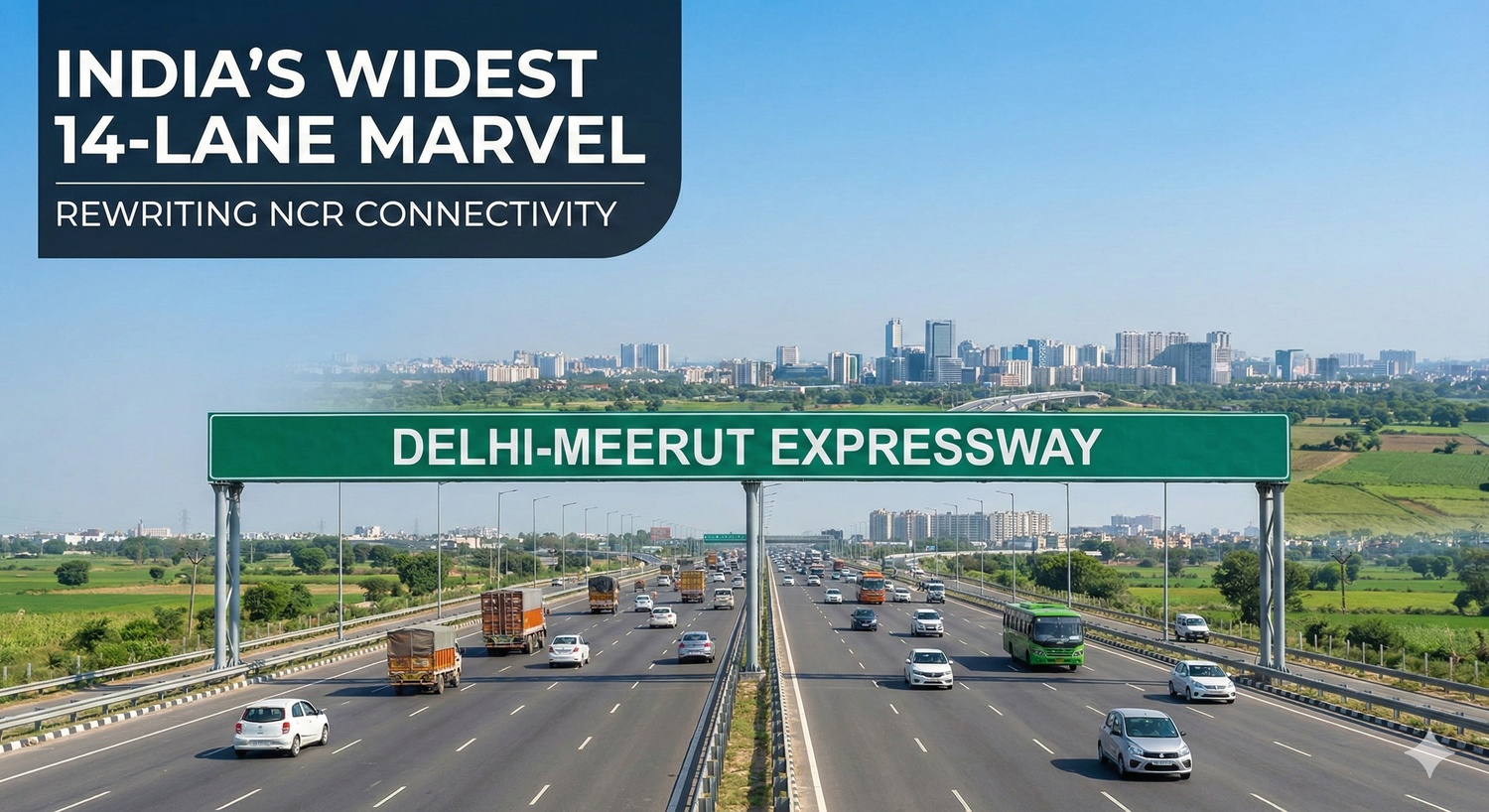
The Delhi-Meerut Expressway, holding the title of India’s widest road with 14 lanes, has revolutionized NCR connectivity by cutting travel time from 2.5 hours to just 45 minutes. This blog explores its four-phase structure, smart tolling technology, and the massive real estate boom it has triggered in Ghaziabad and Meerut.
For decades, the journey from Delhi to Meerut via the old National Highway 24 (NH-24) was a test of patience. It was a route synonymous with bottleneck congestion at Gazipur, endless traffic snarls at Indirapuram, and a grueling 3-hour drive that left commuters exhausted. The "Meerut commute" was something to be endured, not enjoyed.
That narrative has been permanently erased.
Today, the Delhi-Meerut Expressway (DME) stands as a testament to modern Indian infrastructure. It is not just another road; it is an engineering behemoth that holds the distinction of being India’s widest expressway, stretching to a staggering 14 lanes in its initial phases. By slashing travel time to a mere 45 minutes, this 96-kilometer corridor has effectively turned Meerut into a suburb of Delhi, integrated Ghaziabad into the capital’s heartbeat, and unlocked billions in economic potential along its flanks.
This blog takes a deep dive into the anatomy of this super-highway, the smart technology that powers it, and why it is arguably the most critical infrastructure lifeline in Western Uttar Pradesh today.
The DME is unique because it isn't a "one-size-fits-all" road. It is a hybrid model designed to cater to both long-distance travelers and local city traffic simultaneously. To manage this dual load, the project was executed in four distinct packages (phases), each with its own configuration.
This 8.7 km stretch is the showstopper. It is here that the expressway achieves its record-breaking 14-lane width.
Extending 19.2 km, this section continues the 14-lane configuration (6-lane expressway + 8-lane National Highway). It acts as the lifeline for Ghaziabad’s dense residential hubs like Indirapuram, Vaishali, and Crossings Republik. The transformation here includes massive flyovers and underpasses that have made the drive signal-free.
Spanning 22 km, this section branches off towards Hapur on the existing NH-9 alignment. While not 14 lanes, it has been upgraded to a robust 8-lane configuration to handle the heavy commercial traffic heading towards Moradabad and Lucknow.
This is a completely new "Greenfield" alignment stretching 46 km. Cutting through agricultural lands, this 6-lane access-controlled stretch allows vehicles to hit top speeds (100 km/h) without worrying about local traffic interference, terminating directly at the Partapur Bypass in Meerut.
The DME is arguably India’s first "Smart Expressway." The government moved beyond simple asphalt and integrated an Intelligent Transport System (ITS) that manages the flow and safety of thousands of vehicles daily.
The DME does not exist in isolation. It is the spine of a larger multi-modal transport network developing in the NCR.
Parallel Rapid Rail (RRTS):Running almost parallel to the expressway is the Delhi-Ghaziabad-Meerut RRTS (Namo Bharat) corridor. This unique "Road + Rail" combination offers commuters a choice: drive to Meerut in 45 minutes or take the rapid train in 55 minutes. This redundancy ensures that the corridor never faces a total collapse in connectivity.
The Gateway to Uttarakhand:For holidaymakers, the DME is the new gateway to the hills. By bypassing the congested towns of Modinagar and Muradnagar, the expressway has shaved off an entire hour from the journey to Haridwar, Rishikesh, and Dehradun.
Infrastructure is the primary driver of real estate value, and the DME has been a goldmine for property markets along its route.
1. Indirapuram & NH-24 Belt:Localities like Indirapuram and Siddharth Vihar have seen property prices surge by nearly 40-50% since the expressway became operational. The "highway-facing" properties, once noisy and undesirable, are now premium assets due to their direct connectivity to Delhi.
2. Dasna & Pilkhuwa:These were previously considered "far-flung" rural outposts. Today, they are emerging as logistics and warehousing hubs. With the Eastern Peripheral Expressway intersecting the DME at Dasna, this junction has become a logistics hotspot for e-commerce giants.
3. Meerut South (Partapur):Meerut is shedding its image as a distant Tier-2 city. Developers are launching premium townships near the Partapur exit, marketing them to people who work in Noida but prefer the affordable, spacious lifestyle of Meerut.
As of 2026, the authorities have tightened enforcement to maintain the expressway's high-speed standards:
The Delhi-Meerut Expressway is more than just concrete; it is a vision realized. It proved that India could build urban infrastructure that rivals the best in the world—widening roads to 14 lanes in the heart of a chaotic metropolis without halting the city's pulse.
For the daily office-goer, it gave back hours of life previously lost to traffic. For the economy of Western Uttar Pradesh, it opened a high-speed trade corridor. As we look at the expanding network of expressways in 2026, the DME remains the benchmark—the "Widest" proof of a transforming India.
