Published On:
February 23, 2026
Updated On:
February 23, 2026
Discover how the new ₹3,700 crore semiconductor facility in Yamuna City, alongside nine other strategic national projects, is transforming India from a technology importer into a self-reliant global manufacturing powerhouse.
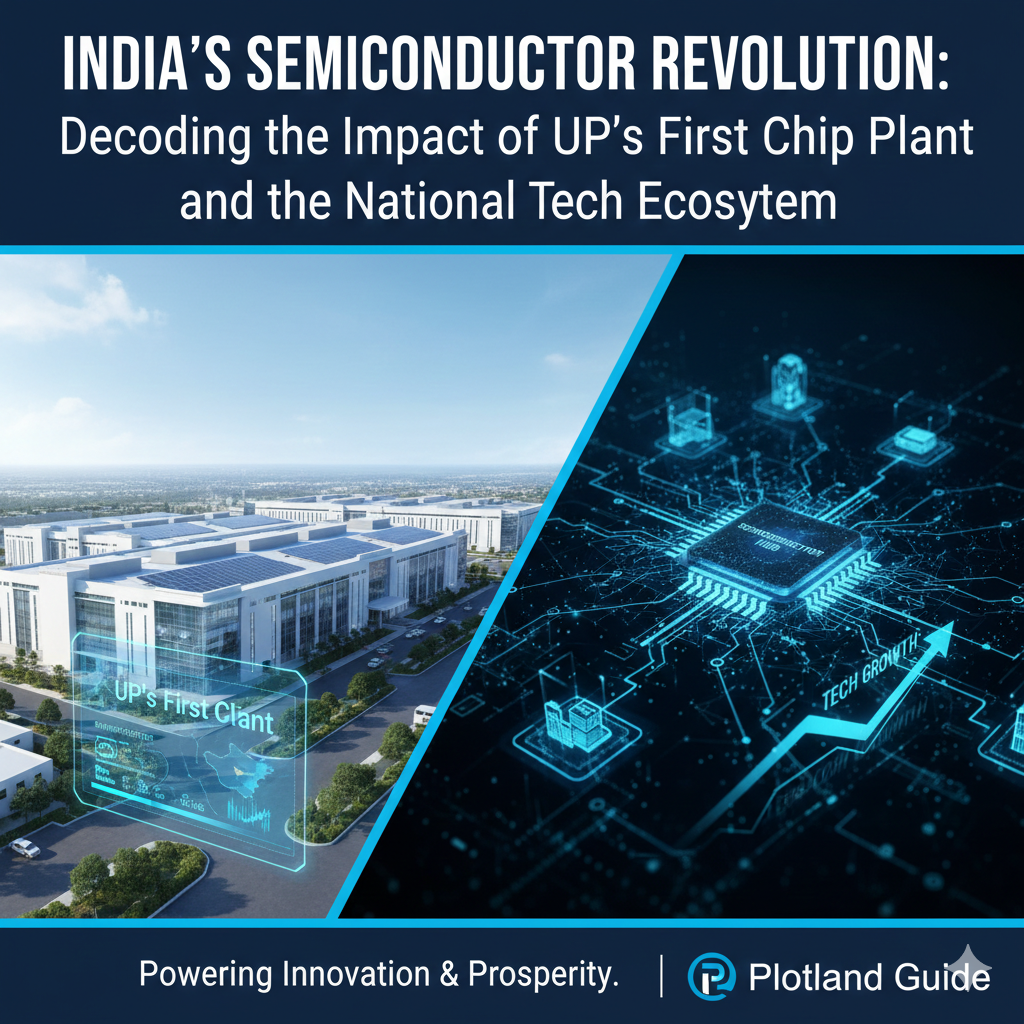
The modern world is entirely dependent on microscopic pieces of engineered silicon. From the smartphones we carry to the vehicles we drive, semiconductors dictate the pace of modern life. For decades, India relied heavily on foreign imports to fuel its massive domestic consumption of electronics. However, a monumental shift is currently underway. With a highly coordinated push toward technological self-reliance, India is rapidly establishing its own semiconductor manufacturing ecosystem.
A major milestone in this journey was recently achieved in Uttar Pradesh with the foundation laying of North India’s very first semiconductor manufacturing unit. Located strategically in Sector-28 of Yamuna City, this facility is more than just a factory; it represents a fundamental pivot in how India positions itself within the global technology supply chain. Coupled with a broader national strategy encompassing a total of ten approved mega-projects across various states, the country is steadily carving out its space in an industry historically dominated by a handful of East Asian nations.
The development taking place in Gautam Buddha Nagar’s Yamuna City is a testament to India’s aggressive industrial strategy. Set against the backdrop of the upcoming Noida International Airport in Jewar, Sector-28 is transforming into a high-tech electronics hub. The anchor of this transformation is a massive ₹3,700 crore Outsourced Semiconductor Assembly and Test (OSAT) facility.
This ambitious project is driven by a joint venture between a leading Indian IT conglomerate and a Taiwanese electronics manufacturing giant, operating under the banner of India Chip Private Limited. Securing 48 acres of prime industrial land, the partnership merges deep-rooted domestic engineering expertise with world-class, global manufacturing practices.
Interestingly, the strategic vision for this plant is highly forward-looking. Initial operations will utilize only about 15 to 20 percent of the allocated land. This deliberate phased approach leaves massive room for future expansion. As domestic and international demand for localized electronic components surges, the facility is designed to scale its production capacity by four to five times, seamlessly adapting to future market requirements without the hurdle of acquiring new land.
The establishment of this semiconductor unit is doing much more than producing technology; it is rewriting the socioeconomic narrative of the entire region. Just a few years ago, the areas surrounding Jewar faced significant infrastructural and security challenges. The industrial climate was largely unfavorable, leading to a migration of businesses and a lack of substantial investment.
Today, the picture is radically different. Enhanced law and order, coupled with aggressive infrastructure development, has turned Yamuna City into a dream destination for global investors. The land that once yielded agricultural produce is now being compensated at highly premium rates, drastically improving the livelihoods of local communities.
Economically, the impact of the Sector-28 facility is profound. Once fully operational by 2028, the plant is expected to generate upwards of 3,500 direct and indirect jobs. Beyond direct employment, a facility of this scale naturally acts as an industrial magnet. It catalyzes a localized supply chain, drawing in raw material suppliers, logistics providers, and specialized service contractors, thereby multiplying the economic benefits across the state of Uttar Pradesh.
To understand the importance of the Yamuna City plant, it is essential to understand what it will actually do. The facility will function as an OSAT—an Outsourced Semiconductor Assembly and Test unit. In the semiconductor manufacturing process, raw silicon wafers are printed with intricate circuits at fabrication plants (fabs). However, these delicate wafers cannot be used directly in consumer electronics. They must be precisely cut, assembled, encased in protective packaging, and rigorously tested for electrical and thermal reliability. This critical backend process is what the UP facility will master.
The primary product focus for this plant will be Display Driver Integrated Circuits (DDICs). These specific chips act as the vital communication bridge between a device's microprocessor and its display panel. Whether it is a smartphone screen, a laptop monitor, a smart television, or the digital dashboard of a modern electric vehicle, DDICs are required to tell the pixels what colors to show and when.
With a planned capacity to process 20,000 wafers per month, the output will be staggering. It is estimated that once production stabilizes, this single facility will be capable of fulfilling approximately 25 percent of India’s total domestic requirement in its specific segment. This drastically reduces the nation's reliance on imported display drivers and ensures that local electronics manufacturers have a steady, domestic supply of critical components.
It is impossible to overstate the importance of semiconductors in contemporary society. Often referred to as the "brains" of electronic gadgets, they have rightfully earned the moniker of "digital diamonds." In the 20th century, a nation's prosperity and geopolitical leverage were largely dictated by its oil reserves. In the 21st century, that power dynamic has shifted entirely to small, highly engineered silicon chips.
Semiconductors automate, regulate, and control almost every machine we interact with daily. Consider everyday conveniences: when a computer is left idle and automatically goes to sleep to save power, it is a semiconductor managing that thermal and power transition. When a driver forgets to fasten their seatbelt and the car's dashboard triggers an audio-visual warning, it is a localized chip processing that sensor data. Even routine household appliances, like a washing machine automatically shutting off the water valve and powering down after a spin cycle, rely entirely on embedded microcontrollers.
Beyond consumer conveniences, these chips form the foundational bedrock for future technologies. Artificial intelligence, high-speed 5G and 6G telecommunications, advanced medical diagnostics, autonomous electric vehicles, and modern defense equipment are all fundamentally impossible without a continuous and reliable supply of advanced semiconductors.
The urgency behind India’s push for domestic manufacturing stems from a harsh reality exposed during the COVID-19 pandemic. The global chip supply chain proved to be incredibly fragile. When border closures and factory lockdowns occurred, the entire world experienced an acute semiconductor shortage. Global automotive giants were forced to halt assembly lines, and consumer electronics launches were delayed by months, all because of the unavailability of components that cost just a few dollars.
This crisis highlighted the severe geographical concentration of semiconductor production. Currently, the global landscape is heavily skewed:
Recognizing the immense economic and strategic vulnerability of relying entirely on imports, the Indian government resolved to turn the crisis into an opportunity. The goal is no longer just to assemble imported parts, but to achieve true self-reliance by building a trusted, resilient semiconductor supply chain that can serve both domestic needs and the global market.
The facility in Uttar Pradesh is a critical piece of a much larger, highly orchestrated national strategy known as the India Semiconductor Mission. Backed by a massive financial outlay, the central government has officially approved 10 major semiconductor manufacturing and packaging projects. Representing a cumulative investment of approximately ₹1.6 lakh crore, these facilities are strategically distributed across six states to build a comprehensive, pan-India tech ecosystem.
Gujarat has emerged as the clear frontrunner, securing the highest number of semiconductor projects. The state is developing a dual-hub strategy:
To ensure balanced industrial growth and mitigate regional supply risks, the mission has aggressively expanded beyond western India:
The simultaneous development of these ten projects marks a watershed moment in India’s industrial history. Building a semiconductor plant is not an isolated event; it is the planting of an economic seed. Wherever a fab or an OSAT facility is established, an entire ecosystem naturally follows. Design houses set up regional offices to work closely with manufacturers, specialized research and development centers are born, technical universities align their curriculums to create industry-ready talent, and a vibrant startup culture emerges to innovate on top of the newly available hardware.
By moving from a software-dominant tech identity to incorporating massive hardware manufacturing capabilities, India is setting the stage for decades of sustained economic growth. The transition from heavily relying on imports to manufacturing millions of chips domestically ensures that the nation is insulated from future global supply chain shocks. As these facilities come online over the next few years, India will not only secure its own digital future but will firmly establish itself as a vital, trusted node in the global technology landscape.
