Published On:
January 29, 2026
Updated On:
January 30, 2026
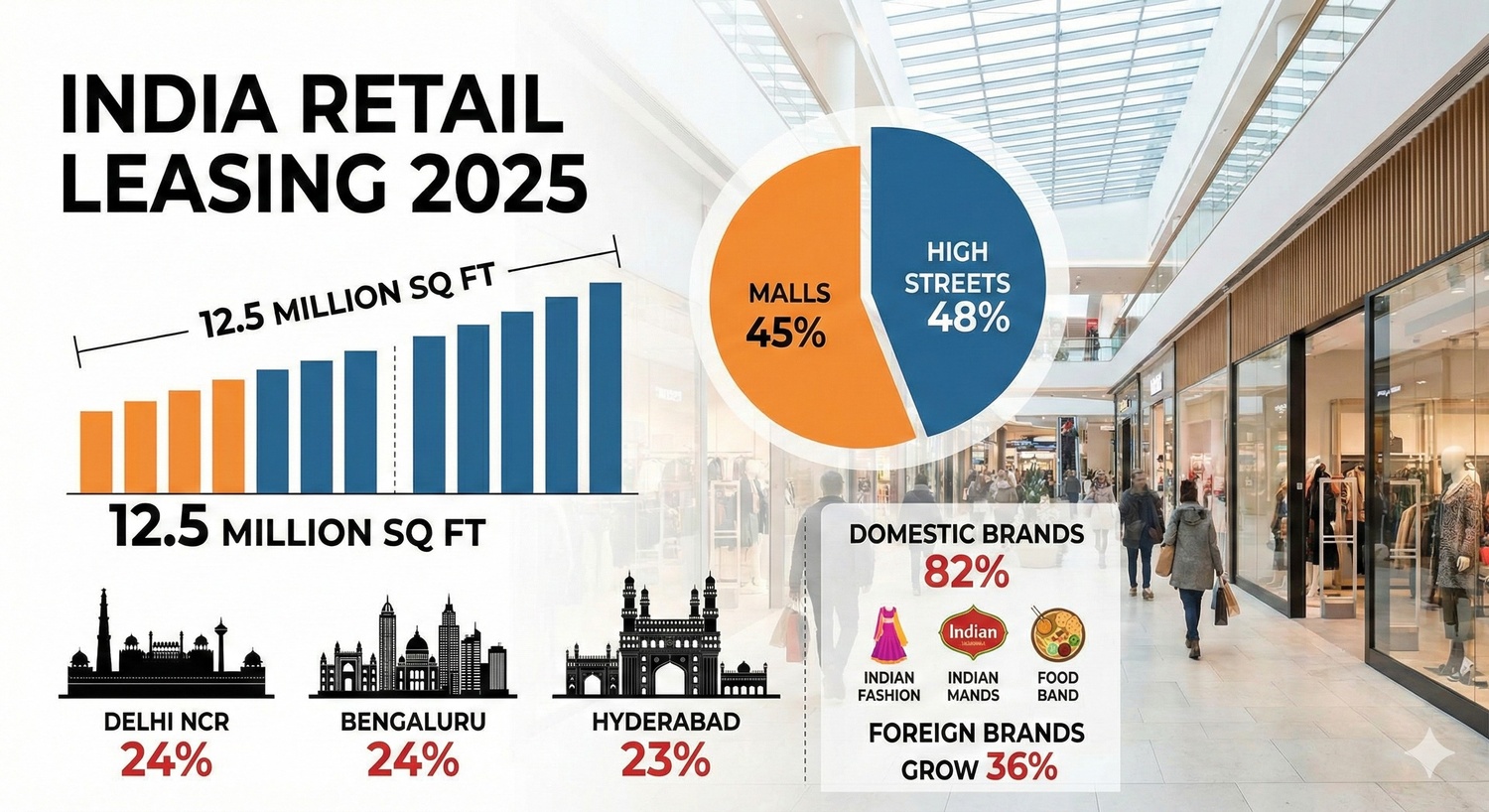
Retail leasing in India's top seven cities surged by over 50% to reach a three-year high of 12.5 million sq ft in 2025. Delhi-NCR and Bengaluru were the primary drivers, accounting for nearly half of the total demand, as domestic brands and a record number of international retailers expanded their footprint across malls and high streets.
If there were any lingering doubts about the resilience of physical retail in the age of quick commerce and one-day delivery, 2025 has effectively silenced them. The Indian retail real estate sector didn't just recover; it roared back to life, hitting a three-year high that has analysts and investors sitting up and taking notice.
According to the latest market data, leasing across the top seven cities touched a staggering 12.5 million square feet in 2025, marking a massive 54% jump compared to the previous year. This isn't merely a statistical spike; it represents a fundamental shift in how urban Indians are shopping, eating, and experiencing leisure. The narrative has moved beyond "revenge spending" to sustained, structural growth, driven by a powerful combination of domestic expansion, international market entry, and a newfound love for high-street shopping.
For stakeholders in the real estate ecosystem—from developers in Gurugram to high-street landlords in Indiranagar—the message is clear: The store is back, but it looks very different from the store of 2019.
To understand the magnitude of this 12.5 million sq ft figure, one must look at the context of the last few years. The post-pandemic years were characterized by cautious optimism, but 2025 broke the shackles of caution. The final quarter of the year alone saw absorption of nearly 3.6 million sq ft, indicating that the momentum is accelerating as we head into 2026.
This surge is supported by a healthy pipeline of supply. Approximately 6.3 million sq ft of new retail space entered the market in 2025, helping to keep rentals competitive while offering brands high-quality, Grade-A environments. The total mall stock in the top seven cities has now crossed the 92 million sq ft mark. However, the absorption numbers suggest that demand is currently outstripping quality supply in prime locations, potentially signaling a landlord's market in premium catchments.
What is driving this? It is a three-pronged engine:
While the growth was pan-India, three cities emerged as the undisputed heavyweights, collectively controlling over 71% of the total leasing activity.
Delhi-NCR retained its crown as the retail capital, absorbing approximately 3.02 million sq ft. The region's unique advantage lies in its geographical spread—from the luxury malls of South Delhi and Vasant Kunj to the massive integrated townships in Noida and Gurugram. The capital’s appetite for luxury and bridge-to-luxury brands remains unmatched, fueling expansive leases in premium malls.
Breathing down the capital’s neck was Bengaluru, with a leasing volume of 2.97 million sq ft. The Silicon Valley of India tells a different story. Here, the demand is driven by a young, affluent demographic that favors high-street culture. Areas like Indiranagar, Koramangala, and the evolving North Bengaluru corridor have become hotspots for experiential retail. The city's unique weather and open-street culture make it the perfect testing ground for new F&B concepts and lifestyle brands.
Perhaps the biggest surprise to the uninitiated is Hyderabad, which stood shoulder-to-shoulder with the leaders, clocking 2.91 million sq ft. The city’s infrastructure overhaul and the booming western corridor (HITEC City, Gachibowli) have created massive micro-markets for retail. Hyderabad is no longer just an IT hub; it is a serious consumption center where luxury brands are increasingly setting up shop.
One of the most fascinating trends of 2025 was the format war: High Streets vs. Malls. For the first time in years, high streets emerged as the winner, commanding a 48% share of the total leasing activity, compared to 45% for shopping malls.
This indicates a significant maturation of the Indian market. Why are brands flocking to high streets?
Bengaluru, in particular, exemplified this trend, with a distinct preference for high-street leases over mall spaces. In contrast, Delhi-NCR and Hyderabad remained loyal to the mall culture, likely due to extreme weather conditions that make air-conditioned environments more attractive.
Who is renting all this space?
Fashion and Apparel continued to be the bedrock of the sector, accounting for 34% of the leasing volume. However, this is a slight dip from previous years, pointing to diversification. The real growth story is in Food and Beverage (F&B), which has grown to capture a 20% share.
In modern retail, "eating out" is the new "shopping." Malls are no longer anchored just by department stores; they are anchored by massive food courts, microbreweries, and experimental dining concepts. Landlords are actively courting F&B brands because they increase "dwell time"—the longer a customer stays in the complex to eat, the more likely they are to shop.
The Rise of Offline D2CAnother critical sub-plot is the aggressive physical expansion of digital-first brands. Direct-to-Consumer (D2C) brands, which started on Instagram or Shopify, are realizing that to scale, they need a physical presence. Leasing by these agile players grew by 48% in 2025. Categories like beauty (think Nykaa, Mamaearth equivalents), jewelry (Giva, CaratLane), and ethnic wear are leading this charge, turning digital clicks into brick-and-mortar bricks.
As we look toward the rest of 2026, the indicators remain bullish. The "Bharat" story is expected to gain center stage, with Tier-2 and Tier-3 cities participating more actively in the organized retail boom.
We are also witnessing the "premiumization" of retail stock. Developers are moving away from building generic concrete boxes to creating "lifestyle centers" that integrate shopping with hospitality, coworking, and entertainment. The 29 new international entrants in 2025 are just the tip of the iceberg; as India's per capita income rises, we can expect a second wave of luxury and bridge-luxury brands entering the market, specifically targeting the top 10 cities.
In conclusion, the 12.5 million sq ft milestone is a testament to the vibrancy of the Indian consumer economy. For investors and developers, the roadmap is clear: build quality, focus on experience, and do not ignore the high street. The Indian shopper is out in force, and they are looking for more than just a product—they are looking for a place to be.
