Published On:
February 10, 2026
Updated On:
February 10, 2026
The Union Budget 2026-27 has unveiled a transformative plan for Indian Railways, announcing seven new high-speed rail corridors and a strategic East-West dedicated freight corridor. These "Growth Connectors" aim to revolutionize passenger travel and logistics, significantly boosting real estate and economic hubs across the country.
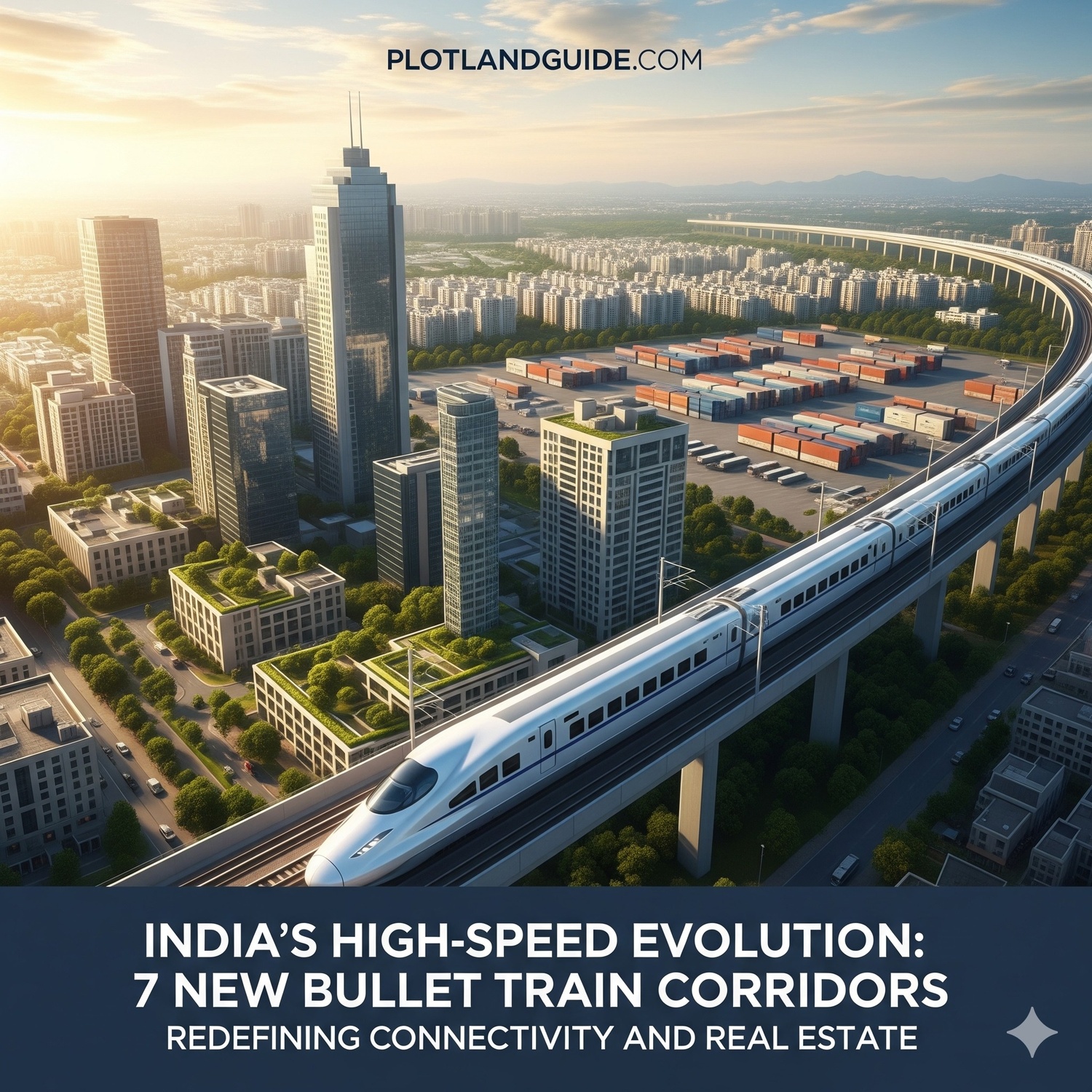
For decades, the Indian railway network has been the lifeline of the nation, moving millions of people and tons of goods daily. However, the narrative is now shifting from mere "movement" to "velocity." In a landmark announcement during the Union Budget 2026-27, the government has laid out a blueprint that promises to fundamentally alter how India travels and trades.
The spotlight is on the approval of seven new High-Speed Rail (HSR) corridors and a massive new Dedicated Freight Corridor (DFC) connecting the East to the West. These projects are not just about cutting travel time; they are envisioned as "Growth Connectors" that will integrate major economic hubs, de-congest existing arterial routes, and catalyze the development of new industrial and residential clusters.
For stakeholders in real estate, logistics, and manufacturing, this is the signal they have been waiting for. The transition from planning to execution is here, and it promises to shrink distances and expand opportunities.
The government’s vision for high-speed rail has expanded significantly beyond the initial Mumbai-Ahmedabad route. The seven newly announced corridors are strategically chosen to link India’s most dynamic commercial and cultural centers.
These corridors are expected to operate at speeds ranging between 250 km/h and 350 km/h, bringing cities closer than ever before.
A major portion of this allocation focuses on Southern India, acknowledging the critical need for rapid connectivity between its growing metros. Five of the seven corridors are concentrated here:
The remaining two corridors focus on connecting the political capital with the cultural heartland and the gateway to the Northeast:
While high-speed passenger trains capture the imagination, the economic backbone of the country relies on how fast goods can move. The Budget 2026 has introduced a game-changing East-West Dedicated Freight Corridor connecting Dankuni (West Bengal) to Surat (Gujarat).
This route is significant for several reasons:
History shows that wherever high-speed infrastructure goes, real estate booms follow. These "Growth Connectors" are expected to unlock the potential of Tier-2 and Tier-3 cities located along these routes.
The announcement is backed by a substantial capital expenditure outlay for the Ministry of Railways, which stands at over ₹2.93 lakh crore for the fiscal year.
While the Mumbai-Ahmedabad High-Speed Rail (MAHSR) project is already in advanced stages of construction—with the first section expected to be operational by 2027—the seven new corridors will now move into the Detailed Project Report (DPR) and land acquisition phases.
The government has entrusted the National High Speed Rail Corporation Limited (NHSRCL) with the execution of these projects. The focus will now shift to surveying, environmental clearances, and finalizing the alignment to ensure minimal disruption and maximum economic impact.
The vision laid out in 2026 is clear: India is building a multimodal transport network that rivals the best in the world. By integrating high-speed passenger travel with a dedicated freight backbone, the government is addressing the twin challenges of urban congestion and logistics inefficiency.
For the common citizen, this means faster, safer, and more comfortable travel. For the economy, it means a more unified market where distance is no longer a barrier to growth. As these corridors transition from blueprints to reality, they will undoubtedly rewrite the economic geography of India.
