Published On:
April 14, 2026
Updated On:
April 14, 2026
Driven by a massive surge in artificial intelligence workloads and cloud infrastructure demand, India's data centre market is projected to more than double, reaching a valuation of $22 billion by 2030. This extraordinary expansion is heavily supported by an influx of foreign institutional investment, a $70 billion development pipeline, and a rapid shift toward hyperscale campuses across both major metropolitan hubs and emerging Tier-II cities.
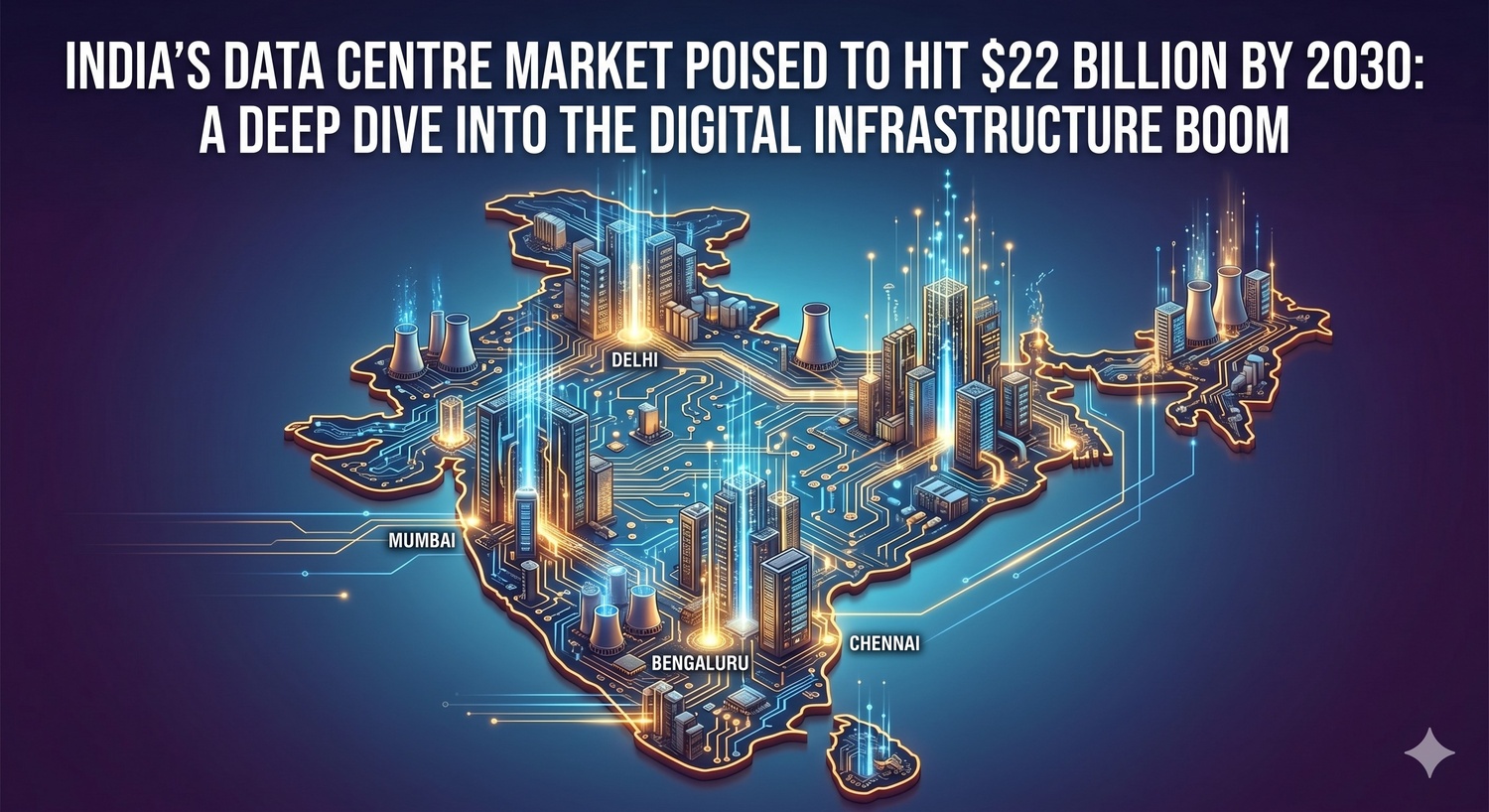
The physical footprint of the internet is expanding at an unprecedented rate, and India is rapidly positioning itself at the absolute center of this global transformation. The infrastructure that powers our digital lives—from streaming platforms and digital payment gateways to complex enterprise cloud architectures and artificial intelligence models—requires massive, highly specialized facilities. Currently valued at approximately $10 billion, the Indian data centre market is on a firm trajectory to more than double its valuation, projected to reach a staggering $22 billion by the year 2030.
This growth is not a slow, steady climb; it is a vertical acceleration driven by absolute necessity. As global data centre capacity pushes toward the 100-gigawatt mark by the end of the decade, India is emerging as a primary destination for large-scale digital infrastructure development. The convergence of a rapidly expanding digital economy, aggressive hyperscale investments, and highly supportive state policies has created an environment where the demand for server space is practically insatiable.
To understand the sheer scale of this market shift, it is necessary to look at the power capacity metrics that define the industry. Data centres are not measured purely by square footage; they are measured by the megawatt (MW) and gigawatt (GW) capacity they can support. Currently, India operates roughly 164 data centres with a total installed IT load capacity sitting between 1.4 and 1.6 GW. To put this in perspective, this is already a massive fourfold increase from the 375 MW capacity the country held just a few years ago in 2020.
However, the current capacity is merely the baseline. There is currently over 700 MW of new capacity actively under construction across the country, with another 1 to 1.2 GW sitting in the advanced planning and approval stages. Industry projections indicate that by the end of 2026, the national installed capacity will reach up to 2.0 GW. Moving further out, the target for 2030 is a massive 4 to 5 GW. Achieving this will require vast tracts of real estate, immense power grid upgrades, and billions of dollars in capital expenditure, signaling a golden era for infrastructure developers and institutional investors.
Building hyperscale data centres is an incredibly capital-intensive endeavor. It requires securing prime real estate with access to redundant, high-capacity power grids and proximity to major fiber optic networks. Recognizing the high-yield potential of these assets, global capital has been flooding into the Indian market. Between 2020 and 2024, the sector attracted between $13 billion and $15 billion in direct investments. Notably, foreign institutional investors accounted for nearly 80 percent of these total capital inflows, demonstrating immense global confidence in India's digital trajectory.
The financial pipeline looking forward is even more robust. Over the next five years, the industry has announced a massive investment pipeline totaling $60 billion to $70 billion. This capital is largely being deployed through joint venture platforms, bringing together the massive balance sheets of global private equity firms with the local execution capabilities of domestic real estate developers. These joint ventures are actively acquiring large land parcels to develop integrated hyperscale campuses that can host the specific needs of major global technology firms.
A major factor accelerating this influx of foreign capital is India’s distinct competitive cost advantage. Developing a high-tier data centre is expensive anywhere in the world, but the capital expenditure required in India is significantly lower than in mature Asia-Pacific markets. The average data centre construction cost in India currently ranges from $6 million to $7 million per megawatt of capacity.
When compared to heavily saturated markets like Singapore or Japan, where land scarcity, stringent zoning laws, and high labor costs push development expenses to a premium, India offers a highly attractive alternative. The ability to acquire large land banks and construct world-class, heavily fortified digital infrastructure at a fraction of the cost makes the country an ideal hub for large-scale deployment. Global operators can achieve a much faster return on investment here while simultaneously tapping into one of the largest consumer internet markets on the planet.
Several parallel technological shifts are acting as the primary catalysts for this infrastructure boom. Foremost among them is the rapid, widespread adoption of Artificial Intelligence. Training and running advanced AI models requires a level of computational power that dwarfs traditional enterprise software. AI workloads demand high-density server racks that consume 10 to 100 times the computing power and electricity of standard applications. To accommodate this, data centres are being completely redesigned with advanced liquid cooling infrastructure and reinforced power grids, driving up the value and scale of new developments.
Simultaneously, the aggressive nationwide rollout of 5G infrastructure has fundamentally altered consumer data consumption. With the implementation of high-speed wireless networks, the average monthly data consumption in India has surged past 25 gigabytes per user. This massive increase in daily data traffic—fueled by high-definition video streaming, online gaming, and digital payment platforms—requires localized data storage to ensure low latency and high performance.
Furthermore, enterprise cloud adoption is accelerating. Traditional corporations, banks, and government agencies are rapidly migrating their legacy IT systems from on-premise server rooms to massive third-party cloud platforms. This migration guarantees operational resilience and scalability, but it relies entirely on the continuous expansion of hyperscale data centre campuses to host those cloud environments.
The landscape of the Indian data centre market is heavily influenced by the presence of global hyperscalers—massive technology companies that operate cloud networks on a global scale. Companies like Amazon Web Services, Microsoft, Google, and Oracle already account for more than half of the country's installed data centre capacity. Their strategy involves either building their own massive, proprietary facilities or leasing massive blocks of space from domestic colocation providers.
Recognizing the strategic importance of this infrastructure, major domestic conglomerates are aggressively entering the fray. Entities like the Adani Group, Reliance Industries, Larsen & Toubro, and the Tata Group are deploying massive capital to build integrated digital ecosystems. They are leveraging their existing expertise in large-scale real estate acquisition, power generation, and project execution to build sprawling tech campuses that can cater directly to the needs of the global hyperscalers. This intense competition between global tech giants and domestic industrial heavyweights is rapidly accelerating the pace of land acquisition and construction across the country.
The rapid expansion of the digital infrastructure sector is not happening in a regulatory vacuum. Recognizing data centres as critical national infrastructure, both the central and state governments have rolled out aggressive policy frameworks designed to eliminate bureaucratic bottlenecks and attract institutional capital.
The implementation of single-window clearance systems has drastically reduced the time required to secure the complex environmental, power, and zoning approvals necessary for large-scale construction. Furthermore, several states are offering highly lucrative financial incentives. These include long-term tax exemptions spanning up to 20 years, significant Goods and Services Tax benefits, and heavily subsidized industrial power tariffs. In some regions, these incentive structures are guaranteed to extend until 2047, providing institutional investors with the long-term regulatory stability required to execute multi-billion-dollar infrastructure bets.
Additionally, ongoing discussions regarding data localization laws—which mandate that certain types of sensitive financial and personal data must be stored physically within the country's borders—are forcing global multinational corporations to secure domestic server space, guaranteeing a captive, high-volume market for facility operators.
While the demand for digital infrastructure is national, the physical locations of these massive facilities are highly concentrated. The real estate dynamics of a data centre require specific environmental and logistical conditions, primarily access to massive, uninterrupted power and proximity to international submarine fiber optic cables.
Because of this, Mumbai remains the undisputed epicenter of India’s data centre market, holding an overwhelming 49 percent share of the nation's operational capacity. Mumbai’s dominance is driven by its status as the financial capital and, critically, its robust network of subsea cable landing stations that connect India to the global internet backbone. Developing infrastructure near these landing stations minimizes data latency, making it highly attractive for financial institutions and cloud providers.
Chennai follows as the second-largest hub, holding an 18 percent market share. Similar to Mumbai, Chennai acts as a vital global data gateway on the eastern coast, boasting multiple submarine cable landings that connect directly to Southeast Asia. The National Capital Region commands an 11 percent share, serving the massive government, defense, and enterprise sectors located in the north. Pune, Bengaluru, and Hyderabad hold 8, 7, and 5 percent shares respectively. These cities leverage their massive, established IT ecosystems, abundant engineering talent pools, and competitive operating costs to attract significant colocation and enterprise data centre investments.
While the primary metropolitan markets will continue to absorb the bulk of hyperscale investments, a significant shift is occurring toward distributed network architectures. Data centre operators are increasingly turning their attention to Tier-II cities to support edge computing and regional digital infrastructure expansion.
Cities such as Ahmedabad, Kochi, Jaipur, and Visakhapatnam are rapidly gaining traction on the national digital map. This decentralization is driven by several practical factors. Land acquisition in primary metros has become exceedingly expensive and highly competitive. Tier-II cities offer massive, unencumbered land parcels at significantly lower price points. Furthermore, state governments in these regions are offering highly aggressive, customized policy incentives to attract tech infrastructure away from the traditional hubs.
From a technical perspective, establishing facilities in these secondary markets reduces latency for the local user base. As digital services, e-commerce, and high-speed streaming penetrate deeper into the country's interior, storing data closer to the end-user becomes critical for performance. The operational capacity across these emerging Tier-II markets is currently estimated between 60 and 80 MW, but with the rapid pace of ongoing construction, it is fully expected to cross the 100 MW threshold by the end of 2026. This secondary market expansion represents the next major frontier for real estate developers specializing in tech infrastructure.
An unavoidable reality of the data centre boom is the massive, concentrated consumption of electricity. As capacity scales from 1.5 GW toward 5 GW, the strain on local municipal power grids becomes a critical logistical challenge. Consequently, the development of modern data centres is becoming deeply intertwined with the renewable energy sector.
Major operators and hyperscalers are committing to aggressive carbon-neutral targets, refusing to rely entirely on traditional, coal-heavy power grids. To secure these massive international tenants, facility developers are increasingly required to secure their own dedicated green energy supply chains. We are seeing a rising trend of data centre operators directly funding the construction of massive solar parks and wind farms in adjacent districts to offset their consumption. This dynamic is creating a parallel boom in commercial real estate dedicated specifically to renewable energy generation, seamlessly linking the tech infrastructure market with the green energy transition.
The trajectory of the Indian data centre market represents one of the most compelling infrastructure growth stories of the current decade. The physical foundations of the digital economy are being poured today, and the scale of the capital being deployed guarantees long-term structural changes to the commercial real estate landscape.
The journey from a $10 billion valuation to a $22 billion market by 2030 is fully supported by the unyielding expansion of cloud computing, the heavy computational demands of artificial intelligence, and the daily digital habits of a massive, increasingly connected population. With nearly $70 billion waiting in the investment pipeline, the industry possesses the financial firepower required to execute its aggressive expansion plans.
As hyperscalers, global private equity firms, and massive domestic conglomerates continue to compete for market share, the demand for prime, power-ready real estate will remain intensely high. The ongoing expansion will not only solidify the dominance of coastal hubs like Mumbai and Chennai but will successfully integrate emerging cities like Jaipur and Kochi into the global digital network. Ultimately, this sustained infrastructure boom ensures that India will not merely participate in the global digital economy, but will operate as a foundational, high-capacity hub for the entire Asia-Pacific region.
