Published On:
April 19, 2026
Updated On:
April 19, 2026
Driven by a volatile mix of tightening labor markets and fluctuating material prices, India's construction costs have surged by up to 14%, forcing the real estate sector to aggressively pivot toward smart building, strategic planning, and alternative land investments to protect margins.
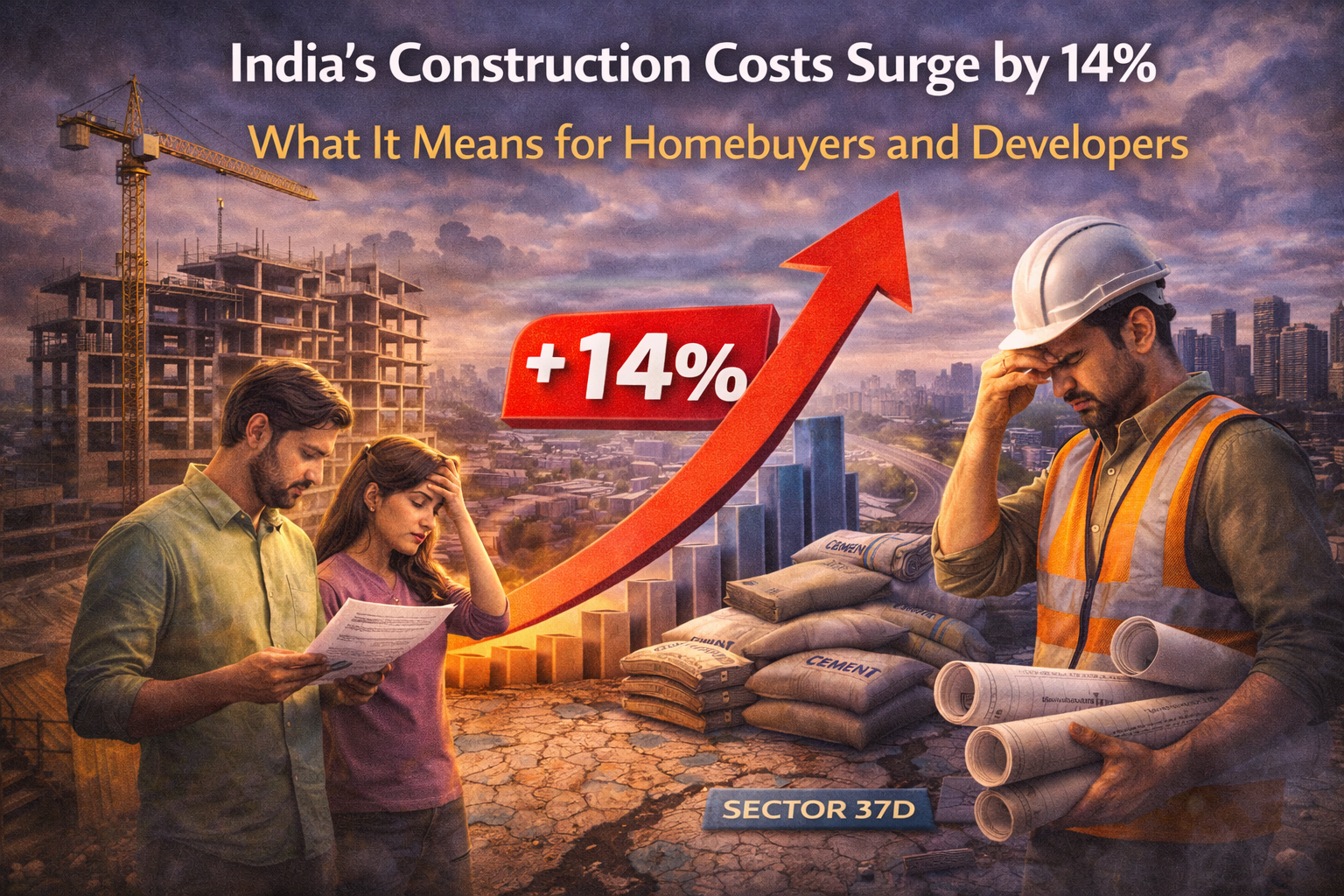
India's real estate and construction sector is experiencing a monumental phase of expansion. Valued at an impressive USD 685 billion in the early months of 2025, the industry is charging forward on a highly aggressive trajectory, firmly projected to hit the phenomenal USD 1.2 trillion mark by 2034. However, beneath this explosive economic growth and the relentless infrastructural push lies a complex, rapidly evolving financial challenge. The baseline cost of bringing these ambitious urban blueprints to physical life is skyrocketing. Recent comprehensive industry data reveals a sharp and decisive surge in construction expenses across the country, with overall development costs escalating by up to 13.9 percent—effectively 14 percent—between 2023 and 2025.
This steep upward curve is fundamentally rewriting the underlying economics of modern urban development. It actively impacts the financial strategies of everyone involved in the ecosystem, from massive institutional developers erecting towering skyscrapers to individual homebuyers saving for their first property. This current economic climate is not merely a temporary inflationary blip that will fade by the next financial quarter; it represents a deep, structural shift in the macroeconomic forces governing global supply chains, human capital availability, and raw commodity pricing. To successfully navigate this new era of real estate, stakeholders must thoroughly understand the root causes of this surge and adapt their long-term investment strategies accordingly.
To accurately comprehend the anatomy of this massive 14 percent construction cost surge, one must first recognize that this inflation is not distributed evenly across the diverse real estate spectrum. Different asset classes are absorbing these financial shockwaves in vastly different ways, dictated entirely by their specific material requirements and labor intensities.
At the absolute top of the cost escalation ladder sits the retail sector and the ultra-luxury residential market. These highly specialized segments are fundamentally characterized by their heavy reliance on high-end imported materials, intricate architectural designs, and premium, custom-built fit-outs. Buyers and tenants in the luxury housing and premium retail markets demand bespoke amenities, imported Italian marbles, advanced smart-home electrical integrations, and premium structural glazing. All of these specialized components are highly susceptible to global supply chain disruptions, international freight rate hikes, and volatile currency exchange fluctuations. Consequently, the financial burden of constructing premium gated communities, high-street retail promenades, and sprawling shopping malls has borne the absolute brunt of the overall market hike, pushing developer margins to their limits.
Conversely, the commercial office space and the hospitality sectors have demonstrated a relatively more insulated, stable financial trajectory. Construction costs for modern Grade-A office parks and commercial hotels experienced a moderate increase, hovering generally around the 6.5 percent to 7.0 percent bracket. While the hospitality sector undeniably still faces immense developmental pressure—with the core cost of creating a premium hotel room now averaging a staggering Rs 1.36 crore per key—these segments benefit massively from highly standardized construction methodologies and massive economies of scale.
Interestingly, the general manufacturing and industrial warehousing sectors remained the most financially stable assets in the entire portfolio. Driven by the massive nationwide push for logistics and supply chain optimization, industrial construction witnessed a very modest 3.8 percent uptick. The inherently utilitarian nature of these massive structures, which prioritize vast, functional floor space over intricate aesthetic details and premium finishes, has successfully shielded them from the extreme price volatilities currently devastating the luxury residential and retail markets.
When analyzing severe construction inflation, the immediate public assumption is almost always that the price of raw materials like steel and cement is the sole culprit. However, the most significant, relentless, and often overlooked driver of the current cost surge is human capital. India is currently navigating a severe and unprecedented tightening of its construction labor market.
Over the past four years, from 2020 leading up to late 2024 and early 2025, the daily wages for both skilled and unskilled construction labor have skyrocketed by an astonishing 23 to 25 percent. This demographic and economic shift is profound. Human labor typically accounts for more than a quarter of the overall financial budget of any major construction project. Therefore, an annual or biennial surge of this magnitude in workforce expenses drastically stretches operational budgets and forces developers to urgently reassess their project viabilities.
Several converging macroeconomic factors are fueling this ongoing labor crisis. The massive, parallel execution of government-backed infrastructure mega-projects—including thousands of kilometers of national expressways, new international airports, and expansive intra-city metro networks—has created an insatiable, localized demand for construction workers. Private real estate developers are now finding themselves in direct financial competition with heavily funded, state-sponsored projects to secure adequate manpower.
Furthermore, as the industry modernizes, there is a rapidly growing demand for highly specialized, skilled labor capable of executing tech-enabled construction techniques, ensuring rigorous international safety standards, and navigating complex regulatory compliances. The historical era of relying entirely on cheap, abundant, and unstructured labor pools is rapidly coming to an end. This irreversible shift is forcing development firms to fundamentally rethink their human resource allocations, heavily prioritizing worker retention, structured training programs, and improved onsite living conditions to secure reliable workforces.
While escalating labor costs have provided a steady, relentless upward pressure on project budgets, the pricing of essential construction materials has resembled a highly volatile financial rollercoaster. The cost metrics for the fundamental building blocks of real estate—including cement, structural steel, aluminum, industrial copper, river sand, and engineered glass—have painted a highly complex, often contradictory picture over the recent two-year period.
Surprisingly, the foundational heavy materials have not been the primary drivers of the recent massive hike. Average cement prices have occasionally seen steep, sudden declines due to localized market oversupply and intense corporate competition, while primary steel prices have witnessed prolonged periods of marginal stabilization or even slight deflation over a twelve-month window. However, these temporary financial reliefs are heavily offset and quickly erased by the aggressive price appreciation in secondary, yet absolutely vital, finishing materials. The procurement costs of high-grade copper wiring, structural aluminum framing, premium imported wood, engineered architectural glass, and even basic natural aggregates like sand and clay bricks have seen moderate to highly significant increases.
Furthermore, the real estate supply chain is deeply, inextricably intertwined with global energy markets. The erratic fluctuations in international crude oil prices have a direct, cascading effect on the entire construction industry. Crude oil dictates the baseline cost of highway logistics, the daily operation of heavy earth-moving machinery, and the complex manufacturing of essential petroleum-based building materials such as advanced waterproofing compounds, specialized industrial paints, and synthetic polymers. Even minor geopolitical tensions that trigger a spike in fuel prices immediately translate into higher interstate freight charges, instantly eroding the carefully planned profit margins of developers who rely heavily on the long-distance transport of heavy building materials.
Faced with this unforgiving and highly complex economic landscape, the Indian real estate industry is refusing to passively absorb these massive financial hits. Instead, leading developers and institutional investors are orchestrating a massive, sector-wide strategic pivot. The overarching philosophy governing the next decade of urban expansion is a definitive transition from sheer volume-based, rapid construction to highly optimized, technologically advanced smart building.
To successfully navigate the 14 percent cost surge without passing the entire financial burden onto the end consumer, corporate developers are aggressively restructuring their procurement strategies. We are witnessing a decisive industry move away from fragmented, localized, project-by-project buying toward centralized, bulk procurement of raw materials. Developers are actively diversifying their vendor bases, heavily exploring localized sourcing to drastically cut down on expensive logistical freight costs, and securing massive, long-term price-lock contracts for essential commodities like steel and cement to actively insulate themselves from sudden, unpredictable market shocks.
Moreover, technology is rapidly taking center stage on the physical construction site. To actively combat the severe, ongoing inflation in labor costs, leading real estate firms are injecting heavy capital into automation and advanced construction methodologies. The widespread adoption of pre-cast concrete technology, modular off-site construction, and Building Information Modeling is accelerating at an unprecedented rate across the country. These highly sophisticated, tech-driven approaches significantly reduce the heavy dependency on manual human labor, minimize expensive material wastage, and drastically accelerate overall project delivery timelines.
In a high-interest-rate environment where construction time is literally equated to money, early-stage architectural planning and rigorous design optimization have emerged as the ultimate financial levers. By identifying structural efficiencies and rectifying potential engineering clashes digitally before a single physical trench is dug, developers are successfully protecting their profit margins while still delivering the high-quality, sustainable, future-ready assets demanded by modern corporate occupiers and discerning luxury investors.
Every massive, structural shift in economic fundamentals naturally creates a parallel, equally massive shift in investor psychology and behavior. As the core cost of vertical, high-rise construction spirals relentlessly upward due to this combined labor and material inflation, smart capital is rapidly pivoting, actively identifying alternative, highly lucrative avenues for long-term wealth creation. One of the most profound, unintended consequences of the 14 percent construction cost surge is the massive resurgence in the market popularity of raw land and plotted residential developments.
The fundamental, unbreakable laws of real estate economics dictate that land inherently appreciates, while physically constructed structures—especially those burdened by artificially high, inflation-driven creation costs—inevitably depreciate over the long term. For the highly strategic investor, pouring massive capital into a luxury high-rise apartment where the base purchase price is heavily inflated by the current 14 percent construction premium represents a significant, highly avoidable financial risk. If global material costs eventually normalize and labor markets stabilize, the massive premium paid upfront for that specific vertical construction essentially evaporates.
Consequently, affluent buyers and massive institutional investors are aggressively pivoting their portfolios toward horizontal expansion. Acquiring independent plots in high-growth peripheral corridors, particularly in emerging Tier-2 and Tier-3 cities that are heavily backed by massive government infrastructure expansion, has become the ultimate strategic hedge against construction inflation.
By aggressively securing the raw land today, these investors effectively decouple their capital from the immediate, chaotic volatility of the steel, cement, and labor markets. They gain absolute, unencumbered ownership of a finite, completely indestructible asset that appreciates purely based on regional infrastructure growth and increasing urban density. The resulting financial flexibility is unparalleled in the current market: an investor can secure the premium plot now at a highly competitive land rate, and strategically defer the actual physical construction of the structure to a future date when material and labor costs potentially cool down. This calculated, highly strategic maneuver is rapidly transforming the outskirts of major metropolitan areas into highly lucrative, heavily sought-after plotted real estate goldmines.
The unprecedented surge of up to 14 percent in India's construction costs over the past two years serves as a powerful, unavoidable catalyst for the ultimate maturation of the domestic real estate sector. The historical days of relying heavily on endless pools of cheap labor and easily predictable, stable material pricing are permanently behind the industry. As the national construction market marches confidently toward its staggering USD 1.2 trillion valuation target by the year 2034, financial resilience and rapid technological adaptability will serve as the ultimate, unforgiving differentiators between monumental success and corporate failure.
Development firms that stubbornly cling to outdated, highly inefficient construction models will undoubtedly find their profit margins severely, perhaps fatally, compressed. However, those forward-thinking entities that actively embrace this new economic paradigm—prioritizing tech-enabled smart building, sustainable and green architectural practices, rigorous financial discipline, and highly diversified asset classes like plotted developments—will thrive spectacularly.
The current environment of severe cost escalation should not be viewed merely as an economic roadblock; it is a vital, necessary stress test for the entire ecosystem. It is forcefully pushing the Indian real estate market to evolve from a purely volume-driven, highly fragmented enterprise into a highly sophisticated, financially disciplined, and technologically advanced global economic engine. By successfully navigating these turbulent financial waters through strategic planning and innovation, the industry is laying a completely modernized, highly robust foundation capable of delivering world-class urban infrastructure for generations to come.
