Published On:
March 23, 2026
Updated On:
March 23, 2026
India's commercial real estate is on the brink of a historic 1 billion square foot milestone in 2026, fueled by a massive surge in Global Capability Centres and a structural shift towards state-of-the-art integrated tech parks. This evolution highlights a soaring demand for sustainable, AI-ready, and wellness-centric workspaces across the country's top-tier cities.
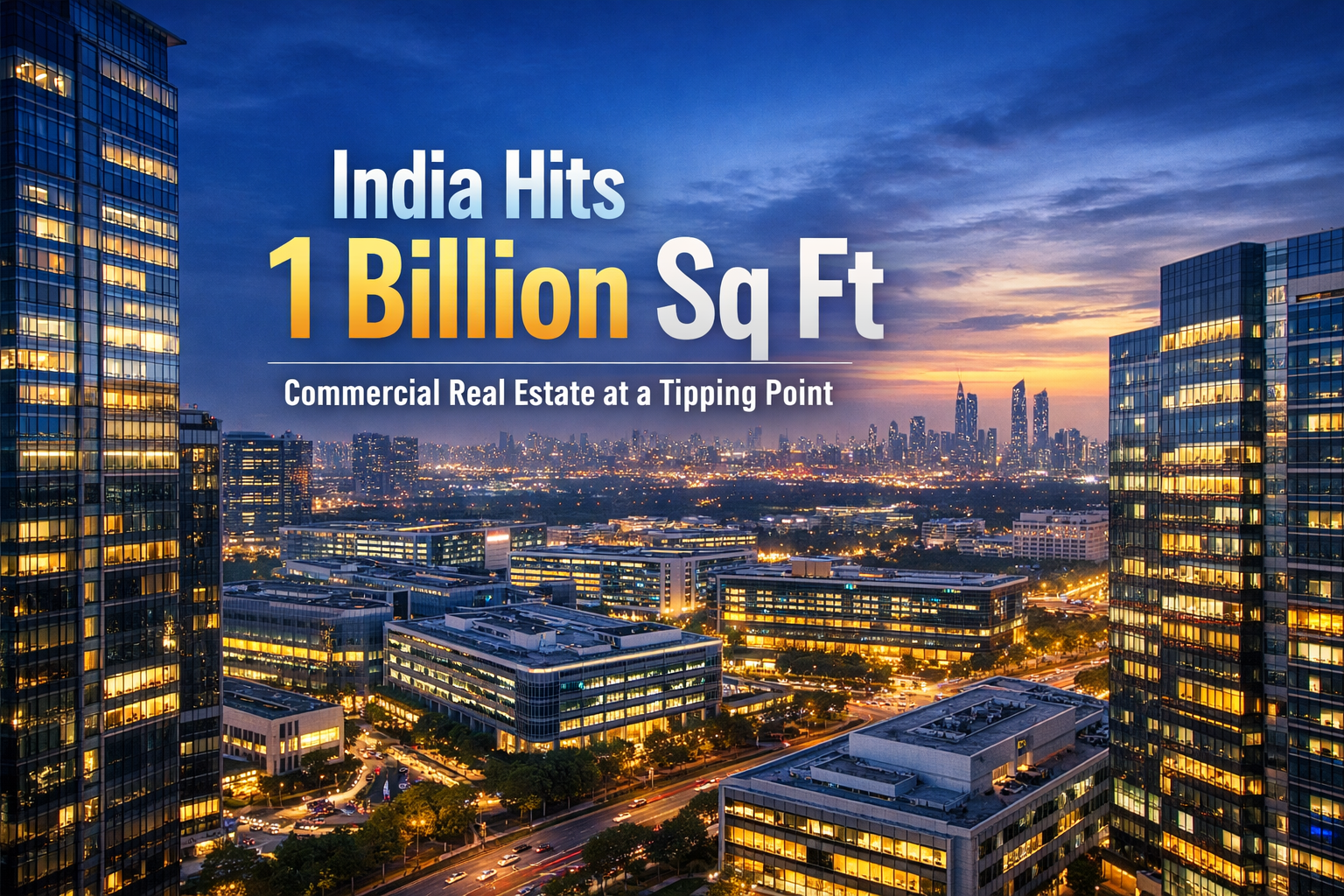
The skyline of corporate India is undergoing a profound transformation. For decades, the growth of commercial real estate in the country was a steady, predictable march. Today, however, that steady march has accelerated into an unprecedented sprint. The narrative of India's office market is no longer just about meeting basic infrastructural needs; it is about setting global benchmarks, fostering cutting-edge innovation, and creating environments that attract the world's top talent.
As we progress through 2026, the country's commercial real estate sector is approaching a truly historic landmark. Projections and recent market outlook reports indicate that India's total office stock is set to surpass the monumental 1 billion square foot milestone this year. This is not merely a quantitative achievement; it represents a fundamental, qualitative shift in how business is conducted, how workspaces are designed, and how global enterprises view the Indian market.
Following a record-breaking performance in 2025, the momentum is undeniable. Last year witnessed annual gross absorption hitting an all-time high of 83.1 million square feet, marking the third consecutive year of robust, uninterrupted growth. Concurrently, new supply peaked at an impressive 58.9 million square feet. To understand the sheer scale and significance of this 1 billion square foot milestone, we must dive deep into the underlying structural evolutions, the changing demands of multinational occupiers, and the relentless rise of integrated tech parks.
Crossing the 1 billion square foot mark is a watershed moment that places India squarely among the most elite commercial real estate markets on the planet. To visualize this scale, one must imagine sprawling business districts, towering skyscrapers, and sprawling technological campuses stretching across the nation's major metropolitan areas.
This milestone is a testament to the immense economic confidence that both domestic and international enterprises have in India's long-term growth story. It reflects a maturing economy that has successfully transitioned from being a cost-arbitrage destination to a premier hub for high-value innovation and strategic operations. Reaching this massive inventory level means that the market now possesses the depth, liquidity, and diversity of assets required to absorb massive corporate expansions without facing immediate supply-side shocks.
Furthermore, this scale brings with it an ecosystem of ancillary industries. A billion square feet of office space requires continuous facility management, advanced security systems, cutting-edge interior design, and sophisticated architectural planning. The ripple effect of this milestone extends far beyond the developers and landlords, creating millions of jobs and driving infrastructural upgrades in surrounding urban and suburban zones.
Perhaps the most fascinating aspect of this unprecedented growth is not just how much space is being built, but what kind of space is dominating the supply chain. The Indian commercial real estate market is currently experiencing a massive structural evolution, characterized by a decisive and permanent shift toward integrated technology parks.
Gone are the days when a standalone glass building with basic amenities was enough to satisfy a corporate tenant. Between 65% and 68% of the projected office supply for the 2026-27 period is expected to be delivered within well-amenitized, investment-grade integrated tech parks. This is a significant leap from previous years, where such developments accounted for approximately 54% of the supply.
This surge reflects a deliberate convergence between the strategic visions of major real estate developers and the rapidly evolving needs of institutional occupiers. Today’s integrated tech parks are essentially micro-cities. They are designed to offer a holistic "work-live-play" environment. These expansive developments feature world-class fitness centers, diverse culinary options, expansive green spaces, childcare facilities, and sometimes even residential and retail components seamlessly woven into the master plan.
For modern enterprises, the quality of the real estate ecosystem they operate in has become a direct input into their ability to attract and retain specialized, highly skilled talent. In a fiercely competitive job market, the workplace itself is a critical recruitment tool. Developers are recognizing this reality and are building ecosystems at a scale that can support the complex, dynamic lifestyles of the modern workforce.
To understand why there is such a ravenous appetite for premium office space in India, one must look closely at the role of Global Capability Centres. GCCs remain the undisputed primary engine driving this demand, accounting for a staggering 39% of total office absorption in the record-breaking year of 2025.
Historically, multinational corporations set up captive centers in India primarily to handle back-office operations, IT support, and routine business processes. However, the mandate of the Indian GCC has fundamentally transformed. These centers are increasingly moving far beyond basic support functions to focus on high-complexity Research and Development (R&D), advanced engineering, and global product ownership.
The data highlights this dramatic shift perfectly. R&D-focused GCCs have been growing at a rate 1.3 times faster than the broader commercial market since 2020. Indian talent is no longer just maintaining software; they are designing the core architecture of global products, leading artificial intelligence initiatives, and driving critical business strategies for Fortune 500 companies.
Because the work has become highly specialized, the physical spaces required to execute this work must also evolve. These advanced GCCs require sophisticated lab spaces, highly secure data environments, and collaborative hubs designed for creative problem-solving. Industry analysis indicates that this momentum is practically hardwired into the market's future, with roughly 65% of current GCC occupiers expecting to expand their real estate portfolios by 10% or more by the end of 2027. This built-in pipeline of demand ensures that the development of integrated tech parks will remain highly lucrative.
While the 1 billion square foot milestone is a national achievement, the growth is heavily concentrated in a few economic powerhouses. Bengaluru, Mumbai, Delhi-NCR, and Hyderabad continue to be the undisputed heavyweights of India's office market, collectively accounting for an overwhelming three-quarters of all leasing activity and new supply peaks.
Bengaluru remains the undisputed tech capital, consistently absorbing massive volumes of space as software giants, tech startups, and GCCs continue to flock to its talent-rich ecosystem. The city's ability to constantly reinvent its micro-markets ensures that it always has premium supply ready for incoming demand.
Mumbai, India's financial nerve center, continues to see robust demand not just from banking and financial services, but increasingly from consulting firms and premium tech enterprises looking for a prestigious address. The city's newer commercial hubs, like the Bandra Kurla Complex and emerging peripheral nodes, are driving significant Grade-A+ supply.
The Delhi-NCR region, encompassing Gurugram and Noida, benefits from incredible infrastructure growth, expansive land availability, and excellent connectivity. This region has become a massive magnet for IT/ITeS companies, consumer tech brands, and manufacturing corporate headquarters.
Hyderabad has emerged as a formidable challenger, often matching or occasionally surpassing traditional hubs in terms of sheer absorption rates. Driven by highly proactive, pro-business government policies, world-class urban infrastructure, and relatively competitive rental rates, Hyderabad has become the destination of choice for massive global tech campuses and life sciences research centers.
As the sheer volume of real estate expands, the industry's approach to the environment has undergone a radical, necessary overhaul. Sustainability is no longer a niche preference or a marketing gimmick; it has become a strict, non-negotiable standard for the commercial real estate industry.
The statistics from the recent peak year are incredibly telling: green-certified assets represented a massive 87% of all commercial completions. This means that nearly nine out of every ten new buildings entering the market are designed to meet rigorous environmental standards regarding energy efficiency, water conservation, and carbon footprint reduction.
This shift is largely driven by the occupier side of the equation. Multinational corporations and GCCs are bound by strict global Environmental, Social, and Governance (ESG) mandates. When these companies look to lease millions of square feet, they absolutely require buildings that align with their corporate net-zero targets. They demand structures with advanced HVAC systems, intelligent lighting that adjusts to natural daylight, rainwater harvesting capabilities, and construction materials that minimize environmental impact.
Developers who fail to secure high-tier green certifications, such as LEED or IGBC ratings, are finding it increasingly difficult to attract premium tenants, regardless of how good their location might be. In the modern era of India's office market, a building that is not green is quickly rendered obsolete.
Looking ahead, the physical brick-and-mortar aspect of real estate is only half the story. The market is witnessing a distinct shift toward Grade-A+ offerings that prioritize technology-enabled, wellness-centric environments. Location, while still crucial, is no longer the sole determining factor for premium valuations.
The modern occupier is intensely focused on how a building functions digitally. As enterprises scale up functions heavily reliant on Artificial Intelligence, such as complex data engineering, automated financial modeling, and algorithmic development, the demand is shifting toward high-quality, tech-enabled office environments. These advanced workflows require incredibly robust, uninterrupted power grids, massive bandwidth capabilities, and state-of-the-art server integrations. It is becoming increasingly evident to market observers that digital infrastructure is now considered just as critical as the physical foundations of a building.
Parallel to this technological arms race is a renewed, intense focus on human-centric design and employee wellness. The post-pandemic workforce has fundamentally different expectations of the office. Companies realize that to convince top-tier talent to commute, the office must offer an experience that cannot be replicated at home.
This means buildings must successfully integrate smart technology—like touchless entry systems, app-based temperature controls, and real-time indoor air quality monitoring—with elements of physical and mental wellness. Natural light optimization, biophilic design featuring extensive indoor greenery, ergonomic workspaces, and dedicated quiet zones for focused work are now standard requirements in high-end lease negotiations. Buildings that can seamlessly marry highly advanced digital infrastructure with a soothing, wellness-oriented human experience are the ones that will define the next massive wave of demand.
As India prepares to officially cross the 1 billion square foot threshold in its commercial office sector, the market stands at a fascinating juncture. The extraordinary leasing volumes and supply completions we are witnessing are not anomalies; they are the natural result of years of strategic ecosystem building, policy refinements, and a deep, structural shift in the global talent pipeline.
The dominance of integrated tech parks proves that the future of work in India is highly experiential, deeply sustainable, and technologically uncompromised. As Global Capability Centres continue to deepen their roots and expand their highly specialized operations, the pressure on developers to deliver world-class, Grade-A+ assets will only intensify.
The journey to 1 billion square feet has been defined by resilience, rapid adaptation, and an unwavering commitment to quality. As we look past 2026, the focus will undoubtedly shift from simply accumulating space to maximizing the intelligence, sustainability, and human-centric value of every single square foot delivered. The Indian commercial real estate market has officially arrived on the global center stage, and the foundation it has built is stronger than ever.
