Published On:
September 27, 2026
Updated On:
September 27, 2026
India’s commercial real estate is undergoing a massive structural transformation, recording an unprecedented office absorption of 45.5 million square feet in the first half of 2026 as Global Capability Centres, sprawling data centres, and direct-to-consumer retail spaces fuel a powerful new growth cycle.
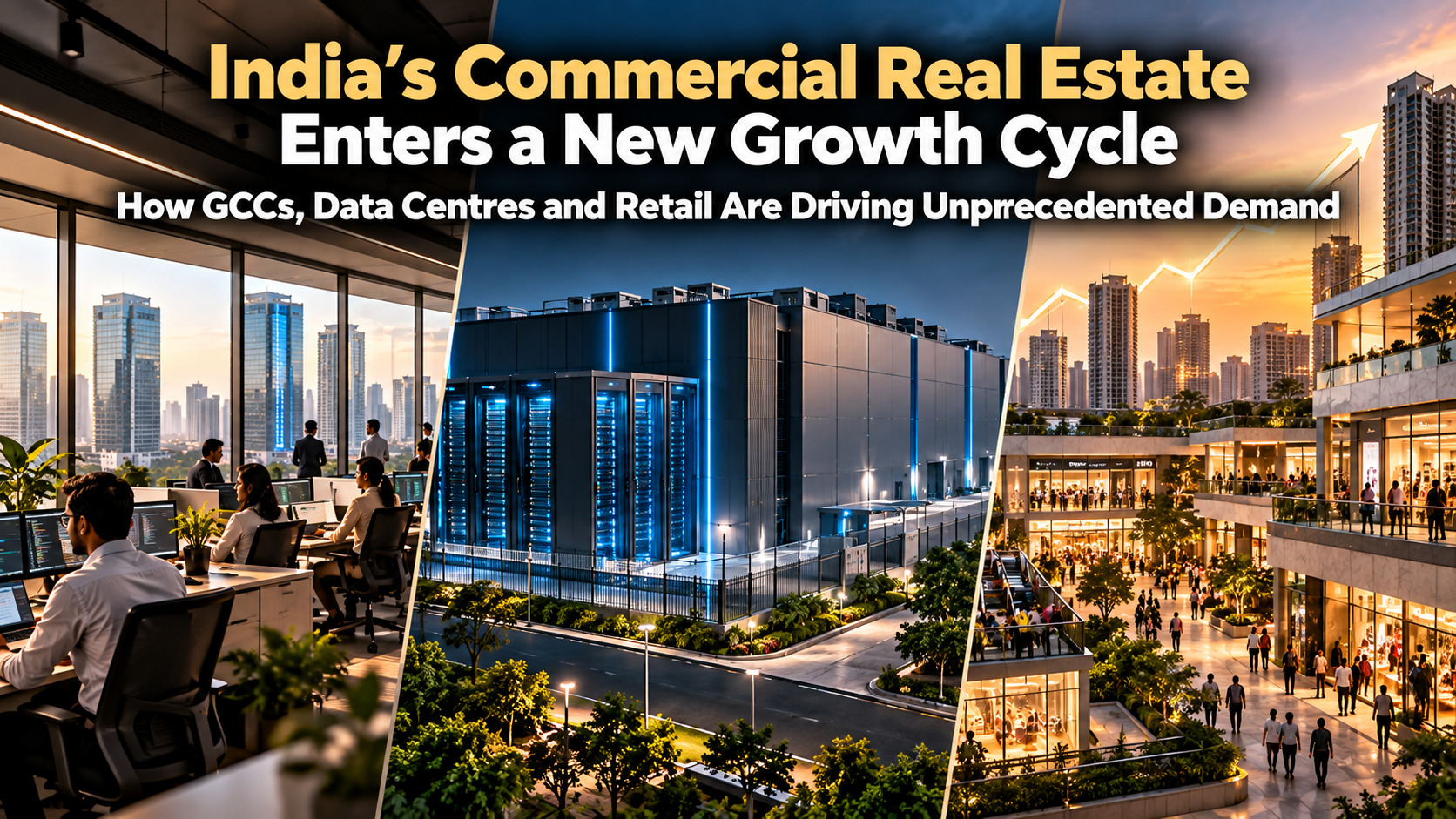
The Indian commercial real estate sector is officially shedding its traditional boundaries and entering an entirely new phase of exponential expansion. For years, the industry was largely defined by standard corporate office leases and conventional shopping malls. Today, the landscape is undergoing a structural transformation. The market has matured into a highly specialized ecosystem, driven by the specific spatial requirements of the modern digital economy. The first half of 2026 has set a new historical benchmark, proving that the demand for commercial space in India is not merely recovering from past economic cycles but is actively breaking new ground.
The sheer volume of space being absorbed across the country paints a picture of aggressive corporate expansion. The demand is no longer confined to traditional business districts but is rapidly spreading across emerging corridors, fueled by three distinct pillars: the relentless rise of Global Capability Centres, the massive infrastructure required for data centres, and a renaissance in experiential retail. As developers pivot to meet these highly specific demands, the definition of what constitutes a premium commercial property is being completely rewritten.
To understand the magnitude of this new growth cycle, one simply needs to look at the absorption metrics from the first half of 2026. The commercial office market recorded an astonishing 45.5 million square feet of gross absorption. This represents the highest leasing volume ever recorded for any half-year period in the history of Indian real estate. The momentum was particularly intense in the second quarter, which alone accounted for 24.6 million square feet of space taken up by corporate occupiers.
This insatiable appetite for physical workspaces firmly puts to rest any lingering doubts about the future of the office. Companies have finalized their long-term hybrid working models, and the consensus is clear: physical collaboration spaces are non-negotiable for fostering company culture and driving innovation.
To match this extraordinary demand, developers have aggressively ramped up their construction pipelines. New supply completions also reached a record high of 32 million square feet in the first six months of the year. This delicate balance of record-breaking absorption and matched supply highlights the sheer scale at which the Indian commercial real estate machinery is now operating. Developers are no longer taking blind risks; they are delivering highly customized, future-ready buildings that cater to the exacting standards of global tenants.
If there is a single engine driving this commercial real estate boom, it is the Global Capability Centre. Historically, multinational corporations viewed India primarily as a destination for cost-arbitrage, setting up basic business process outsourcing units in standard office buildings. That era is completely over. Today, GCCs are the innovation hubs, engineering backbones, and research and development nerve centres for some of the world's largest companies.
Because these centres are now responsible for core intellectual property development, they require top-tier talent. To attract and retain the best software engineers, data scientists, and product managers in India, multinational corporations are demanding world-class real estate. They require state-of-the-art campuses featuring collaboration zones, wellness facilities, premium food and beverage options, and strict environmental, social, and governance compliance.
The numbers reflect this dramatic shift in the tenant profile. In the first half of 2026, Global Capability Centres accounted for a staggering 46 percent of all Grade A office leasing across the country, absorbing roughly 16.6 million square feet of premium space. In the National Capital Region alone, GCC leasing stood at nearly 0.9 million square feet in just the first quarter. These organizations are taking up large-format spaces, often signing massive multi-floor or entire-building leases that provide long-term stability to developers and real estate investment trusts. As India solidifies its position as the global capital for GCCs, this specific tenant category will continue to dictate the architectural and operational standards of commercial real estate.
While gleaming office towers dominate the skyline, a quieter but equally massive real estate revolution is happening on the ground: the exponential expansion of data centres. The digital economy—powered by cloud computing, artificial intelligence, e-commerce, and widespread internet penetration—requires immense physical infrastructure. Data centres are the factories of the twenty-first century, and their real estate requirements are fundamentally changing regional development strategies.
Unlike traditional office spaces, data centres require massive land parcels, specialized structural engineering to support heavy server racks, uninterrupted high-voltage power supplies, and massive cooling infrastructure. Because of these unique requirements, data centre development is pushing the boundaries of commercial real estate outward into emerging corridors that offer space at scale.
The National Capital Region provides a perfect case study for this phenomenon. The Noida, Greater Noida, and Yamuna Expressway regions are rapidly transforming into India’s premier digital hubs. Technology giants and leading global data centre operators are investing billions into these corridors. This expansion is not just a single-location story; it is a wider regional strategy.
The presence of these massive data parks has a profound ripple effect on the surrounding real estate. The digital infrastructure acts as a powerful magnet, attracting allied technology firms, managed service providers, and cybersecurity companies to the immediate vicinity. This, in turn, supports the emergence of fully integrated business districts, providing a massive boost to the development of surrounding retail spaces, commercial complexes, and luxury residential projects. Real estate is increasingly following the infrastructure that enables the digital economy, and the land parcels along major expressways are becoming some of the most valuable commercial assets in the country.
Parallel to the workspace revolution, the retail real estate sector is experiencing its own aggressive growth cycle. The core philosophy of retail real estate is changing; it is increasingly following where people work, live, and spend their leisure time. This behavioral shift is making well-planned high streets and mixed-use commercial developments just as important, if not more so, than traditional enclosed shopping malls.
During the first half of 2026, retail leasing across the country reached an impressive 3.9 million square feet, marking a robust 20 percent increase year-on-year. The National Capital Region emerged as one of the most dominant retail markets in this period. While fashion and apparel brands naturally drove a significant portion of this activity—accounting for around 40 percent of the total leasing—the most disruptive trend has been the aggressive physical expansion of Direct-to-Consumer brands.
For years, D2C companies operated strictly in the digital realm, acquiring customers through social media and fulfilling orders via localized warehouses. However, customer acquisition costs online have skyrocketed, and brands have realized that long-term brand loyalty requires physical interaction. Today, D2C companies are utilizing physical retail stores as a core component of their expansion strategy rather than treating them as a separate, experimental channel.
These digitally native brands accounted for approximately 28 percent of all retail leasing in the first half of the year. Their entry into the physical market has provided high streets and organized retail destinations with a powerful new source of occupier demand. These brands typically seek highly visible, experiential spaces where customers can touch and feel the products before completing the transaction, either in-store or online. This omnichannel approach is keeping the demand for premium retail spaces incredibly high, forcing developers to rethink store layouts and customer flow within their commercial projects.
Perhaps the strongest indicator of the depth and sustainability of this current commercial real estate cycle is the unprecedented flow of institutional capital. Global private equity funds, sovereign wealth funds, and domestic institutional investors do not deploy capital based on short-term trends; they look for structural, long-term returns.
In the first half of 2026, institutional real estate investment in India reached an impressive 4.5 billion dollars, representing a massive 50 percent increase compared to the same period in the previous year. Crucially, office assets accounted for more than 40 percent of these total capital inflows.
This liquidity injection is vital for the health of the sector. It ensures that established developers have the financial backing required to acquire large land parcels, construct massive integrated business districts, and fund the capital-intensive infrastructure required for data centres and high-end retail spaces. The willingness of global institutions to heavily back Indian commercial assets underscores a deep confidence in the macroeconomic stability of the country and the specific growth trajectories of the GCC and digital infrastructure sectors.
The broader national trends are highly visible when examining the specific micro-markets of the National Capital Region. The NCR landscape perfectly illustrates how commercial real estate is adapting to the new demands of corporate occupiers. In the first quarter of 2026 alone, Delhi-NCR recorded 2.8 million square feet of gross office leasing.
The distribution of this leasing activity highlights the importance of established infrastructure. Gurugram, with its mature corporate ecosystem and established rapid transit links, accounted for a massive 60 percent of this leasing volume. Noida followed closely, capturing 37 percent of the market share.
Specific micro-markets are emerging as absolute favorites among corporate tenants. The Noida Expressway corridor was the largest single micro-market for leasing activity, driven by its excellent road connectivity, proximity to upcoming aviation infrastructure, and the availability of large, contiguous floor plates that GCCs demand. Similarly, established areas like Udyog Vihar and the NH-8 Prime corridor in Gurugram recorded significant leasing activity.
Occupiers have become highly selective. A commercial location must offer more than just a physical building to succeed over the long term. Demand is strictly driven by accessibility, the quality of internal and external infrastructure, the standard of surrounding residential and civic developments, and seamless connectivity to major transit hubs. As emerging corridors across the NCR and other major metropolitan areas continue to improve their infrastructure, they become highly attractive to businesses seeking efficient, future-ready environments.
The Indian commercial real estate market of 2026 is virtually unrecognizable from the market of a decade ago. It has evolved from a fragmented sector reliant on basic outsourcing and unorganized retail into a sophisticated, highly institutionalized ecosystem.
The record-breaking absorption of 45.5 million square feet of office space is not an anomaly; it is the new baseline. As multinational corporations continue to scale their Global Capability Centres to leverage Indian engineering talent, and as the digital economy demands millions of square feet of data centre infrastructure, the foundational demand for commercial space will remain incredibly strong.
Coupled with the aggressive physical expansion of digitally native retail brands and the unwavering support of global institutional capital, the sector is insulated against short-term economic volatility. Developers who understand these shifting dynamics and focus on building integrated, infrastructure-rich, and future-ready commercial environments will lead the market. India’s commercial real estate has firmly entered a new era of growth, driven by specialized demand, technological integration, and a clear vision for the future of work and commerce.
