Published On:
February 3, 2026
Updated On:
February 3, 2026
Noida International Airport in Jewar is set to transform India’s aviation landscape as the country’s largest airport, integrating world-class infrastructure with net-zero sustainability. This comprehensive guide explores its massive scale, multi-modal connectivity, and the economic boom it is triggering across the National Capital Region.
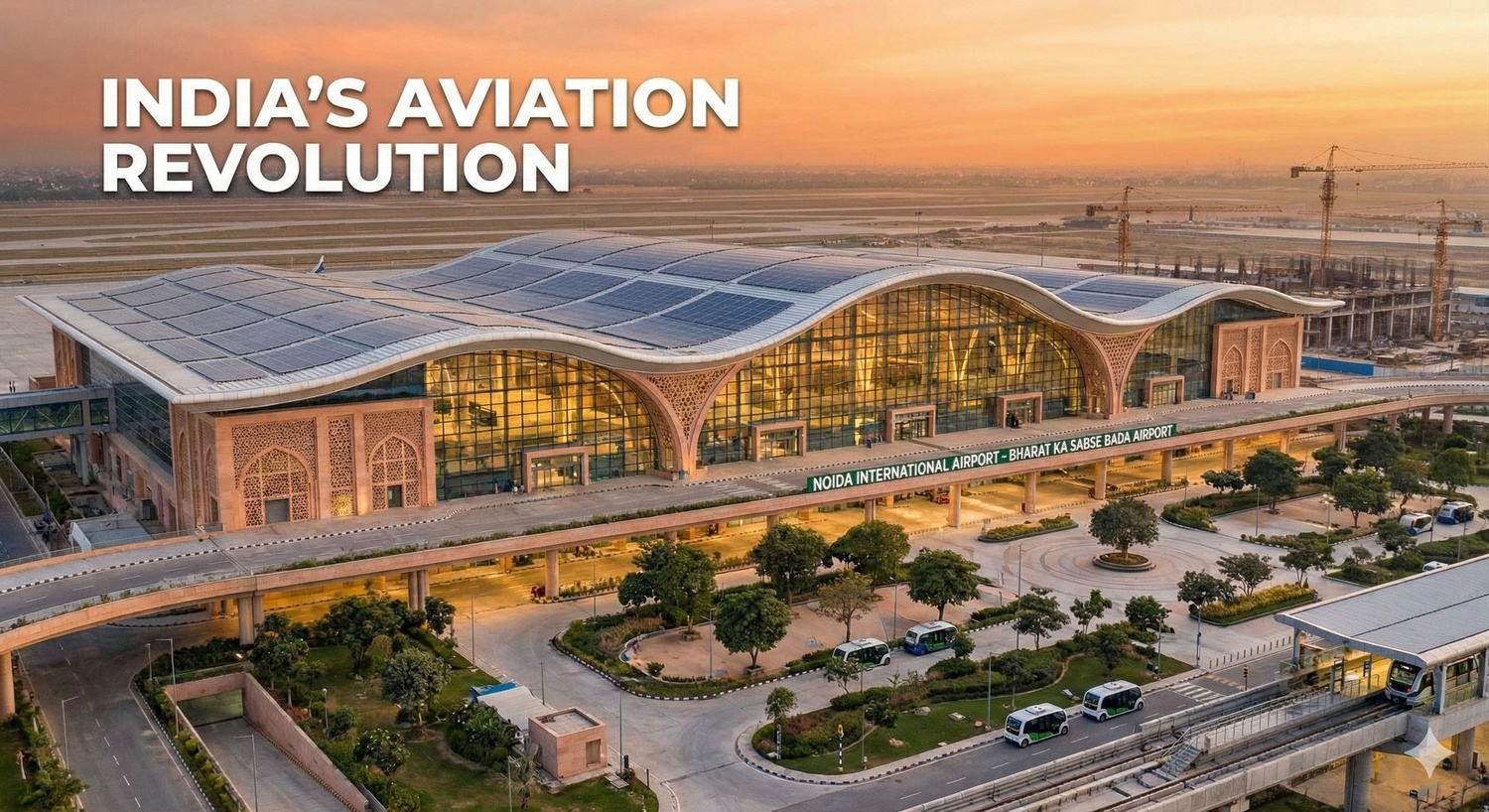
The landscape of Indian aviation is standing on the precipice of a monumental shift. In the sprawling plains of the Gautam Buddha Nagar district, a colossus is rising that promises to redefine how the country travels, trades, and connects with the world. This is the story of the Noida International Airport, often referred to as Jewar Airport, a project so vast in its ambition that it is poised to become "Bharat ka sabse bada airport"—India's largest airport.
For decades, the Indira Gandhi International Airport in New Delhi has shouldered the burden of the region’s skyrocketing air traffic. However, as the National Capital Region (NCR) continues to expand its economic footprint, the need for a second, more advanced aviation hub became undeniable. The response to this need is not just another airfield but a futuristic aero-city designed to serve millions, power industries, and anchor the economic destiny of Uttar Pradesh.
This blog delves deep into every facet of this mega-project, from its staggering master plan and Swiss-engineered efficiency to the ripple effects it is already creating in real estate and industry.
To truly appreciate the magnitude of the Noida International Airport, one must look beyond the immediate construction fences. The project is being developed in four distinct phases, a strategic rollout designed to match capacity with the growing demand of India’s aviation sector.
Phase 1: The BeginningThe initial phase, which is currently nearing completion, is designed to hit the ground running. It features a single runway and a terminal building capable of handling 12 million passengers annually. While this number is impressive on its own, it is merely the starting line. The infrastructure in this phase includes state-of-the-art air traffic control systems, cargo terminals, and the essential groundwork that allows for seamless expansion. The focus here is on executing a launch that blends operational efficiency with passenger comfort, setting a high standard for what is to come.
The Ultimate BlueprintThe long-term vision extends all the way to 2050. By the time the final phase is operational, the airport is projected to feature multiple runways—plans suggest up to six, making it a rarity in global aviation. The passenger capacity is expected to swell to a staggering 70 million to 120 million per year. This scale effectively positions it to surpass existing Indian hubs and compete with the largest airports in Asia and the world. The master plan envisions a facility where domestic and international traffic flows seamlessly, supported by a dual-airport system in the NCR that eliminates congestion and enhances reliability.
An airport, no matter how grand, is only as good as the roads and rails that lead to it. One of the most critical criticisms of historical infrastructure projects in India has been poor last-mile connectivity. The planners of the Noida International Airport have addressed this with a multi-modal transport hub that promises to be a game-changer for the region.
Perhaps the most transformative element of the connectivity plan is the integration of the Regional Rapid Transit System (RRTS). The Ghaziabad-Jewar corridor is designed to shrink distances, allowing passengers to travel from the heart of the NCR to the airport at high speeds. Unlike traditional metro systems, the RRTS is built for longer distances and higher velocities, ensuring that a traveler from Ghaziabad or Greater Noida West can reach the terminal with predictable travel times. This rail link will essentially unify the catchment areas of the two major airports in the region, allowing for easy transfers and reducing the reliance on private vehicles.
The airport is strategically sited just hundreds of meters from the Yamuna Expressway, a high-speed corridor that already serves as a lifeline for Western Uttar Pradesh. A dedicated interchange is being constructed to ensure that traffic flowing to and from the airport does not bottleneck the main highway. Furthermore, connectivity to the Eastern Peripheral Expressway allows cargo and passengers from Haryana and other neighboring states to access the airport without entering the congested chaos of Delhi. This road network is crucial for the logistics sector, ensuring that trucks can move goods in and out of the cargo terminals swiftly.
Innovation is also evident in the proposed local transit solutions. Plans for a personal rapid transit system, commonly known as Pod Taxis, are in motion to connect the airport with the upcoming Film City and other key commercial hubs in the vicinity. This futuristic mode of transport will not only serve a functional purpose but also add to the modern aesthetic of the region. Additionally, extensions to the existing Noida Metro Aqua Line are being mapped out to ensure that the airport is accessible to the daily commuter and the workforce that will power this massive facility.
The developer, Zurich Airport International AG, brings a legacy of Swiss precision to the project. The design philosophy of the terminal is a marriage of Swiss efficiency and Indian hospitality. The goal is to create a process-driven environment where wait times are minimized, and passenger flow is intuitive.
Biometrics and Digital FirstThe terminal is being built as a digital-native infrastructure. Contactless processing, biometric check-ins, and automated baggage drops are standard features rather than afterthoughts. The intention is to make the journey from the curbside to the boarding gate as frictionless as possible. For the modern traveler, this means less time standing in queues and more time relaxing in the terminal’s retail and lounge areas.
Architectural AestheticsVisually, the airport pays homage to the rich cultural heritage of Uttar Pradesh. The terminal design incorporates elements inspired by the ghats of Varanasi and the grand courtyards of traditional Indian havelis. This architectural approach ensures that while the technology is global, the soul of the airport remains distinctly local. Natural light is a key component of the design, reducing the need for artificial lighting and creating a sense of space and calm—a sharp contrast to the frantic energy often associated with busy transit hubs.
In an era of climate crisis, building a massive infrastructure project requires a deep commitment to environmental stewardship. The Noida International Airport is positioning itself as India’s first net-zero emissions airport. This is not just a marketing tagline but a fundamental operational mandate.
The Green LungA significant portion of the airport’s land has been dedicated to green cover. An 8-acre forest reserve is being cultivated within the premises, featuring local tree species like neem, pipal, and banyan. This green lung serves multiple purposes: it acts as a carbon sink, preserves local biodiversity, and aids in noise reduction. The landscaping is designed to be water-efficient, utilizing native plants that require less irrigation.
Renewable Energy and EfficiencyThe energy needs of the airport will be met primarily through renewable sources. A massive solar farm is being developed on-site to generate clean electricity. The terminal buildings are designed with high-performance glazing and passive cooling techniques to reduce the load on air conditioning systems. Rainwater harvesting ponds and advanced waste management systems, including a sewage treatment plant that recycles water for landscaping and cooling, ensure that the airport’s ecological footprint is minimized. The goal is to set a benchmark for sustainable infrastructure development in India.
The construction of an airport of this magnitude acts as a powerful economic multiplier. The impact is already visible in the transformation of the region from a quiet agricultural belt to a buzzing industrial and residential hotspot.
The announcement and subsequent construction of the airport have triggered a gold rush in the real estate market. Property prices in sectors along the Yamuna Expressway have seen significant appreciation. Investors and homebuyers are flocking to the area, anticipating that the operational airport will drive demand for housing. From affordable housing projects to luxury townships, developers are launching new inventories to cater to the expected influx of airport employees and allied professionals. The region, once considered a distant outpost, is now viewed as the next premium suburb of the NCR.
The Yamuna Expressway Industrial Development Authority (YEIDA) has master-planned the region to host specialized industrial clusters. Often referred to as "cities within a city," these include plans for a Japanese City, a Korean City, and an electronics manufacturing hub. These specialized zones are designed to attract foreign direct investment by offering tailored infrastructure. The proximity to the airport is a critical selling point for multinational companies that require quick access to global markets for their executives and their high-value, low-volume cargo.
The project is a massive job creator. During the construction phase alone, thousands of workers have been employed. As the airport transitions to operations, the demand for skilled labor will skyrocket. Roles in aviation management, ground handling, security, retail, and hospitality will open up. To support this, skill development centers are being established to train the local youth, ensuring that the economic benefits of the project trickle down to the community. The vision is to transform the local demographic from an agrarian workforce to a skilled industrial and service-oriented workforce.
While passenger traffic often grabs the headlines, the strategic value of the Noida International Airport lies equally in its cargo capabilities. Western Uttar Pradesh is a hub for manufacturing, textiles, and electronics. Currently, exporters have to transport their goods to Delhi, facing traffic delays and unpredictable logistics costs.
The new airport will feature a dedicated multi-modal cargo hub. With integrated warehousing and logistics zones, it will allow for the rapid movement of goods. This is particularly vital for perishable goods and time-sensitive electronics. The seamless connection to the road and rail network means that a product manufactured in a factory in Noida or Agra can be on a flight to Europe or Southeast Asia in record time. This logistical efficiency is expected to boost the export competitiveness of the entire North Indian region.
The inauguration of the Noida International Airport will mark the entry of the National Capital Region into the elite club of global metropolitan areas served by two major international airports. This dual-airport system is standard in cities like London, New York, and Tokyo. It provides resilience to the aviation network; if one airport faces technical issues or adverse weather, the other can absorb the load.
Moreover, it creates a competitive environment that benefits the consumer. Airlines will have more slots to choose from, potentially leading to better connectivity and competitive fares. For the traveler living in Noida, Greater Noida, Ghaziabad, or Agra, the days of trekking across the city to catch a flight are numbered.
The Noida International Airport is more than just concrete runways and glass terminals; it is a statement of intent. It represents a bold step towards modernizing India’s infrastructure and unlocking the economic potential of its hinterlands. As the first flights prepare to take off, they will carry not just passengers but the aspirations of a region hungry for growth.
From its green philosophy to its Swiss-engineered precision and its massive scale, "Bharat ka sabse bada airport" is shaping up to be a landmark that will be studied and admired for decades. It is a testament to what is possible when vision, planning, and execution converge. The countdown has begun, and soon, the skies over Jewar will be buzzing with the sound of progress.
