Published On:
April 19, 2026
Updated On:
April 19, 2026
Faridabad is rapidly shedding its industrial-only image to become a prime real estate destination in the NCR, driven by massive infrastructure upgrades like the FNG Expressway, Delhi-Mumbai Expressway linkages, and upcoming rapid transit systems. This unprecedented connectivity boom is attracting grade-A developers and premium homebuyers, transforming the city into a highly connected, well-balanced, and lucrative market for both end-users and investors.
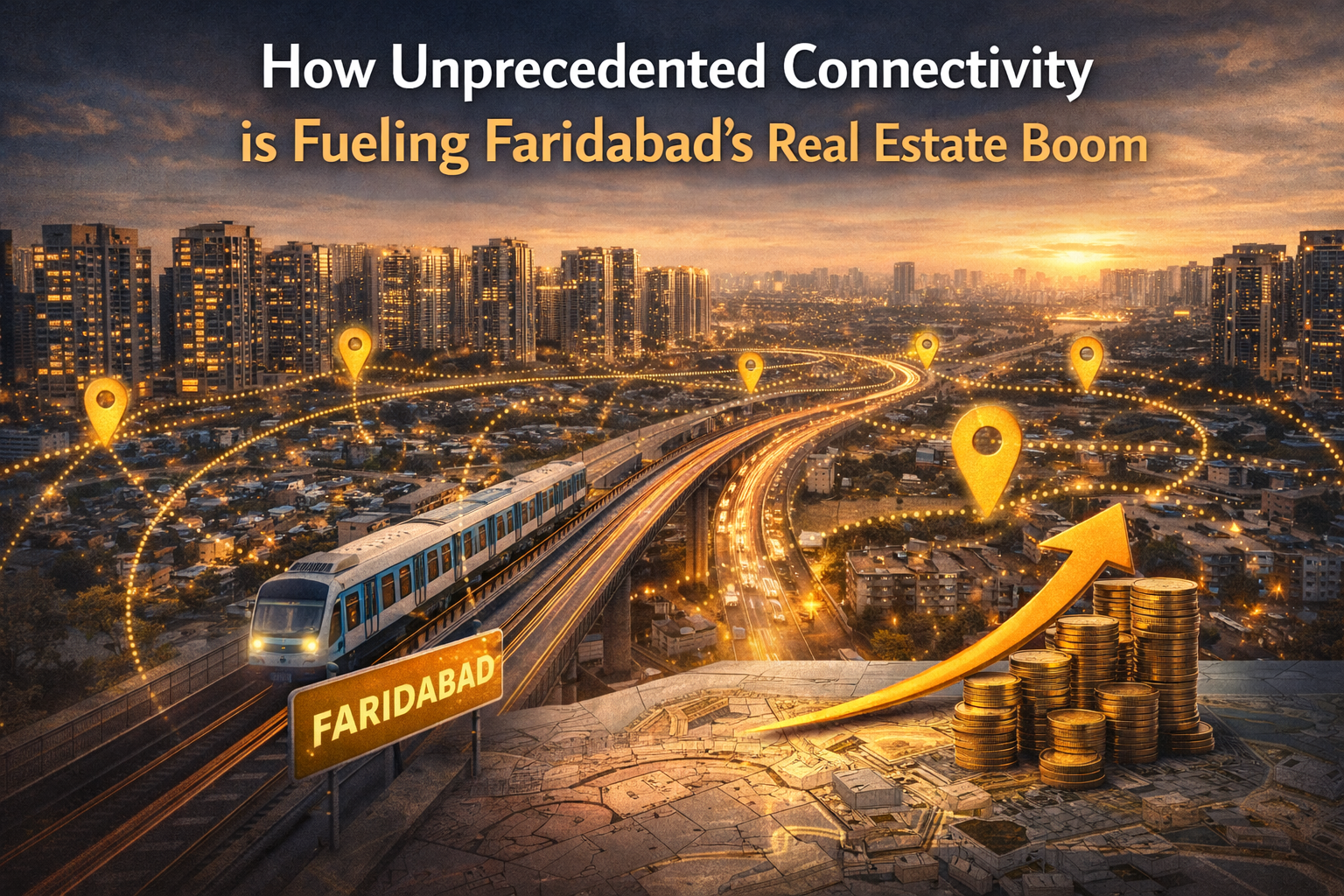
For decades, the real estate narrative of the National Capital Region was dominated by the meteoric rise of Gurugram and the massive, planned expansion of Noida. Meanwhile, Faridabad, despite sharing a direct border with the national capital, was often relegated to the background. It was viewed primarily through an industrial lens—a city defined by its manufacturing units and workforce housing rather than premium residential living or sleek commercial hubs. However, that outdated perception is currently undergoing a radical and permanent transformation.
Today, the city is experiencing a comprehensive real estate renaissance. This shift is not the result of a sudden, organic population spillover; it is the direct consequence of a highly strategic, multi-billion-dollar overhaul of regional infrastructure. At the absolute core of this market repositioning is connectivity. New expressways, rapid transit systems, and international airport linkages are actively tearing down the physical and psychological barriers that once isolated the city. As these mega-corridors take shape, they are fundamentally altering the region's economic geography, turning a peripheral industrial town into one of the most promising, high-growth real estate markets in northern India.
The foundation of any thriving real estate market is its road network, and the ongoing infrastructure projects in the region are nothing short of transformative. These are not merely local road-widening exercises; they are massive interstate lifelines designed to integrate local micro-markets with global economic engines.
Perhaps the most highly anticipated project driving immediate real estate appreciation is the Faridabad-Noida-Ghaziabad (FNG) Expressway. Spanning approximately 56 kilometers, this six-lane mega-project is designed to seamlessly stitch together the region's major residential and commercial zones. Historically, commuting between these satellite cities required navigating severely congested intra-city routes, resulting in significant travel fatigue and lost productivity. The FNG Expressway bypasses these arterial bottlenecks entirely.
For the real estate sector, the implications are massive. A corporate professional working in Noida’s bustling IT corridors or Ghaziabad's commercial centers can now realistically and comfortably maintain a primary residence here. By reducing travel time to a predictable 30 to 45 minutes, the expressway has unlocked dormant residential demand. It effectively merges the employment hubs of neighboring cities with the relatively affordable housing supply of Faridabad, driving up property values and investor interest along the entire corridor.
While the FNG integrates the city locally, the Delhi-Mumbai Expressway connects it nationally. As a major node on this monumental mobility backbone, the city is poised to handle a massive influx of interstate trade and transit. But the true game-changer for the local property market is the recently approved 31.4-kilometer greenfield link corridor connecting this expressway directly to the upcoming Noida International Airport at Jewar.
Built as a six-lane elevated corridor, this project will slash travel time to the airport to under an hour. This places the southern and eastern sectors of the city right in the influence zone of what is slated to become a massive global aviation and logistics hub. The areas along this alignment—stretching from Ballabgarh through Mohana and Chhaysa—are already witnessing a surge in land transactions. This infrastructure effectively positions the city to absorb the massive commercial, hospitality, and warehousing demand that always accompanies an international aerotropolis.
Complementing the road networks is a heavy investment in mass public transit. The steady expansion of the Delhi Metro’s Violet Line has already proven successful in changing daily commuting patterns, offering a clean, reliable link directly into central Delhi. Building on this success is the proposed Namo Bharat RRTS (Regional Rapid Transit System). This high-speed rail network aims to connect Gurugram, Faridabad, and Noida, shrinking travel times from hours to mere minutes. Transit-oriented development is highly attractive to the modern workforce, and properties located within the influence zones of these transit stations are projected to command significant rental and capital premiums in the coming years.
As physical connectivity improves, the demographic profile of the homebuyer naturally evolves. Ten years ago, the local real estate market was heavily skewed toward utilitarian, budget-friendly compact housing, catering almost exclusively to the local industrial workforce. Today, the influx of higher-income corporate professionals, entrepreneurs, and IT workers has matured the market, leading to a decisive pivot toward aspirational living.
Grade-A developers have recognized this shift and are actively altering the skyline. The focus has moved away from basic apartments toward large-format homes, expansive gated communities, and luxury high-rises. Modern buyers are demanding robust smart-home technologies, expansive clubhouses, dedicated co-working spaces within residential complexes, and sustainable, eco-friendly architectural designs.
Furthermore, there is a distinct and growing appetite for premium plotted developments. Buyers are increasingly drawn to the concept of resort-style villas and custom-built homes situated within highly secure, managed townships. These developments offer a curated lifestyle ecosystem with ample green space, open-air gyms, and walking trails—providing a stark, appealing contrast to the dense, concrete-heavy environments found in older parts of the National Capital Region.
This wave of infrastructure-led development is not distributed evenly; it is heavily concentrated in specific micro-markets that are emerging as the new centers of gravity for the city’s real estate sector.
The epicenter of the modern housing boom is undoubtedly Greater Faridabad, widely known as Neharpar. A decade ago, this area was viewed by many as a speculative long-term bet. Today, it stands as a fully realized, meticulously planned urban landscape. Characterized by wide arterial roads, modern drainage systems, and underground utility cabling, Neharpar represents the future of the city's residential market. It offers the space and planning that older sectors simply cannot match, making it a magnet for integrated township projects.
For buyers seeking exclusivity, Sector 81 has rapidly established itself as a hub for high-end, luxury living. With immediate access to the highway and proximity to existing metro infrastructure, it attracts top-tier developer projects and a wealthy demographic. Similarly, the legacy neighborhood of Sector 14 remains a highly sought-after destination for premium living, boasting wide, tree-lined avenues, established parks, and an irreplaceable sense of community prestige.
Sector 86 appeals strongly to the mid-segment and upper-mid-segment buyers, offering an optimal balance of competitive pricing and modern lifestyle amenities. Meanwhile, Sector 88 is witnessing rapid appreciation due to its immediate highway access and the influx of high-quality apartment complexes and independent floors. These sectors provide a tangible blueprint of what the broader residential future looks like, perfectly blending affordability with an upgraded standard of living.
A thriving residential sector cannot exist in a vacuum; it requires a robust commercial and retail backbone to sustain long-term growth. As the population base expands and household incomes rise, the commercial real estate sector is experiencing a mirrored resurgence.
We are witnessing the rapid introduction of European-style high streets, open-air retail promenades, and state-of-the-art business parks. The strategy is to create self-contained economic ecosystems where residents have immediate access to fine dining, global retail brands, and premium office spaces without having to cross city borders. This commercial influx is absolutely vital. It transitions the area from being a mere "bedroom community"—where people sleep but work elsewhere—into a self-sustaining urban center capable of generating its own localized employment and economic momentum.
While expressways and metro lines bring people to a city, it is the lifestyle and community infrastructure that keeps them there. The true test of a maturing real estate market lies in the parallel development of its civic and social pillars.
A major driver of the current buyer confidence is the rapid establishment of top-tier educational institutions, multi-specialty healthcare facilities, and organized recreational zones. Families are increasingly willing to relocate to these new sectors because they no longer have to compromise on the quality of their children's education or their family's medical care. The holistic development of this social infrastructure ensures that the current wave of migration into the city is not a temporary investment trend, but a permanent, structural demographic shift.
From an investment standpoint, the financial logic driving this market is highly compelling. The established real estate markets of Gurugram and Noida have largely reached a point of saturation. Entry costs in those cities have skyrocketed, barring many mid-segment buyers and significantly compressing the potential for rapid capital appreciation.
Faridabad offers a rare and closing window of opportunity: a combination of immediate affordability and massive, highly visible upside potential. Investors entering the market today are essentially pricing in the future completion of the FNG Expressway, the RRTS transit system, and the Jewar airport link. Market analysts generally suggest a logical investment horizon of three to seven years. Over this period, as these multi-billion-dollar infrastructure milestones transition from construction sites to operational realities, property valuations in these connected corridors are expected to align much more closely with their pricier neighbors.
The industrial baseline of the city also provides a unique safety net for investors. The established clusters of manufacturing and ancillary suppliers guarantee a steady, resilient demand for rental homes and workforce-oriented projects, ensuring consistent rental yields while waiting for long-term capital appreciation to mature.
The city is no longer waiting in the wings. Through a calculated, aggressive, and well-funded expansion of its connectivity networks, it has completely repositioned itself on the real estate chessboard. It has evolved from a peripheral, single-industry zone into a dynamic, aspirational, and highly connected urban center. The convergence of national highways, regional expressways, and rapid transit is doing more than just reducing commute times; it is building a completely new civic identity. For homebuyers looking for an upgraded lifestyle and investors seeking the next wave of high-yield returns, this market represents one of the most balanced, promising, and fundamentally sound real estate opportunities in the entire National Capital Region today.
