Published On:
June 29, 2026
Updated On:
June 29, 2026
If a Patwari is delaying your land partition, you can bypass them by filing a formal written complaint with the Tehsildar or Sub-Divisional Magistrate (SDM). Understanding that the Revenue Court, not the Patwari, holds the actual legal authority to divide property is the key to resolving stalled ancestral land disputes.
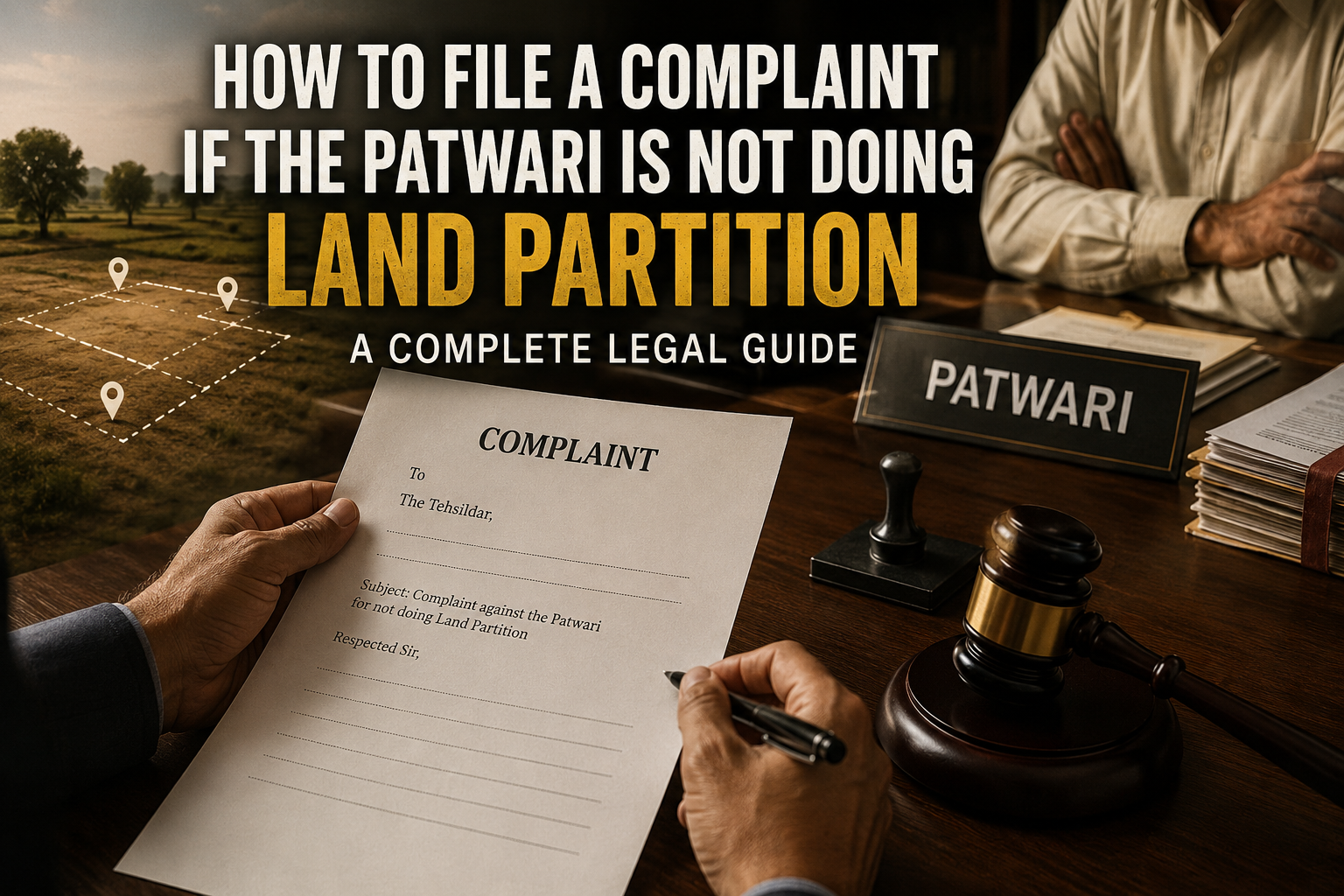
Dividing ancestral or jointly owned land in India often feels like navigating an endless maze of bureaucracy. For many families, the biggest hurdle in the property partition process is the local revenue officer, commonly known as the Patwari or Lekhpal. It is a familiar story across rural and semi-urban landscapes: multiple visits to the revenue office, endless waiting, and a process that simply refuses to move forward. If you are stuck in a situation where the Patwari is not doing the land partition or is unnecessarily delaying the preparation of vital reports, you are not alone, and more importantly, you are not out of options.
Understanding the administrative hierarchy and your legal rights is the first step toward breaking this deadlock. Many property owners mistakenly believe that the local Lekhpal or Patwari has the final say in property division. This misconception allows minor officials to stall proceedings, sometimes for years. The truth is that the law provides clear, structured pathways to escalate your grievances, bypass uncooperative officials, and get your rightful property shares legally demarcated. Whether you are looking to clear your title for a future sale, secure compensation for land acquisition, or simply resolve a family dispute, taking the right legal steps is absolutely essential.
To effectively navigate a delayed land partition process, you must first understand what a Patwari actually does and the limits of their authority. The Patwari is essentially the foundational record-keeper of the state's revenue department at the village level. Their primary responsibilities revolve around maintaining and updating land records, not making judicial decisions.
The day-to-day duties of a Patwari include measuring land, inspecting crop cultivation, recording changes in ownership due to inheritance or sale, and updating crucial documents like the Khasra and Khatauni. The Khasra is a detailed register containing information about a specific plot of land, its dimensions, and the crops grown there. The Khatauni is the register of individuals cultivating or occupying the land. When a request for land partition is initiated, the Patwari's job is strictly to verify the existing ground realities, check the current records, and prepare a preliminary factual report.
They do not possess the judicial power to pass an order for partition. They cannot legally divide the land on their own authority or settle complex disputes regarding who gets which specific portion of the property. Their role is administrative and investigative. Therefore, waiting indefinitely for a Patwari to magically resolve a partition issue is a flawed strategy. If they are delaying the preliminary report without a valid reason, they are failing in their administrative duty, and you have every right to escalate the matter to their superiors.
If the Patwari is just the record-keeper, who actually divides the land? The legal authority to mandate a land partition rests entirely with the Revenue Court. This judicial body operates under the state's specific land revenue codes and is presided over by officials like the Tehsildar or the Naib Tehsildar.
When you want to divide an agricultural or non-agricultural plot among co-owners, the formal application must be directed to the Revenue Court. The Tehsildar acts as the judicial officer in these matters. Upon receiving a partition application, the Tehsildar issues notices to all interested parties and co-sharers, giving everyone a fair opportunity to present their side. The Tehsildar will then ask the Patwari to submit the ground report.
Once the report is submitted and all parties are heard, the Tehsildar examines the evidence, the land records, and the claims of the co-sharers. Based on this thorough examination, the Revenue Court passes a formal, legally binding order for partition. It is this order that dictates how the land will be divided, not the personal opinion of the Patwari. Recognizing this hierarchy empowers you to shift your focus from pleading with the local record-keeper to actively pursuing a resolution in the Revenue Court.
When the Patwari deliberately stalls the process, refuses to measure the land, or neglects to submit the necessary report to the Tehsildar, you must take formal action. Relying on verbal requests will not yield results and leaves no paper trail. Here is the structured approach to escalating your complaint.
Your first line of escalation is the Tehsildar or the Naib Tehsildar, as they are the direct administrative superiors to the Patwari. Draft a clear, concise written complaint detailing the timeline of your partition request. Mention the exact dates you approached the Patwari, the specific plot numbers involved, and the nature of the delay. Attach photocopies of all relevant land documents, including the latest Khasra and Khatauni, as well as any previously submitted applications.
Filing a formal written complaint forces the administrative machinery to acknowledge your issue on paper. Often, a direct inquiry or a show-cause notice from the Tehsildar is enough to prompt the Patwari to immediately finalize and submit the pending report. The Tehsildar has the authority to summon the Patwari and demand an explanation for the delay, effectively clearing the bottleneck.
If the Tehsildar fails to take action, or if the Patwari remains uncooperative despite the Tehsildar's intervention, the next step is to approach the Sub-Divisional Magistrate. The SDM holds significant executive and magisterial powers over the entire sub-division and acts as an appellate authority in many revenue matters.
You can file an appeal or a formal grievance with the SDM's office. In your application, clearly state that your previous complaints to the Tehsildar have not resulted in any progress. The SDM has the power to bypass the local delays, order an independent inquiry, and issue strict directives to the lower revenue staff to expedite the partition process. A directive from the SDM carries heavy weight and is rarely ignored by the field staff.
In cases involving extreme negligence, suspected corruption, or persistent refusal to perform official duties, you can escalate the complaint to the District Magistrate or District Collector. Furthermore, almost every state government now operates centralized online grievance redressal portals. Filing a complaint on these portals assigns a tracking number to your case and mandates a time-bound resolution from the concerned department. Because these online complaints are monitored at the state level, local officials are usually pressured to resolve them swiftly to maintain their departmental performance metrics.
A Patwari's delay is often just a symptom of a much larger problem: a deep-rooted family dispute. In many instances, the Patwari hesitates to act because one or more co-sharers actively object to the division. When family members cannot agree on how the land should be split, the process transitions from a simple administrative task to a complex legal battle.
If mutual consent is impossible, the matter must be resolved through the judicial system. Depending on the nature of the land and state laws, a partition suit must be filed either in the Revenue Court or a Civil Court.
Initiating a partition suit involves a specific legal sequence. Once the suit is filed, the court will evaluate the ancestral lineage, registered deeds, and revenue records to determine the exact legal share of every claimant.
The court first issues what is known as a preliminary decree. This decree does not physically divide the land; rather, it officially declares the specific percentage or share that each legal heir is entitled to receive. For example, it might declare that three siblings each own a one-third share of the total property.
Following the preliminary decree, if the parties still cannot agree on the physical boundaries of their respective shares, the court moves to the final decree. During this phase, the court may appoint a local commissioner to physically inspect the property and suggest a fair division by metes and bounds. The final decree is the ultimate legally binding document that physically divides the property, allocates specific portions to specific individuals, and orders the revenue authorities to update the land records accordingly. Once a final decree is issued, the Patwari has no choice but to implement the court's exact orders in the records.
Whether you are filing a complaint against a delaying official or initiating a partition suit in court, having impeccable documentation is your strongest weapon. Missing or outdated paperwork gives officials an easy excuse to reject or stall your application. Always ensure you have multiple copies of the following documents organized and ready.
First, obtain the most recent certified copies of the Khasra and Khatauni. These are the foundational proofs of the current ownership status and are absolutely non-negotiable. You can usually download digitally signed copies from your state's official land records portal.
Second, gather all title documents. This includes old sale deeds, gift deeds, or previous mutation documents that prove how the land came into your family's possession. If the land is ancestral, these documents establish the chain of title over generations.
Third, a certified family tree is often required, especially in cases of inheritance. This document maps out all the legal heirs and must usually be verified and stamped by the village head or a competent local authority.
Finally, ensure you have up-to-date identity proofs for all applicants, such as Aadhaar cards, along with receipts showing that all property taxes and land revenue payments are fully cleared up to the current financial year. Revenue officials frequently halt processes if there are outstanding dues on the land.
Dealing with revenue departments requires patience, strategy, and a firm understanding of administrative procedures. One of the most critical habits you can develop is to document everything. Never rely on verbal assurances from a Lekhpal or Patwari. If you submit an application, always get a receiving stamp and signature on a photocopy for your records. If you are asked to provide additional documents, submit them with a formal covering letter.
If your application seems to have vanished into the bureaucratic void, use the Right to Information Act. Filing an RTI application asking for the daily progress report of your partition file is a highly effective way to jolt officials into action. Government employees are legally bound to respond to RTI queries within a specific timeframe, and the prospect of having to explain their inaction in writing often forces them to process the file immediately.
Additionally, keeping your land records updated proactively prevents future headaches. Whenever a family member passes away or a portion of land is sold, ensure the mutation process is completed immediately. Allowing records to remain outdated for decades is the primary reason partition cases become hopelessly complicated.
Lastly, do not hesitate to seek professional legal counsel. Revenue laws are complex, deeply rooted in historical state legislation, and frequently updated. A lawyer who specializes in local land revenue matters can draft your applications with the correct legal terminology, represent you effectively before the Tehsildar or SDM, and ensure that your property rights are fiercely protected against both uncooperative officials and dissenting relatives.
A delayed land partition can stall your financial plans, prevent property development, and cause immense stress. However, being held hostage by a Patwari who is not doing their job is not a situation you have to accept. By understanding that the true power of property division lies with the Revenue Courts and higher administrative officials, you can take decisive action. Gather your documents, formalize your requests in writing, and do not be afraid to escalate your grievances to the Tehsildar, the SDM, or state portals. Securing clear, legally defined boundaries for your property is a fundamental right, and with the correct procedural approach, you can successfully navigate the system to protect your assets and your peace of mind.
