Published On:
March 18, 2026
Updated On:
March 18, 2026
Digitized Bhulekh portals in states like Bihar, Uttar Pradesh, and Jharkhand now allow citizens to easily download 100 to 150-year-old land records and Khatiyan online, providing crucial legal proof to prevent property disputes and secure real estate transactions.
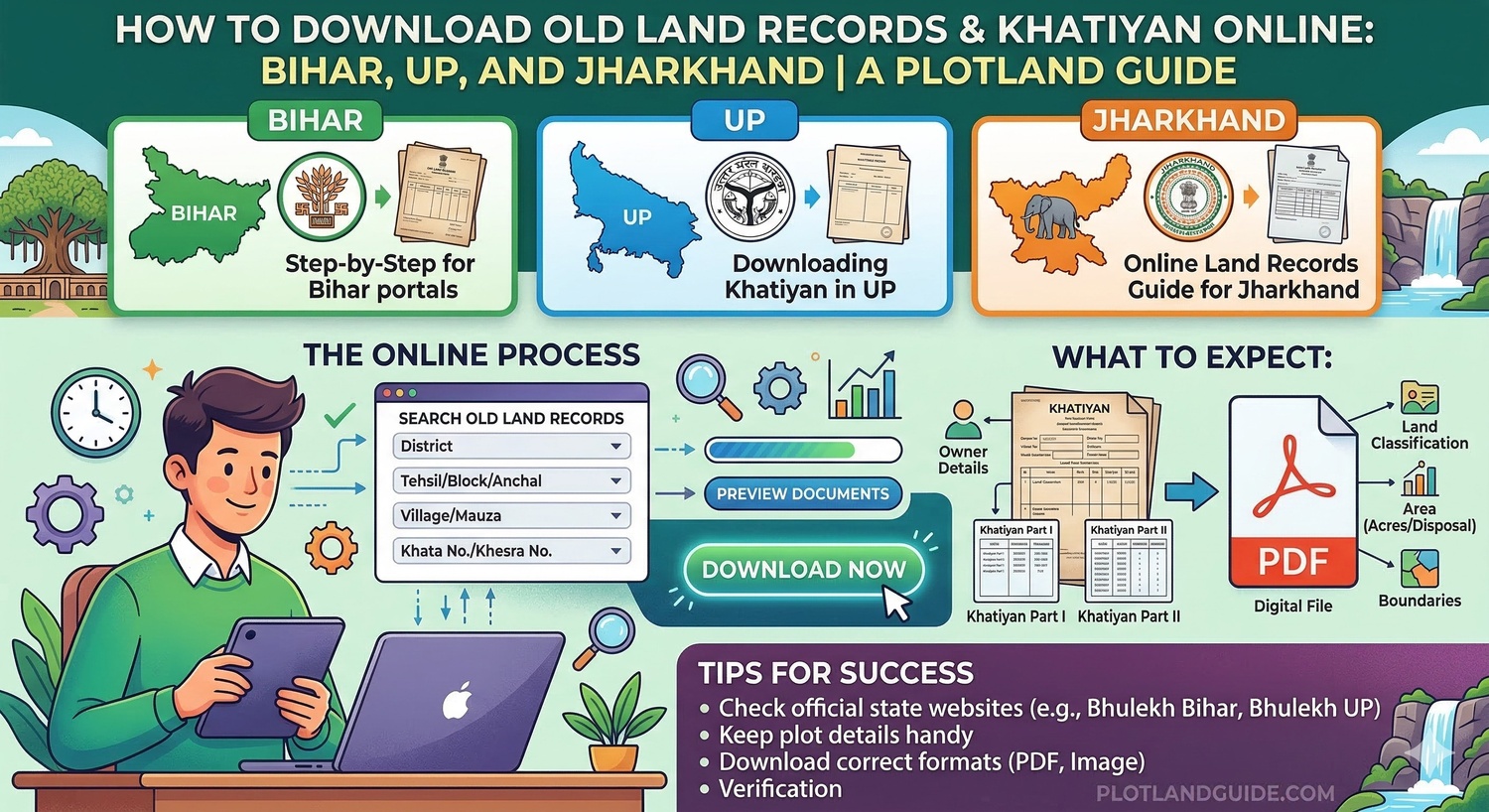
The landscape of property ownership and real estate management in India has undergone a massive transformation over the past few years. Historically, tracking down land records meant making endless rounds of government revenue offices, dealing with red tape, and physically searching through fragile, decades-old paper files. Today, the process of verifying property details has been brought directly to your fingertips. Thanks to extensive digitization efforts by various state governments, citizens can now access and download land records that are over a century old using their mobile phones or computers.
Whether you are trying to resolve an ancestral property dispute, planning to buy agricultural land, or simply looking to secure a loan against your property, having access to accurate, official land records is absolutely vital. States like Bihar, Uttar Pradesh, and Jharkhand have taken the lead in making these documents publicly accessible through their dedicated Bhulekh portals. Understanding how to navigate these websites to retrieve your Khatiyan, Khasra, or Khatauni can save you immense time, money, and legal hassle.
A property transaction in India is heavily reliant on a clear, undisputed paper trail. Land records are not just administrative formalities; they are the fundamental bridge between physical possession of a piece of land and legally recognized ownership. While physical possession might seem secure, without the backing of a documented Record of Rights, your claim to a property remains vulnerable.
One of the most important documents in this ecosystem is the Khatiyan. Originating during the cadastral surveys of the early 1900s, the Khatiyan serves as a comprehensive history of a specific land parcel. It details the names of the current and previous owners, their respective shares, the total area, and the specific rights associated with that land. When a dispute arises, whether within a family over inherited land or between a buyer and a seller, the Khatiyan is often the first document summoned by courts and revenue officers to establish the legitimate chain of ownership.
The absence of updated and verified land records is a leading cause of litigation in the country. Unclear property titles can lead to instances where a single plot is fraudulently sold to multiple buyers, or public land is illegally encroached upon. By checking historical records, potential buyers can trace the lineage of a property back several decades, ensuring that the person selling the land has the absolute legal right to do so, and that the land is free from active litigation or undisclosed mortgages.
Furthermore, these documents are the backbone of rural and agricultural finance. Financial institutions rigidly require verified land records like the Khatiyan or Khatauni before sanctioning loans, especially agricultural credits or loans against property. Without these digitized records, millions of farmers and landowners would be entirely cut off from the formal banking sector.
Before diving into the online portals, it helps to understand the terminology commonly used across North and East Indian land revenue systems.
The term Khasra essentially refers to a specific survey number assigned to a plot of land in a rural area. Think of it as a unique identity number for a land parcel. The Khasra document provides granular geographical details, including the total area, the type of soil, the crops cultivated on it, and the exact boundaries defining where one plot ends and another begins.
Moving a step further, the Khatauni is a register that aggregates all the Khasra numbers owned by a specific individual or a family within a village. While the Khasra details the land itself, the Khatauni focuses on the cultivator or the owner, listing all their landholdings in one place along with their tax liabilities.
Jamabandi, another term frequently encountered, is the overarching Record of Rights. It is a master document prepared and updated periodically by the revenue administration, reflecting the current ownership, cultivation rights, and up-to-date status of the land after incorporating any recent mutations or transfers of ownership.
The shift from manual ledgers to digital databases is largely driven by the central government's modernization programs aimed at creating an integrated land information management system. This initiative has successfully computerized the vast majority of land records across rural India, translating complex, localized data into accessible online formats.
For the average citizen, this means that historical records, often dating back 100 to 150 years, have been scanned, indexed, and uploaded to state-specific Bhulekh websites. These portals are designed to provide transparency, allowing anyone to verify land ownership details from anywhere in the world, an especially useful feature for non-resident Indians managing property back home.
Retrieving your old land documents is a straightforward process once you know which portal to visit and what details to keep handy. You will generally need to know the name of your district, the specific block or tehsil, and the village or mauza where the land is situated. Having the Khasra or Khata number accelerates the search significantly.
The Bihar government has streamlined property services through its dedicated portal, Bihar Bhumi. This website acts as a centralized hub for all revenue and land reform services in the state.
To download an old Khatiyan or check your land details, you need to navigate to the official Bihar Bhumi website. On the homepage, look for the section dedicated to viewing digitized land records or the Jamabandi register. The portal will prompt you to select your respective district and the local circle or block from a digital map or a dropdown menu.
Once you have narrowed down the geographical location, you must select your specific mauza or village. The system then offers multiple ways to search for the record. You can search by entering the name of the recorded tenant, the exact Khata number, or the Khasra number. If you do not have these specific numbers, you can opt to search through all the accounts in that particular mauza, though this might take a bit longer to sift through. Upon locating the correct entry, the portal displays the comprehensive land document on the screen, detailing the ownership history and plot dimensions. You can easily save this document as a PDF or print it directly for your records.
Uttar Pradesh manages its vast agricultural and residential land data through the UP Bhulekh portal. This system was specifically designed to eliminate the need for physical visits to the local Lekhpal or Patwari office, bringing ultimate transparency to the state's land administration.
To view your Khatauni or verify land details in UP, visit the official UP Bhulekh website. The homepage is highly intuitive, offering direct links to view the copy of the Khatauni. You will be asked to complete a simple captcha verification before proceeding.
The next step involves a geographic drill-down. You must sequentially select your district, then your tehsil, and finally the village where the property is located. To make the village selection easier, the portal provides a Hindi alphabetical keyboard to quickly filter the village names.
Similar to the Bihar portal, UP Bhulekh allows you to search for the specific land record using the Gata or Khasra number, the Khata number, or the name of the account holder. Entering the exact Khasra number is usually the fastest method. Once the system retrieves the record, you can view the complete Khatauni, which outlines the names of all co-owners, the share of each owner, and any remarks regarding ongoing disputes or bank loans tied to that specific plot. This digital document can be downloaded and used for preliminary verification during property sales.
For properties located in Jharkhand, the state government operates the Jharbhoomi portal, a comprehensive digital platform developed in collaboration with the National Informatics Centre.
To download a Khatiyan or view Register-II details, you need to open the Jharbhoomi website. On the left side of the homepage, you will find an option dedicated to viewing the Khata and Register-II. Clicking this will redirect you to a new page where you must choose whether you want to view the Khatiyan or the Register-II document.
The portal will then ask you to fill in the location details, starting with the district, followed by the specific anchal or block, and the name of the mauza. You can then search for the document using the account number or the name of the landholder. After entering a security captcha, clicking the search button will pull up the relevant historical land records.
It is worth noting that for certain advanced features or to download digitally signed, certified copies of these documents, the Jharbhoomi portal may require you to create a user account. Registration is a simple process requiring basic details like your name, address, email ID, and a mobile number. Once registered and logged in, you gain full access to download verifiable copies of your ancestral land records.
While the digitization of land records has brought unprecedented convenience, it is important to approach these online documents with a clear understanding of their legal standing and limitations.
First and foremost, the records available on these Bhulekh portals are primarily for informational purposes and preliminary verification. While they accurately reflect the data held by the revenue department, an uncertified printout from a website might not be admissible as absolute legal proof in a court of law or for official property registration. For formal legal proceedings or to execute a sale deed, you will typically need to apply for a digitally signed copy or obtain a certified physical copy from the local revenue office.
Additionally, land ownership in India is largely presumptive. The name on the digital land record creates a strong legal presumption of ownership, but it is not a government-guaranteed title. This means the ownership can still be challenged in a civil court if another party presents superior evidence. Therefore, when purchasing a property, checking the online Khatiyan should only be the first step in your due diligence process. It must be followed by a thorough verification of the physical title deeds, encumbrance certificates, and a search for any pending civil litigation.
Another critical factor to keep in mind is the mutation process. Whenever a property changes hands due to a sale, inheritance, or gift, the new owner must officially apply for mutation, locally known as Dakhil-Kharij, to have their name updated in the government's revenue records. If the previous owner sold the land but the buyer never completed the mutation process, the online portal will continue to show the old owner's name. Always ensure that the physical sale deed matches the details reflected in the online Bhulekh database to avoid complications down the line.
The ability to download old land records and Khatiyan online is a monumental leap forward for property rights and transparency in India. Portals like Bihar Bhumi, UP Bhulekh, and Jharbhoomi have empowered ordinary citizens, removing the traditional barriers that once made land verification a daunting task. By taking a few minutes to navigate these websites, you can trace the history of your ancestral land, confidently verify the credentials of a property you intend to purchase, and protect your investments from fraudulent claims. Staying informed and proactively checking these digital records is the smartest way to secure your real estate assets in today’s rapidly evolving market.
