Published On:
July 26, 2026
Updated On:
July 26, 2026
Checking your Khasra and Khatauni details online has become effortless with state-specific Bhulekh portals, ensuring transparency and reducing property fraud. This comprehensive guide covers everything from understanding land record terminology to the step-by-step process of accessing and updating your property details digitally.
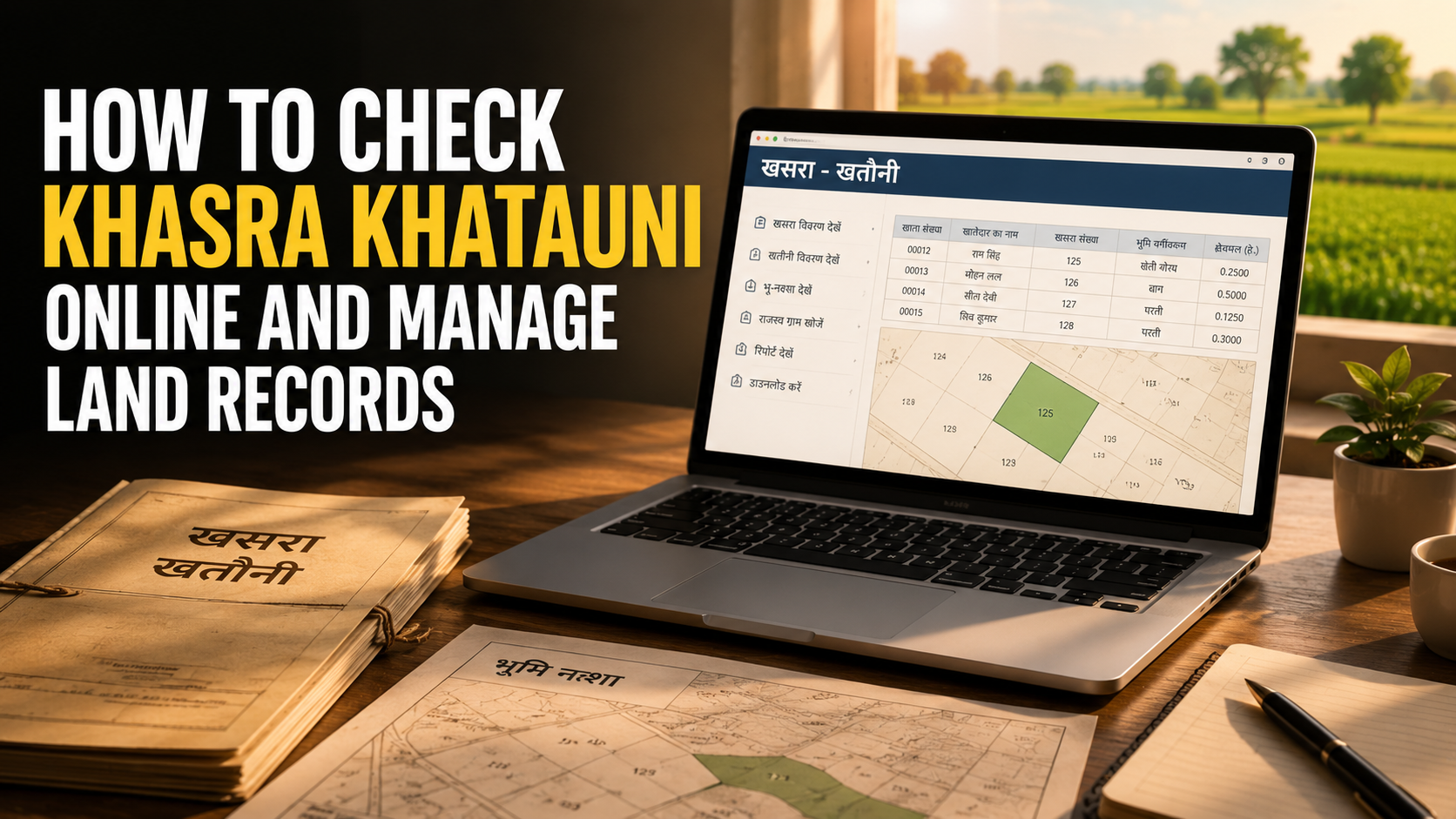
Investing in real estate or inheriting ancestral property comes with a massive responsibility, and the most crucial part of this process is verifying land ownership. For decades, land records were hidden away in dusty government offices, meticulously maintained in heavy paper ledgers by local revenue officers. Finding a single detail about a land parcel meant navigating endless red tape, enduring long waiting times, and sometimes dealing with misplaced documents.
Today, the landscape of property management has completely transformed. The digitization of land records across the country has brought property details straight to our fingertips. The unified digital system, commonly known as Bhulekh, is designed to provide transparent, secure, and instant access to all land-related information. Whether you are a prospective homebuyer wanting to run a background check on a plot, a farmer applying for an agricultural loan, or a landowner trying to verify property lines, understanding how to navigate the online land record portals is an absolute necessity.
Before diving into the process of checking land records online, it is highly important to understand the vocabulary used by the revenue departments. Words like Khasra, Khatauni, and Jamabandi might sound complex, but they represent very logical divisions of property data.
What Exactly is Bhulekh?The term Bhulekh is a combination of two Hindi words: Bhu, which means land, and Lekh, which translates to account or record. Therefore, it literally means maintaining a record of the land. It serves as an umbrella term for the digital database that holds complete information about land ownership, property area, and historical land transactions. The central government, under the Digital India Land Records Modernization Programme, mandated every state to digitise their physical property ledgers, leading to the creation of state-specific portals that citizens can access at any time.
Decoding the Khasra NumberIn urban areas, houses and plots are given plot numbers or house numbers. In rural or semi-urban areas, agricultural and non-agricultural land parcels are assigned a unique identification number known as a Khasra number. When a village map is drawn, every piece of land is surveyed and given this specific serial number. A Khasra number is essentially the identity card of a specific piece of land. It holds deep geographical and agricultural details about the plot. If you pull the records for a specific Khasra number, you will find out the exact total area of that land, the type of soil present, the crops being cultivated on it, the number of trees on the property, and its exact geographical boundaries. It also lists the names of the owners and cultivators. It is the most granular level of property identification.
Understanding the Khatauni NumberWhile a Khasra number represents a specific piece of land, a Khatauni number represents the owner or the family that owns the land. It is quite common for a single person or a family to own multiple different plots of land scattered across a village, meaning they own multiple Khasra numbers. A Khatauni number consolidates all the Khasra numbers owned by an individual or a family in a particular village under one single account. If you want to know the total land holdings of a specific person in a village, you would search for their Khatauni number. It is an account number that provides a complete overview of a landowner's entire portfolio within that revenue village.
The Significance of Jamabandi, RoR, and FardYou will often come across terms like Record of Rights, Jamabandi, or Fard depending on which state you reside in. The Record of Rights is the master document that legally establishes ownership of the land. It contains the names of the landowners, the extent of their shares, details of any ongoing tenancy, and most importantly, any encumbrances or loans taken against the property. Jamabandi is the term predominantly used in northern states like Punjab, Haryana, and Rajasthan to refer to this Record of Rights. Fard is simply a localized term used to request a physical or digital copy of the Jamabandi. Having a certified copy of the Record of Rights is mandatory when selling property or registering it in a new name.
The concept of maintaining land records is not new to the Indian subcontinent. Systems to measure and tax land existed even during the Indus Valley Civilization and were highly refined during the medieval period and subsequent British rule. However, these systems relied entirely on manual entry. Fast forward to modern times, managing millions of land parcels on paper became unsustainable. Documents would get damaged due to weather, misplaced, or tampered with, leading to endless property disputes.
To resolve this, the government initiated the Computerization of Land Records scheme as far back as 1988-1989. However, true momentum was gained recently with the rollout of state-specific online portals. This massive digitization drive meant that revenue department officials physically scanned and entered decades of property data into centralized servers. Today, this digital infrastructure is a powerful tool against property fraud, making illegal land grabbing extremely difficult since the actual ownership status is always publicly verifiable online.
Moving property records to the digital space has brought immense relief to property owners and buyers alike. One of the primary advantages is the absolute transparency it introduces into real estate transactions. Previously, a buyer had to blindly trust the seller's property documents or hire a legal expert to run a time-consuming physical check at the registrar's office. Now, anyone can instantly verify if the seller actually owns the land and has the right to sell it.
Furthermore, checking land records online is incredibly time-saving. There is no longer a need to stand in long queues or take days off work to visit the local tehsil or revenue office. Citizens can access their land maps, ownership details, and mutation statuses directly from their smartphones or laptops, 24 hours a day.
These digital records are also critical for financial matters. If a farmer or property owner wishes to apply for a bank loan, banks require the latest copy of the land records to ensure the property is free from prior disputes or undisclosed mortgages. By downloading the certified digital copy, loan processing becomes significantly faster. It also helps families resolve inheritance matters peacefully, as the exact division of land is clearly mapped out in the digital Khatauni.
While every state manages its own separate website for land records, the core architecture of these platforms is remarkably similar. Whether you are looking for property in Uttar Pradesh, Maharashtra, or Karnataka, the logical steps to find your land records follow a uniform pattern.
The first step is always to identify the correct official portal for your respective state. Once you are on the homepage, you will typically look for options labelled as Search Land Records, View Khatauni, or Record of Rights. Clicking this will lead you to a geographical filter.
Because land records are categorized hierarchically, you must narrow down the location of the property. The portal will prompt you to select the District from a drop-down menu. Once the district is chosen, you must select the specific Tehsil or Taluka. Following the Tehsil, you will be asked to select the exact Village where the land is situated. Choosing the correct village is vital, as Khasra numbers repeat across different villages.
After pinpointing the location, the portal will offer multiple ways to search for the specific property. You can search by the Khasra number if you know the exact plot identity. You can search by the Khatauni number if you want to see an individual's total holdings. Alternatively, if you do not know the numbers, most portals allow you to search directly using the landowner's name.
Let us look at how this works specifically on the UP Bhulekh portal as an example. When you visit the official Uttar Pradesh land records website, you will navigate to the option to view the copy of Khatauni. You will then select your district, tehsil, and village from the provided lists. A search box will appear asking for the Khasra or Gata number. Once you input the correct number and solve the captcha security code, the portal instantly generates a detailed digital document displaying the names of the current owners, the size of the land, and any active loans or remarks against that property. You can then download or print this document for your personal records.
Because land is a state subject in India, there is no single central website to check property details. Instead, each state has developed its own customized platform to cater to regional languages and specific local administrative needs.
In Uttar Pradesh, citizens use the UP Bhulekh portal, which is one of the most heavily trafficked land record websites in the country. Madhya Pradesh operates MP Bhulekh, which not only provides land records but also allows citizens to file and track property-related complaints digitally.
In Rajasthan, the system is known as Apna Khata, where residents can easily check their Jamabandi details and track mutation statuses. Maharashtra uses the Mahabhulekh system, which provides property cards and digital extracts, a crucial document for property ownership in the state.
Eastern states have also fully embraced this digital shift. West Bengal operates the Banglarbhumi portal, a highly sophisticated system that allows users to request Mouza maps, check plot information, and track the status of property conversion cases. Bihar manages its records through the Bihar Bhumi platform, where users can pay land taxes online and view their Khasra details.
Down south, Tamil Nadu relies on the Patta Chitta system, while Karnataka utilizes the Bhoomi portal, which even provides geo-referenced cadastral maps. Regardless of the name, the underlying objective of all these portals remains the same: complete digitization and public accessibility of land data.
Finding an error in your land records, such as a misspelled name, or needing to update the records after a legal name change or inheritance, is a common scenario. Updating your name on the Bhulekh portals is a formal legal process that must be followed strictly to ensure the property title remains clear.
The process begins with drafting a legal affidavit. This affidavit must clearly state your current name as it appears on the records, your new proposed name, the specific reason for the name change, and the complete address of the property in question. This document must be printed on stamp paper of appropriate value and notarized properly, often requiring the signatures of gazetted officers or witnesses.
Once the affidavit is ready, you are required to publicly declare this name change. This is done by publishing an advertisement in at least two local newspapers. One advertisement should ideally be in a regional language newspaper and the other in an English daily. The advertisement must contain the old name, new name, date of birth, and property details.
Following the newspaper publication, the next crucial step is getting the name change published in the State Gazette. You must submit your affidavit, copies of the newspaper advertisements, and a formal application to the department of publication to have a gazette notification issued.
With the gazette notification in hand, you must then visit your local land registry or revenue office. You will submit a formal application for the name change along with all the supporting documents, including the gazette copy, ID proofs, and previous land records. The revenue officials will then initiate an investigation or field verification to ensure the request is legitimate and not an attempt at property fraud. Once the revenue officer approves the application, the central database is updated, and the new name will begin reflecting on the online Bhulekh portal.
To ensure your name change request is processed smoothly without unnecessary delays, having the correct documentation ready is essential. You will need your primary identity proofs such as an Aadhaar card, PAN card, or Voter ID. You must provide the original sale deed or title deed that proves your ownership of the property in question.
If the property is jointly owned, you will absolutely need a No Objection Certificate from all the other co-owners before your individual name can be altered in the records. You should also carry the latest downloaded copies of the current land records showing the old name, along with the receipt of the fee payment made for the name change application. A neatly compiled file of these documents significantly speeds up the verification process at the revenue office.
While checking Khasra and Khatauni online is designed to be user-friendly, users often encounter slight hiccups due to minor errors. The most common mistake is selecting the wrong village name. Many villages in a district can have similar-sounding names, and selecting the wrong one will yield no results or show someone else's property. Always cross-check the exact revenue village name mentioned in your original sale deed.
Another frequent issue is entering the wrong search parameter. Users often confuse the Khasra number with the Khatauni number. If you try to search for a Khasra number in the Khatauni search box, the system will return an error. Always ensure you have selected the correct search filter before typing in the digits. Additionally, when searching by owner name, spelling variations can cause problems. Since these records were manually digitized from old regional language ledgers, the English transliteration of a name might be spelled slightly differently than how you write it today. It is always safer to search using the unique Khasra number to avoid name-related discrepancies.
The transition from fragile paper maps and dusty ledgers to instant online portals is a monumental achievement in property governance. Understanding how to check your Khasra, Khatauni, and Jamabandi details empowers you to make informed, secure real estate decisions. It eliminates the dependency on middlemen and ensures that you have total visibility over your most valuable assets. By maintaining accurate, up-to-date land records and utilizing the state-wise online platforms, property owners can safeguard their investments, streamline legal processes, and navigate the real estate landscape with absolute confidence.
