Published On:
November 3, 2025
Updated On:
February 23, 2026
A complete step-by-step guide to buying agricultural land near Noida International Airport (Jewar) safely. Covers verification of Khasra–Khatauni–Mutation, avoiding scams, safe payment structure, legal frameworks, and post-purchase rights. Includes details on ₹4,300/sq.m compensation, 7% abadi plot benefit, and land-use conversion (143 Order). Essential reading for investors eyeing land in the YEIDA–Jewar–Tappal–Thora belt.
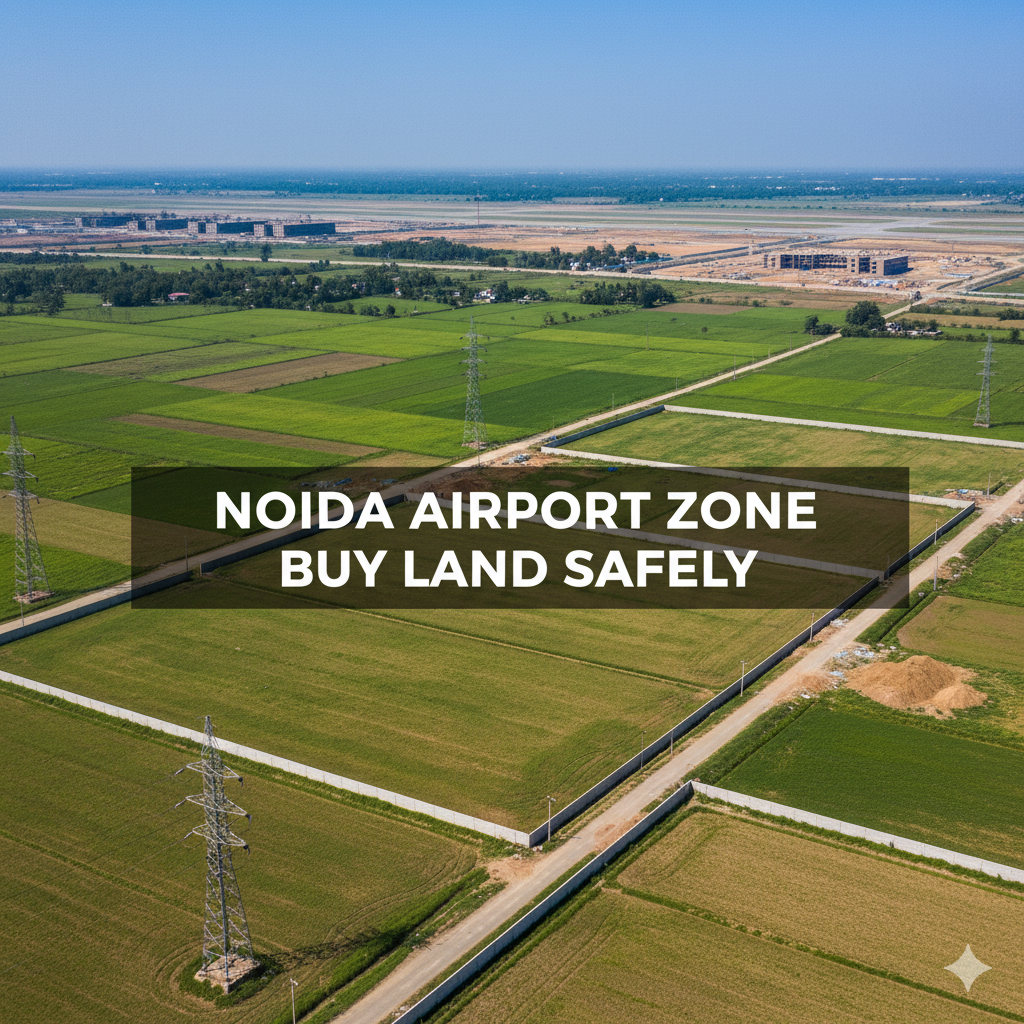
The Yamuna Expressway region near Noida International Airport (Jewar) is rapidly transforming into a prime real estate and investment destination. With massive projects such as the Film City, Medical Device Park, and multiple industrial clusters under the Yamuna Expressway Industrial Development Authority (YEIDA), land values have been rising steadily.
But buying agricultural land here requires meticulous due diligence — from verifying ownership and land records to ensuring safe payments and compliance with state land laws. Below is the complete, fact-based investor guide for buying land in and around Jewar safely.
Start by identifying plots in villages within 5–15 km of the Noida International Airport boundary. Villages like Rohi, Kishorepur, Dayanatpur, Ranhera, Thora, Karauli Bangar, and Mundhera are among the most sought-after.
Check whether the land falls under YEIDA’s notified sectors (like Sector 22D, 24, 28, 29, 30, 33, 34, 36, or 37). Avoid parcels already under Section 4 or Section 6 notification of the Land Acquisition Act, since those are reserved for public projects.
Request these key records from the seller:
The seller must be a bhumidar with transferable rights — not an asami (tenant), since asami land cannot be legally sold.
Go to upbhulekh.gov.in → Search by Khasra/Khatauni number → Select District: Gautam Buddha Nagar and Tehsil: Jewar.
Check if:
Hire a local surveyor or revenue lawyer to measure the boundaries and cross-check them with the official bhu-naksha map on the UP Bhulekh site. Confirm access through public or private rasta (road). Landlocked plots without registered pathways face resale and development challenges.
Khasra is a survey number or unique ID for each plot, showing its size, use type, and location.
Khatauni is the register that lists all plots owned by a person or family, confirming ownership and cultivation rights.
Mutation (Dakhil Kharij) is the process of updating government revenue records after a sale.
After your registry, apply for mutation at the Jewar Tehsil Office or online through the UP Revenue portal within six months. The typical fee ranges between ₹200–₹500 per plot. Mutation ensures you are recorded as the new legal owner and eligible for future compensation or development benefits if the land is acquired.
Red Flags:
Avoid buying if:
Rural transactions often carry risks such as:
Under the U.P. Stamp Act, 2008:
At the Sub-Registrar Office, both buyer and seller appear with Aadhaar, PAN, two witnesses, and passport-sized photos. The registered sale deed is issued the same day.
After registry, buyers can erect temporary fencing, pillars, or boundary markers. Permanent construction, however, requires land-use conversion (LUC) approval.
Land can be leased to another farmer for cultivation through a notarized lease. For leases longer than three years, registration is mandatory. The land must continue to be used for agricultural purposes only unless converted.
If planning a farmhouse, warehouse, or educational facility, apply for conversion under Section 143 of the UPZALR Act.
Applications are filed with the Tehsildar, Jewar, and forwarded to the District Magistrate.
Typical approval time: 30–90 days.
Conversion fee: ₹50–₹100 per sq. metre, depending on land use.
If your plot falls in an upcoming YEIDA sector, you may receive:
Keep your registry and mutation updated to ensure your compensation or abadi plot claim is valid when acquisition takes place.
Agricultural land transactions in the Jewar–YEIDA zone are governed by multiple regulations. The U.P. Land Revenue Act, 1901 covers mutation, land survey, and record management. The U.P. Zamindari Abolition & Land Reforms Act, 1950 defines ownership categories such as bhumidhar (owner) and asami (tenant) and sets out rules for transfer and conversion.
The Land Acquisition, Rehabilitation & Resettlement Act, 2013 governs compensation, rehabilitation, and land acquisition procedures when YEIDA or the government acquires land for public projects. Stamp duties and registration requirements are outlined in the U.P. Stamp Act, 2008.
The YEIDA Development Regulations guide sector planning, layout approvals, and abadi plot allocations for landowners whose land is acquired for development.
Q1: Can non-Uttar Pradesh residents buy agricultural land in Jewar or YEIDA?
Yes. There is no restriction on individuals from other Indian states buying agricultural land in Uttar Pradesh, provided the buyer is an Indian citizen.
Q2: Can NRIs purchase agricultural land near Noida Airport?
No. Non-Resident Indians (NRIs) are not allowed to buy agricultural land, plantation property, or farmhouses in India as per RBI guidelines under FEMA.
Q3: What is the minimum plot size for agricultural purchase?
There’s no fixed legal minimum, but plots are typically measured in bigha or biswa (1 bigha ≈ 842 sq. metres). For practical and resale purposes, aim for at least half a bigha (≈842 sq. m). This 1 bigha calculation holds true in Yeida only.
Q4: How is compensation calculated if land is acquired by YEIDA?
Compensation is based on the prevailing notified rate (₹4,300 per sq. metre) multiplied by your land area. In addition, you are eligible for 7% of the acquired area as a developed abadi plot within the same sector.
Q5: Can agricultural land be converted into farmhouse or commercial use?
Yes, after obtaining a 143 Conversion Order under the UPZALR Act. Without this approval, construction for non-agricultural use is illegal.
Q6: What is mutation, and why is it necessary?
Mutation (Dakhil Kharij) records you as the new owner in revenue records. Without mutation, you cannot claim compensation, government notices, or future benefits if the land is acquired.
Q7: What documents are needed at registry time?
Aadhaar card, PAN card, passport-size photographs, original sale deed, proof of payment, and two witnesses.
Q8: Is leasing land to another farmer allowed?
Yes, leasing for agricultural use is legal if executed through a notarized agreement. Leases longer than 3 years must be registered.
The Jewar–YEIDA–Noida Airport zone represents one of India’s strongest long-term rural-to-urban transition markets. With proper verification through UP Bhulekh, safe payment structuring, and adherence to UPZALR and YEIDA regulations, investors can secure both legal ownership and future growth benefits.
By following this step-by-step guide — from registry and mutation to fencing and optional conversion — you can confidently invest in agricultural land near the Noida Airport with both security and clarity.