Published On:
April 23, 2026
Updated On:
April 23, 2026
The newly proposed 5-kilometer, six-lane elevated corridor from the Tilpata roundabout to the Dadri railway overbridge is set to fundamentally resolve the severe traffic bottlenecks on the DSC Road. Catalyzed by the upcoming Noida International Airport, this critical infrastructure upgrade will bypass local congestion, significantly cut commute times, and inevitably trigger a major real estate appreciation cycle across the Greater Noida and Dadri regions.
Anyone who spends a significant amount of time commuting across the National Capital Region is intimately familiar with the daily struggle on the Dadri-Surajpur-Chhalera route. Commonly known as the DSC Road, this vital artery is the lifeblood connecting the urban residential sectors of Noida with the massive industrial ecosystems of Greater Noida and the logistics hubs of Dadri.
The pattern of travel here is entirely predictable and universally frustrating. A journey starts with smooth movement, but as the vehicle approaches key intersections, the pace suddenly drops. Within minutes, traffic comes to a complete standstill. This route carries an incredibly heavy mix of traffic—heavy freight trucks hauling industrial materials, corporate cabs ferrying IT professionals, intercity buses, and a massive volume of local two-wheelers navigating out of nearby urban villages. For years, this chaotic blending of long-distance commuters and localized traffic has kept the Noida-Dadri stretch under immense pressure.
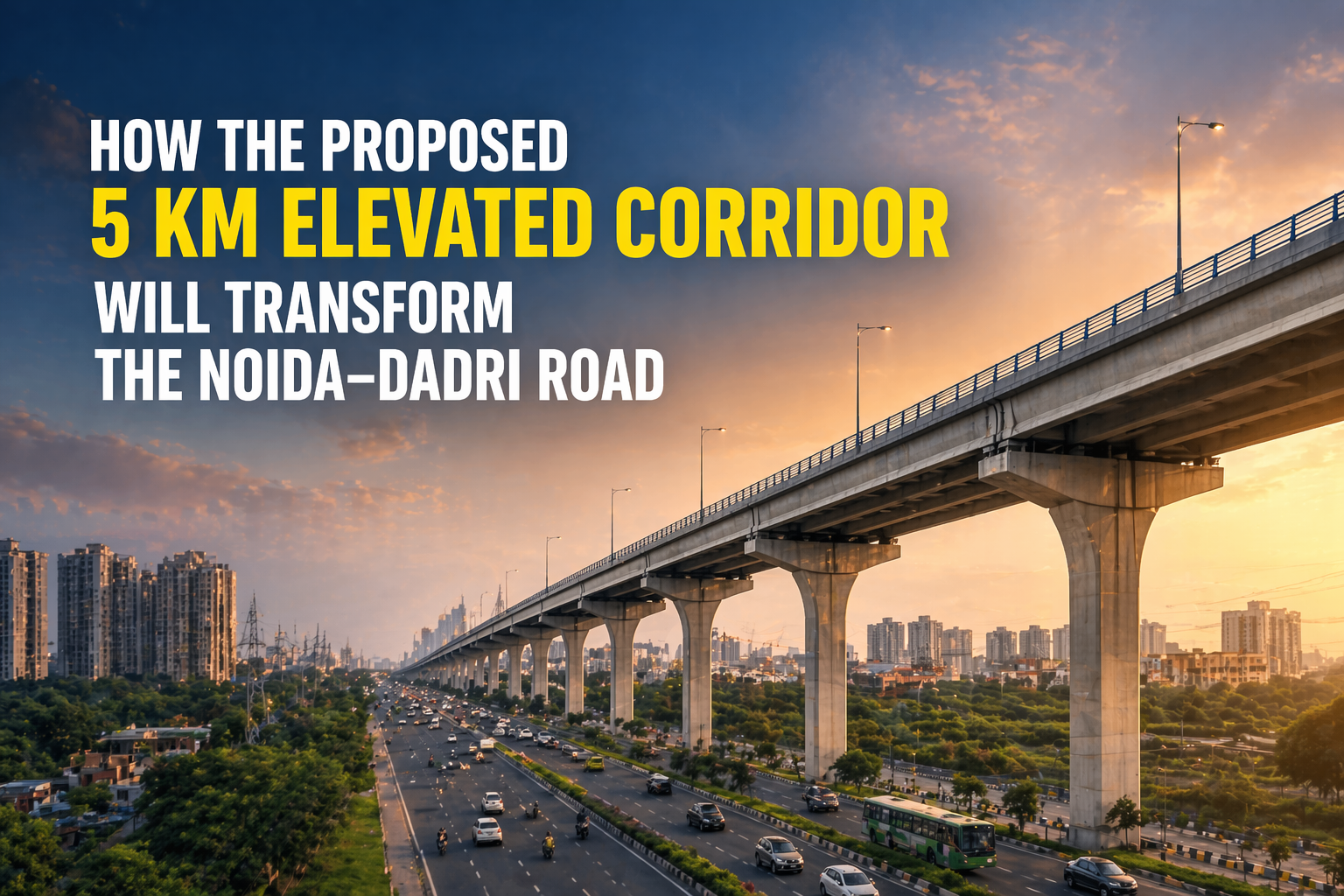
To permanently resolve this logistical nightmare, local urban planning authorities have put forward an aggressive and highly anticipated infrastructure proposal. A new 5-kilometer elevated corridor is being planned to bypass the most congested segments of the Noida-Dadri road. The core philosophy behind this massive undertaking is incredibly straightforward: lift the heavy, through-traffic off the ground and allow it to flow uninterrupted above the local commercial hustle.
The sheer scale of this proposed infrastructure project reflects the urgent need for a permanent traffic solution. According to preliminary engineering outlines, the project will take the shape of a massive 5-kilometer, six-lane elevated roadway.
Geographically, the corridor is strategically positioned to tackle the absolute worst of the current bottlenecks. The elevated structure is designed to begin approximately 500 meters before the notorious Tilpata roundabout for commuters approaching from the Surajpur side. From there, it will soar over the ground-level chaos, flying entirely past the congested village borders and local market zones, before finally touching down and merging near the Dadri railway overbridge.
This specific alignment is not an accident. The Tilpata to Dadri stretch is widely considered the most crippling choke point on the entire DSC route. By designing a six-lane skyway, city planners are ensuring that the new road possesses more than enough carrying capacity to handle not just the current vehicular load, but the exponential traffic growth projected for the next two decades. Vehicles traveling from Noida and Greater Noida directly toward the Dadri industrial area, the Grand Trunk Road (GT Road-91), and the sprawling rural outskirts will no longer be forced to navigate the maze of ground-level traffic signals and local pedestrian crossings.
To truly understand why the authorities are pushing for a high-cost elevated structure, one must look at the ground reality of the Tilpata junction. Initially, the most logical and cost-effective strategy to ease the traffic was simply to widen the existing surface roads.
However, executing road expansion in this specific pocket proved to be an administrative and logistical impossibility. The land running alongside the main road in Tilpata is heavily encroached upon, featuring a massive volume of unauthorized commercial and residential construction. When authorities attempted to clear the land to widen the carriage width and build modern drainage systems, they were met with fierce resistance from the local village populations.
When the road widening initiative stalled, the administration explored an alternative strategy: creating a dedicated bypass road. The blueprint for the bypass intended to connect the 130-meter wide road slightly ahead of the Tilpata roundabout, cutting through villages like Khodna Kalan, Kailashpur, and Roupbas, and ultimately linking up with the Dadri bypass. Unfortunately, this project also hit a massive roadblock. Acquiring agricultural and residential land from these densely populated villages became an insurmountable legal and social hurdle, completely derailing the bypass vision.
Faced with the impossibility of widening the surface roads and the failure of the bypass land acquisition, the urban planners were left with only one viable engineering alternative. The vertical airspace was the only undisputed territory left. Building a 5-km elevated corridor directly above the existing right-of-way effectively bypasses the land acquisition disputes and the illegal construction hurdles, providing a clean, conflict-free path for development.
The urgency to build the Tilpata elevated road is not just about solving today’s traffic jams; it is a preemptive strike against a looming infrastructure crisis. The entire Greater Noida and Yamuna Expressway region is standing on the precipice of an economic and logistical explosion, largely driven by the imminent operational launch of the Noida International Airport at Jewar.
As the mega-airport prepares to launch commercial flights in the coming months, the cascading effect on regional traffic will be unprecedented. The DSC road serves as a major feeder route connecting the broader Delhi-NCR to the airport region. Furthermore, an enormous flyover built on the Dedicated Freight Corridor, located on the crucial 130-meter wide road connecting Greater Noida West (Noida Extension) to Greater Noida, is also slated to become fully operational shortly.
Once the freight corridor flyover opens and the airport traffic ramps up, the vehicular pressure converging on the 130-meter road will multiply exponentially. The Tilpata roundabout sits directly in the crosshairs of this incoming traffic surge. If a high-capacity elevated corridor is not constructed, the intersection will suffer total gridlock, paralyzing the movement of goods and commuters across the twin cities. Planners recognize that waiting for the traffic to collapse before building the solution would be catastrophic for the region's economic growth.
This newly proposed 5-km stretch is actually part of a much larger, multi-year master plan to transform the entire DSC Road into a seamless, high-speed travel corridor. For years, the local authorities have been working systematically to eliminate choke points along this historic route.
The blueprint for an elevated DSC road is not a new concept. In late 2025, a major milestone was achieved when the administration finally opened a 4.5-kilometer, six-lane elevated road stretching from the Aghapur petrol pump crossing all the way to the Noida Special Economic Zone (NSEZ). That project successfully bypassed some of the most heavily congested urban villages in Noida, including Barola, Bhangel, and Salarpur, completely transforming the commute for residents of surrounding residential sectors.
The Aghapur-NSEZ project proved that while elevated roads in dense urban corridors are difficult to build, they fundamentally fix the traffic equation once completed. The new Tilpata to Dadri elevated corridor is essentially the logical continuation of that exact same strategy. Piece by piece, the authorities are elevating the transit over the most congested pockets, moving steadily toward a reality where a commuter can drive from the Delhi border all the way to Dadri without stopping at a single surface-level traffic light.
The psychological and economic impact of this proposed elevated corridor on the daily commuter cannot be overstated. Currently, driving through the Noida-Dadri road requires intense concentration and immense patience. The mix of heavy transport vehicles taking wide turns, local residents stepping out onto the carriageway, and haphazardly parked transport vehicles creates a highly stressful environment.
With the 5-km elevated corridor handling the bulk of the fast-moving, long-distance traffic, the entire dynamic of the journey will shift. For drivers taking the elevated route, the benefits are obvious: uninterrupted speed, massive fuel savings, and an entirely predictable travel time. The frustrating cycle of accelerating and slamming on the brakes will be eliminated.
However, the benefits are equally profound for the people who remain on the ground level. With thousands of cars and trucks diverted to the skyway, the existing surface-level DSC road will finally have the breathing room it desperately needs. Local residents from Tilpata, Surajpur, and Dadri will be able to navigate their neighborhoods without fighting interstate freight traffic. The local commercial markets will become far more accessible, and pedestrian safety will improve drastically as the sheer volume of heavy machinery on the ground is reduced.
There is a golden rule in urban economics: where heavy infrastructure goes, intense real estate development inevitably follows. The proposed 5-km elevated corridor near the Noida-Dadri road is already sending strong, positive signals through the local property market, catching the immediate attention of smart investors and home buyers.
Historically, while the industrial and commercial potential of Greater Noida and Dadri has always been immense, the residential real estate market in the immediate vicinity of the DSC road has suffered purely due to the connectivity nightmare. Prospective home buyers and corporate tenants have often shied away from the area, deterred by the prospect of spending hours stuck in gridlock at the Tilpata roundabout.
As the elevated corridor moves from a proposal on paper to a concrete reality, this negative perception will dissolve. Seamless connectivity instantly boosts the livability index of a region. Residential sectors in Greater Noida, particularly those bordering the 130-meter wide road and the Dadri belt, are perfectly positioned to witness a steady appreciation in property values.
Furthermore, the commercial and warehousing sectors stand to gain massively. The logistics industry relies heavily on predictable transit times. With a high-speed elevated road ensuring that freight trucks can move from the industrial parks of Dadri directly onto the wider expressway networks without getting bogged down in village traffic, the demand for warehousing and commercial real estate in the vicinity will surge. Property analysts generally agree that while price corrections don’t happen overnight upon an announcement, the long-term capital appreciation in areas flanking major infrastructural upgrades is virtually guaranteed.
While the vision is clear and the necessity is absolute, large-scale infrastructure projects require meticulous planning and rigorous bureaucratic validation. The 5-km elevated corridor is currently in the crucial preliminary stages.
The Greater Noida Authority is actively moving to initiate a comprehensive feasibility study, which will be executed by the highly experienced Uttar Pradesh Bridge Corporation. This initial survey is designed to map the exact geographical challenges, verify the structural viability of sinking 140-plus pillars into the existing road median, and accurately estimate the financial outlay required for the massive six-lane deck.
Once the state government and higher-ranking administrative officials review and approve the findings of the feasibility report, the engineering teams will draft a Detailed Project Report. This exhaustive document will finalize the architectural blueprints, outline the exact land and airspace requirements, and set the technical milestones for the construction phase.
It is a well-known reality that civil engineering projects of this magnitude take significant time to execute. Constructing a six-lane skyway over a live, heavily trafficked arterial road requires incredibly complex traffic diversion plans and restricted working hours to ensure public safety. Local authorities are also concurrently planning immediate, short-term relief measures, such as designing specialized U-turns on the 130-meter road, to keep the traffic moving while the lengthy approvals and construction phases for the elevated corridor play out.
Ultimately, the proposal for the 5-km elevated corridor on the Noida-Dadri road represents a bold, uncompromising approach to urban planning. It acknowledges that temporary fixes and minor road widenings are no longer sufficient for a region poised to become a global economic hub. By committing to world-class, multi-level infrastructure, the authorities are not just fixing a traffic jam; they are paving the way for the future prosperity of the entire National Capital Region.
