Published On:
February 27, 2026
Updated On:
February 27, 2026
Noida’s upcoming 45-metre arterial road running parallel to the Noida-Greater Noida Expressway is set to resolve chronic traffic congestion by providing a seamless local commute alternative. Once the final land acquisition gaps near Sectors 163-167 are cleared, this corridor will significantly boost real estate values and improve daily life across prime residential sectors.
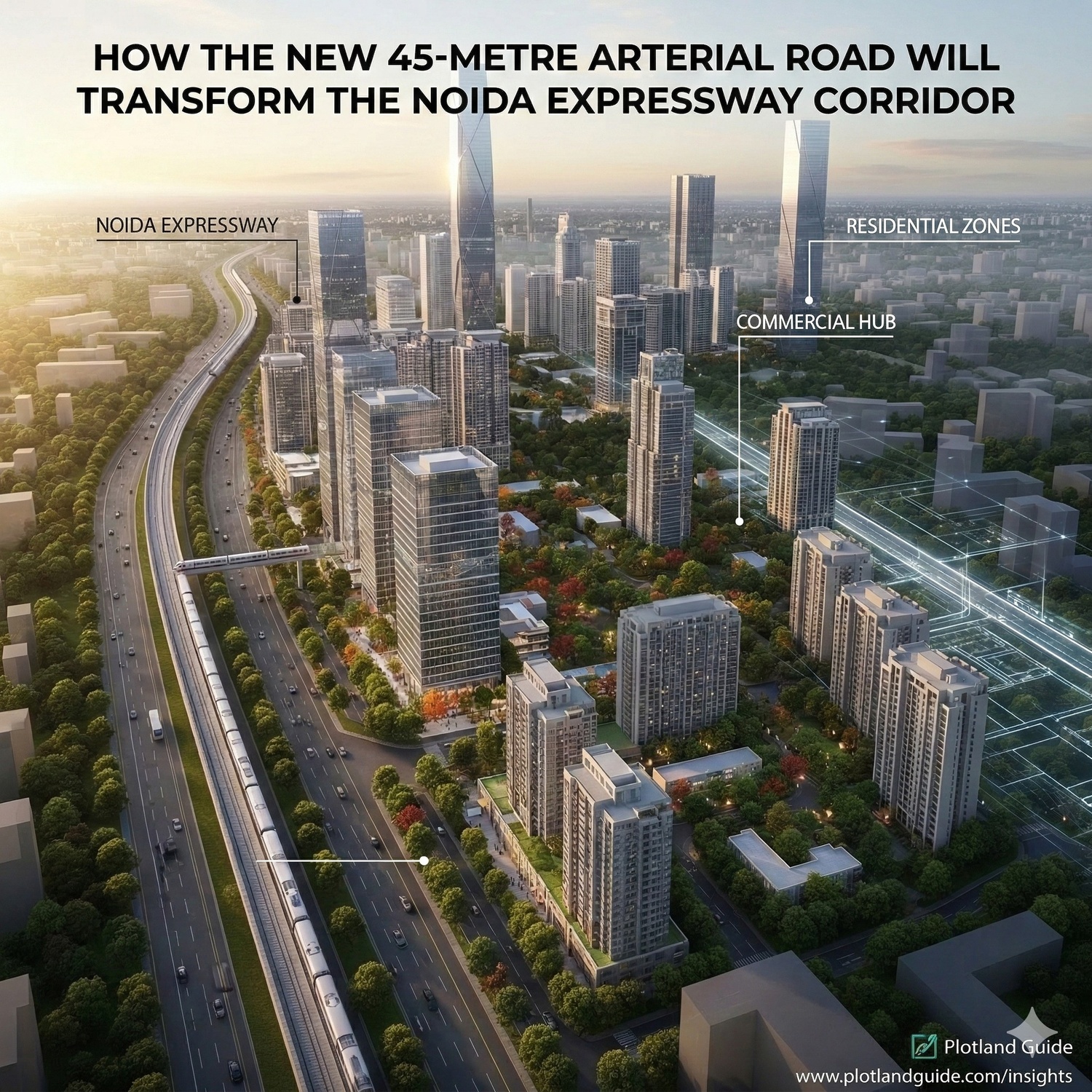
The Noida-Greater Noida Expressway has long been the primary artery connecting the national capital to the rapidly expanding real estate markets of Gautam Buddha Nagar. Over the years, this six-lane high-speed corridor has witnessed exponential growth, transforming into a bustling stretch flanked by towering residential complexes, corporate parks, and commercial hubs. However, this massive development has brought with it a severe side effect: crippling traffic congestion.
For the thousands of residents living in the newly developed sectors along this route, stepping out for a short trip to a local grocery store or a nearby school often means merging into heavy, high-speed traffic. This forced merging of local commuters with inter-city travelers has turned daily commuting into a frustrating ordeal. Recognizing this growing infrastructural strain, the local development authority is now fast-tracking a critical project: a 45-metre-wide arterial road designed to run parallel to the expressway. This project is not just a traffic management tool; it is a structural upgrade that will redefine property dynamics and daily living for thousands of families.
To understand the significance of this new road, one must look at how traffic flows in the region today. The expressway was originally designed for high-speed, long-distance travel, seamlessly connecting Delhi with Greater Noida and further down to the highly anticipated YEIDA region. It was never intended to handle internal sector-to-sector traffic.
However, as massive residential projects in sectors like 150, 151, 152, and 168 reached completion and saw an influx of residents, a distinct problem emerged. The internal sector roads were not fully connected or developed. Consequently, if a resident in Sector 150 needed to visit a clinic or a mall in Sector 168, they had no choice but to take their vehicle onto the main expressway.
This scenario plays out thousands of times every morning and evening. School buses, delivery trucks, two-wheelers, and private cars making short trips are forced to navigate the entry and exit ramps of the main highway. This constant merging and exiting drastically slows down the traffic flow, leading to massive snarls, especially during peak office hours. The lack of a continuous service lane or an alternate internal route has effectively choked one of the region’s most vital transport corridors.
The blueprint to solve this crisis lies in the city's master plan, which mandates the construction of wide, parallel arterial roads to absorb local traffic. The proposed 45-metre road is designed exactly for this purpose. Running alongside the main expressway, it aims to act as an internal highway for the adjoining sectors.
Once fully operational, this road will completely segregate local vehicular movement from long-distance traffic. A resident wanting to drop their child at a nearby school will simply use this 45-metre corridor without ever needing to touch the expressway. This separation is crucial for maintaining the high-speed nature of the main highway while simultaneously providing a safer, slower, and much more convenient route for local residents.
The concept is straightforward, but the execution has faced significant hurdles. A large portion of this road has already been constructed, paving the way for smooth internal transit in certain pockets. However, a fully functional arterial road needs to be continuous, and this is where the current challenge lies.
The primary reason this parallel road is not yet functioning at its full capacity is due to a few critical missing links. Specifically, there are three distinct patches, each roughly 70 to 80 metres long, located between Sectors 163 and 167, where construction has completely halted.
These gaps exist because the local administration has not yet been able to acquire the necessary land from local farmers and landowners. The heart of the issue, as is common with many infrastructure projects in expanding urban zones, revolves around compensation. Landowners are holding out for better financial terms, while the authorities must operate within their stipulated budgets and land valuation frameworks.
This standoff has created a frustrating situation where a highly anticipated infrastructure project is sitting idle, unable to serve its intended purpose because of a few hundred metres of unpaved land. The administration is now actively engaging with the affected parties. Negotiations are back on the table, and the authority has expressed a strong commitment to resolving these compensation disputes. Clearing these final hurdles is the absolute top priority to make the corridor functional.
For anyone tracking property and land investments across Noida and Greater Noida, infrastructure upgrades of this magnitude are massive value drivers. The completion of this 45-metre road is expected to have a profound impact on real estate valuations and buyer sentiment in the immediate vicinity.
Sectors 150, 151, 152, and 168 have already established themselves as premium residential destinations. Sector 150, in particular, is heavily marketed for its sprawling green spaces, golf courses, and high-end apartments. However, the recurring complaint from potential buyers and current residents has always been the chaotic local traffic and the forced dependency on the expressway.
By providing a dedicated, wide arterial road, the local authority is directly addressing the biggest deterrent to living in these premium sectors. Better connectivity immediately translates to a higher quality of life, which in turn drives up property demand. Real estate market analysts anticipate that once the road is fully functional, these sectors will see a noticeable appreciation in property rates. The convenience of having a smooth, uncongested route for daily chores will make these areas even more attractive to homebuyers.
Furthermore, this development is a massive positive signal for the commercial real estate sector. As connectivity improves, the commercial viability of the areas bordering the new road increases. There will likely be a surge in demand for commercial plots, retail spaces, and local shopping complexes along this route, as businesses recognize the value of setting up shop on a highly accessible local artery.
The significance of smoothing out traffic on the Noida Expressway extends far beyond the immediate sectors. This highway is the primary gateway to Greater Noida and the Yamuna Expressway Industrial Development Authority (YEIDA) region. With the upcoming international airport, proposed film city, and numerous industrial hubs slated for development along the Yamuna Expressway, traffic volumes are guaranteed to multiply in the coming years.
If the entry point to this massive economic corridor remains choked with local commuters, it creates a severe bottleneck that can slow down the overall economic momentum. The 45-metre road is a proactive measure to prevent this. By taking local traffic out of the equation, the administration is ensuring that the main expressway remains a high-speed transit corridor capable of handling the massive influx of cargo and passenger traffic expected once the mega-projects in the YEIDA region become fully operational.
This forward-thinking approach gives large-scale land investors and homebuyers the confidence to pour capital into the region. Knowing that local authorities are actively solving logistical challenges makes the entire Noida-Greater Noida-YEIDA belt a highly secure investment destination.
Beyond property values and high-speed commutes, the completion of this road will have immediate, tangible benefits for the safety and economy of the local community.
One of the most critical advantages is the drastic improvement in emergency response times. Currently, ambulances and fire engines often get stuck in unpredictable expressway traffic, where an accident or a sudden influx of vehicles can cause miles-long tailbacks. A dedicated local arterial road provides a reliable, alternative route for emergency services, ensuring they can reach residential complexes and hospitals much faster during critical moments.
Additionally, the local economy stands to gain immensely. E-commerce deliveries, local logistics, and the movement of goods between sector markets will become much more efficient. Delivery personnel will no longer have to navigate the fast-moving traffic of the expressway just to reach an adjacent sector. This streamlined movement cuts down delivery times and ultimately supports the growth of small businesses operating within these residential hubs.
The development of the 45-metre road is just one piece of a much larger puzzle. It reflects a broader shift in how the city is managing its rapid urbanization. In recent times, the administration has taken a multi-pronged approach to infrastructure management.
Alongside road construction, there have been massive anti-encroachment drives aimed at clearing footpaths and service lanes, ensuring that the existing road network is utilized to its maximum capacity. There are also comprehensive plans in motion to reroute heavy freight traffic and improve overall truck movement, keeping massive commercial vehicles away from residential streets entirely.
Other large-scale projects, such as the construction of new elevated roads and the continuous expansion of the transport network, are all working in tandem to support the city's growth. The goal is to transition from a car-dependent, single-highway model to a multi-layered transit system where local, regional, and inter-city traffic all have their dedicated, optimized routes.
Large infrastructure projects like airports and massive expressways often grab all the headlines. However, it is the completion of vital, connecting arteries like this 45-metre road that truly dictates the daily living experience of a city's residents.
While it may not be the most glamorous project on the board, its impact will be deeply felt by anyone who navigates the Noida-Greater Noida corridor on a regular basis. By eliminating the forced merging of local and inter-city traffic, this road will bring a much-needed sense of order and predictability to the commute.
The final hurdle now rests on the successful negotiation between the authorities and the local landowners. Given the high stakes and the massive public benefit at play, there is strong optimism that these missing links will soon be acquired and paved. Once the asphalt settles and the barricades are removed, the 45-metre road will quietly transform from a stalled project into the vital lifeline that finally breaks the bottleneck of the Noida Expressway.
