Published On:
June 22, 2026
Updated On:
June 22, 2026
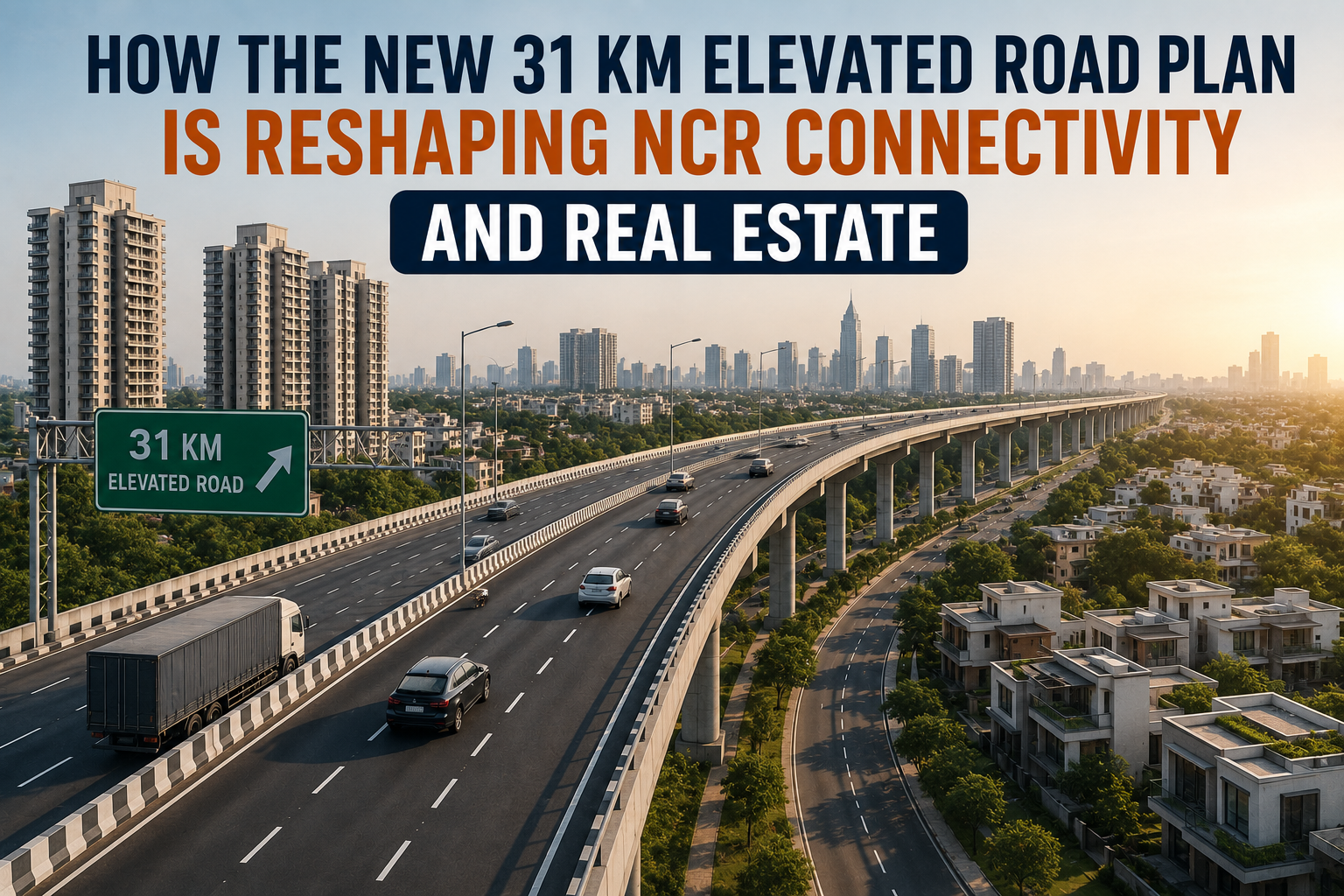
The newly proposed 31-kilometer, eight-lane elevated expressway along the Yamuna Pushta will create a seamless, signal-free corridor from East Delhi to the operational Noida International Airport. By bypassing the heavily congested Noida Expressway, this mega-infrastructure project is set to drastically reduce commute times and trigger a massive real estate boom across surrounding micro-markets.
Anyone who commutes daily between Delhi and Greater Noida understands the exhausting reality of the region's traffic. The existing Noida-Greater Noida Expressway, once hailed as a marvel of modern infrastructure, has gradually succumbed to the sheer volume of urban expansion. During peak morning and evening hours, the corridor frequently transforms into a slow-moving parking lot. Now, introduce a massive new variable into this equation: the Noida International Airport at Jewar.
With commercial flight operations having officially commenced, the region is bracing for an unprecedented influx of vehicular movement. The aviation hub is projected to handle roughly 1.2 crore passengers annually during its initial operational phase alone. Relying solely on the existing road network to shoulder this massive transit load would lead to catastrophic gridlock. Recognizing the urgency of this impending logistical nightmare, infrastructure authorities have finalized a masterstroke solution. A brand new, high-capacity 31-kilometer elevated road plan has been formally greenlit to completely bypass the traditional city bottlenecks, ensuring that Delhi Jewar airport connectivity remains swift, seamless, and entirely signal-free.
This colossal infrastructure upgrade goes far beyond simply pouring concrete and erecting pillars. It represents a fundamental geographical shift that will redefine regional mobility, turbocharge economic activity, and permanently alter the real estate dynamics of the National Capital Region.
To truly grasp the magnitude of this infrastructure initiative, one must look at its highly strategic alignment. The core of this master plan is a sprawling 31-kilometer elevated expressway designed to run completely parallel to the existing Noida Expressway. Instead of cutting through densely populated urban centers, the route intelligently utilizes the Yamuna embankment, locally known as the Pushta Road.
The physical specifications of the project highlight its ambitious capacity. It will be constructed as a massive eight-lane elevated structure, providing ample width to handle high-speed airport-bound traffic alongside heavy commercial freight. The alignment officially originates near the Okhla Barrage in Noida Sector 94, perfectly positioned right at the Delhi border. From there, it will soar above the river embankment, charting a direct path through major corporate and institutional zones encompassing Sectors 95, 125, 126, and all the way down to Sector 135.
The elevated journey finally concludes by descending into the Chi-IV sector of Greater Noida, situated strategically opposite Gautam Buddha University. At this crucial junction, the new road will seamlessly merge into the broader Yamuna Expressway network, providing a straight, uninterrupted dash to the airport terminal. To ensure that the communities situated along this massive stretch are not bypassed entirely, the design blueprint incorporates three distinct loops and interchanges. These carefully placed exit and entry ramps will allow local commuters and corporate professionals working in the intermediate sectors to easily access the high-speed corridor without causing bottlenecks on the main carriageway.
While the 31-kilometer elevated stretch is the undisputed centerpiece of this initiative, it is actually part of a much larger, highly intricate master puzzle. Urban planners recognized that simply building a highway from Sector 94 would not solve the problem of getting commuters out of the deep pockets of East and South Delhi. To achieve a truly frictionless journey, three separate road infrastructure projects have been stitched together, creating what is being referred to as the Tri-Project Formula.
The first critical piece of this puzzle is the Chilla Elevated Road. Currently under construction and slated for completion by mid-2027, this 5.5-kilometer, six-lane structure begins at the Chilla regulator near Mayur Vihar in Delhi and flies directly over the chaotic city traffic, depositing vehicles at the Mahamaya Flyover.
The second component serves as the vital missing link. Authorities are constructing a specialized 1.4-kilometer elevated connector bridge. This crucial, albeit short, segment is designed to bridge the physical gap between the Mahamaya Flyover and the starting point of the new Pushta Road highway.
The third and final piece is the monumental 31-kilometer National Highways Authority of India (NHAI) elevated corridor itself.
When these three distinct projects are fully integrated, the result is an engineering marvel. A traveler originating from Mayur Vihar or the Akshardham stretch in East Delhi will be able to ascend onto the elevated network and drive continuously in the air, completely bypassing every single traffic light, intersection, and localized jam in Noida, before seamlessly merging onto the Yamuna Expressway. This interconnected vision guarantees that airport transit times will be measured in predictable, stress-free minutes rather than unpredictable, frustrating hours.
The journey from the drafting board to active execution for this corridor has not been without its complexities. Massive civil projects must always balance the demands of rapid urbanization with the absolute necessity of ecological preservation.
Early iterations of this connectivity plan proposed extending the elevated corridor even further north to link directly with the DND Flyway. However, rigorous site inspections revealed that such an extension would cast a heavy shadow over highly sensitive zones, most notably the Okhla Bird Sanctuary and the Dalit Prerna Sthal. Recognizing the severe environmental and heritage implications, authorities made the crucial decision to drop the DND extension entirely. By fixing the starting point firmly at Sector 94, the project completely avoids encroaching upon the protected bird sanctuary, ensuring that regional development does not come at the cost of the local ecology.
Furthermore, the administrative execution of the project has seen a strategic shift to ensure timely delivery. While earlier feasibility studies and physical inspections of the existing two-lane embankment road were conducted by state-level expressways authorities, the sheer scale and national importance of the corridor necessitated central intervention. The NHAI has officially assumed full responsibility for the project's execution. A strict, non-negotiable two-year deadline has been established to bring this eight-lane giant to life, with rapid land acquisition protocols already being finalized in a rare, synchronized effort between the Noida, Greater Noida, and Yamuna development authorities.
The urgency behind this 31-kilometer elevated road plan is directly tied to the operational realities of the newly inaugurated aviation hub. An airport of this massive scale functions as an entirely new economic gravity well, pulling in immense daily traffic that extends far beyond casual travelers.
A functioning international airport demands a relentless, continuous flow of movement. Airline crews, ground operations staff, logistics operators, cargo trucks, and massive corporate fleets must travel to and from the facility around the clock. The existing Noida-Greater Noida Expressway is already operating at peak saturation during business hours. Forcing a projected 1.2 crore annual airport passengers—along with thousands of tons of cargo—onto that same aging infrastructure would not just cause traffic jams; it would actively choke the region's economic output.
The new elevated corridor acts as a high-speed pressure release valve. By completely segregating the heavy, fast-moving airport-bound traffic from the slower, localized daily office commutes, the entire regional network becomes infinitely more efficient. Professionals working in central Noida will experience significantly reduced congestion on the old expressway, while international travelers will enjoy world-class, predictable transit times on the new elevated route.
Whenever a multi-billion rupee infrastructure project of this magnitude is officially cemented, the surrounding real estate market undergoes a radical and permanent transformation. The promise of slashing commute times from the heart of the national capital down to Greater Noida is effectively erasing the psychological distance that previously deterred buyers from investing in peripheral sectors.
The most immediate and aggressive capital appreciation is anticipated in the micro-markets situated directly along the Yamuna Pushta alignment. Sectors such as 94, 95, 125, 126, and 135 have historically been viewed as prime institutional and corporate hubs, hosting major universities and towering IT parks. However, their residential appeal was somewhat capped by the grueling highway traffic. With the new elevated corridor providing ultra-fast entry and exit points through its three strategic loops, these sectors are rapidly becoming the most coveted residential addresses in the city.
Homebuyers and investors are heavily targeting these zones, fully aware that properties offering immediate access to a signal-free airport corridor command massive premium valuations. We are already witnessing a sharp surge in inquiries for premium apartments, luxury condominiums, and high-end rental properties in these specific areas. Corporate executives, expatriates, and aviation professionals who require rapid access to both the airport and the central business districts of Delhi will form a highly lucrative tenant base, driving up rental yields significantly.
The real estate impact is not isolated to Noida alone. The terminus point of the elevated road—the Chi-IV sector and the surrounding areas near Gautam Buddha University in Greater Noida—is poised for a monumental boom. For years, Greater Noida has offered exceptional, wide-road urban planning and affordable square footage, but its distance from central Delhi remained a massive sticking point for daily commuters.
The new 31-kilometer expressway completely shatters that barrier. By dropping commuters directly into Chi-IV, Greater Noida is suddenly thrust into the immediate transit orbit of the capital. This newly unlocked accessibility is transforming the area into a hotspot for large-scale integrated townships, premium villa projects, and sprawling commercial retail spaces. Families who previously found Greater Noida too disconnected are now eagerly buying into the market, trading cramped city apartments for expansive suburban living, secure in the knowledge that their daily commute has been optimized by an eight-lane elevated highway.
Furthermore, the commercial real estate sector is aggressively acquiring land parcels around these terminal points. The hospitality industry is rushing to establish five-star transit hotels, premium service apartments, and massive convention centers to cater to the upcoming influx of international business travelers. Logistics companies are equally active, snapping up warehousing spaces near the Yamuna Expressway merge point to ensure their cargo fleets have immediate, unhindered access to the airport's freight terminals.
Infrastructure of this caliber acts as a massive economic multiplier. The 31-kilometer elevated road is the physical artery that will pump investment, talent, and capital into the broader Yamuna Expressway region.
As global corporations and multinational capability centers observe the seamless integration of road and air transit, their reluctance to move operations out of central Delhi or Gurugram will rapidly dissolve. The ability to establish massive corporate campuses in the relatively affordable zones of Greater Noida, while maintaining a sub-forty-minute connection to an international aviation hub, is an irresistible proposition for global businesses. This corporate migration will create thousands of localized jobs, further fueling the demand for high-quality housing, retail arcades, and international schools along the entire corridor.
The National Capital Region is currently standing at the precipice of its most significant urban evolution in a generation. The 31-kilometer Yamuna Pushta elevated corridor is a masterclass in forward-thinking urban planning. It directly addresses the immediate crisis of highway congestion while proactively laying the foundational groundwork necessary to support a massive global aviation economy.
By integrating seamlessly with the Chilla Elevated Road and the Mahamaya connector, this tri-project framework promises a future where the grueling, unpredictable daily commute is permanently relegated to the past. As the heavy machinery mobilizes and the massive concrete pillars begin to rise from the river embankment over the next 24 months, the boundaries of what constitutes the central urban core are effectively expanding. For commuters seeking relief, businesses seeking efficiency, and investors seeking unparalleled capital growth, this elevated highway is the ultimate gateway to the future of the National Capital Region.
