Published On:
April 23, 2026
Updated On:
April 23, 2026
The reopening of a crucial 900-metre missing link between sectors 68 and 69 on Gurgaon's Southern Peripheral Road has catalyzed a ₹25.3 crore road expansion project. This long-awaited infrastructural upgrade promises to eliminate severe traffic bottlenecks, drastically cut commute times, and drive a massive surge in real estate value across emerging residential hubs.
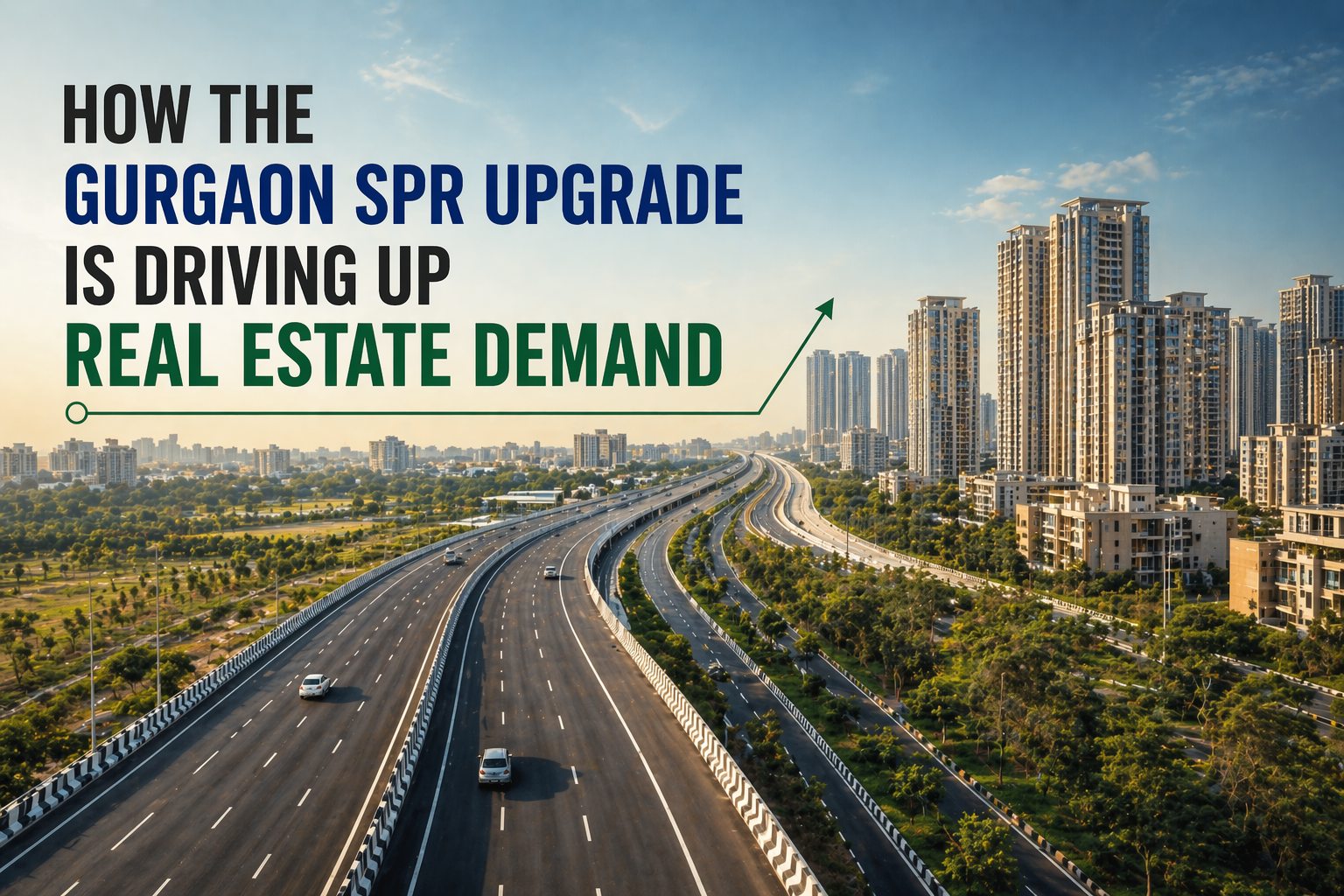
Some roads do not just carry daily vehicular traffic; they shoulder the immense weight of an entire city’s economic and residential growth. Over the past decade, this is exactly what happened to the Southern Peripheral Road in Gurgaon. Designed to act as a seamless bypass, the corridor was quickly swallowed by the city’s rapid urban sprawl. Glass corporate towers, sprawling luxury housing clusters, and bustling retail hubs grew at a pace that far exceeded the development of the underlying civic infrastructure. The inevitable result was a daily commuting nightmare, characterized by endless bottlenecks and frustrating delays.
However, a major breakthrough is currently unfolding. The highly anticipated Gurgaon SPR upgrade is finally in motion, spearheaded by the reopening of a notorious missing link that has plagued drivers for years. For the thousands of residents and corporate professionals who rely on this arterial stretch to dodge the chaotic traffic of the Delhi-Jaipur highway, this development is nothing short of a massive relief.
Understanding the Bottleneck: Why the 900-Metre Missing Link Mattered
In the complex matrix of urban road networks, even the smallest disruption can cause catastrophic traffic failures. For a long time, the primary culprit behind the agonizing traffic jams on the Southern Peripheral Road was a mere 900-metre incomplete stretch of road situated right between Sector 68 and Sector 69. While 900 metres might sound insignificant on paper, in a heavily populated urban corridor, a gap of this size completely chokes vehicular movement.
Because this crucial link was missing, the continuity of the entire Southern Peripheral Road was broken. Thousands of cars, freight trucks, and two-wheelers were forcefully diverted into narrow, makeshift detours on a daily basis. These enforced detours easily added anywhere from fifteen to twenty-five minutes to incredibly short local trips. The missing connection quietly disrupted the flow of the entire region, creating a massive ripple effect of congestion that spilled over into surrounding neighborhoods. Drivers were forced to engage in aggressive merging, while the local residential lanes, never designed to handle heavy highway traffic, deteriorated rapidly under the immense vehicular load.
Inside the ₹25.3 Crore Expansion Plan: More Than Just a Patchwork
Recognizing that a simple patch-up job would not sustain the projected future growth of the city, the Gurugram Metropolitan Development Authority has rolled out a comprehensive ₹25.3 crore road expansion plan. This initiative goes far beyond merely laying down asphalt over the missing 900-metre stretch. It is a highly strategic redesign of how traffic behaves and flows through the corridor.
The most critical component of this expansion is the construction of approximately 3.5 kilometers of brand new, high-quality service roads. In addition, the authorities are developing a parallel corridor aimed directly at reducing the core load on the main carriageway of the Southern Peripheral Road. This specific design philosophy targets one of the most fundamental flaws of Gurgaon's historical road planning: the chaotic blending of fast-moving, long-distance traffic with slow-moving local vehicles.
By introducing dedicated service lanes alongside a dual carriageway, local residents looking to access their residential societies or nearby markets will no longer need to merge onto the high-speed main road. The heavy inter-sector traffic is completely segregated from the neighborhood commute. Furthermore, the civic authorities are stepping away from a purely motorized focus. The new road design actively incorporates green belts to reduce pollution, properly paved footpaths for pedestrian safety, and dedicated cycle tracks to encourage alternative, eco-friendly transit options.
How the Reopened Link Transforms Daily Commutes
The reopening of the Sector 68 and 69 link is not a flashy piece of infrastructure. It does not feature the towering pylons of a massive expressway or the architectural grandeur of a multi-level interchange. Yet, the impact on the daily lives of the local population is profound. Sometimes, the most effective urban solutions are the simplest ones that restore the natural flow of movement.
With the 900-metre gap finally bridged, the immediate effect is a drastic reduction in stop-start traffic. Commuters living and working across Sectors 58 through 75 are the first to experience this massive upgrade. The agonizing daily crawl through forced detours has been eliminated, translating into significantly shorter office commutes and a highly predictable travel time. Improved last-mile connectivity within the interior sectors means that residents can navigate their local environment without the chronic stress that previously defined the Gurgaon driving experience.
Real Estate Boom: The Ripple Effect on Sectors 58 to 75
In the real estate sector, there is an unwritten law that property developers and investors follow religiously: capital always follows infrastructure. The state of the roads fundamentally shapes property markets far more effectively than glossy marketing brochures. When a region's connectivity improves, a surge in housing demand and commercial interest is guaranteed to follow closely behind.
The areas flanking the Southern Peripheral Road, particularly the newly developing sectors of Gurgaon, have been commanding attention for several years. However, the chronic traffic bottlenecks previously acted as a psychological barrier for many mid-income buyers and luxury investors who prioritized a smooth daily commute. The reopening of the missing link and the ongoing road expansion plan act as a massive catalyst, adding a thick layer of confidence to the local property market.
Real estate analysts are already noting a sharp uptick in demand for apartments and villas situated along the SPR corridor. Better road networks directly correlate with superior resale value and highly lucrative rental yields. The upgrade signals to both end-users and long-term investors that the civic administration is actively committed to the region's livability. As a result, the SPR is rapidly cementing its status as one of Gurgaon's premier luxury and premium mid-segment housing hubs, where capital appreciation feels inevitable rather than speculative.
The Broader Vision: Elevated Corridors and Signal-Free Transit
While the ₹25.3 crore upgrade and the fixing of the Sector 68-69 gap provide immediate relief, they are actually just the opening act of a much larger, highly ambitious master plan for the Southern Peripheral Road. To truly future-proof the city against the next wave of demographic expansion, the Gurugram Metropolitan Development Authority has engineered a massive, multi-phase infrastructure overhaul.
Moving beyond surface-level expansions, the civic body is actively advancing a massive ₹755 crore mega-project designed to construct a signal-free elevated corridor along the most congested segments of the SPR. The focal point of this massive financial outlay is the highly critical Vatika Chowk interchange. The blueprint outlines a sprawling 4.2-kilometer elevated stretch that will directly link Vatika Chowk to National Highway 48.
This specific corridor is planned as an eight-lane elevated expressway, featuring four lanes in each direction to facilitate high-speed, uninterrupted traffic movement. Below the elevated structure, an intricate network of three-lane primary service roads and two-lane secondary service lanes will handle the ground-level, localized traffic. By strategically placing ramps and loops at major junctions, vehicles will be able to navigate the corridor and change directions without ever having to stop at a traditional traffic light. This layered infrastructure design ensures that heavy logistics vehicles and inter-city commuters bypass the local city traffic entirely, permanently eliminating the severe gridlock that typically plagues Vatika Chowk during peak hours.
Mastering the Terrain: The 12-Kilometre Ghata Chowk Plan
The vision for a signal-free Southern Peripheral Road extends even further. After years of intense debate and numerous design revisions regarding the feasibility of underpasses versus flyovers, state authorities have finalized a master directive to develop the entire 12-kilometre stretch from Ghata Chowk all the way to NH-48 as a continuous elevated road.
This decision was heavily influenced not just by traffic volume, but by the unique geographical challenges of the Gurgaon landscape. The natural gradient of the Aravalli foothills dictates that during the intense monsoon season, heavy rainwater naturally flows from the elevated Ghata region directly towards Badshapur. Historically, this topography has resulted in severe waterlogging and flooding across the surface roads, bringing the entire southern corridor to a grinding halt every rainy season.
By committing to a fully elevated corridor, the authorities are executing a brilliant dual-purpose engineering solution. The elevated road guarantees the smooth, uninterrupted movement of traffic regardless of the weather conditions on the ground, while the surface level can be properly engineered with advanced drainage networks to manage the monsoon runoff without destroying the asphalt.
Strategic Connectivity: The Ultimate Distribution Spine
To fully grasp the magnitude of the Gurgaon SPR upgrade, one must look at a regional map. The Southern Peripheral Road does not exist in isolation; it is the vital connecting artery between some of the most critical infrastructure mega-projects in northern India.
The SPR serves as the primary distribution spine linking the newly inaugurated Dwarka Expressway, the monumental Delhi-Mumbai Expressway, and the highly utilized Gurugram-Sohna Elevated Corridor. By upgrading the SPR to a high-capacity, signal-free route, the government is essentially creating an unbroken chain of high-speed transit. A logistics truck or a corporate commuter will soon be able to exit the Delhi-Mumbai Expressway, merge onto the elevated SPR, and seamlessly transition onto the Dwarka Expressway without ever touching a local city street or waiting at a red light. This level of hyper-connectivity is unprecedented in the National Capital Region and will fundamentally alter the logistics and commercial dynamics of the state.
Why Infrastructure Defines the Future of New Gurgaon
The continuous evolution of the Southern Peripheral Road is a testament to a broader shift in how urban planning is currently being approached in Gurugram. For years, the city’s growth was heavily reactive; authorities only built flyovers and expanded roads after the traffic congestion had spiraled entirely out of control.
The current wave of developments, from the reopening of the crucial missing link to the planning of the massive Vatika Chowk elevated corridor, highlights a much more proactive strategy. Planners are now looking ahead, anticipating the massive influx of residents and businesses that will occupy the under-construction commercial hubs and luxury residential projects bordering the corridor. They are prioritizing connectivity and long-term travel time reliability over short-term patchwork fixes.
For the everyday commuter, these mega-projects and multi-crore budgets ultimately boil down to something incredibly simple and highly valuable: reclaiming lost time. Whether it is a resident of Sector 70 shaving twenty minutes off their morning drive, or a family finally enjoying a smooth, stress-free ride home during the evening rush hour, the true value of the SPR upgrade lies in the massive improvement to the overall quality of urban life. As the concrete is poured and the final missing links are paved over, the Southern Peripheral Road is rapidly transforming from a dreaded daily bottleneck into the premier, high-speed lifeline of modern Gurgaon.
