Published On:
August 24, 2026
Updated On:
August 24, 2026
The Yamuna Expressway Industrial Development Authority has officially approved a colossal 480-acre university township in Sector 14, designed to create a globally competitive education and innovation ecosystem. Integrated with upcoming medical hubs and industrial clusters, this visionary project is set to exponentially drive real estate demand and transform the Noida region into a premier knowledge economy.
The landscape of the National Capital Region is undergoing a profound structural evolution. For years, the Yamuna Expressway was viewed primarily as a high-speed transit corridor connecting Greater Noida to Agra, flanked by vast expanses of agricultural land and speculative real estate projects. Today, that perception is rapidly changing. Driven by aggressive infrastructural planning and the imminent operationalization of the Noida International Airport at Jewar, the region is transforming into a meticulously planned mega-city. However, the most compelling catalyst for this transformation is not just aviation or traditional manufacturing—it is the strategic pivot towards higher education and institutional development.
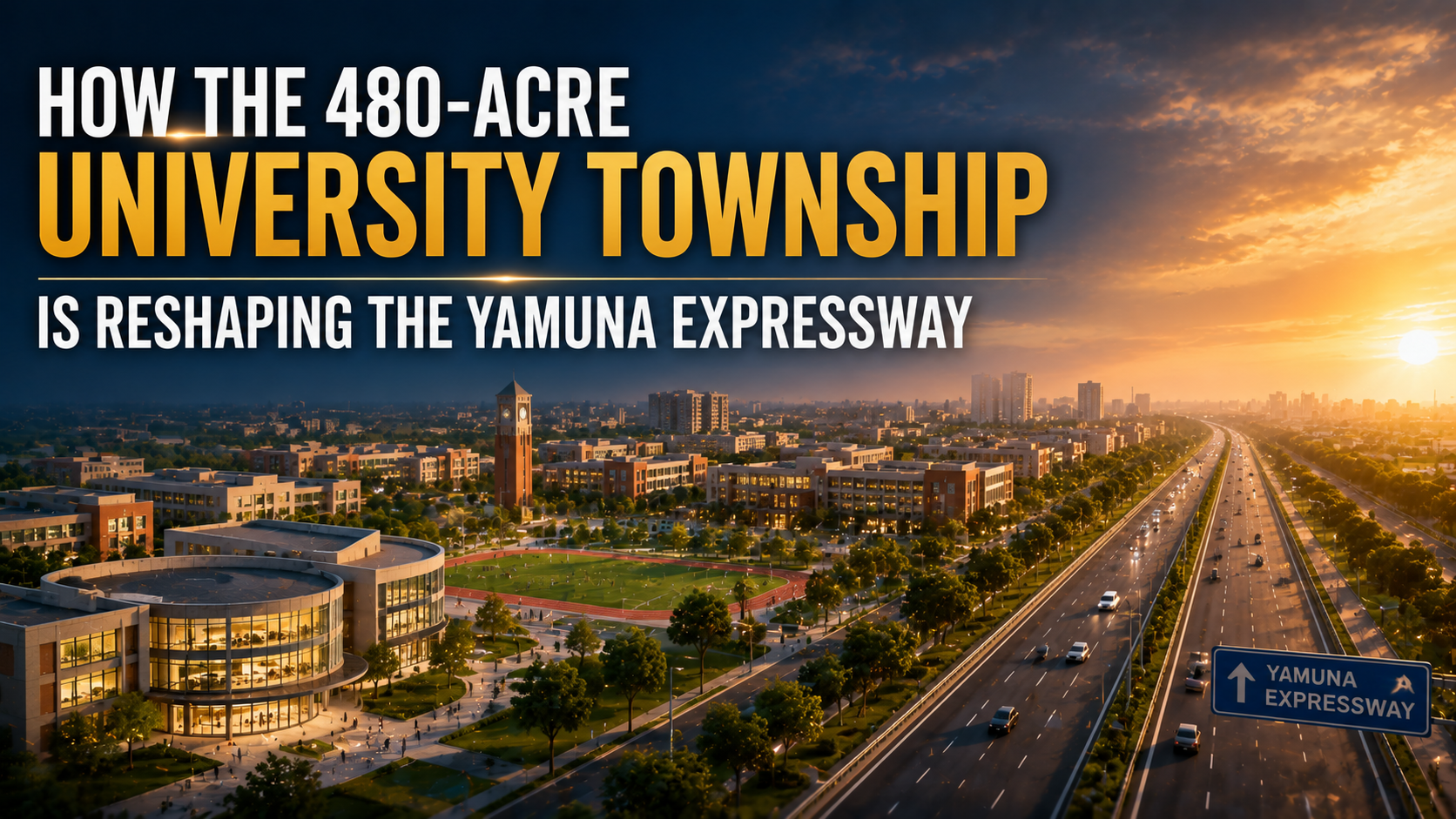
In a landmark decision during its recent board meeting, the Yamuna Expressway Industrial Development Authority officially approved the creation of a massive university township. Spanning an incredible 480 acres in Sector 14, this development is the first of a proposed series of five educational townships intended to be built along the expressway. This is not merely an allocation of land for a few college campuses; it is a visionary urban planning initiative aimed at building a fully integrated, self-sustaining knowledge and innovation ecosystem. For real estate investors, prospective homebuyers, and urban analysts, this development signals a monumental shift in the economic trajectory of the Yamuna Expressway corridor.
To understand the magnitude of the 480-acre allocation, it is essential to look at the global models that have inspired it. The planners envision this township functioning similarly to the world-renowned Kendall Square in Cambridge, Massachusetts, or the Tsukuba Science City in Japan. The core philosophy is to completely erase the traditional boundaries between academia and industry.
A university township operates on a scale far larger than a traditional educational institution. It is designed as an all-encompassing urban center where students, professors, and researchers live, work, and innovate within a single planned environment. Beyond academic blocks and lecture halls, the 480-acre expanse will house cutting-edge research laboratories, startup incubation centers, massive central libraries, and advanced skill-development facilities. It will also feature dedicated residential zones comprising student dormitories, faculty housing complexes, and premium guest accommodations for visiting international scholars.
The true genius of this plan lies in its location. By positioning the university township directly adjacent to the rapidly developing industrial hubs along the Yamuna Expressway, the authority is engineering a seamless pipeline from education to employment. Students pursuing degrees in engineering, biotechnology, or business administration will have direct, physical access to the manufacturing plants, tech parks, and corporate offices being built just a few sectors away. This physical proximity fosters aggressive collaboration between universities and corporations, driving research funding, internship programs, and immediate job placements.
The 480-acre university township does not exist in isolation. It is a critical piece of a much larger, highly orchestrated master plan designed to turn the region into a powerhouse of specialized industries. During the same board meeting, the authority sanctioned a sweeping array of complementary mega-projects that will directly interact with the educational sector.
Most notably, a colossal 500-acre medical hub has been approved across Sectors 13 and 14. This health-centric development will sit right next to the university township, creating an unparalleled synergy. The medical hub is expected to attract top-tier medical colleges, super-specialty hospitals, and advanced clinical research organizations. For students enrolled in the adjacent university township, this means immediate access to world-class medical training and research facilities.
The industrial diversification extends even further into the life sciences. The authority has reserved a significant land parcel in Sector 6 to develop a dedicated Pharmaceutical Formulation Manufacturing Cluster. Designed to meet stringent international Good Manufacturing Practice standards, this cluster will house facilities producing everything from injectables to advanced medicinal formulations. Furthermore, to cement the region's status as a healthcare manufacturing leader, a state-of-the-art medical device testing facility is being established in accordance with strict international compliance frameworks.
By clustering a university township, a medical hub, and a pharmaceutical manufacturing zone within a few kilometers of each other, the planners are creating a self-reinforcing economic loop. The universities provide the highly skilled talent and the research capabilities, while the medical and pharmaceutical hubs provide the capital, the practical application, and the ultimate employment destination.
The ambition of the Yamuna Expressway corridor extends well beyond education and healthcare. Recognizing the urgent need to capture international manufacturing investments, the authority has also approved the reservation of 300 acres for the establishment of a dedicated Taiwan City. This specialized zone is specifically tailored to attract Taiwanese electronics, semiconductor, and technology manufacturing companies. As global supply chains continue to shift, having a dedicated international tech city will drastically elevate the industrial profile of the entire region.
Supporting this massive influx of students, healthcare professionals, and international tech workers requires robust civic infrastructure. To this end, plans are in motion for a modern interstate bus terminal to ensure seamless public transit connectivity. For recreation and regional prestige, a sprawling international sports stadium is also being planned, capable of hosting major national and global sporting events. Every single one of these projects—from Taiwan City to the international stadium—adds an immense layer of intrinsic value to the region, ensuring that the population migrating to the university township will have access to a world-class, globally connected lifestyle.
While the master plan is undeniably spectacular on paper, executing mega-projects spanning hundreds of acres involves navigating the deeply complex reality of land acquisition. The Yamuna Expressway corridor has a highly sensitive history regarding land rights and farmer compensation. When the expressway was initially being constructed over a decade ago, the region witnessed intense friction and widespread protests from local agricultural communities who felt they were not adequately compensated for their ancestral lands.
Those early disputes serve as a permanent cautionary tale for regional planners. A project as massive as a 480-acre university township, coupled with a 500-acre medical hub, requires the seamless aggregation of vast land parcels. Any prolonged litigation or community resistance could severely delay construction timelines.
To prevent history from repeating itself and to ensure smooth project execution, the authorities have recently overhauled their compensation frameworks, adopting a far more conciliatory and financially lucrative approach for landowners. The rates for purchasing land through mutual consent for planned development have been strategically increased. Currently, landowners are being offered enhanced financial compensation rates per square meter, with built-in provisions for receiving developed residential plots as part of the settlement.
This alternative arrangement—offering farmers a percentage of developed land in addition to a fixed financial payout—is a game-changer. It transforms displaced farmers from mere subjects of acquisition into direct stakeholders in the region's urbanization. As the university township develops and the value of the surrounding land skyrockets, the farmers who hold these developed plots stand to reap massive financial benefits. Maintaining this transparent, mutually beneficial relationship with the local communities will be the single most critical factor in ensuring the timely realization of the university township.
For the real estate sector, the announcement of the 480-acre university township is the equivalent of striking oil. Educational institutions act as incredibly powerful, recession-proof economic anchors. While corporate offices might downsize during a recession and manufacturing plants might face supply chain disruptions, universities continue to operate, enroll students, and employ faculty year after year.
This creates a highly stable, continuous demand for real estate. The immediate micro-markets surrounding Sector 14 are poised to experience an unprecedented surge in property valuations and rental yields. The most obvious and immediate requirement will be student housing. While the township will undoubtedly have internal dormitories, the sheer volume of the student population will inevitably spill over into the surrounding sectors. This presents a massive opportunity for real estate developers to introduce purpose-built co-living spaces, managed student accommodations, and affordable studio apartments.
Simultaneously, the thousands of professors, researchers, doctors, and administrative staff who will be employed across the university township and the adjacent medical hub will require high-quality residential housing. This demographic typically seeks premium apartments, gated villa communities, and family-oriented amenities. Consequently, developers who have already secured land banks along the expressway are aggressively pivoting their project designs to cater to this highly educated, upper-middle-class workforce.
The commercial real estate sector will also experience a massive derivative boom. A vibrant student and professional population requires a diverse retail ecosystem. We can expect a rapid proliferation of shopping arcades, multiplexes, cafes, bookstores, and fitness centers in the immediate vicinity. Furthermore, the presence of startup incubators within the university township will drive demand for flexible co-working spaces and boutique corporate offices just outside the campus boundaries.
For years, investing in the Yamuna Expressway was considered a long-term play, heavily reliant on the eventual success of the Jewar Airport. However, the introduction of the university township fundamentally alters the investment timeline and the risk profile of the region. The airport provides global connectivity, but it is the educational, medical, and industrial townships that provide the actual substance—the daily footfall, the massive employment generation, and the sustainable economic activity.
Homebuyers and investors looking at the Noida and Greater Noida markets must now factor the university township into their calculations. Properties located within a ten-to-fifteen-kilometer radius of Sector 14 are structurally positioned for aggressive capital appreciation over the next five to seven years. As the initial ground-breaking occurs and the physical infrastructure of the academic blocks begins to take shape, buyer confidence will solidify, driving property prices upward in a highly predictable trajectory.
Moreover, this development brings a much-needed demographic shift to the region. A landscape dominated by students, healthcare professionals, and tech researchers inherently fosters a progressive, safe, and culturally vibrant community environment. This makes the Yamuna Expressway not just a lucrative place to invest, but an incredibly desirable place to actually live.
The blueprint laid out by the Yamuna Expressway Industrial Development Authority is nothing short of audacious. By dedicating 480 acres to a university township and seamlessly integrating it with massive medical and manufacturing hubs, Noida is essentially building a new, highly specialized city from scratch.
As the administrative cogs turn and the land acquisition processes advance, the focus will soon shift to execution. Attracting elite national and international universities to set up campuses within the township will be the next major milestone. If the authorities can maintain their current momentum, ensure fair land acquisition practices, and execute the infrastructure development on schedule, the Yamuna Expressway is destined to become much more than a transport corridor.
It is on a definitive path to becoming India’s premier knowledge economy hub—a place where education, healthcare, and global manufacturing converge. For the real estate market, the university township is the ultimate catalyst, promising to deliver sustained, high-yield growth for decades to come, and permanently etching the Yamuna Expressway onto the global map of master-planned urban excellence.
