Published On:
July 26, 2026
Updated On:
July 26, 2026
The digital revolution in finance has fundamentally shifted the investment paradigm from outright asset ownership to simplified, fractional access, breaking down entry barriers across government bonds, real estate, and equity markets.
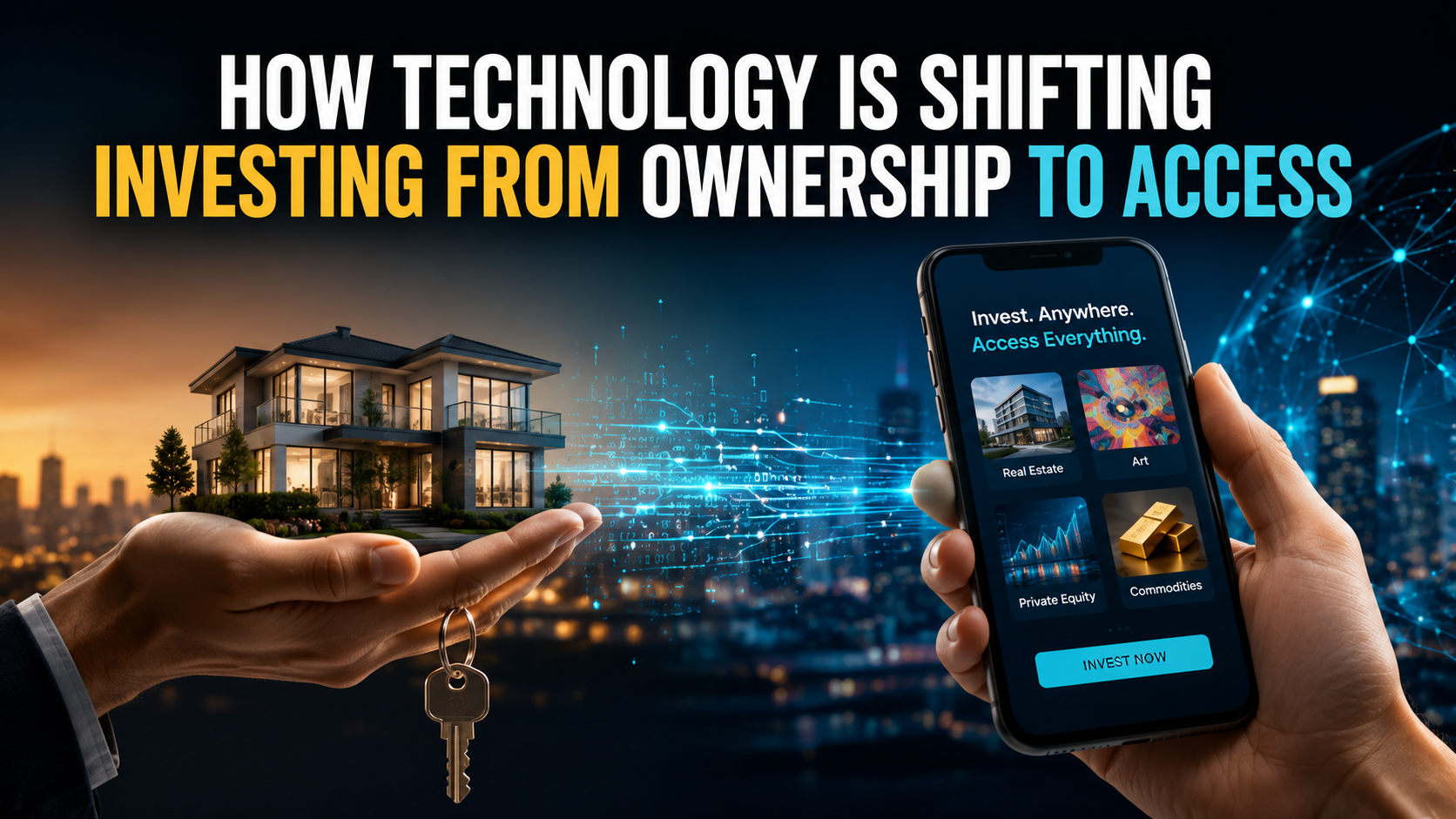
For decades, the mechanics of investing were built around a simple concept: outright ownership. If you wanted to participate in the real estate market, you needed the capital to buy an entire property. If you wanted to buy stocks, you called a broker and purchased large blocks of shares. If you wanted government bonds, you went through institutional channels. The entry barriers were exceptionally high, and the operational friction kept the vast majority of retail participants out of the most lucrative financial asset classes.
Today, that entire system has been structurally rewired. The underlying assets have not changed. A commercial office building still generates rental yield, a government bond still pays sovereign interest, and a mutual fund still represents a basket of equities. What has drastically transformed is how everyday individuals interact with these instruments.
Technology has initiated a profound shift from the traditional concept of exclusive ownership to a modern model of frictionless access. We are no longer required to commit massive amounts of capital to participate in premium opportunities. Through digital infrastructure, regulatory innovation, and fractionalised investing frameworks, the financial ecosystem has been broken down into bite-sized economic units. This comprehensive evolution is not just a passing trend; it is a permanent restructuring of how wealth is generated, preserved, and distributed.
To understand what is happening in the investment world, it helps to look at how technology has altered consumer behaviour in other areas of our daily lives. A generation ago, listening to music meant buying a physical compact disc. Watching a movie at home meant purchasing a DVD. Commuting meant buying a car and dealing with insurance, maintenance, and depreciation.
Then came the streaming and ride-sharing revolution. Technology shifted the consumer focus away from owning the physical asset and towards simply accessing the service when needed. We now pay a small fee to access endless libraries of music and media, or summon a vehicle on demand without ever worrying about oil changes or parking spaces.
The financial sector is now reflecting this exact same pattern. Instead of locking up crores of rupees to buy a physical asset, an investor can participate in the economic benefits of that asset through digital channels. Technology has systematically lowered the entry barriers, digitised complex transactions, and vastly improved the transparency of capital markets. This paradigm shift means wealth creation strategies that were once exclusively available to institutional players and ultra-high-net-worth individuals are now available on a smartphone screen.
One of the most striking examples of this technological shift is how individuals now access sovereign debt. Historically, government securities were the domain of large banks, provident funds, and institutional investors. Retail participation was minimal due to complex bidding processes and a lack of direct market access.
This friction was entirely removed with the introduction of the Reserve Bank of India's Retail Direct platform. The platform is a prime example of technology rewriting the rules of engagement. It allows everyday retail investors to open a digital account directly with the central bank. Without the need for any broker, bank dealer, or middleman, individuals can now buy and sell government securities with complete transparency and control.
The digital portal allows users to place non-competitive bids in the primary issuance of central government securities, state development loans, and treasury bills. This means investors do not have to worry about quoting the exact yield or price in an auction; they simply participate and receive their allotment. Furthermore, the platform provides direct access to the secondary market through a screen-based electronic anonymous order matching system.
By taking this process entirely online, the central bank has bridged a massive financial inclusion gap. Investors can now enjoy the safety and long-term stability of sovereign bonds from the comfort of their homes, accessing services around the clock without waiting for physical bank branches to open. The underlying instrument remains the same, but the route to participation has been entirely simplified through technology.
Perhaps nowhere is the shift from ownership to access more visible, and more impactful, than in the commercial real estate sector. The commercial office segment has always commanded premium rental yields, typically much higher than standard residential properties. However, participating in India’s commercial real estate growth story used to be highly binary. An investor either needed tens of crores to buy physical office spaces or had to settle for broad secondary market exposure through traditional public real estate investment trusts.
The rapid digital evolution of the property market has introduced newer investment models that structurally transform the real estate capital stack. Through technology-enabled platforms, the asset class is being broken down. Emerging fractional ownership frameworks now allow individuals to buy into yielding, premium commercial assets with significantly lower minimum capital thresholds.
To bring this expanding ecosystem of fractional property investing under a uniform and protected legal framework, the market regulator formally amended its guidelines, establishing the Small and Medium Real Estate Investment Trusts framework. This regulatory move reshapes the rules of engagement by enforcing institutional-grade safeguards on digital platforms.
Under these new guidelines, the minimum asset size for an investment scheme is set between fifty crore and five hundred crore rupees, opening up an entirely new tier of commercial buildings for regulated investment. To shield investors from the risks of construction delays, the rules mandate that the vast majority of the scheme's assets must be fully completed and income-generating. Crucially, the regulations require that all of the net distributable cash flows must be paid out directly to investors, ensuring consistent cash flow delivery.
Platforms that facilitate these investments are no longer just acting as brokers; they are gateways to previously inaccessible wealth generation. They allow an investor to bypass the massive capital requirements, stamp duty hassles, and property management headaches associated with physical ownership. Instead, the investor simply accesses the financial benefits of the premium real estate market.
While real estate and government bonds showcase recent regulatory shifts, the equity markets provide the longest-standing proof of technology’s power to widen participation. The operational friction involved in buying listed shares or mutual funds used to be immense. It required physical forms, wet signatures, in-person verification, and long waiting periods for execution.
Today, the entire lifecycle of an equity investment is handled digitally. An investor can complete their 'know your customer' verification using biometric authentication, open a demat account, and start a systematic investment plan in a matter of minutes. Digital platforms have made it incredibly easy to compare products, execute transactions, and monitor portfolios from a single, unified interface.
This removal of practical obstacles has led to explosive industry growth. The total assets under management in the mutual fund industry have swelled to massive proportions, reflecting an expanding, geographically diverse investor base across the country. The digital revolution solved a crucial problem: it made financial products easier to discover, understand, and access. Technology has not altered what an exchange-traded fund represents or how a mutual fund operates, but it has completely reinvented the user experience.
The shift toward accessible investing is heavily supported by underlying technological infrastructure that ensures security, auditability, and trust. As the financial sector breaks assets down into smaller units, maintaining accurate records of ownership becomes infinitely more complex.
To solve this, many modern fractional investing and digital platforms utilize advanced ledger systems and blockchain-based architectures. These decentralized networks support immutable record-keeping and robust transaction management. By maintaining tamper-evident digital records of ownership interests, these systems provide a level of transparency that traditional paper-based ledgers could never achieve.
This infrastructure is not just a backend convenience; it is a critical component of investor protection. When hundreds of individuals hold fractional stakes in a single commercial asset, the integrity of the ownership record is paramount. The technology ensures that every transaction, every dividend distribution, and every transfer of ownership is permanently recorded and instantly verifiable.
While the democratization of capital markets is undoubtedly a positive development, it brings forth a new set of challenges. The greatest misconception about technology in finance is the assumption that a simplified process equates to a safer investment. This is a dangerous fallacy.
Technology has made investing significantly faster, vastly more convenient, and widely accessible. However, it has not made investing risk-free. Markets continue to fluctuate, economic cycles still turn, and the underlying assets are still subject to commercial realities.
When entry barriers are lowered, the responsibility on the individual investor increases proportionally. A digital platform can seamlessly execute a trade in a fraction of a second, but it cannot determine whether that specific asset aligns with your personal financial goals, your timeline for needing liquidity, or your inherent tolerance for risk.
The wider choice available to investors today demands a higher level of financial literacy. Easier access does not eliminate the fundamental need for diversification. It does not replace the requirement for thorough due diligence. Just because you can buy into a premium commercial building or a government bond from your smartphone while waiting for a coffee does not mean the decision should be made lightly. Investors must actively educate themselves about the mechanics of the assets they are accessing, the fee structures of the platforms they use, and the regulatory frameworks protecting their capital.
We are currently witnessing a golden age of financial accessibility. The transition from requiring outright ownership to enabling fractional access is reshaping the demographics of wealth creation. The financial sector is no longer an exclusive club reserved for those with immense inherited capital or deep institutional connections.
As we move forward, the next phase of financial innovation will likely focus less on merely digitizing existing legacy processes and more on discovering innovative ways to widen participation even further. As more alternative asset classes become available through highly regulated digital channels, the everyday investor will enjoy a level of choice and flexibility that previous generations could not have imagined.
The underlying investments will always remain the bedrock of the economy. The buildings will still stand, the businesses will still operate, and the governments will still issue debt. What has permanently changed is the door to enter these markets. Technology has swung that door wide open, inviting anyone with a smartphone and a willingness to learn into the fold. The rules of investing have indeed been rewritten, and the future of wealth building is now accessible to all.
