Published On:
August 24, 2026
Updated On:
August 24, 2026
A comprehensive analysis of how AI-led tech layoffs and global geopolitical uncertainties triggered a 6.1% decline in India's Q2 2026 housing sales, disproportionately impacting the sub-₹1 crore segment in major IT hubs even as property prices paradoxically continued their upward surge.
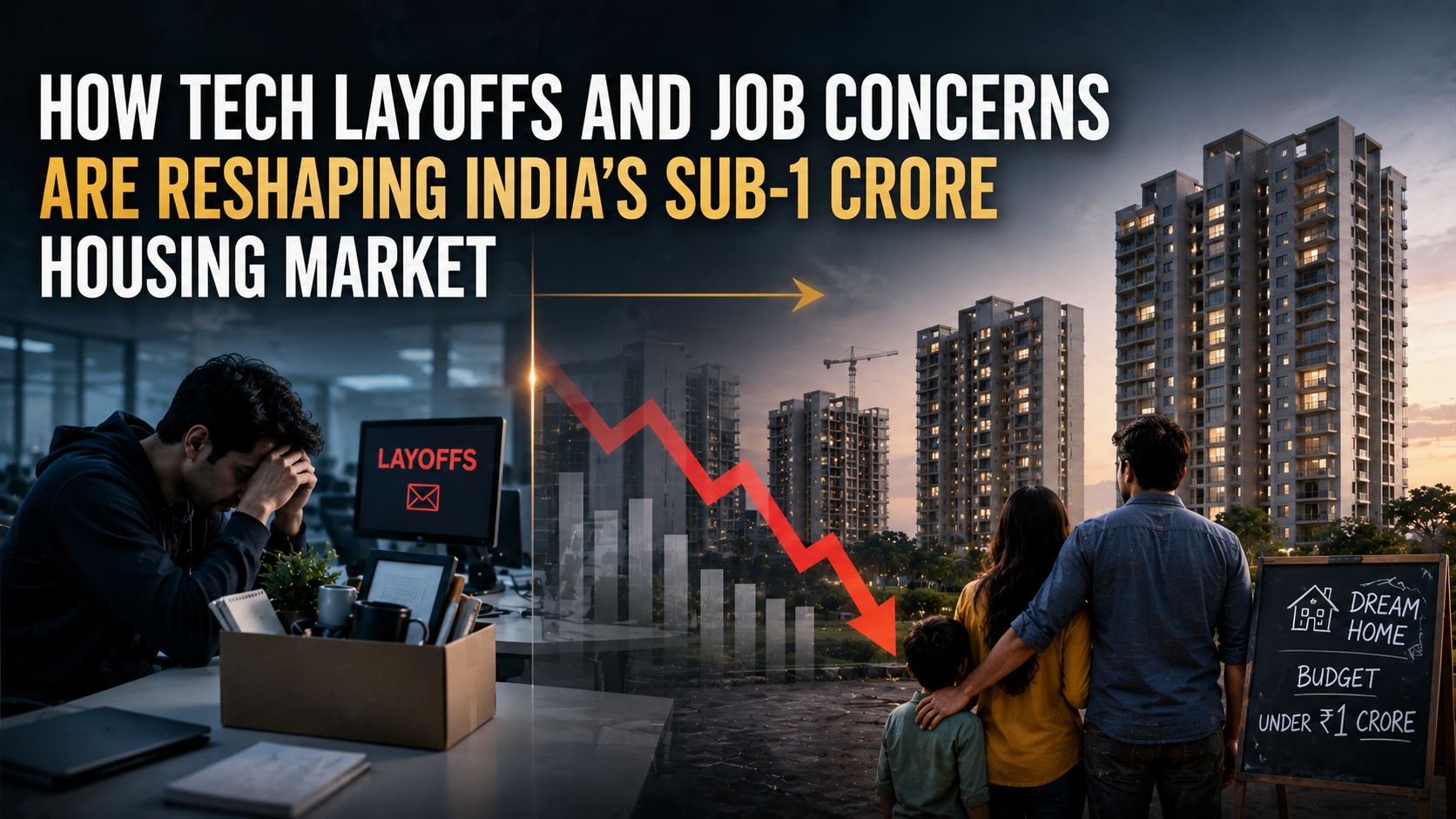
For years, the Indian real estate market has been heavily propelled by a highly predictable and robust demographic: the salaried technology professional. Armed with stable incomes, predictable career trajectories, and a strong desire for homeownership, the IT workforce has historically been the primary engine driving demand in the mid-segment housing sector. However, as the data from the second quarter of 2026 reveals, this foundational pillar of the residential market is undergoing a profound stress test.
Housing sales across India’s top eight residential hubs witnessed a noticeable 6.1 percent year-on-year decline between April and June, dropping to 91,729 units from the 97,674 homes sold during the same period last year. On a sequential basis, the drop was 4.4 percent. While industry analysts anticipated a mild pre-monsoon sluggishness, the depth and specific concentration of this slowdown have sparked intense discussions. The core of this deceleration is not a generalized economic failure, but rather a highly targeted anxiety rippling through the corridors of the nation's technology hubs. Driven by a wave of AI-led workforce restructuring and prolonged tech-sector layoffs, job security concerns are fundamentally altering buyer behaviour, resulting in a severe contraction of the critical sub-₹1 crore housing segment.
To understand the current housing slowdown, one must look closely at the seismic shifts occurring within the global technology sector. The aggressive integration of artificial intelligence across corporate operations is no longer just a boardroom buzzword; it is actively reshaping payrolls. Multinational corporations and domestic IT giants alike are optimizing their workforce, transitioning toward AI-led productivity models that require fewer mid-level coding and administrative roles.
This environment of restructuring has bred a palpable sense of job insecurity among tech professionals. Purchasing a home is arguably the largest financial commitment an individual makes, typically involving a long-term mortgage spanning fifteen to twenty years. When a prospective buyer is unsure about their employment stability over the next twelve months, taking on a massive housing loan is immediately deferred. Consequently, the enthusiasm for long-term financial commitments has chilled significantly.
This hesitation is particularly devastating for the sub-₹1 crore housing market. Homes priced below this threshold have traditionally served as the sweet spot for first-time homebuyers, young couples, and mid-level corporate employees. In previous years, this segment was the undisputed volume driver for developers. Now, squeezed by corporate layoffs and broader macroeconomic anxieties, this buyer demographic is retreating to the sidelines. They are choosing the financial flexibility of the rental market, prioritizing cash liquidity over real estate assets in an increasingly unpredictable corporate landscape.
The domestic anxieties of the tech workforce are being compounded by a volatile international climate. The global geopolitical arena in 2026 has been marked by heightened tensions, most notably the escalating conflict between the United States and Iran. Global instability naturally breeds economic caution, particularly in an interconnected economy like India, where many large corporations rely on stable international supply chains and foreign capital inflows.
When global markets are jittery, the psychological impact on the everyday homebuyer is immediate. Prospective purchasers who were on the fence about closing a property deal are now adopting a wait-and-watch approach. Site visits and digital property inquiries remain healthy, indicating that the foundational desire to own a home has not vanished. However, the conversion cycle—the time it takes for a buyer to move from viewing a property to signing a check—has elongated drastically. Buyers are negotiating with unprecedented rigor and are willing to walk away from projects if they sense they are overpaying.
The geographical distribution of the Q2 2026 sales dip perfectly illustrates the tech-sector correlation. Cities whose real estate fortunes are deeply intertwined with the IT and ITeS industries bore the absolute brunt of the slowdown.
Pune, a massive stronghold for both IT services and manufacturing, recorded the steepest annual sales decline among all major markets. Housing transactions in the city plummeted by a staggering 20.8 percent, falling to 12,642 units. The city’s peripheral corridors, which have seen a massive influx of affordable and mid-segment projects catering directly to the tech workforce, suddenly found themselves starved of immediate buyers.
Bengaluru, widely recognized as the Silicon Valley of India, closely mirrored this struggle. Sales in the city fell by 9.2 percent to 14,186 units. The narrative in Bengaluru is deeply tied to the global corporate restructuring wave. As startup funding normalizes and large tech parks see rationalized headcounts, the traditional influx of young professionals eager to buy their first apartments has momentarily paused.
Beyond the tech hubs, the traditional heavyweights of Indian real estate also experienced notable contractions. The Mumbai Metropolitan Region, the largest market by volume and value, registered a 7 percent annual decline, as did the sprawling Delhi-National Capital Region. Ahmedabad, traditionally a high-volume, affordable market, saw a sharp 20.2 percent drop, reflecting a broader sentiment of buyer caution extending beyond just the tech community.
In stark contrast to the national narrative of caution, certain southern markets completely defied the downward trend, posting incredibly robust growth figures.
Chennai emerged as the standout performer of the quarter, recording a massive 36 percent year-on-year surge in housing sales, jumping to 7,183 units. This exceptional performance is attributed to the city’s highly disciplined supply pipeline and diversified economic base. Unlike markets overly dependent on IT, Chennai is anchored by robust automotive, manufacturing, and healthcare sectors. This economic diversity provided a critical buffer, insulating the local real estate market from the tech-centric volatility that crippled other cities.
Hyderabad also showcased remarkable resilience. Despite housing a massive IT ecosystem susceptible to the same global tech layoffs as Bengaluru, Hyderabad’s sales rose by a highly impressive 14.6 percent, reaching 13,196 units. The city’s sustained growth is supported by its booming pharmaceutical and data-centre industries, alongside massive, ongoing infrastructure upgrades. Furthermore, Hyderabad continues to offer relatively spacious, modern housing at competitive entry price points in its expanding peripheral zones, allowing it to sustain intense buyer interest despite macroeconomic headwinds.
Kolkata presented a unique trajectory, leading sequential sales growth with a 22 percent quarter-on-quarter recovery. While its total sales volume remained 8.6 percent below the previous year's figures, the sequential jump indicates a genuine, demand-led recovery taking root in the eastern metropolis.
One of the most fascinating aspects of the Q2 2026 data is the behaviour of real estate developers in the face of slowing sales. Traditionally, developers pull back on new project launches during a slump to avoid creating massive piles of unsold inventory. However, the current market is exhibiting deep-seated supply-side confidence.
Despite the 6.1 percent drop in sales volumes, new residential launches across the top eight cities actually rose by 6 percent year-on-year, pushing 89,161 fresh units into the market. This indicates that developers view the current buyer hesitation as a temporary, cyclical pause rather than a long-term structural failure. Because overall sales still outpaced new supply during the quarter, the broader demand-supply equation remains fundamentally stable, averting the threat of an immediate inventory crisis.
Developers have also found some relief on the operational front. Recent macroeconomic adjustments, including a stable repo rate environment and moderating inflation, have provided a predictable backdrop for long-term project planning. More specifically, reductions in the Goods and Services Tax on critical raw materials have been highly beneficial. The GST on cement was slashed from 28 percent to 18 percent, while the tax on marble and granite was reduced from 12 percent to 5 percent. These tax cuts have provided developers with an estimated 2 to 3 percent buffer in construction costs. However, rather than passing these savings onto consumers in the form of lower apartment prices, developers have largely absorbed this buffer into their project economics to protect their profit margins against other inflationary pressures.
Perhaps the most counterintuitive takeaway from the April-June quarter is the trajectory of property valuations. Standard economic theory suggests that when demand softens, prices should stabilize or drop. In the 2026 Indian real estate market, the exact opposite is occurring.
Despite softer transaction volumes and shrinking market share for the sub-₹1 crore segment, housing prices across the eight major cities continued their relentless upward march. The sales-weighted average price increased by 1 percent sequentially to reach ₹10,153 per square foot, successfully maintaining its position above the psychological ₹10,000 threshold for the second consecutive quarter.
The most striking example of this price paradox is Bengaluru. Despite suffering a near 10 percent drop in sales, the city recorded the strongest annual price appreciation in the country, with average property rates surging a staggering 26 percent to ₹9,931 per square foot. The Mumbai Metropolitan Region cemented its status as the most expensive market, with average prices jumping 20.4 percent year-on-year to hit ₹15,422 per square foot. Pune, the city hit hardest by falling sales, crossed the ₹8,000 per square foot mark for the first time in its history. Even Ahmedabad, which remains the most affordable of the major markets at ₹5,295 per square foot, recorded a strong sequential price increase.
This relentless price growth is driven by several underlying factors. First, the cost of land acquisition in core urban areas continues to skyrocket. Second, there is a distinct premiumization occurring in the market. Developers are intentionally shifting their strategic focus away from low-margin affordable housing toward higher-margin premium and luxury projects. Modern buyers, while fewer in number, are demanding higher-quality homes featuring advanced security systems, sustainable architecture, and expansive amenities. This shift toward premium inventory ensures that the average per-square-foot valuation of the market continues to rise, even as the total number of units sold declines.
As the Indian real estate market navigates the complex intersection of rising prices and cautious buyers, the upcoming quarters will serve as a critical litmus test for the sector's underlying strength. The residential market in 2026 is undoubtedly maturing. The speculative, volume-driven frenzies of the past are being replaced by a highly selective, value-driven environment.
Industry focus is now squarely fixed on the third quarter, which historically benefits from the surge of festive-season demand. Developers are positioning their newly launched inventory to capture the attention of buyers who have been sitting on the fence for the past several months.
Furthermore, massive urban infrastructure completions are expected to act as significant demand catalysts. The operationalization of major transit networks, such as the Phase 3 expansion of the Bengaluru Metro, the Line 3 extension in Pune, and Phase 2 of the Chennai Metro, will drastically improve connectivity to peripheral suburban corridors. These infrastructure milestones often serve to unlock the real estate potential of previously inaccessible areas, providing buyers with new, relatively affordable housing options that do not compromise on commute times.
Ultimately, the future trajectory of the sub-₹1 crore housing segment rests heavily on affordability and corporate stability. If the global geopolitical landscape stabilizes and the technology sector finds a new equilibrium in the AI era, the pent-up demand currently waiting on the sidelines will inevitably flow back into the market. Until then, developers and buyers alike are operating in a sophisticated, multi-speed market where extreme caution and record-breaking price appreciations are coexisting side by side.
