Published On:
August 22, 2026
Updated On:
August 22, 2026
South Delhi luxury independent floors witnessed a massive 6% to 21% year-on-year price appreciation in the second quarter of 2026, driven by an acute supply shortage and aggressive neighborhood redevelopment. A significant influx of capital from high-net-worth individuals and non-resident Indians seeking investment safety is pushing prime property values toward the ₹50 crore mark.
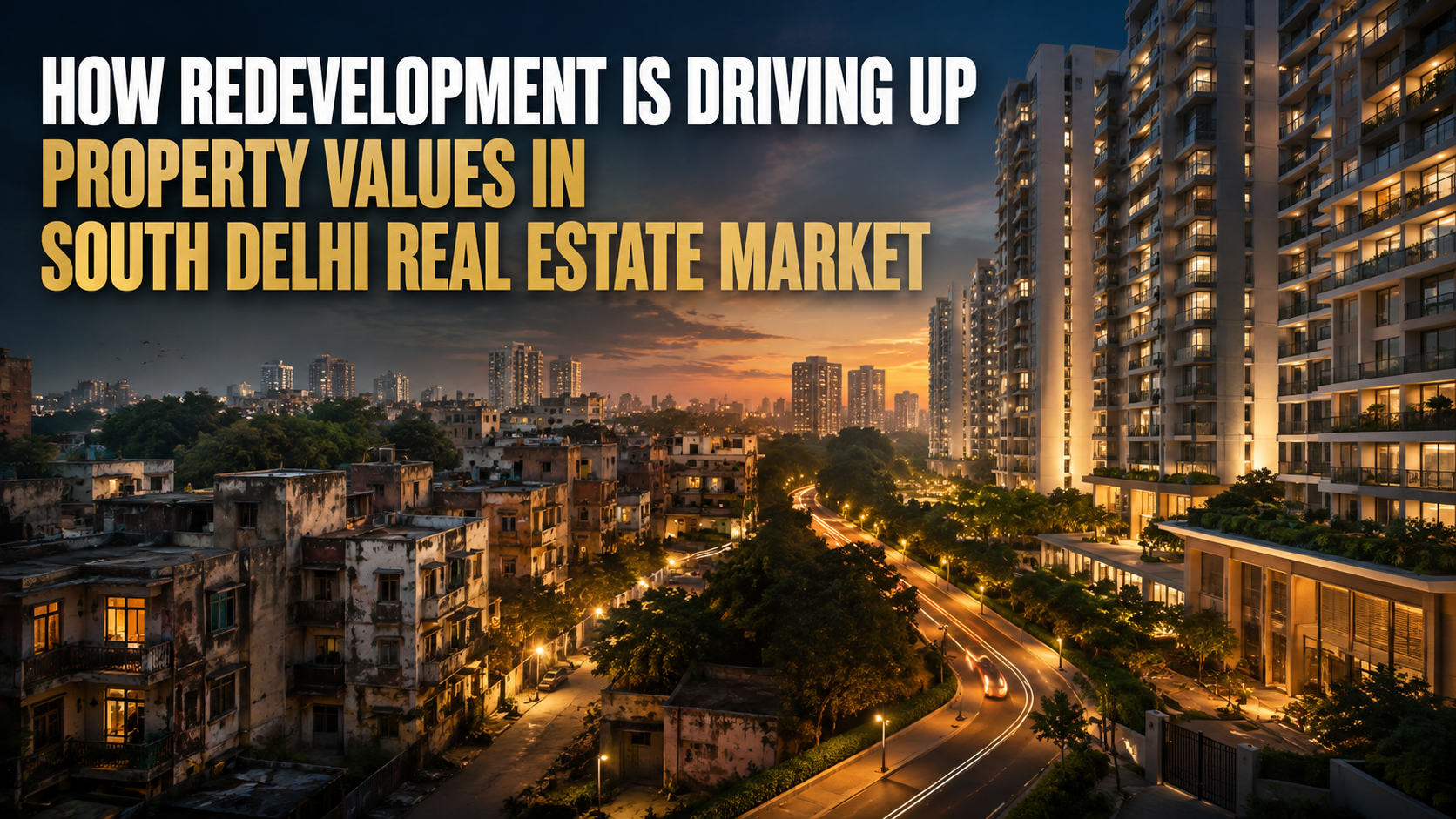
The Indian residential real estate landscape in 2026 presents a fascinating contrast. While housing demand across several major metropolitan cities has shown distinct signs of moderation following years of aggressive post-pandemic buying, one specific micro-market is completely defying the broader national slowdown. The luxury residential sector in South Delhi is currently experiencing an unprecedented upward trajectory. Recent market intelligence from real estate funds focusing on the region highlights that the average price of premium independent floors has surged by up to 21% year-on-year during the April to June quarter.
This rapid capital appreciation is not a random market anomaly. It is the result of a perfect storm of economic and structural factors converging on a very limited geographical area. The region is seeing a massive wave of premiumisation, where older, conventional homes are being systematically replaced by ultra-modern, expansive living spaces. This transformation, coupled with an increasing appetite from the super-rich, is fundamentally altering the pricing dynamics of the national capital's most prestigious postal codes.
To grasp the sheer scale of the current boom, one must look at the hard data emerging from the second quarter of the year. The market is witnessing aggressive double-digit growth, completely disconnected from the cooling trends seen in mid-segment housing elsewhere. The spotlight is firmly on independent luxury floors, a housing format that has become the absolute gold standard for affluent buyers who desire the privacy of a bungalow combined with the modern amenities of a high-rise penthouse.
In the absolute upper echelon of the market, price tags have reached historic highs. A standard 2,500 square foot independent floor that commanded a healthy valuation just a year ago has seen its price swell by over a fifth. For larger, sprawling properties spanning 6,000 square feet, the financial commitment required has grown exponentially, with average transaction values steadily marching toward the ₹50 crore threshold. This level of appreciation in a mature, established market indicates that buyers are not merely purchasing real estate; they are parking capital in what they view as a highly secure, generational asset class.
The municipal classification of Delhi divides neighborhoods into specific alphabetical categories for taxation, circle rates, and administrative purposes, with Category A representing the absolute pinnacle of luxury and exclusivity. This elite group includes storied neighborhoods such as Vasant Vihar, Panchsheel Park, Golf Links, Chanakyapuri, Anand Niketan, Shanti Niketan, Westend, Jor Bagh, Sundar Nagar, and Maharani Bagh. These are areas where diplomatic missions, top industrialists, and multi-generational wealth reside.
During the second quarter of 2026, properties in these Category A colonies recorded the sharpest growth in the entire city, clocking a 20% to 21% year-on-year increase. To put this into perspective, a 2,500 square foot floor in these enclaves, which was valued between ₹16 crore and ₹22 crore in the same period last year, is now successfully commanding anywhere from ₹18 crore to ₹28 crore.
The larger formats are seeing even more aggressive bidding. A 6,000 square foot property in a Category A neighborhood has moved from a previous range of ₹36 crore to ₹45 crore up to a staggering ₹41 crore to ₹56 crore. Buyers targeting these specific pin codes are rarely deterred by rising interest rates or macroeconomic fluctuations. For them, owning a piece of a Category A colony is the ultimate status symbol, and the willingness to pay a massive premium for a highly coveted address is stronger than ever before.
Just a slight notch below the diplomatic enclaves sit the Category B colonies. This tier includes highly sought-after, affluent neighborhoods like Defence Colony, Greater Kailash, Green Park, Safdarjung Enclave, Anand Lok, Chirag Enclave, Gulmohar Park, Niti Bagh, and Kailash Colony. While the price points here are slightly more accessible than their Category A counterparts, the growth trajectory is equally impressive, making them a focal point for serious real estate investment.
In these localities, a standard 2,500 square foot floor has seen a solid 10% year-on-year appreciation. Prices have moved from a baseline of ₹8.5 crore to ₹11 crore up to a new bracket of ₹9 crore to ₹12.5 crore. Larger units, such as 3,200 square foot floors, have also recorded a steady 6% annual growth, pushing their values well past the ₹14 crore to ₹19 crore mark.
These neighborhoods serve as the perfect middle ground for successful professionals, startup founders, and growing families who want the South Delhi lifestyle, excellent connectivity, and vibrant local markets without crossing into the ₹30 crore plus territory. The steady, predictable appreciation makes Category B locations an incredibly stable and lucrative holding for long-term investors.
The single biggest catalyst transforming the South Delhi landscape in 2026 is neighborhood redevelopment. Unlike peripheral metropolitan areas where developers can acquire massive tracts of vacant land to launch thousand-unit high-rises, South Delhi is completely landlocked. There is virtually zero new land available for primary development. The only way to create fresh housing inventory is to tear down the old and build anew.
Industry estimates suggest there are roughly 18,500 plots spread across the 42 Category A and B colonies in the region. The cumulative redevelopment potential of these specific plots is evaluated at an astronomical ₹6.5 lakh crore. This represents a massive, untapped economic opportunity that is currently being activated.
Original landowners, many of whom have held their properties for decades, are increasingly partnering with boutique luxury developers. They are knocking down older, structurally outdated single-family homes and replacing them with stilt-plus-four-floor luxury apartments. This strategy allows the original owners to retain a portion of the newly built property while monetizing the rest. For the broader market, it unlocks fresh, high-quality inventory in neighborhoods where supply has traditionally been choked.
The homes replacing the older structures are not just newer; they are fundamentally different in their design, scale, and execution. Today's luxury buyer has experienced global living standards and expects the exact same level of sophistication in the national capital. This has led to a massive wave of premiumisation across all new builds.
The new independent floors being constructed are marvels of modern engineering and luxury. Buyers are insisting on features that were once considered extravagant but are now absolute baseline requirements. This includes fully automatic private elevators that open directly into the living room, advanced smart-home automation systems, imported marble flooring, expansive walk-in closets, and modular European kitchens.
Furthermore, the stilt parking requirement mandated by modern building codes has solved one of the oldest and most frustrating problems of living in South Delhi: secure vehicle parking. The ability to safely park three to four luxury vehicles within the premises, complete with dedicated EV charging stations, adds immense practical value to these newly redeveloped floors.
The demand side of this equation is being heavily fueled by India's rapidly expanding club of High-Net-Worth Individuals (HNIs) and Ultra-High-Net-Worth Individuals (UHNIs). The base of the super-rich in the country has multiplied significantly, with the ₹100-crore income club growing at an unprecedented rate over the past five years. This has resulted in a massive pool of domestic capital looking for secure, tangible asset deployment.
For the domestic ultra-rich, the stock market's inherent volatility often necessitates balancing their portfolios with hard assets. South Delhi real estate fits this requirement perfectly. It offers a rare combination of social prestige, capital safety, and strong historical appreciation. These buyers are not taking out massive home loans; a significant portion of these high-value transactions is funded through liquid capital, corporate bonuses, or business equity. This effectively insulates this specific micro-market from the pressures of fluctuating banking interest rates that often cool down the affordable housing sector.
While domestic wealth is a massive driver, the influence of Non-Resident Indians (NRIs) on the 2026 property boom cannot be overstated. Current geopolitical tensions, particularly the ongoing uncertainties and conflicts in West Asia and the Middle East, have triggered a significant shift in global investment patterns. Expatriates who previously parked their wealth in the Gulf or European markets are increasingly bringing their capital back to India to ensure asset security.
South Delhi has emerged as a primary beneficiary of this capital flight. NRIs are looking for stability, capital preservation, and the familiarity of an established market. They recognize that despite global economic headwinds, the structural resilience of prime Indian real estate remains unmatched. Furthermore, streamlined Foreign Exchange Management Act (FEMA) regulations have made it easier than ever for the global diaspora to acquire premium residential assets back home without unnecessary bureaucratic hurdles.
These overseas buyers are particularly attracted to the high rental potential of Category A and B colonies. Properties in these areas are frequently leased by diplomats, multinational corporate executives, and expatriates stationed in Delhi, ensuring a steady, high-yielding rental income in addition to the underlying capital appreciation.
To truly understand the unique value proposition of South Delhi, it is helpful to contrast it with the emerging real estate corridors in the broader National Capital Region. For instance, the Yamuna Expressway Industrial Development Authority (YEIDA) region, driven by the upcoming Jewar International Airport, is currently a massive focal point for speculative investment and rapid infrastructural growth.
However, the investment philosophies driving these two regions are entirely different. The Yamuna Expressway belt is a high-growth, future-facing market attracting buyers looking for early-entry advantages and massive percentage returns over a five to ten-year horizon based on future infrastructure. South Delhi, conversely, is about immediate prestige, absolute scarcity, and wealth preservation today. One is a bet on what the future will look like, while the other is an investment in an irreplaceable, legacy asset. Both are thriving in 2026, but they cater to completely different segments of the wealth spectrum and investment intent.
At the core of the 2026 price surge is the simple, undeniable economic principle of supply and demand. The supply of luxury floors in premium Delhi neighborhoods is inherently capped. It is impossible to create another Golf Links or Vasant Vihar. The geographical boundaries are permanently fixed, and the existing neighborhood density cannot be arbitrarily increased beyond strict municipal regulations.
As wealth creation in India accelerates, the number of families capable of affording a ₹20 crore or ₹50 crore home is growing much faster than the rate at which these homes can be built. This widening gap between a booming affluent class and a rigidly restricted housing supply creates a perpetual seller's market. Whenever a high-quality, newly redeveloped floor hits the market in a prime locality, it is quickly absorbed, often through private wealth networks without even requiring public listing.
Looking ahead through the remainder of 2026 and into the future, the trajectory for South Delhi's luxury real estate market appears firmly pointed upward. The fundamental drivers—zero new land availability, aggressive and profitable redevelopment, and massive wealth concentration—are long-term structural realities, not fleeting seasonal trends.
While the extreme pace of percentage growth may eventually stabilize as base prices become increasingly elevated, a market correction is highly unlikely given the absolute absence of oversupply. The ongoing transformation of older colonies into modern, low-density luxury hubs will continue to unlock immense economic value. For landowners holding generational property, developers specializing in boutique builds, and wealthy investors seeking capital safety, the region will remain one of the most lucrative and resilient real estate markets in the country.
The 6% to 21% price surge witnessed in the second quarter is a clear testament to the enduring appeal of the national capital's most prestigious addresses. In an era of global economic uncertainty and shifting regional dynamics, the luxury floors of South Delhi stand as a fortress of wealth preservation, seamlessly combining the charm of heritage neighborhoods with the cutting-edge luxury demanded by the modern homebuyer.
