Published On:
March 24, 2026
Updated On:
March 24, 2026
The upcoming Noida International Airport in Jewar is triggering an unprecedented economic and real estate boom across the NCR, transforming the region into a global aviation, logistics, and corporate hub while driving massive property value appreciation and infrastructural development.
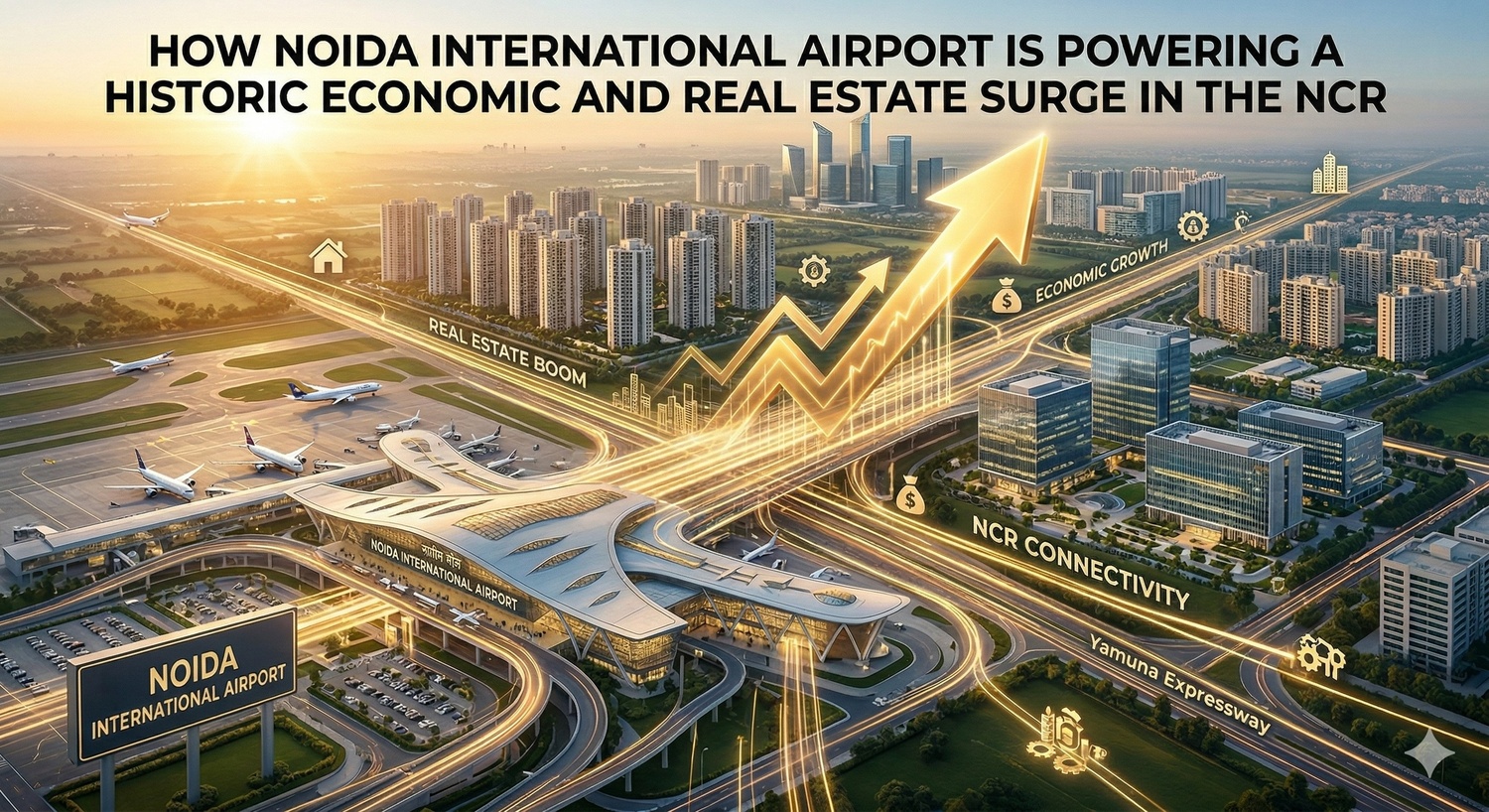
The National Capital Region is undergoing a historic structural transformation. With the inauguration of the highly anticipated Noida International Airport in Jewar scheduled for March 28, 2026, the entire economic trajectory of northern India is shifting. What was once viewed primarily as an affordable alternative to traditional corporate hubs is rapidly evolving into a hyper-connected, global urban ecosystem. This mega infrastructure project is not merely an addition to the region’s transport network; it is a fundamental growth engine redefining the financial, industrial, and real estate markets of the entire corridor.
For years, the NCR property and business conversation heavily favoured established pockets, but the momentum has now definitively shifted towards the Noida-Jewar belt. Comprehensive market analyses suggest that the project will influence a massive economic impact zone spanning 20,000 to 25,000 square kilometres. With a population base of nearly 50 million people within this influence area, the economic multipliers generated by the airport are set to unlock a new era of urban development, foreign direct investment, and wealth creation.
To understand the sheer magnitude of the economic impact, one must look at the scale of the airport itself. Operating under the code DXN, the facility has recently secured crucial clearances, including its provisional aerodrome license and security approvals, paving the way for commercial operations. The first phase of the development, built with an estimated investment of over ₹10,000 crore, features a 3,900-metre runway and a state-of-the-art terminal designed to handle 12 million passengers annually.
However, this is just the beginning. The master plan envisions a multi-decade expansion that will eventually see the airport spanning over 11,000 acres with up to five or six runways. Upon reaching full capacity in the coming decades, the passenger volume is projected to scale up to an astounding 70 to 120 million annually. This long-term scalability ensures that the region will not just experience a temporary boom but sustained, multi-generational economic growth. The facility is fully equipped with advanced aviation technology, highly efficient cargo terminals, and a dedicated Maintenance, Repair, and Overhaul (MRO) centre, positioning it to capture a significant share of both domestic and international aviation traffic.
The broader region influenced by the Noida International Airport already holds significant economic weight, contributing a substantial 6.43% to India's total Gross Domestic Product. Locally, Noida’s existing economic fundamentals are robust, contributing roughly ₹2.63 trillion—or about 10.3%—to the Gross State Domestic Product of Uttar Pradesh. Per capita income in the city has also crossed the prestigious ₹1 million mark. The introduction of a world-class aviation hub onto this already strong foundation is creating an explosive economic multiplier effect.
The development of the airport is acting as a massive magnet for institutional capital. Authorities have aggressively promoted the region through industry-friendly policies and rapid infrastructure investments, leading to a surge in commercial commitments. In just a single year, the Yamuna Expressway Industrial Development Authority (YEIDA) recorded the approval of 54 new industrial units and executed over 700 lease deeds. This surge in land allocation for manufacturing and logistics is a strong indicator of corporate confidence in the Noida-Jewar corridor. Companies are aggressively positioning themselves to benefit from the reduced logistics costs and faster transportation times that the airport will naturally facilitate.
The commercial real estate sector in Noida has aggressively priced in the impending operationalization of the airport. Global corporations, particularly Global Capability Centres (GCCs), are moving swiftly to secure premium office spaces ahead of the massive influx of businesses. Market data reveals that office rentals in key Noida micro-markets have surged by as much as 29% since 2019. The total regional office stock has now expanded to a robust 43.4 million square feet.
In the first nine months of 2025 alone, leasing by international entities and GCCs reached approximately 928,000 square feet. This sharp rise in international investor confidence is transforming the Noida–Greater Noida Expressway into a premier commercial corridor. It now accounts for a massive chunk of all Grade-A office leasing across the entire NCR. Beyond traditional office spaces, the area is witnessing high demand for specialized commercial developments, including retail hubs, co-working spaces, and premium hospitality ventures. The anticipation of heavy footfall from domestic and international travellers, airline crew, and business executives has spurred the planning and development of luxury hotels, convention centres, and serviced apartments in the immediate vicinity of the airport.
Perhaps the most visible and widely discussed impact of the Noida International Airport is the staggering appreciation in residential property values. The days of Noida being exclusively a budget-friendly market are firmly in the past. Between the first quarter of 2020 and the first quarter of 2025, residential property prices in Noida experienced a remarkable 92% increase, while Greater Noida recorded an even steeper 98% growth. This easily outperformed the overall average appreciation seen across the broader National Capital Region.
The sheer scale of value creation in the land market is even more striking. Land prices within a zero to ten-kilometre radius of the airport have skyrocketed by 150% to 200% since 2019. This is driven by an intense rush of developers looking to secure early access to what is undeniably the most strategic real estate destination of the decade.
The buyer demographic has also evolved. While early investments were heavily speculative, the current demand is distinctly driven by end-users and long-term investors. Professionals moving to the region for employment in the newly established industrial and corporate hubs are seeking quality housing. High-end and premium residential properties are seeing excellent absorption rates, particularly in thoughtfully planned sectors like Sector 150, which has built a strong reputation for low-density living, expansive green spaces, and premium amenities. Buyers from across Delhi and other premium NCR markets are upgrading to Noida, drawn by the superior infrastructure, wider roads, and better civic systems.
The real estate ecosystem around the new aviation hub offers highly diverse investment avenues, catering to various budgets and financial goals. One of the standout performers in the current market is the studio apartment segment. Located primarily along the Yamuna Expressway and within a 15-kilometre radius of the airport, these compact units are experiencing explosive demand. They are perfectly positioned to cater to the incoming workforce of airline staff, logistics professionals, and business travellers. Investors in these units are targeting aggressive rental yields, with expectations hovering around the 7% to 10% mark once flight operations stabilize.
Plotted developments and mixed-use townships in the YEIDA sectors are also drawing massive attention. The steady rise in plot allotments and the quick absorption of residential inventory point to a deep-seated confidence in the region's future. For those looking at capital appreciation, experts forecast an additional 20% to 30% upside in property values along the Yamuna Expressway corridor through 2026 and 2027. Areas like Greater Noida West, the Techzone sectors, and the immediate periphery of Jewar town remain sweet spots, offering a highly attractive balance of relatively accessible entry prices and excellent potential for long-term capital gains.
An airport of this scale is fundamentally a cargo and logistics powerhouse, and the surrounding infrastructure is being meticulously engineered to support this. The development of a multi-modal logistics hub near the airport is a critical piece of the puzzle, expected to generate upwards of 15,000 direct jobs. This facility will modernize regional logistics efficiency, providing seamless movement of freight between air, road, and rail networks.
The industrial ecosystem taking shape around Jewar is highly diversified. The region is quickly becoming a preferred destination for massive warehousing operations, e-commerce fulfilment centres, and high-tech manufacturing. The presence of dedicated economic zones, including planned electronics hubs, medical device parks, and the highly anticipated Film City, creates a self-sustaining economic loop. Large-scale international investment zones, including dedicated industrial cities for Japanese and Korean manufacturers, are also in the advanced stages of planning and development. This intense industrialization guarantees a continuous influx of capital and human resources, providing a permanent bedrock of demand for local real estate and commercial services.
The success of any global aviation hub relies entirely on its connectivity to the broader region, and the infrastructure push surrounding the Noida International Airport is nothing short of spectacular. The airport is not existing in a vacuum; it is being integrated into one of the most comprehensive transportation grids in the country.
The Yamuna Expressway and the Eastern Peripheral Expressway provide immediate, high-speed road access, ensuring that freight and passengers can move efficiently across northern India without entering the congested city centres of Delhi. Furthermore, massive capital is being deployed into next-generation transit systems. A new 31-kilometre expressway connecting the airport directly to the Delhi–Mumbai Expressway via Faridabad is under construction, ensuring seamless integration with India’s largest freight and passenger corridor.
Public transit is also receiving a massive overhaul. Metro extensions are actively being mapped out to link core Noida sectors directly to the airport. Additionally, a planned Rapid Rail Transit System (RRTS) will drastically cut down commute times, potentially connecting the airport to Delhi in under half an hour. There are also advanced plans for high-speed rail networks linking the aviation hub to major cultural and economic centres like Varanasi. This multi-modal integration—combining expressways, rapid rail, metro networks, and air travel—ensures that the Jewar region will function as the ultimate transportation nucleus of northern India.
The inauguration of the Noida International Airport is a watershed moment that permanently alters the hierarchy of real estate and economic centres within the National Capital Region. The growth being witnessed today is not a speculative bubble; it is backed by actual, physical infrastructure development, massive corporate leasing, actual land acquisitions by manufacturing giants, and proactive government policies.
As the airport scales its operations from daytime domestic flights in the initial months to full-scale, 24-hour international operations later in the year, the region will inevitably see a further acceleration in commercial activity. The ongoing transformation of the Noida–Greater Noida–YEIDA corridor is a textbook example of infrastructure-led urban development. Over the next decade, as subsequent phases of the airport come online and the surrounding industrial and commercial hubs reach maturity, this region is poised to firmly establish itself as one of the most dynamic, future-ready global destinations in the country. For businesses, investors, and homebuyers, the corridor offers a rare, generational opportunity to be part of a rapidly ascending economic powerhouse.
