Published On:
June 22, 2026
Updated On:
June 22, 2026
The National Capital Region is set to experience a transit revolution as high-speed Namo Bharat rapid rail trains and local Delhi Metro extensions co-exist across six massive new corridors. This dual-network strategy will drastically cut commute times to Sonipat, Panipat, Manesar, and Palwal to under 30 minutes, sparking a major real estate boom across outer suburban hubs.
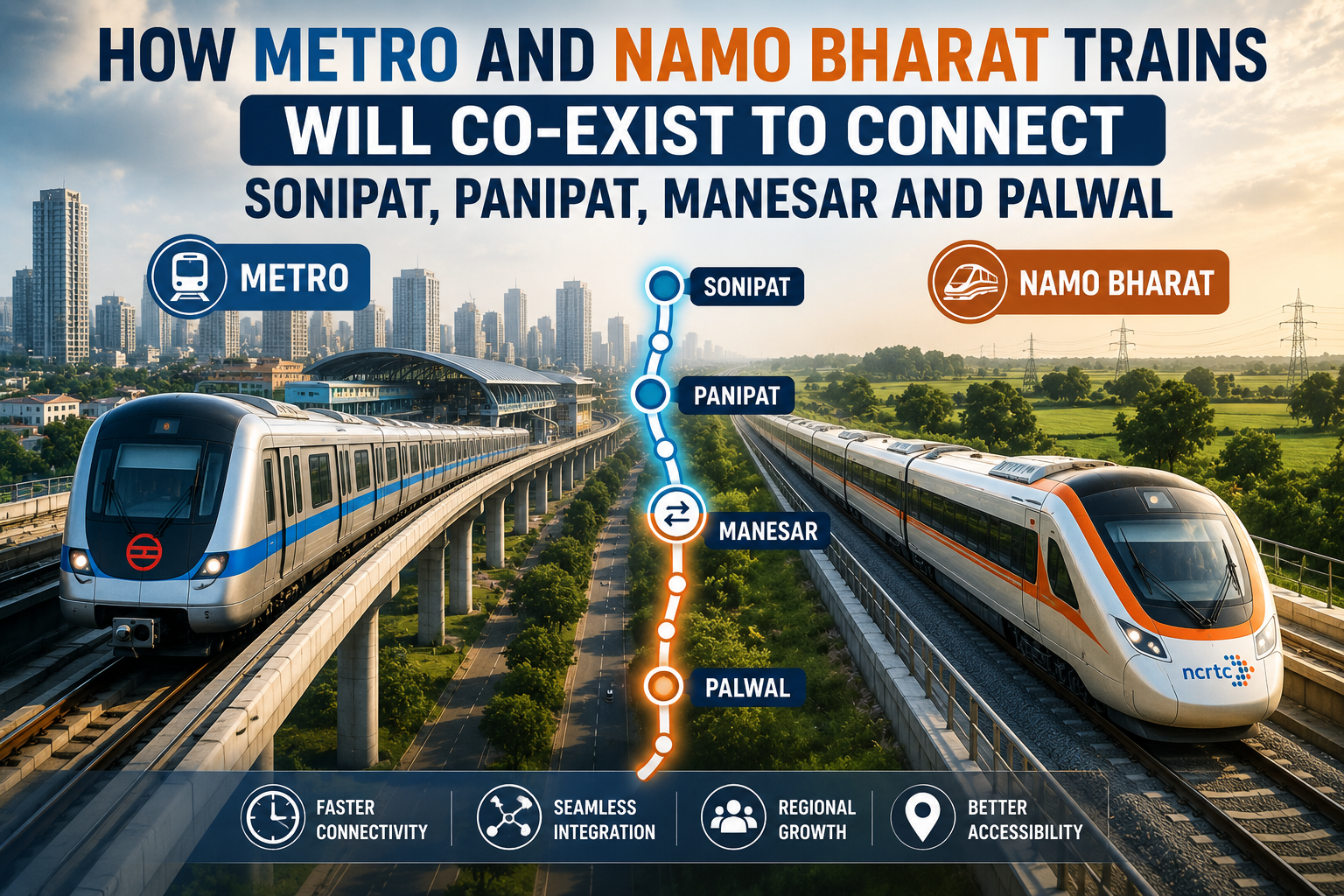
For decades, millions of daily commuters have battled severe traffic congestion across the sprawling National Capital Region. The highways connecting the central capital to its rapidly expanding peripheral industrial towns have historically suffered from immense vehicular pressure, turning what should be a straightforward commute into an exhausting daily ordeal. Recognizing that adding more highway lanes is no longer a sustainable solution, infrastructure planning authorities have fundamentally shifted their approach to regional mobility.
A massive, multi-layered transit upgrade is currently unfolding across the region. The National Capital Region Planning Board has greenlit a revolutionary transport framework where the existing, highly successful local metro networks will officially co-exist and run parallel to the futuristic, high-speed Namo Bharat Regional Rapid Transit System. The central objective of this ambitious master plan is to establish an ultra-efficient, thirty-minute mobility corridor that seamlessly connects the capital's borders with outer satellite cities like Sonipat, Panipat, Manesar, and Palwal.
This transformative shift away from a single-mode transport reliance towards a highly integrated, dual-transit system is unprecedented in Indian urban planning. It promises to reshape how millions of people live, work, and invest across North India over the next decade.
To understand the sheer scale and ingenuity of this new infrastructure rollout, one must look at how the two different rail systems are designed to complement each other rather than compete. Historically, suburban commuters relied heavily on overcrowded regional passenger trains or slow-moving interstate buses. The new master plan entirely replaces that outdated infrastructure with a highly sophisticated two-tiered approach.
The Namo Bharat trains represent the high-speed backbone of this new era. Engineered to reach top operational speeds of 160 kilometers per hour, these aerodynamic, world-class trainsets are specifically designed for long-distance regional travelers. They will feature significantly fewer stops, ensuring that a commuter traveling from the deep industrial belts of Panipat or Alwar can reach central Delhi in less than an hour. These trains are equipped with premium amenities, including business-class seating, dedicated luggage space, and advanced climate control, prioritizing comfort for long-haul daily travelers.
Running parallel to these high-speed rapid rail corridors will be the expansive local Metro network. While the rapid rail skips smaller neighborhoods to maintain its high velocity, the metro lines will serve as the critical capillary network. The metro trains will provide highly frequent, localized stops, catering perfectly to short-distance daily commuters, students, and local shoppers. By operating these two distinct systems in tandem, the transit authorities are ensuring that both speed and localized accessibility are achieved simultaneously, drastically reducing the overall transit burden on the heavily polluted interstate highways.
The implementation of this integrated transport network is spread across six distinct geographic corridors, each targeting a specific industrial, residential, or commercial belt within the National Capital Region.
This eastern corridor serves as the flagship testing ground for the dual-transit philosophy and is widely recognized as the first two-in-one transit route in the country. Stretching over 82 kilometers, this corridor connects the densely populated urban centers of Delhi, Ghaziabad, and Meerut. What makes this specific route an engineering marvel is the concept of shared infrastructure. In certain stretches, particularly within the city limits of Meerut, both the high-speed Namo Bharat regional trains and the local Meerut Metro trains utilize the exact same physical track infrastructure. While the Namo Bharat trains effortlessly handle the interstate crowd rushing toward Delhi, the localized metro services maximize domestic mobility within Meerut city itself. This shared-track model drastically reduces land acquisition requirements and massive capital construction costs.
Heading northwest from the capital, this highly anticipated corridor aims to bridge the gap between Delhi and the massive agricultural and industrial powerhouses of Haryana, encompassing towns like Kundli, Murthal, Gannaur, Samalkha, and Panipat. The strategy here is a perfect execution of parallel dual connectivity. For localized transit, the Haryana government is actively working to extend the existing Red Line of the Delhi Metro from its current limits near Rithala and Narela directly into the Kundli and Sonipat borders. Simultaneously, the heavy-duty Delhi-Panipat-Karnal rapid rail corridor will be constructed parallel to this route. This 136-kilometer rapid rail line will provide an express transit option, allowing residents of Panipat to bypass all local traffic and reach central Delhi in approximately 45 to 50 minutes, a journey that currently takes over two hours by road.
The southern expansion into Haryana targets the incredibly wealthy and heavily congested corporate and automotive manufacturing belts of Gurugram, Manesar, and beyond. This corridor is witnessing intense, active construction. On the localized front, civil work has already commenced on a massive new, independent metro line that will extend from Gurugram's Sector 56 directly into the heart of industrial Manesar. Running right alongside this metro expansion is the colossal Delhi-Gurugram-SNB-Alwar Namo Bharat rapid rail project. This high-speed corridor will originate in Delhi, cut through Aerocity and Gurugram, and provide express connectivity to the massive manufacturing hubs of Bawal, Sotanala, and Rewari. A massive multi-modal interchange hub is currently being developed at Pachgaon, ensuring commuters can flawlessly switch between the local metro and the regional rapid rail.
Targeting the heavy industrial and manufacturing belt of southern Haryana, this corridor is set to completely eliminate the notorious traffic jams along the Delhi-Agra National Highway. The localized transit solution involves a direct, aggressive extension of the existing Violet Line. Currently terminating at the Raja Nahar Singh station in Ballabhgarh, the metro tracks are being prepped for an extension that will push deep into Palwal. Simultaneously, a brand-new Namo Bharat corridor is in the advanced planning stages to connect Delhi to Faridabad, Ballabhgarh, and Palwal. This rapid rail line will be mostly elevated, running parallel to the highway to bypass the congested residential sectors, thereby slashing the travel time from Delhi to Palwal to under an hour.
This western corridor is vital for providing high-speed access to the rapidly growing educational institutions and industrial pockets of western Haryana. The initial phase of this transit upgrade involves detailed feasibility surveys to extend the existing Green Line from its current endpoint in Bahadurgarh further out to Asaudha. In the subsequent phases of the master plan, this localized metro network will be complemented by a dedicated rapid rail link extending directly to Rohtak, complete with strategic multi-modal interchange hubs planned along the highway route.
While most corridors radiate outward from Delhi, this specific proposed route is designed to connect two major satellite cities directly, completely bypassing the capital. Planning authorities have proposed an independent metro corridor spanning roughly 52 to 60 kilometers that will link the industrial city of Faridabad directly with the corporate hub of Gurugram. This crucial lateral connection will allow hundreds of thousands of daily office commuters to travel between the two cities without having to route their journey through the already congested interchange stations inside the central capital.
The true brilliance of this dual-transit strategy lies in its physical integration. Transit planners understand that commuters despise changing trains, navigating long walkways, or exiting stations just to switch from a regional train to a local metro. To solve this, the entire system is built around the concept of seamless, frictionless interoperability.
The beating heart of this entire transit ecosystem is the Sarai Kale Khan station in central Delhi. This specific location is being transformed into a futuristic, massive multi-modal mega-hub. All three of the primary Phase-1 Namo Bharat corridors—heading toward Meerut, Panipat, and Alwar—will converge exactly at this single station. A commuter boarding a high-speed train in Meerut will be able to travel all the way to Gurugram or Panipat without ever having to step out of the rapid rail network.
Furthermore, the rapid rail stations across all corridors are deliberately designed to intersect directly with existing local transit lines. Throughout the network, the rapid rail will physically integrate with at least eight major metro stations, several inter-state bus terminals, and major railway junctions. Commuters will transition from the 160-kilometer-per-hour regional trains to the localized metro network via climate-controlled walkways, high-speed elevators, and dedicated underpasses, ensuring a completely weather-proof, highly secure, and exceptionally fast daily commute.
Whenever multi-billion dollar transit infrastructure of this magnitude is formally announced and executed, the real estate landscape undergoes a radical, permanent transformation. The promise of slashing commute times from two hours down to a predictable, air-conditioned forty-five minutes is heavily decentralizing the property market. Homebuyers and institutional investors who previously found the central capital and prime Gurugram markets prohibitively expensive are now aggressively turning their capital toward these newly connected outer rings.
The dual connectivity model is triggering a massive land development boom in the northern sectors, specifically around Rai, Kundli, and Murthal in Sonipat. These areas are seeing a tremendous influx of residential plot investments and massive commercial land transactions, driven by the upcoming Red Line extension and the Panipat rapid rail.
Similarly, the corporate and logistics sectors are actively capitalizing on the Gurugram-Manesar-Rewari belt. With direct, high-speed freight and passenger connectivity assured by the upcoming Pachgaon interchange, logistics operators are heavily acquiring land for massive warehousing facilities, while developers are launching affordable housing projects targeted at the vast industrial workforce. Down south, the Palwal and Prithla regions are rapidly emerging as highly favored destinations for long-term real estate investments, transitioning from distant agricultural lands into highly structured, transit-oriented urban developments.
Beyond the obvious benefits of reduced travel times and surging property values, the integration of these massive rail networks carries profound environmental and macroeconomic implications. The National Capital Region has long struggled with severe, hazardous air quality, heavily exacerbated by the millions of private cars, diesel-guzzling commercial trucks, and aging buses that idle in endless highway traffic jams every single day.
The shift toward a fully electrified, high-capacity mass transit system represents a monumental step toward environmental sustainability. By providing a clean, safe, and highly reliable alternative to road travel, the authorities project a massive reduction in the daily volume of private vehicles entering the capital. This significant decrease in vehicular emissions, coupled with the eco-friendly, energy-efficient design of the modern trainsets, will play a crucial role in lowering the region's overall carbon footprint.
Economically, this transit framework actively promotes the decentralization of wealth and opportunity. By breaking down the geographical barriers of distance and commute fatigue, businesses are no longer strictly required to pay exorbitant commercial rents in the center of the city. Corporate offices, global capability centers, and large-scale manufacturing units can confidently establish their base of operations in outer regions like Karnal, Rewari, or Palwal, secure in the knowledge that they remain perfectly connected to the central talent pool and logistical hubs of Delhi.
The strategic coexistence of local metro networks with the high-velocity Namo Bharat rapid rail system is a masterful stroke of urban planning. It acknowledges the complex, multi-layered travel needs of a rapidly expanding mega-region. As the heavy civil construction progresses across these six massive corridors, the physical boundaries of the National Capital Region are effectively shrinking.
Over the next few years, as these interconnected lines systematically open to the public, the traditional struggles of suburban commuting will be permanently relegated to the past. The successful execution of this dual-transit blueprint will not only elevate the daily quality of life for millions of residents but will firmly establish the region as a globally competitive, deeply connected, and highly sustainable economic powerhouse.
