Published On:
June 29, 2026
Updated On:
June 29, 2026
India’s real estate landscape in 2026 is fundamentally defined by massive infrastructure-led growth, where record-breaking capital expenditure on transit networks and industrial corridors is unlocking high-growth micro-markets and shifting demand toward well-connected suburban hubs. This era of infrastructure development is not just about connectivity; it is a structural evolution turning secondary cities into economic powerhouses and reshaping how institutions and individuals invest in property
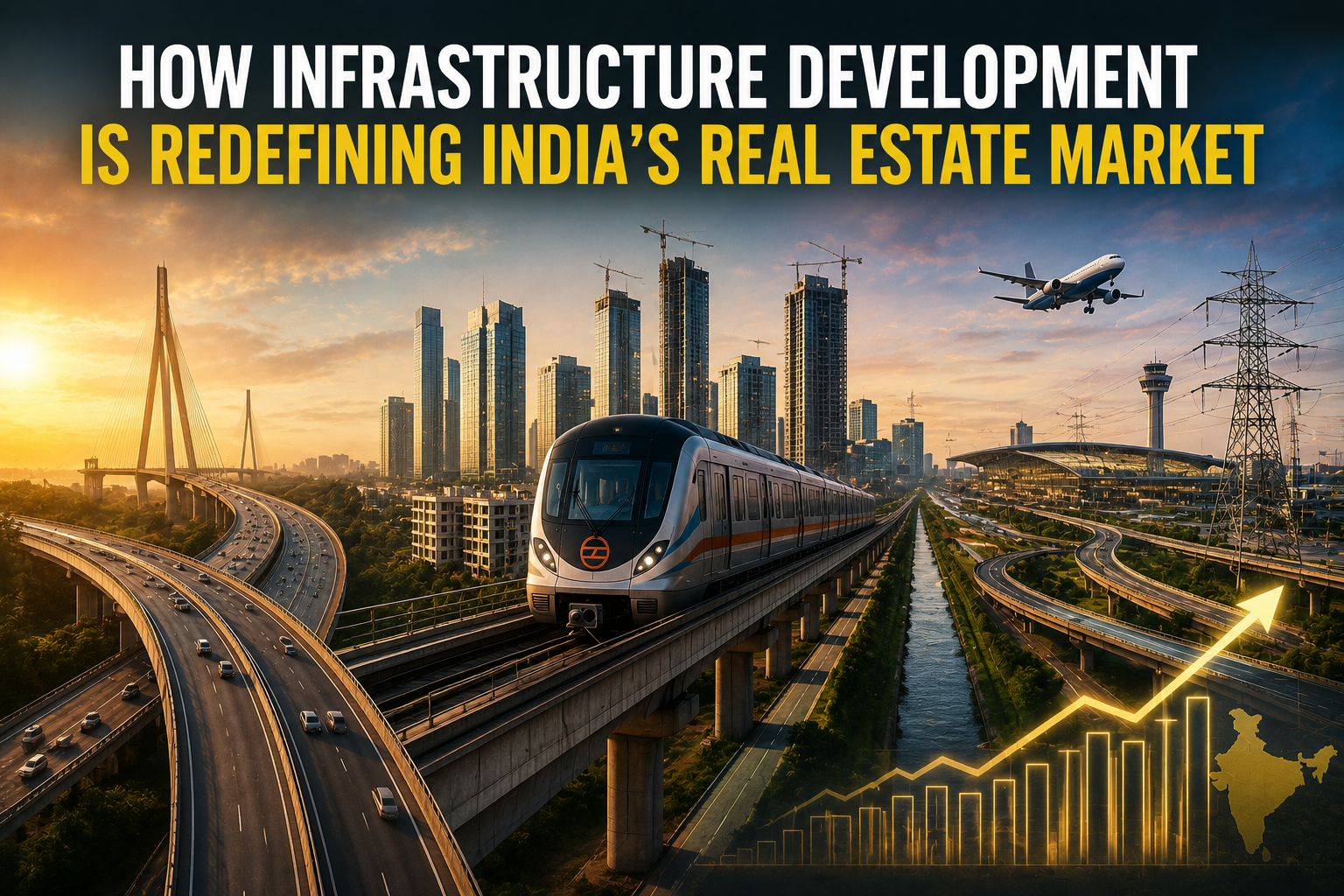
The Indian real estate sector is currently navigating its most significant transformation in decades. For years, the industry was tethered to the constraints of legacy urban planning, where property value was almost exclusively determined by proximity to established city centers. Today, that narrative has been rewritten. As of 2026, the primary engine driving real estate appreciation, buyer behavior, and institutional investment is the unprecedented scale of infrastructure development across the country. With the government’s infrastructure outlay reaching an ambitious ₹12.2 lakh crore in the 2026–27 Union Budget, the physical geography of the nation is being remapped to support a new, high-growth economic reality.
This is not merely a story of laying more asphalt or tracks; it is the story of creating a holistic ecosystem where mobility, commerce, and residential lifestyle intersect. By compressing commute times and bridging the gap between previously isolated suburbs and major business hubs, infrastructure projects are effectively democratizing real estate value.
The current fiscal year has been defined by a decisive policy shift. The central government’s commitment to sustained infrastructure spending is providing the bedrock upon which the real estate market is expanding. Unlike speculative booms of the past, the current appreciation in property prices is supported by tangible physical assets.
The massive capital expenditure on transport networks—spanning highways, railways, and urban transit systems—is acting as a powerful catalyst for project feasibility. When a project is located within a 5-to-10-kilometer radius of a proposed expressway or a metro interchange, the risk profile for that asset drops significantly. Investors and developers are increasingly recognizing that government spending acts as a lead indicator for where demand will materialize next. This environment has fostered a more stable and resilient market, where property prices in emerging corridors are rising in tandem with the physical progress of the infrastructure projects serving them.
If one concept defines the modern Indian homebuyer’s preference in 2026, it is Transit-Oriented Development (TOD). The days of enduring multi-hour commutes are coming to an end, as the metro rail network and regional rapid transit systems (RRTS) expand their footprints.
Infrastructure planners have moved toward a model where high-density residential and commercial clusters are centered around transit hubs. This transition has a two-fold impact. First, it makes peripheral locations—which were once considered too far for daily office travel—highly desirable. Second, it shifts the focus of property selection. Buyers now prioritize the ease of public transit access, such as proximity to a metro station or an interchange point, over a prestige address in a congested central business district.
The effect of this shift is visible in the rapid appreciation of micro-markets situated along new metro lines and expressways. Properties in these zones are experiencing a "connectivity premium." As commute times shrink, the utility of these locations increases, which in turn drives rental demand and price appreciation. This is becoming the new gold standard for long-term real estate investment.
In 2026, the impact of aviation infrastructure on real estate has evolved into the "aerotropolis" model. Major greenfield airports are no longer just travel terminals; they are acting as regional economic anchors. The development of a new international airport triggers a predictable, highly profitable development cycle for the surrounding real estate.
In the initial stages, land near these hubs sees a surge in transactions as investors look to secure a foothold. As the airport nears operational status, the demand shifts toward residential units for the workforce—pilots, logistics staff, retail employees, and corporate executives. Finally, once the airport is fully functional, the area matures into a massive commercial node. Hotels, hospitality zones, and massive warehousing parks begin to cluster around the facility.
This cycle is currently transforming several regions across India. The proximity to an international airport is now considered one of the highest-value amenities a residential or commercial project can offer. It guarantees a captive demand from business travelers and logistics companies, providing a level of rental yield and vacancy protection that is difficult to replicate in other locations.
The growth of India’s manufacturing and e-commerce sectors has necessitated a complete overhaul of the country's logistics infrastructure. The push toward industrial corridors and dedicated freight networks has redefined the warehousing and industrial real estate segment.
Modern industrial parks, characterized by plug-and-play facilities, high-grade warehousing, and data centers, are springing up along major industrial corridors. These areas are not just centers for manufacturing; they are increasingly incorporating support infrastructure for the workforce, including residential housing and retail services. This integration of industrial, commercial, and residential use cases is creating self-sustaining micro-markets.
For real estate developers, this segment offers a critical diversification opportunity. As the demand for rapid delivery and e-commerce distribution grows, the need for warehousing space located near consumption centers—or at strategic logistics nodes—has surged. These industrial-linked real estate projects are becoming a favorite for institutional investors because they provide long-term, stable cash flows, which are often backed by national or multinational corporate leases.
Perhaps the most structural change in the Indian real estate landscape is the decentralization of growth. The intense focus on strengthening the infrastructure of Tier 2 and Tier 3 cities is turning them into the next wave of high-growth markets.
The introduction of City Economic Regions (CERs) is a cornerstone of this trend. By fostering planned urban development that integrates industrial growth with quality residential spaces, the government is helping these cities transition into self-contained economic hubs. This is a massive boon for real estate, as it prevents the over-crowding of Tier 1 metros and allows for a more balanced national development.
In 2026, buyers who previously moved to metros for better opportunities are now finding high-quality living standards and career prospects in their own or neighboring regional hubs. This reverse-migration of talent is fueling residential demand in these smaller cities. Investors are increasingly looking at these locations for their entry-level affordability combined with the rapid appreciation potential that comes with early-stage infrastructure maturity.
The infrastructure-led boom is also changing who is buying and funding real estate in India. The sector is moving away from a reliance on speculative, retail-driven capital toward a more sophisticated, institutionalized ecosystem.
Domestic institutional capital is currently at an all-time high, accounting for a majority of real estate investments. This is supported by the growth of Real Estate Investment Trusts (REITs), which have brought transparency, liquidity, and professional management to commercial real estate. As infrastructure projects lower the risk profile of assets, institutional investors—including pension funds and private equity firms—are finding more confidence in deploying capital into Indian projects.
This shift to institutional funding has a direct impact on the end-user. Projects backed by institutional capital are more likely to be completed on time, adhere to higher quality standards, and be located in areas with well-planned supporting infrastructure. It is creating a "flight to quality," where buyers and tenants are increasingly opting for assets managed by reputed developers and backed by strong institutional governance.
Looking ahead, the trajectory of Indian real estate is clear: it will be defined by its multi-nodal geography. The concentration of all economic activity in the core of massive metros is giving way to a more distributed network of cities, all connected by high-speed corridors.
The upcoming high-speed rail networks, scheduled for development over the next few years, will further compress travel times between major cities, effectively creating "super-regions" where living in one city and working in another becomes a feasible reality. This will expand the catchment area for real estate demand even further, turning entire corridors into residential growth zones.
For both homeowners and investors, the strategy for the coming years should be one of alignment. The best opportunities are no longer found by looking for the "next big thing" in a vacuum; they are found by tracking the path of infrastructure progress. By identifying the intersection points of highways, metro lines, and industrial clusters, stakeholders can position themselves in areas that are not just growing, but are structurally designed to be the economic nerve centers of the future.
Infrastructure is the silent architect of India's 2026 real estate success. It provides the connectivity that drives demand, the utility that supports price growth, and the stability that attracts institutional capital. In this new era, those who understand the language of infrastructure development—and the specific corridors it unlocks—are the ones who will define the next chapter of wealth creation in the Indian property market.
