Published On:
June 2, 2026
Updated On:
June 2, 2026
While the global pandemic sparked predictions of the physical workplace’s demise, India's commercial real estate sector is experiencing record-breaking growth. Fuelled by the rapid expansion of Global Capability Centres, a shift toward experiential workspace designs, and a surge in retail investor participation through fractional ownership, the Indian office is being fundamentally reinvented into a high-yield strategic asset.
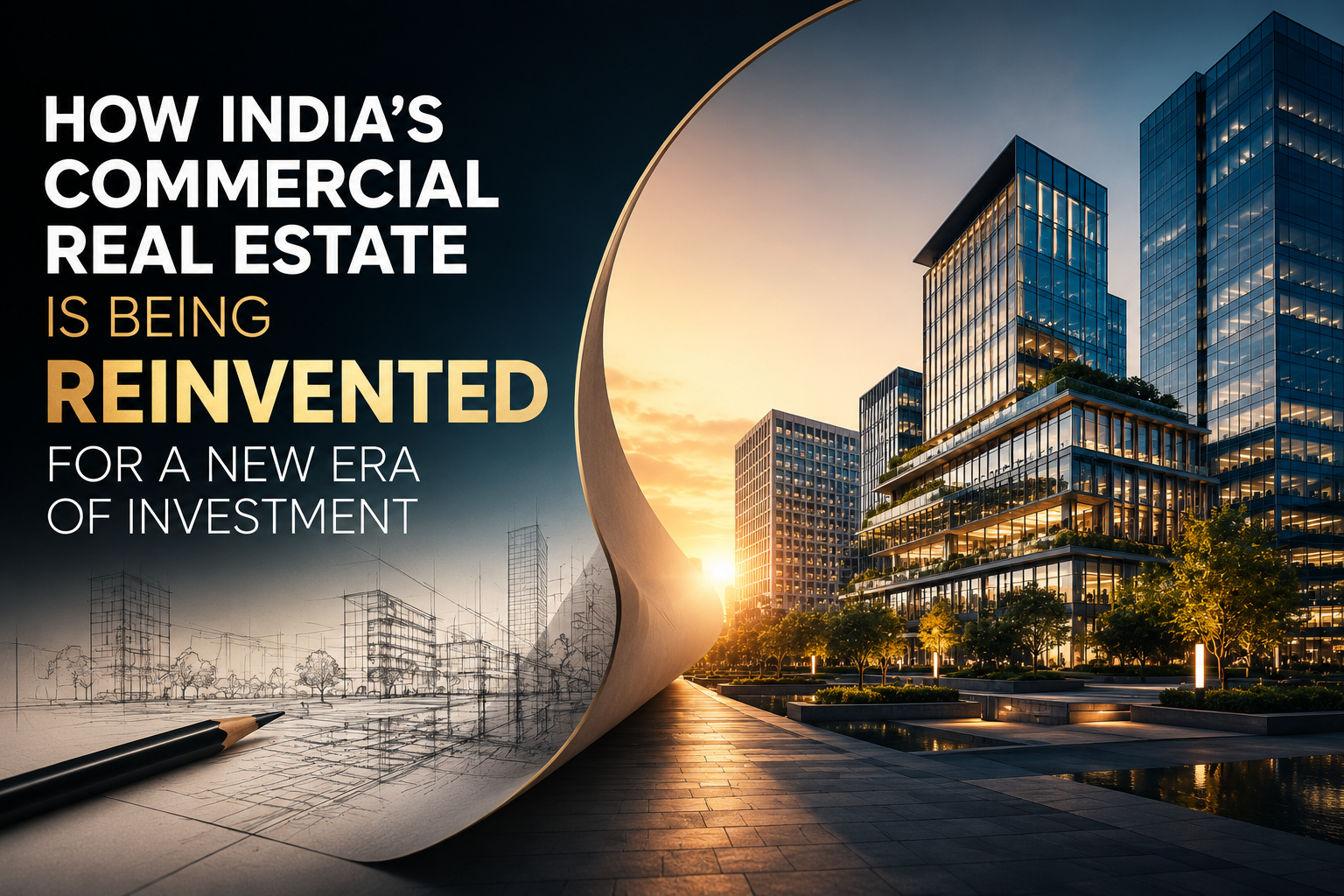
A few years ago, the future of the traditional office looked incredibly bleak. The global health crisis triggered widespread predictions that corporate workplaces were destined for obsolescence, with remote work championed as the permanent, irreversible future. Across the globe, glass towers and sprawling business parks suddenly felt like relics of a bygone era, and mature commercial real estate markets entered a period of deep anxiety. However, the narrative unfolding in India tells a radically different story.
Far from disappearing, the Indian office is undergoing a profound reinvention. Across the country’s major urban centres, the demand for premium commercial spaces has not just remained resilient; it has shattered previous records. This extraordinary resilience is fundamentally reshaping the landscape, prompting institutional and retail investors alike to show a renewed, aggressive interest in the country's commercial real estate ecosystem. The widespread assumption that all global office markets function identically has been proven entirely wrong by the sheer velocity of India's corporate absorption.
To understand why the commercial office sector is thriving here while stalling elsewhere, one must look at India's shifting position in the global economic ecosystem. For multinational corporations, the country has long shed its reputation as merely a cost-saving, back-office outsourcing destination. Today, it stands as a highly strategic global operations hub. The driving force behind this transformation is the explosive expansion of Global Capability Centres across primary tech markets like Bengaluru, Hyderabad, Pune, Chennai, and the National Capital Region.
Recent market data from early 2026 paints a clear picture of this momentum. Global Capability Centres have absorbed millions of square feet of premium office space, consistently accounting for nearly half of all office leasing activity nationwide. In the first quarter of the year alone, these capability hubs leased record-breaking volumes of space. These centres are no longer just handling basic support functions; they are critical innovation engines managing end-to-end global operations, advanced analytics, artificial intelligence prototyping, and niche research and development.
Furthermore, the demographic of these capability centres is broadening. We are witnessing the rapid rise of mid-market and nano centres—agile, highly specialized units that require immediate, scalable infrastructure. Alongside global tech giants, domestic consulting firms, massive banking and financial institutions, and engineering conglomerates are aggressively expanding their physical footprints. Unlike mature Western markets where office space often serves legacy administrative functions, Indian commercial spaces are deeply tied to rapid organisational growth, headcount expansion, and intense collaboration. This dynamic completely rewires the demand equation, turning physical space into a non-negotiable asset for scaling businesses.
While the demand for space is robust, the nature of what companies are demanding has fundamentally changed. The modern employee expects a workplace that feels less like a transactional location to merely sit and work, and more like a holistic, experiential environment. Consequently, developers are pivoting away from rigid, cubicle-heavy layouts in favour of integrated, lifestyle-oriented corporate campuses.
Today's Grade A commercial assets function as self-contained ecosystems. They are meticulously designed with wellness zones, collaborative lounges, expansive food courts, and sprawling green infrastructure. Sustainability is no longer viewed as a supplementary marketing feature but as a strict baseline requirement. A massive majority of new leasing transactions are taking place in green-certified tech parks, driven by uncompromising corporate mandates for environmental, social, and governance compliance. Buildings that offer energy-efficient designs, smart climate controls, advanced water recycling systems, and high indoor air quality consistently command premium rental rates and suffer from significantly lower vacancy levels. Global tenants simply will not sign a lease in a building that compromises their internal carbon-neutral targets.
This evolution is heavily tied to the modern war for talent. The physical office has become an essential extension of corporate culture, brand identity, and employee retention strategies. When a workspace promotes well-being and a genuine sense of community, it naturally draws the workforce back. By transforming the office into an experiential destination, companies are finding that their real estate investments directly correlate with operational productivity and employee satisfaction.
Historically, real estate discussions in India were dominated by residential property appreciation and individual developers. Today, the conversation around premium commercial real estate has elevated to the level of national infrastructure. A major office district is no longer seen as just a cluster of buildings; it is recognized as a powerful economic engine that dictates urban development patterns.
When a sprawling commercial hub is established, it instantly influences massive secondary growth. It generates immense employment, necessitates the expansion of transport networks, and creates sustained demand for retail and hospitality sectors in the immediate vicinity. These commercial nodes effectively become self-sustaining micro-economic zones. This infrastructure-like quality is exactly why massive institutional capital continues to flow into Indian commercial real estate, viewing high-quality assets as long-term, strategic holds.
We see this structural transformation playing out vividly in emerging growth corridors across the National Capital Region. While established hubs in Gurugram and Delhi continue to see activity, regions like the Noida-Greater Noida Expressway and the Yamuna Expressway Industrial Development Authority belt are capturing incredible market momentum. Driven by massive structural catalysts—most notably the operationalisation and continuous expansion of the Noida International Airport at Jewar—these specific corridors are absorbing a massive chunk of total office leasing. The influx of global capability centres and corporate consolidations in these micro-markets has pushed Grade A rental rates to new peaks, signaling a clear maturation of the local commercial ecosystem. Property appreciation in these specific zones has been historically strong, driven by integrated urban planning that includes metro expansions, sprawling green belts, and dedicated tech zones. Investors who understand that commercial buildings are the foundational infrastructure of modern commerce are positioning themselves in these high-growth corridors to capture long-term value, moving away from saturated legacy markets.
As the commercial real estate landscape matures, so too does the investor base. There was a time when real estate investing in India automatically meant purchasing a residential flat, renting it out, and hoping for gradual capital appreciation. However, the mindset of the modern Indian investor has significantly broadened. The allure of commercial real estate—characterised by institutional-grade tenants, structured long-term leases, and highly predictable recurring rental income—is becoming impossible to ignore.
Market reports indicate that the Indian real estate sector attracted an unprecedented capital influx exceeding five billion dollars in the first quarter of 2026 alone, with a significant portion directed toward commercial assets. This massive deployment of capital underscores a maturing market that is heavily driven by institutional confidence. But the true game-changer for the everyday investor has been the exponential growth of the fractional ownership market, a segment projected to cross tens of thousands of crores by the end of the decade.
Historically, acquiring a piece of a Grade A office building or a high-tech logistics warehouse required tens of crores, restricting the asset class to ultra-high-net-worth individuals and massive funds. Fractional ownership has shattered this barrier to entry. By pooling capital through heavily regulated, transparent platforms, everyday investors can now own a proportionate share of a high-value commercial asset with minimum investments often starting in the highly accessible range of ten to twenty-five lakhs.
This model provides investors with direct exposure to specific, pre-leased properties, offering targeted annual rental yields that significantly outperform traditional residential leasing. In a commercial fractional setup, an investor enjoys predictable cash flows backed by long-term corporate leases, alongside the potential for substantial capital appreciation upon the eventual sale of the asset. With market watchdogs introducing strict regulatory frameworks to ensure transparency, fractional ownership has transitioned from a niche financial technology concept into a mainstream wealth management tool. It allows investors to diversify their portfolios away from pure equities and residential properties, adding a layer of stable, commercial-backed income.
Complementing the demand for traditional long-term leases is the explosive growth of flexible and managed workspaces. As businesses navigate rapid expansion phases in a dynamic economic environment, they increasingly require absolute agility in their real estate footprints. Flexible workspace operators have become some of the largest consumers of commercial real estate in the country, absorbing millions of square feet annually to build out premium, ready-to-use environments.
This segment is thriving because it perfectly bridges the gap between a company's need for high-quality infrastructure and its desire for operational flexibility. Domestic enterprises, agile startups, and mid-sized global centres are leveraging these managed spaces to establish an immediate operational presence without the massive capital expenditure and time delays of a custom fit-out. Landlords and developers are actively partnering with flex operators to ensure their buildings can cater to this dynamic demand. The result is a hybrid commercial ecosystem where long-term corporate anchors coexist seamlessly with agile, fast-moving teams under the exact same roof.
One of the most consistently overlooked elements of this entire narrative is that India's broader urbanisation journey is still in its middle innings. Millions of individuals continue to migrate toward massive urban centres every year, and the formalisation of the corporate ecosystem is accelerating at an unprecedented pace. The country's commercial office stock is hurtling toward the incredible milestone of one billion square feet of premium space by the end of this decade.
This continuous demand for organised, institutional-grade commercial infrastructure is not merely a cyclical market bounce; it is a deep, structural shift in how the Indian economy operates. When multinational corporations and domestic giants commit to massive, multi-year commercial leases in emerging hubs or established tech parks, they are doing much more than securing a place to put desks. They are making a definitive, capital-intensive bet on the future.
Ultimately, the unrelenting resilience of the office market is the clearest possible reflection of overarching economic confidence. Companies simply do not pour billions of dollars into scaling their physical commercial infrastructure unless they possess an unwavering belief that sustained, robust growth lies ahead. The office has indeed evolved—shedding its skin as a mundane obligation to become a vibrant, strategic asset—but in the context of the Indian growth story, it is more vital and visible than ever before.
