Published On:
August 24, 2026
Updated On:
August 24, 2026
The ongoing West Asia crisis has introduced a distinct "wait-and-watch" phase in Dubai’s broader real estate market, yet the luxury segment remains fiercely resilient as global high-net-worth investors double down on premium safe-haven assets.
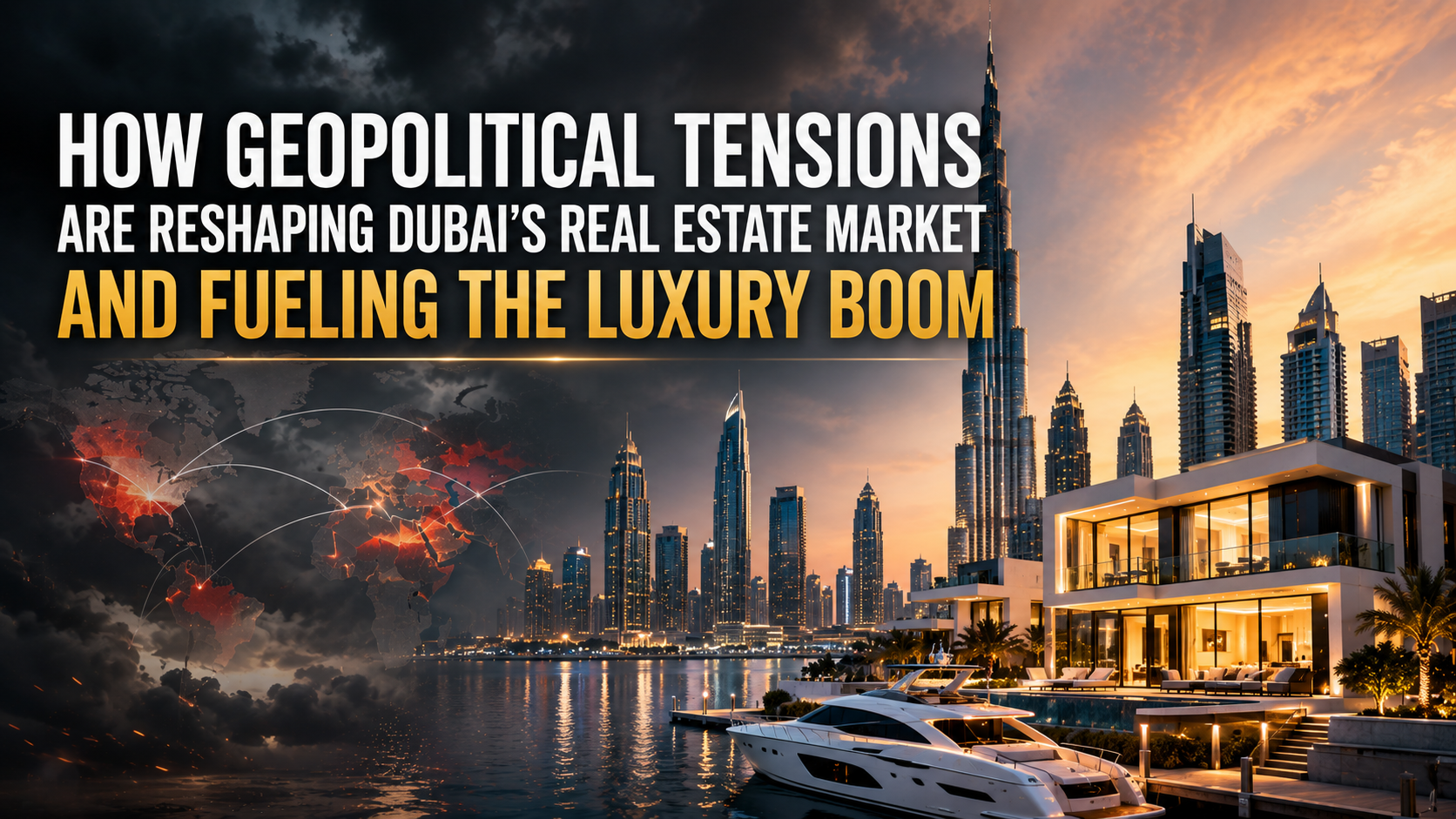
Dubai has long cemented its reputation as a structural fortress of stability within a historically volatile region. For decades, the emirate’s real estate market has thrived on a simple but powerful premise: offering a secure, tax-efficient, and luxurious haven for global capital. However, the escalating geopolitical tensions across West Asia are currently putting that narrative through a real-time stress test. As regional conflicts continue to dominate international headlines in 2026, the ripple effects are undeniably making their way into the macroeconomic landscape of the Middle East, reshaping how capital moves and how properties are transacted.
Within the property sector, this geopolitical turbulence has created a fascinating tale of two markets. On one side, the broader residential segment is experiencing a palpable cooling-off period. Everyday homebuyers and mid-tier investors are stepping back, adopting a cautious approach as they reassess their financial commitments amidst regional uncertainty. On the other side of the spectrum, the ultra-luxury market is completely defying gravity. While the mid-market pauses, high-net-worth individuals and institutional investors are aggressively channeling wealth into prime Dubai real estate, treating these trophy assets as the ultimate store of value during times of conflict.
Understanding this complex dynamic requires looking well beyond the surface-level transaction volumes. It requires a deep dive into buyer psychology, the evolving nature of global capital flight, and the specific structural advantages that allow certain segments of Dubai’s property market to flourish even when the broader region faces immense geopolitical pressure.
The immediate fallout from the current West Asia crisis has introduced a significant degree of short-term caution across the broader property landscape. Following exceptionally strong transaction levels at the beginning of the year, market activity has noticeably moderated. Potential buyers are no longer rushing to close deals in a frenzy of bidding wars; instead, they are adopting a highly measured, analytical approach. Decision-making cycles have elongated considerably. Where a buyer might have finalized a purchase within a few weeks during the post-pandemic boom, that same demographic is now taking months to evaluate opportunities, focusing intensely on intrinsic value, build quality, and precise location.
This shift is particularly evident in mortgage-backed transactions. As buyers weigh the potential for broader economic disruption, there is a natural hesitation to take on substantial long-term debt. Purchasers have become far more price-sensitive and selective than they have been in recent years. They are scrutinizing payment plans, comparing developers with intense rigor, and heavily weighing the long-term holding costs of the properties they are viewing.
Industry analysts emphasize that this cooling in transaction velocity should not be mistaken for a permanent structural weakening in demand. Rather, it represents a much-needed period of market normalization. The frenzy of blind bidding and rushed acquisitions has faded, replaced by a disciplined, fundamentals-driven environment. Buyers are essentially hitting the pause button, choosing to wait for greater geopolitical clarity before committing their capital to large, illiquid assets in the mid-tier market.
To truly grasp the current state of the market, one must differentiate between demand that has been destroyed and demand that has simply been delayed. Recent residential investor sentiment surveys reveal that the underlying interest in Dubai real estate remains incredibly robust. Data indicates that nearly half of prospective buyers still intend to purchase property within the next twelve months, while roughly a third remain undecided but actively engaged in the search process. This clearly points to deferred rather than diminished demand.
Investment continues to be the overwhelming primary driver for these property searches, with over half of active market participants identifying as investors rather than end-users seeking a primary residence. Because these buyers are motivated by long-term yield, capital appreciation, and portfolio diversification, they have the financial flexibility to be patient. They are carefully monitoring the regional situation, waiting for the optimal entry point.
During this holding pattern, the criteria for a successful transaction have evolved. Connectivity, the quality of the finished product, and, most importantly, the developer’s historical track record have become the ultimate deciding factors. Buyers are no longer willing to take risks on unproven developers or poorly connected neighborhoods. They want ironclad guarantees that their investment will hold its value, regardless of the macroeconomic headwinds blowing through the wider Middle East.
One of the most striking trends to emerge from this climate of uncertainty is the heavy pivot toward ready and secondary-market properties over off-plan developments in the broader residential sector. Current market surveys highlight that approximately sixty percent of buyers now prefer ready homes, compared to just under a quarter who still favor off-plan projects.
This preference is entirely rooted in risk mitigation. When geopolitical tensions run high, buyers prioritize certainty above almost all else. A completed property eliminates the risk of construction delays, supply chain disruptions, and shifting delivery timelines—concerns that have been amplified by the global ripple effects of the West Asia crisis. In neighboring markets like India, for example, regulatory bodies have already had to extend real estate project timelines by several months specifically due to supply chain disruptions caused by the regional conflict. Dubai buyers are keenly aware of these logistical vulnerabilities and are adjusting their purchasing strategies accordingly.
Furthermore, ready properties offer immediate gratification. End-users can move in immediately, securing their living situation, while investors can instantly place the property on the rental market to begin generating cash flow. This immediate yield acts as a vital financial buffer against broader economic volatility.
However, this shift is simultaneously putting immense pressure on older secondary-market apartment stock. With an estimated ninety thousand new residential units expected to be delivered across Dubai over the coming months, the supply of available homes is expanding rapidly. This influx gives buyers significantly more choice. Older apartments that lack modern amenities, contemporary layouts, and energy-efficient specifications are finding it increasingly difficult to compete. To attract cautious buyers, sellers of older secondary units will likely need to adjust their pricing expectations or invest in substantial renovations to match the high quality of newer developments entering the market.
While the mid-market carefully weighs its options, the prime and ultra-prime segments of Dubai’s real estate market are operating in an entirely different reality. The luxury market has not just held firm; it continues to attract strong, sustained interest at a pace that defies the regional geopolitical narrative. During the first quarter of 2026, Dubai recorded over two thousand transactions for homes priced above the ten-million-dirham threshold. While the sheer velocity of transactions moderated slightly month-over-month as the quarter progressed, the total volume of capital flowing into premium assets remains staggering.
This divergence is a classic hallmark of periods marked by geopolitical stress. During times of severe regional or global uncertainty, affluent international buyers do not retreat to cash; instead, they treat high-quality real assets as the ultimate safe haven. The ongoing crisis has acted as a powerful catalyst for capital flight, with ultra-high-net-worth individuals from conflict-adjacent zones aggressively redirecting their wealth into neutral, stable environments. Dubai, alongside established global wealth hubs like London and Switzerland, is a primary beneficiary of this wealth migration.
Villas are the undisputed champions of this luxury boom, accounting for more than three-quarters of all prime transactions. Sprawling, secluded, and highly customized, these properties offer the privacy and exclusivity that elite buyers demand. Interestingly, while the broader market shies away from unbuilt projects, off-plan properties remain a massive driver of activity at the luxury tier. Nearly eighty percent of all transactions above ten million dirhams in the first quarter were off-plan purchases.
This suggests that when dealing with top-tier, highly reputable developers in premium communities like The Oasis, Dubai Hills Estate, and Jumeirah Golf Estates, wealthy buyers are entirely unbothered by delivery risks. They possess absolute confidence in the long-term completion and appreciation of these marquee projects. Furthermore, Dubai’s structural economic advantages—such as zero capital gains tax, a currency firmly pegged to the US dollar, and a highly attractive residency-by-investment framework—provide an impenetrable layer of financial security that easily overrides short-term regional anxieties.
The demographic makeup of the capital flowing into Dubai has also shifted materially over the past few years, further insulating the luxury market from localized shocks. While European and South Asian buyers, particularly high-net-worth individuals from India, remain a foundational presence, the market is witnessing a remarkable surge in capital from Central Asia, East Africa, and the wider global diaspora.
These international buyers share a common behavioral thread in the current climate: they are adopting a highly selective approach, prioritizing long-term quality and generational value over quick speculative flips. For the luxury segment, the buyer profile skews heavily toward individuals acquiring second, third, or even fourth properties. Their motivations are deeply rooted in global portfolio diversification rather than immediate primary residence needs. Because they are rarely reliant on local mortgage financing, they are largely immune to fluctuating interest rates and are highly unlikely to abandon a strategic acquisition simply due to negative regional news cycles.
Additionally, the market is seeing a fascinating transition in how property is bought and sold, helping to maintain momentum despite external pressures. The rise of tokenized real estate and digital property shares is introducing a completely new, borderless ownership model. Platforms offering fractional ownership of premium assets are seeing inventory sell out in a matter of minutes. This modern, highly liquid approach to real estate investment is injecting fresh capital into the market, keeping sales active and engaging a younger, tech-savvy generation of global investors who view Dubai as the ultimate modern metropolis.
As 2026 progresses, it is evident that the West Asia crisis has fundamentally reshaped the immediate trajectory of Dubai’s real estate landscape, transforming it into a highly nuanced, multi-speed market. For the mid-tier and broader residential sectors, the prevailing sentiment will likely remain one of calculated caution. Buyers will continue to demand tangible value, heavily favoring ready properties and established communities. This cautious approach will inevitably force developers of new projects to offer more competitive pricing and flexible payment plans to secure commitments in a crowded marketplace.
However, the continued resilience of the luxury and ultra-prime segments serves as a powerful testament to Dubai’s enduring global appeal. The confidence in the supply side is just as strong as the demand; in the first half of the year alone, nearly two hundred new property developers entered the Dubai market, eager to capitalize on the sustained influx of foreign wealth. This massive expansion of the development pipeline highlights a deep-seated belief in the city's long-term absorption capacity.
Ultimately, the geopolitical tensions have acted as a clarifying filter for the real estate sector. The speculative frenzy of the past has been systematically replaced by strategic, fundamentals-driven investing. As long as Dubai continues to offer unparalleled safety, world-class infrastructure, and a highly favorable tax environment, it will undoubtedly maintain its status as the premier safe haven for global real estate capital, completely regardless of the storms brewing beyond its borders.
