Published On:
April 19, 2026
Updated On:
April 19, 2026
Slated for a year-end completion, the innovative double-decker flyover along Delhi’s Pink Line corridor is set to permanently eliminate severe traffic bottlenecks in the northeast while completing the city’s first circular metro loop. This massive infrastructure upgrade is not only revolutionizing urban mobility but also creating highly lucrative, long-term wealth generation opportunities for strategic real estate investors focused on emerging, highly connected corridors.
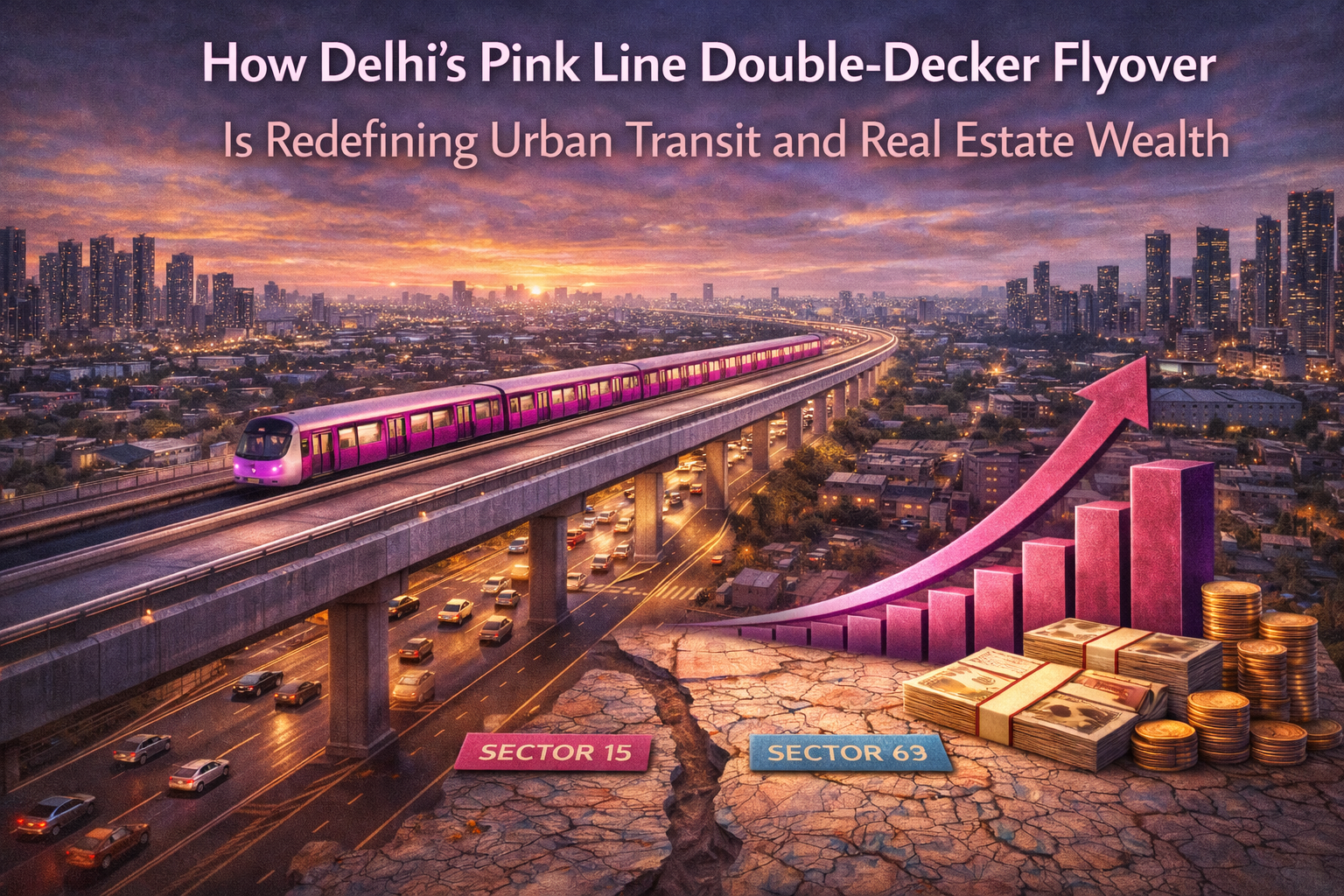
The relentless expansion of the National Capital Region brings with it an unprecedented surge in vehicular density, pushing traditional road networks to their absolute breaking point. For years, city planners have grappled with the physical impossibility of widening roads in highly congested, legacy neighborhoods where every square inch of land is already occupied. The standard playbook of urban development—demolishing structures to carve out wider arterial highways—has become completely unviable in a metropolis like Delhi. Recognizing this critical spatial constraint, transport authorities have executed a massive pivot in their engineering strategy, choosing to look vertically rather than horizontally.
This shift in urban planning philosophy has materialized into one of the most ambitious infrastructure projects in the city's modern history: the integrated double-decker flyover along the Delhi Metro Pink Line corridor. Combining a high-speed road flyover and an elevated metro viaduct into a single set of imposing concrete pillars, this structure is a masterclass in spatial optimization. As the project enters its final lap, targeting full operational status by the end of this year, it promises to completely overhaul the daily commute for hundreds of thousands of citizens while quietly rewriting the real estate dynamics of North East Delhi.
To truly grasp the magnitude of this project, one must understand the historic logistical nightmare that defines the Bhajanpura and Yamuna Vihar stretches. This specific zone acts as a massive funnel, absorbing heavy commercial and passenger traffic moving between Wazirabad, Shahdara, and the borders of Uttar Pradesh. The resulting bottlenecks have historically crippled local productivity, forcing commuters to idle away countless hours in relentless gridlock.
The introduction of the 1.4-kilometer-long double-decker viaduct is engineered to surgically bypass this exact chaos. The architectural layout is both practical and awe-inspiring. The lower deck functions as a dedicated, signal-free road flyover designed exclusively for vehicular traffic, including cars, buses, and heavy commercial transit. By elevating the long-distance, through-traffic off the ground, the street level is instantly liberated. Pedestrians, local shopgoers, and neighborhood residents can finally navigate their immediate surroundings without dodging aggressive highway traffic.
Suspended directly above this vehicular flyover is the upper deck, which exclusively carries the parallel tracks of the Delhi Metro. This dual-level design allows the transport authorities to deliver two entirely distinct, high-capacity mobility solutions using the exact same land footprint. It is a highly sustainable method of building cities. Instead of triggering massive displacement through land acquisition, the city has successfully stacked its transit infrastructure, proving that advanced engineering can easily triumph over spatial scarcity.
The upper tier of this double-decker structure is not just a random metro extension; it is the final, critical piece of a much larger, historic puzzle. The tracks gliding over Bhajanpura are part of the crucial 12.3-kilometer Maujpur to Majlis Park corridor. The inauguration of metro operations on this specific stretch earlier this year marked a monumental milestone for the entire country's public transport system, effectively transforming the Delhi Metro Pink Line into India's very first circular ring metro.
Spanning a massive 71.5 kilometers with 46 strategically placed stations, this U-shaped loop now completely encircles the capital. The impact on cross-city travel is nothing short of revolutionary. Historically, a commuter traveling between Maujpur and Majlis Park would be forced to navigate deep into the highly saturated central interchange hubs like Kashmere Gate or Rajiv Chowk, wasting immense time changing trains and navigating crowded platforms. With the loop now completely sealed, that exact same journey is a direct, seamless twenty-minute ride.
This circular route acts as a massive intersecting wheel, connecting with almost every other operational radial line in the Delhi Metro network. It drastically reduces the heavy dependency on core stations and distributes the daily passenger load much more evenly across the city. For the residents and student populations in North East Delhi, it provides unprecedented, rapid access to the University of Delhi's North Campus and the commercial centers of South Delhi, effectively shrinking the vast geography of the capital.
While the upper deck of the structure is already seeing active metro trains, the lower road flyover has remained frustratingly inaccessible to the public. Mega-infrastructure projects in densely populated urban centers rarely proceed without friction, and this double-decker marvel is no exception. The primary culprit behind the delay was a prolonged administrative battle regarding mandatory environmental clearances.
For nearly two years, the construction of the vital approach ramps required to merge the road traffic onto the lower deck was completely stalled due to pending permissions from the state forest department for localized tree felling. Without these crucial entry and exit ramps, the road flyover portion of the massive concrete structure was essentially a bridge to nowhere.
However, late last year, the bureaucratic deadlock was finally broken, and the necessary environmental clearances were officially secured. Acting rapidly on this green light, the transport corporation immediately initiated the final phase of construction. Fresh, highly specific tenders have been aggressively floated to execute the remaining balance of the work. With a dedicated contract exceeding eleven crore rupees, engineering teams are now tasked with the complex job of constructing the reinforced earth retaining structures and launching the final concrete spans. The administrative timeline attached to these new contracts is incredibly tight, mandating completion within a strict six-month window from the award date. This rigorous schedule firmly places the complete, fully functional opening of the vehicular flyover towards the final weeks of 2026.
The Bhajanpura-Yamuna Vihar structure is merely the vanguard of a much broader, city-wide infrastructure strategy. Transport planners have realized that the double-decker configuration is the ultimate blueprint for the future of urban mobility. Under the massive Phase IV expansion plan, the capital is actively constructing three such highly integrated viaducts.
Beyond the Pink Line, a massive 2.2-kilometer double-decker flyover is currently taking shape between the Azadpur and Ashok Vihar stations. This structure will serve the Janakpuri West to RK Ashram Marg corridor, acting as a vital extension of the Magenta Line. The foundation work for the massive ramp sections is already well underway, and heavy concrete girders are actively being hoisted into place.
Simultaneously, the longest of these three engineering marvels is rising in the southern part of the city. A sprawling 2.4-kilometer integrated viaduct is being aggressively built between the Sangam Vihar and Ambedkar Nagar stations along the highly anticipated Tughlakabad-Aerocity corridor, officially designated as the Golden Line. By standardizing this multi-modal approach across various new corridors, the city is aggressively addressing surface-level congestion in tandem with mass transit expansion, creating a deeply interconnected, highly resilient urban transport web.
Whenever a government injects billions of rupees into heavy infrastructure, the surrounding real estate market undergoes a massive, aggressive repricing. The completion of the Maujpur-Majlis Park corridor and the impending opening of the Bhajanpura double-decker flyover are acting as powerful catalysts for the property landscape in North East Delhi. Neighborhoods like Yamuna Vihar, Gonda, and Khajuri Khas, which were historically viewed as isolated, highly congested pockets, are suddenly stepping into the spotlight as prime, highly connected residential hubs.
In the immediate short term, we are witnessing a sharp upward revision in rental yields and apartment valuations located within a tight radius of the new metro stations. Professionals and students are highly willing to pay a premium for housing that offers direct, frictionless access to a circular metro line that bypasses the city's notorious road traffic.
However, for sophisticated investors focused on long-term wealth generation, the true opportunity lies far beyond the immediate trading of high-density city apartments. The fundamental, unbreakable rule of real estate economics dictates that massive infrastructure permanently alters the trajectory of land valuations. While buying a readymade flat near a new metro station provides immediate utility, it is ultimately an investment in a depreciating asset. Over a ten-to-fifteen-year horizon, towering apartment buildings inevitably suffer from severe structural wear and tear, and escalating society maintenance overheads begin to aggressively eat into the overall rental yields.
The smartest capital in the market utilizes these massive infrastructure announcements as a directional compass to acquire raw land and plotted developments in the expanding peripheral corridors. Infrastructure like the Pink Line ring metro creates a massive decentralization of the city's population. As inner-city congestion clears and connectivity becomes seamless, the borders of the city naturally expand outward.
Consider the historical precedent set by the early expressways and metro lines connecting to Noida and Greater Noida. The investors who aggressively bypassed densely packed, vertical group housing to acquire independent plots in those emerging, infrastructure-heavy corridors witnessed exponential, multi-fold capital appreciation over the subsequent decades. They built secure, generational wealth by holding an indestructible asset—the earth itself—while the surrounding civic amenities and commercial hubs matured.
The new transit nodes created by Delhi’s Phase IV expansion, specifically the double-decker corridors, are actively setting the stage to replicate this exact wealth creation dynamic. The frictionless connectivity ensures that areas previously considered too distant or difficult to access are now highly viable for large-scale plotted townships. Acquiring independent land in these newly connected zones offers absolute ownership control, zero dependency on a housing society's restrictive redevelopment plans, and the ultimate freedom to custom-build a legacy property. As the heavy transport infrastructure transitions from active construction sites to fully operational realities, the valuation of plotted land in these specific influence zones will inevitably skyrocket, rapidly transforming previously overlooked tracts into highly sought-after real estate goldmines.
The imminent completion of the Pink Line double-decker flyover represents far more than just a localized engineering victory over traffic congestion; it is a profound, structural evolution of the national capital. By masterfully stacking a high-speed vehicular bypass underneath the city's first fully circular metro loop, urban planners are proving that smart, vertically integrated design is the ultimate solution to legacy gridlock. For the weary commuters of North East Delhi, the end of the year promises the long-awaited reality of a signal-free, frictionless journey. But for the astute real estate investor, this monumental infrastructure milestone serves as a glaring green light, illuminating the highly lucrative path toward long-term wealth creation through strategic land acquisition in the city's rapidly expanding, seamlessly connected new corridors.
