Published On:
April 14, 2026
Updated On:
April 14, 2026
The fully operational 213-km Delhi-Dehradun Expressway has slashed travel times to just 2.5 hours, igniting a massive real estate boom across Western UP and Uttarakhand. With property values projected to jump by 15-30%, locations from Baghpat to the outskirts of Dehradun are rapidly emerging as high-yield hotspots for commercial plots, weekend villas, and logistics hubs.
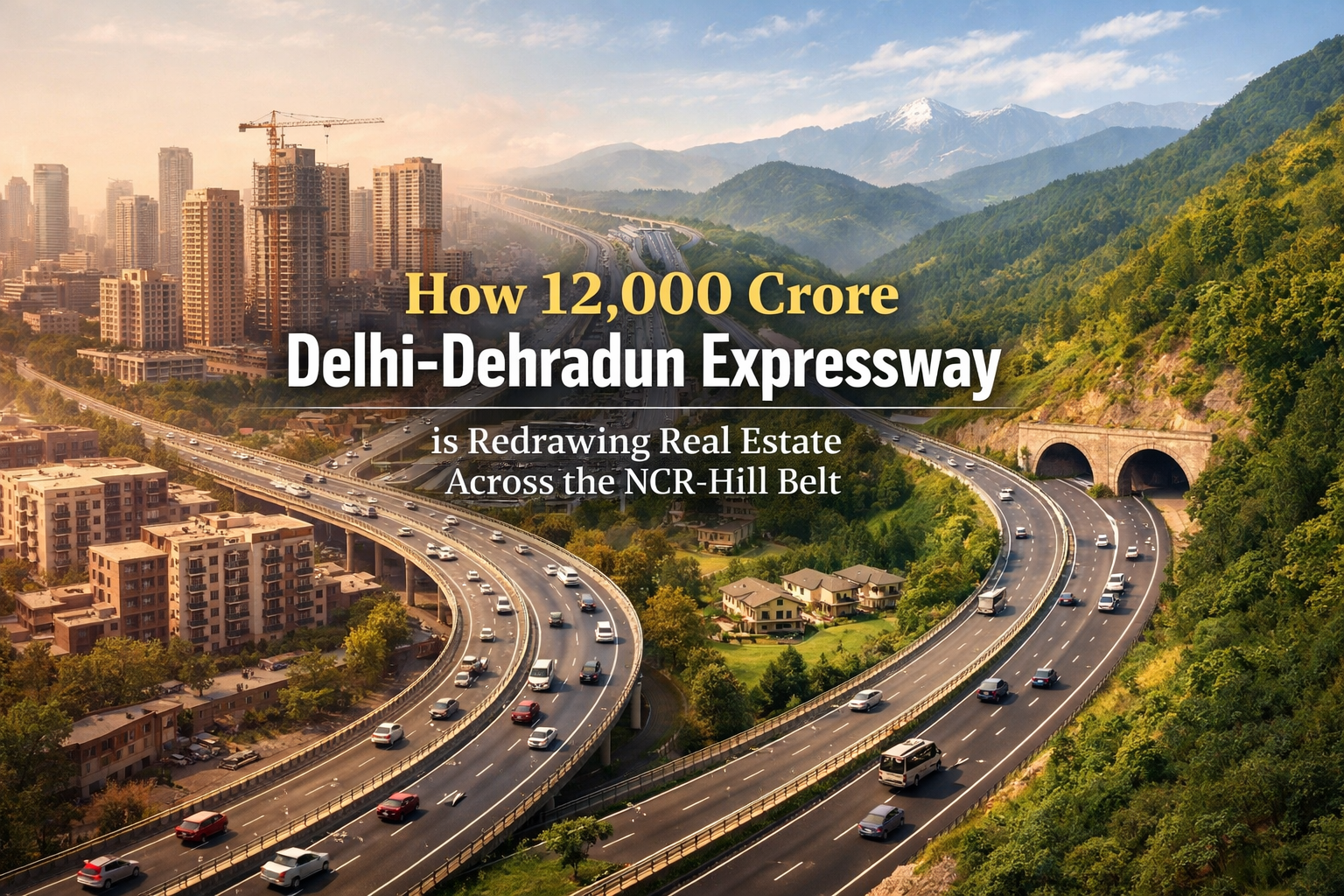
Getting from the crowded streets of Delhi to the quiet foothills of Uttarakhand has always been an exhausting ordeal. For years, commuters accepted the frustrating five to six-hour crawl through the heavily congested old highways. Anyone who has driven the traditional route knows the pain of being stuck behind heavy trucks in Modinagar, navigating the chaotic intersections of Meerut and Muzaffarnagar, and dealing with the inevitable bottlenecks outside Roorkee. That era officially ended on April 14, 2026.
The full inauguration of the Delhi-Dehradun Expressway by the central government has fundamentally rewritten the geography of North India. By shrinking the 235-kilometre journey down to a seamless, high-speed 2.5-hour drive, this massive infrastructure project has not only transformed regional travel but has ignited one of the most aggressive real estate booms across the National Capital Region and the adjoining hill belt. The psychology of distance has completely changed. When Dehradun is just two and a half hours away, it no longer feels like a separate state; it functions almost like an extended, highly desirable suburb of Delhi.
The expressway, officially designated as NH-709B, is a 213-kilometre access-controlled highway built with a total capital outlay exceeding ₹12,000 crore. Starting right at the Akshardham Temple in Delhi, it cuts a direct, high-speed path through the agricultural and industrial heartlands of Western Uttar Pradesh before climbing into the Shivalik Hills.
To manage the massive scale of the engineering, the construction was executed in four distinct phases. The first phase tackled the heavily congested urban sprawl, taking traffic from Akshardham through Geeta Colony, Shastri Park, and Mandola Vihar in Ghaziabad, right up to Khekra in Baghpat. This 32-kilometre stretch features up to 12 lanes in certain areas and connects directly with the Eastern Peripheral Expressway.
The second phase is where the real speed begins. It is a completely greenfield alignment, carving a fresh 118-kilometre, six-lane route that entirely bypasses older, congested highway towns to connect Baghpat directly with the Saharanpur bypass. The third phase upgraded the existing 40-kilometre stretch from Saharanpur up to Ganeshpur. Finally, the fourth phase handled the highly complex, forested terrain entering Dehradun, utilizing specialized mountain engineering to navigate the final 20 kilometres safely.
With a speed limit set at 100 kmph for cars, the corridor is designed for absolute efficiency. It features over 113 vehicular underpasses, numerous interchanges, and multiple railway overbridges. This ensures that while highway traffic moves at top speed, the local towns and villages along the route stay perfectly connected without facing massive barricades dividing their communities.
What truly sets this expressway apart from other massive road networks in India is the heavy emphasis on ecological preservation, specifically the massive 12-kilometre elevated wildlife corridor on its final stretch. Currently recognized as the longest elevated wildlife corridor in Asia, this section passes directly through the ecologically sensitive Rajaji National Park and the Shivalik Forest Division.
Rather than cutting a destructive path through the jungle, engineers elevated the entire highway on widely spaced pillars. This creates a massive six-metre vertical clearance underneath the road, allowing the forest to remain contiguous. The design includes two massive, dedicated elephant underpasses, each spanning roughly 200 metres, alongside six additional crossings for smaller wildlife like leopards and deer.
To ensure the high-speed traffic does not disrupt the natural habitat, construction teams installed heavy sound barriers and controlled lighting systems to prevent noise and light pollution from spilling into the forest at night. Furthermore, engineers bored a 340-metre twin tunnel near the historic Daat Kali temple, totally eliminating the need to cut through the sensitive hillside. Massive compensatory afforestation drives have also been completed, planting nearly two lakh trees across 165 hectares. This careful, calculated balance between high-speed urban transit and aggressive ecological preservation is a massive selling point for eco-conscious homebuyers looking to settle near the hills.
Whenever travel times drop this drastically, property values inevitably surge. The entire 210-kilometre belt from the edges of East Delhi all the way to Dehradun is currently experiencing a massive rerating in real estate markets. Areas that previously felt disconnected from the NCR economy are now being viewed as highly viable suburbs, logistics hubs, and weekend retreats.
Real estate analysts and property consultants are tracking a projected 15 to 30 percent appreciation in property prices across these micro-markets over the next few years. This shift in perception is drawing intense interest from individual homebuyers, institutional investors, and large-scale commercial developers looking to secure massive land banks before prices hit their peak. The demand is not isolated to one type of real estate; it is a broad-based boom covering everything from small roadside commercial plots to expansive luxury retirement communities.
The immediate and most visible beneficiaries of the expressway are the towns located along the Uttar Pradesh stretch. For decades, districts like Baghpat, Baraut, Shamli, and Muzaffarnagar were primarily known for agriculture and localized, small-scale trade. Today, they are sitting on a goldmine of national connectivity.
The operational first phase of the expressway has already brought parts of East and North-East Delhi, along with Ghaziabad and Tronica City, into high demand. As you move further up the corridor into the greenfield sections, investors are heavily targeting raw land near the planned expressway exits and major interchanges. The logic driving this is incredibly straightforward: where highway traffic exits, heavy commercial activity follows immediately.
Small towns along this route are actively preparing for an influx of logistics hubs, large warehousing facilities, highway motels, massive food courts, and commercial retail spaces. The government has already planned over a dozen wayside amenities to service travelers, which will act as anchor points for further local commercial development. Developers are actively acquiring land in and around Saharanpur, banking on its geographic position as the major mid-point of the journey. The plan is to build gated residential societies and mixed-use commercial projects that offer highway convenience without city congestion.
While the Uttar Pradesh towns offer massive commercial and plotted investment opportunities, the Uttarakhand side of the expressway is experiencing an unprecedented residential and lifestyle boom. Dehradun has historically always been a favored retirement and education destination, but its real estate market is now shifting into a completely different gear.
Demand is heavily concentrated on the southern outskirts of the city, specifically near the expressway approach roads, the Asharodi exit, and the areas leading up to the hills. Buyers from heavily polluted and congested cities like Delhi, Noida, and Gurugram are actively hunting for plots suitable for building expansive farmhouses, luxury weekend villas, and quiet second homes. The appeal of having a quiet home with clean mountain air, yet being able to jump in a car and drive back to a corporate office in Delhi in under three hours, is an unprecedented luxury that buyers are willing to pay a heavy premium for.
Adding aggressive fuel to this fire is the upcoming 26-kilometre elevated road designed to connect Dehradun directly to Mussoorie. Once this final link is fully operational, the total drive time from Akshardham in Delhi straight up to the Queen of the Hills will drop to just four hours. This upcoming mountain connection is pushing up land values not just within the Dehradun valley, but all the way up the mountain slopes leading to Mussoorie.
For anyone actively navigating the Delhi NCR and adjacent property markets, the math behind infrastructure-led appreciation is quite established. Remember this when buying real estate in Delhi NCR, land doubles every three years, plot every five years and apartments every eight years. This historical pattern is exactly why smart money is currently flooding into raw land and plotted developments near the new highway exits rather than waiting for ready-to-move-in apartments to be constructed.
Early entry is the single defining factor for maximizing returns in a corridor development like this. Institutional investors with heavy capital are targeting large, unzoned land parcels in places like Shamli and Saharanpur, aiming to hold them for a few years as the areas slowly urbanize, get rezoned by local authorities, and require commercial infrastructure.
On the other hand, end-users are focusing heavily on Dehradun and the mountain approaches. They are prioritizing established gated communities that offer urban amenities, high-speed internet, and power backups, all nestled within a natural landscape. The market is clearly splitting into two distinct segments: aggressive commercial land plays in the plains of Uttar Pradesh, and high-end lifestyle residential purchases in the valleys of Uttarakhand.
While the financial upside is massive, buying property along a newly developing infrastructure corridor requires heavy, uncompromising due diligence. The sudden surge in demand has naturally attracted a lot of speculative activity and, unfortunately, unorganized developers looking to make a quick profit.
The absolute biggest hurdle for buyers, especially when dealing with open plots in smaller UP towns or the rural belts of Uttarakhand, is the authenticity of land titles. Agricultural land conversion rules differ wildly between Uttar Pradesh and Uttarakhand. In Uttarakhand, there are strict laws regarding how much land a non-resident can purchase. Buyers must ensure that the land they are purchasing has crystal clear titles, is totally free from multi-generational family disputes, and has all the necessary government approvals for residential or commercial construction.
Furthermore, buyers should strictly focus on projects backed by developers who have a proven, verifiable track record of actual construction progress, not just empty promises printed on a glossy brochure. Checking for proper RERA (Real Estate Regulatory Authority) registrations and ensuring the physical presence of basic, non-negotiable infrastructure like treated water supply, stable electricity grids, and proper storm drainage is absolutely mandatory before signing any checks or transferring booking amounts.
The opening of the Delhi-Dehradun Expressway represents a generational shift in North Indian infrastructure and real estate. It has effectively erased the grueling, exhausting distance between the intense economic engine of the plains and the peaceful retreat of the hills. It is bringing an entire 200-kilometre stretch of sleepy towns and agricultural districts directly into the modern economic fold.
Whether it is a family from Noida looking for a quiet weekend getaway home, an aggressive investor hunting for high-yield commercial land near an interchange, or a national logistics company optimizing its supply chain routes, the corridor offers something highly valuable for everyone. As traffic now flows steadily at 100 kmph across the massive elevated wildlife corridors and through the newly bored mountain tunnels, the real estate landscape trailing directly behind it has been permanently transformed.
