Published On:
May 3, 2026
Updated On:
May 3, 2026
Haryana has introduced a landmark amendment to its building code, making comprehensive electric vehicle charging infrastructure entirely mandatory for all new residential and commercial real estate projects, paving the way for a fully EV-ready urban ecosystem.
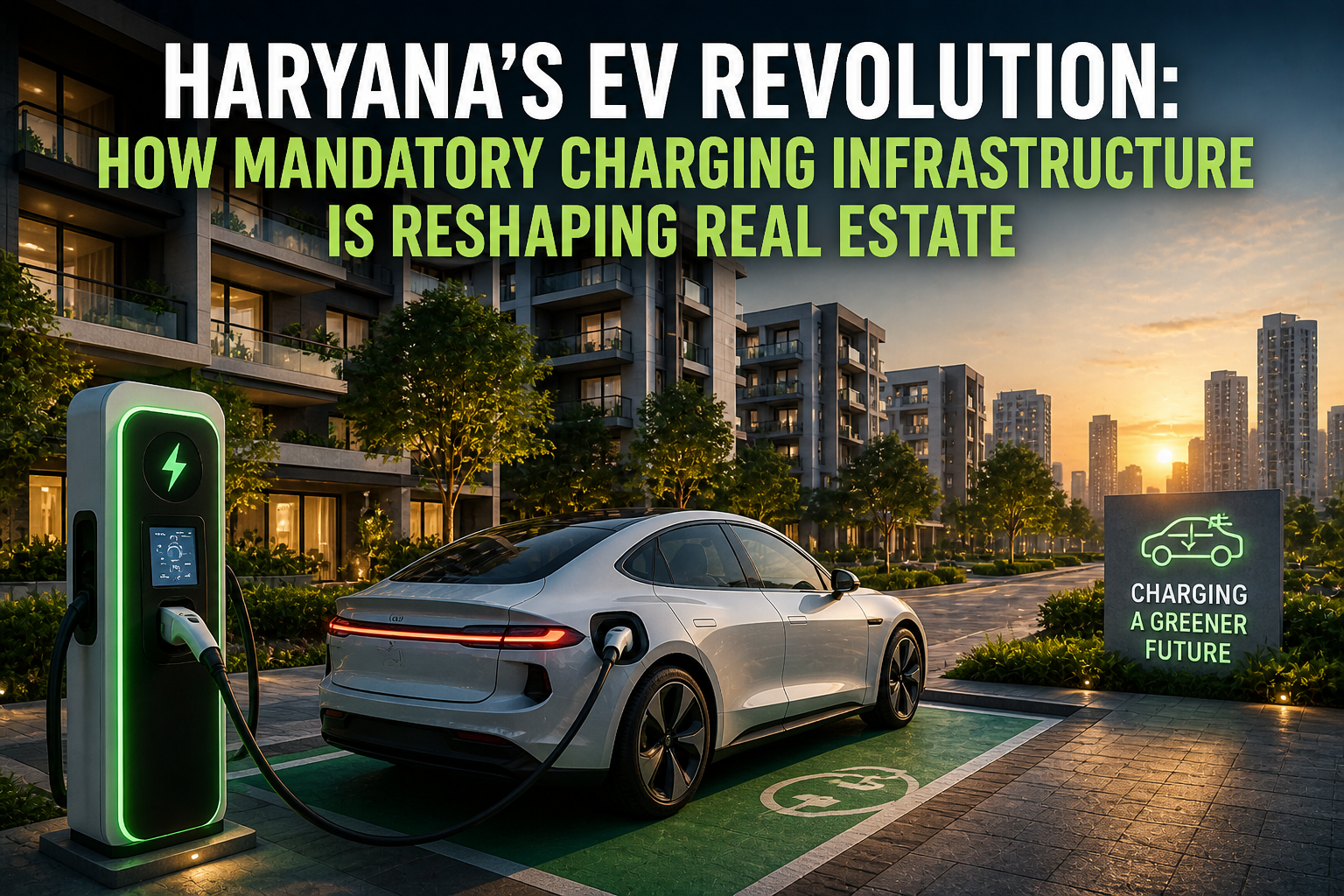
The electric vehicle revolution across India is no longer a distant futuristic concept; it is an active, rapidly accelerating reality on our roads today. However, as the adoption of electric cars and two-wheelers continues to surge at an unprecedented pace, a glaring infrastructural bottleneck has consistently threatened to slow down this momentum: the severe lack of accessible, reliable home and workplace charging stations. Potential buyers have frequently hesitated, not because they doubt battery technology or the long-term financial savings of electric mobility, but purely out of deep-seated range anxiety and the logistical nightmare of finding a plug in a dense urban environment.
Recognizing that sustainable mobility is fundamentally impossible without a robust, deeply integrated supporting ecosystem, the Haryana government has taken a monumental, incredibly proactive step. In a move that is set to completely transform the real estate landscape across the National Capital Region, the state’s Department of Town and Country Planning has proposed sweeping, highly strategic amendments to the Haryana Building Code of 2017. These incoming regulations shift the focus entirely from merely offering vehicle purchase incentives to fundamentally altering how modern cities are built, mandating that electric vehicle charging infrastructure becomes a standard, non-negotiable feature in all upcoming building developments.
Historically, urban planning and automotive infrastructure have existed in relatively separate silos. Gas stations were built on commercial land parcels along highways, while residential complexes simply needed standard parking spaces. The transition to electric mobility completely obliterates this separation, bringing the refueling process directly into our basements, stilt parking lots, and office complexes. The state authorities have acutely realized that retrofitting older buildings with complex, heavy-load electrical wiring is not only exorbitantly expensive but often structurally impossible without severe disruption to the residents.
To completely eradicate this future hurdle, the new policy strictly mandates that EV readiness must be integrated at the absolute foundational planning stage of any new real estate project. Instead of treating charging stations as an optional, premium luxury amenity offered only by top-tier luxury builders, the government is ensuring that the electrical conduits, the heavy-duty wiring, and the physical spatial planning for chargers are baked into the very blueprints of the building. This proactive integration guarantees that as the population naturally transitions toward electric vehicles over the next decade, the urban infrastructure of rapidly expanding cities like Gurugram, Faridabad, and Panchkula will be fully prepared to absorb the massive electrical demand without requiring chaotic, post-construction structural modifications.
A blanket rule demanding chargers everywhere would be logistically highly inefficient, which is why the proposed amendments are heavily detailed and highly specific regarding the actual volume of required infrastructure. The policy intelligently differentiates between the high turnover rates of commercial properties and the overnight, long-duration charging habits typically seen in residential societies.
For all new and renovated non-residential projects, which encompasses massive shopping malls, expansive corporate office parks, high-street retail complexes, and luxury hotels possessing parking facilities for ten or more vehicles, the regulatory requirement is intensely robust. Developers are legally required to install at least one fully functional electric vehicle charging point for every three designated parking slots. This aggressive 1:3 ratio ensures that working professionals and retail consumers will never have to fight over limited charging access during peak business hours.
Conversely, the requirement for residential developments—including massive group housing societies, cooperative housing projects, and standard residential blocks managed by local welfare associations—is set at a highly practical ratio of one active charging point for every five parking spaces. Most crucially, beyond just installing the active chargers, the mandate dictates that one hundred percent of all parking slots across both residential and commercial categories must be made entirely EV-ready from day one. This means developers must lay down the empty conduits and necessary wiring networks across the entire parking grid. When a resident eventually purchases an electric vehicle years down the line, installing their personal charger will be a simple, plug-and-play operation rather than a massive civil engineering project.
One of the most persistent, loudest friction points in modern real estate development revolves around the Floor Area Ratio, commonly known as FAR. This metric strictly dictates the maximum allowable built-up area a developer can construct on a specific plot of land. Every square foot dedicated to a technical utility room or specialized infrastructure traditionally eats into the highly lucrative, sellable floor space, making developers incredibly hesitant to add non-mandatory structural features.
In an absolute masterstroke of regulatory planning, the state government has officially proposed that all space utilized for electric vehicle charging infrastructure will be entirely exempt from FAR calculations. This specific financial and structural exemption acts as a massive catalyst for compliance. Real estate developers can now confidently design expansive, highly sophisticated charging hubs, dedicated electrical load management rooms, and advanced transformer setups without constantly worrying about losing highly profitable residential or commercial square footage. By removing the financial penalty associated with building green infrastructure, the government has brilliantly aligned the developers' profit motives with the state's broader ecological and sustainability targets.
For the past few years, the integration of electric vehicle chargers in high-rise buildings has been trapped in a deeply confusing, highly frustrating regulatory gray area, specifically regarding fire safety. Because lithium-ion battery fires require highly specialized suppression techniques, local fire departments and municipal authorities have historically been extremely reluctant to issue mandatory No Objection Certificates for buildings attempting to install chargers in enclosed basements. This led to numerous stalled projects and deeply frustrated residential welfare associations who were completely blocked from upgrading their societies.
The new amendments tackle this exact issue head-on, replacing years of bureaucratic confusion with crystal-clear, actionable guidelines. The draft explicitly permits the installation of high-capacity electric chargers in both deep basements and stilt parking areas, provided the developer stringently adheres to a newly defined set of strict fire safety norms and technical engineering standards.
This brings immense clarity to the construction sector. Builders now possess a definitive, standardized checklist of safety requirements—ranging from specialized ventilation systems to advanced, automated thermal detection and chemical fire suppression grids—that must be integrated into the basement architecture. Once these specific safety parameters are met, the project is legally cleared. This balanced, highly pragmatic approach perfectly ensures the absolute physical safety of the building's occupants while finally completely unlocking the ability to charge vehicles in the dense, space-constrained environments typical of modern metropolitan high-rises.
The true, long-term brilliance of making electric vehicle readiness mandatory at the initial construction stage becomes highly apparent when analyzing the massive financial costs of retrofitting. Tearing up thick concrete driveways, core-drilling through foundational basement walls to run heavy electrical cables, and aggressively upgrading a completed building’s main power transformer to handle sudden, massive spikes in electrical load is a logistical nightmare. It invariably leads to massive financial disputes between society residents, unexpected special assessment fees, and years of delayed implementation.
By legally forcing developers to lay the groundwork while the concrete is still wet, the state is effectively saving future homeowners hundreds of thousands of rupees in eventual community upgrade costs. Furthermore, this policy acts as the ultimate cure for the psychological barrier of range anxiety. When a prospective car buyer knows with absolute certainty that they have a dedicated, safe, and heavily regulated charging point waiting for them in their office basement and another right in their home parking spot, the perceived risk of transitioning away from traditional internal combustion engines completely evaporates. The vehicle seamlessly charges while the owner works or sleeps, completely removing the necessity of visiting public refueling stations.
From an investment and property valuation perspective, this regulatory shift introduces a highly significant new dynamic into the National Capital Region's real estate market. Today's modern, highly educated property buyers are no longer simply looking at the marble flooring or the size of the clubhouse; they are actively seeking out smart, sustainable, and entirely future-proofed living spaces.
Properties that boast comprehensive, high-tech EV readiness will immediately command a highly noticeable premium in both the primary sales market and the secondary rental ecosystem. Imagine a prospective tenant or a secondary market buyer evaluating two identical apartments in a premium Gurugram sector. One building requires them to park their newly purchased electric SUV on the street due to a lack of internal charging, while the other offers a dedicated, fast-charging port right at their designated basement pillar. The EV-ready property instantly wins, securing faster transactions, significantly higher tenant retention rates, and superior, long-term capital appreciation.
Real estate channel partners, wealth managers, and property consultants will rapidly pivot their marketing strategies to heavily highlight EV infrastructure as a core, non-negotiable selling point. Furthermore, as the deadline for these compliance mandates approaches, developers who proactively adapt and aggressively market their early compliance will easily position themselves as highly progressive, forward-thinking market leaders, capturing the immediate attention of the environmentally conscious, high-net-worth demographic.
The upcoming implementation of these strict building code amendments represents far more than just an update to municipal construction rules; it is a highly definitive, irreversible pivot toward a greener, entirely sustainable urban future. By legally embedding the core requirements of electric mobility directly into the physical concrete and steel of our newest cities, Haryana is setting a formidable, highly progressive benchmark that other expanding states will inevitably be forced to follow.
While real estate developers will undoubtedly need to adjust their initial capital expenditure models, heavily upgrade their internal electrical planning, and strictly coordinate with advanced fire safety engineers, the overarching, long-term economic and environmental benefits absolutely dwarf these minor initial hurdles. This mandate completely guarantees that the multi-crore infrastructure projects currently breaking ground across the state will not be rendered technologically obsolete within a decade.
As public feedback concludes and these draft rules are officially cemented into the state legislative framework, the entire development ecosystem will seamlessly shift. The era of the electric vehicle being treated as a niche, alternative lifestyle choice is officially ending. Through highly aggressive, deeply intelligent urban planning, the state has ensured that clean, electric mobility will become the absolute, frictionless standard for every new homeowner, corporate employee, and real estate investor navigating the future of Northern India.
