Published On:
February 5, 2026
Updated On:
February 5, 2026
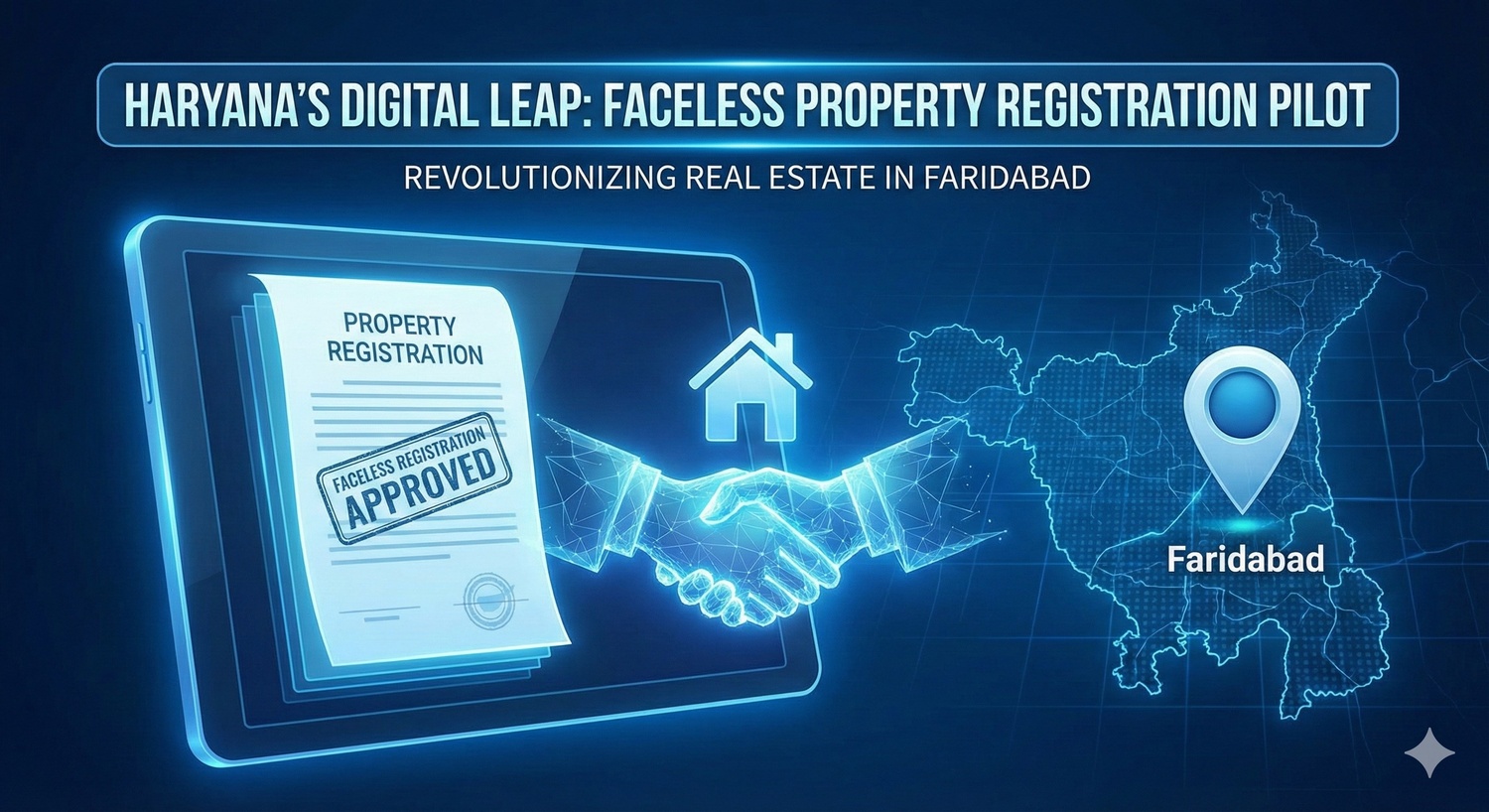
The Haryana government has launched a revolutionary pilot project for faceless property registration in Faridabad, allowing citizens to register property from home without visiting government offices. This fully digital, secure, and transparent system aims to eliminate corruption, reduce processing time, and set a new benchmark for land governance in India.
For decades, buying or selling property in India has been synonymous with one exhausting reality: the Tehsil run. The process typically involves endless queues, chaotic paperwork, navigating through middlemen, and spending hours—sometimes days—at the Sub-Registrar’s office. It is a system that has long been plagued by opacity, delays, and an unfortunate reliance on manual discretion.
However, the real estate landscape in Haryana is about to witness a seismic shift. In a landmark governance reform announced in February 2026, the Haryana government is rolling out a Faceless Property Registration Pilot in Faridabad. Scheduled to launch by the end of March 2026, this initiative promises to make the physical "registry office visit" a thing of the past.
By leveraging cutting-edge cloud technology and digital verification, the state government is moving towards a "zero-touch" system where you can register your property from the comfort of your living room. This blog dives deep into what this new pilot entails, how the technology works, and why this could be the most significant real estate reform for Haryana in decades.
The "Faceless Property Registration" initiative is a fully digital workflow designed to eliminate the physical interface between the citizen and the government official. Unlike the previous "paperless" systems that still required a final visit for biometric verification, this new pilot aims to digitize the entire chain.
The Core Concept:The system replaces the need for physical presence with robust digital authentication methods like Aadhaar-based e-signatures and video verification. The goal is to remove human discretion from the process, thereby plugging leaks for corruption and ensuring that every application is treated with equal speed and transparency.
The Pilot Phase:
For the average homebuyer or investor in Faridabad, the new workflow promises to be as simple as online banking. Here is a breakdown of the anticipated process based on the government's framework:
Applicants will log in to the dedicated revenue department portal. Instead of carrying physical bundles of paper, you will upload digital copies of the Sale Deed, identity proofs (Aadhaar/PAN), and property details.
This is the game-changer. Instead of standing in front of a camera at the Tehsil office, the system will likely use Video KYC and Aadhaar authentication to verify the identity of the buyer and seller remotely.
The entire platform is hosted on the Government of India’s MeitY Cloud. This ensures enterprise-grade security for your sensitive property documents, protecting them from physical damage, loss, or tampering.
Stamp duty and registration fees are calculated automatically by the software and paid via integrated digital payment gateways, eliminating the "cash handling" risk entirely.
Once the documents are uploaded and fees paid, the Sub-Registrar reviews the application digitally. If everything is in order, the deed is digitally signed and approved.
Perhaps the most critical feature is the integration of automatic mutation. Once the registry is approved, the system automatically triggers the update in the land records (Jamabandi), ensuring that the ownership change is reflected instantly without a separate application.
The choice of Faridabad for this pilot is no accident. As one of the most bustling industrial and residential hubs in the National Capital Region (NCR), Faridabad sees a high volume of property transactions daily.
This reform is not just about upgrading software; it is about upgrading the citizen's experience.
The biggest advantage of a faceless system is the removal of the "middleman." By eliminating physical interaction, the scope for demanding bribes to "move the file" or "get a slot" is effectively eradicated. The software processes files based on a "First-In, First-Out" logic, ensuring fairness.
For Non-Resident Indians (NRIs) and elderly citizens, this is a blessing. Selling or buying property previously required expensive travel and physical presence. With this system, a property transaction in Faridabad could theoretically be completed by an owner sitting in New York or Bengaluru.
What used to take 4 to 8 hours of waiting can now be completed in under 30 minutes of active screen time. The digital audit trails also mean that errors are flagged instantly by the system, rather than being discovered weeks later by a clerk.
With records stored on the MeitY Cloud, your property title is safe from physical disasters like fire or flood, which have historically plagued record rooms in India.
While the initiative is groundbreaking, the 3-month pilot will be critical in ironing out operational challenges.
Future Expansion:Success in Faridabad will likely lead to a phased rollout in other high-transaction districts like Gurugram, Panchkula, and Sonipat. The vision is to eventually have the entire state of Haryana operating on this friction-free platform.
The launch of the faceless property registration pilot in Faridabad is a clear signal that Haryana is serious about "Minimum Government, Maximum Governance." By treating property registration as a service rather than a bureaucratic favor, the state is setting a new benchmark for transparency and ease of doing business in India.
For the residents of Faridabad, the days of chaotic Tehsil visits may soon be over. As we approach the end of March, all eyes will be on this pilot—because if it succeeds, it won't just change how we register land; it will change how we trust the system.
