Published On:
April 14, 2026
Updated On:
April 14, 2026
The Haryana government's recent decision to increase the Floor Area Ratio (FAR) to 3.0 for retirement housing projects will drastically improve the financial viability of senior living developments, paving the way for world-class, integrated retirement communities across the state, particularly in Gurugram.
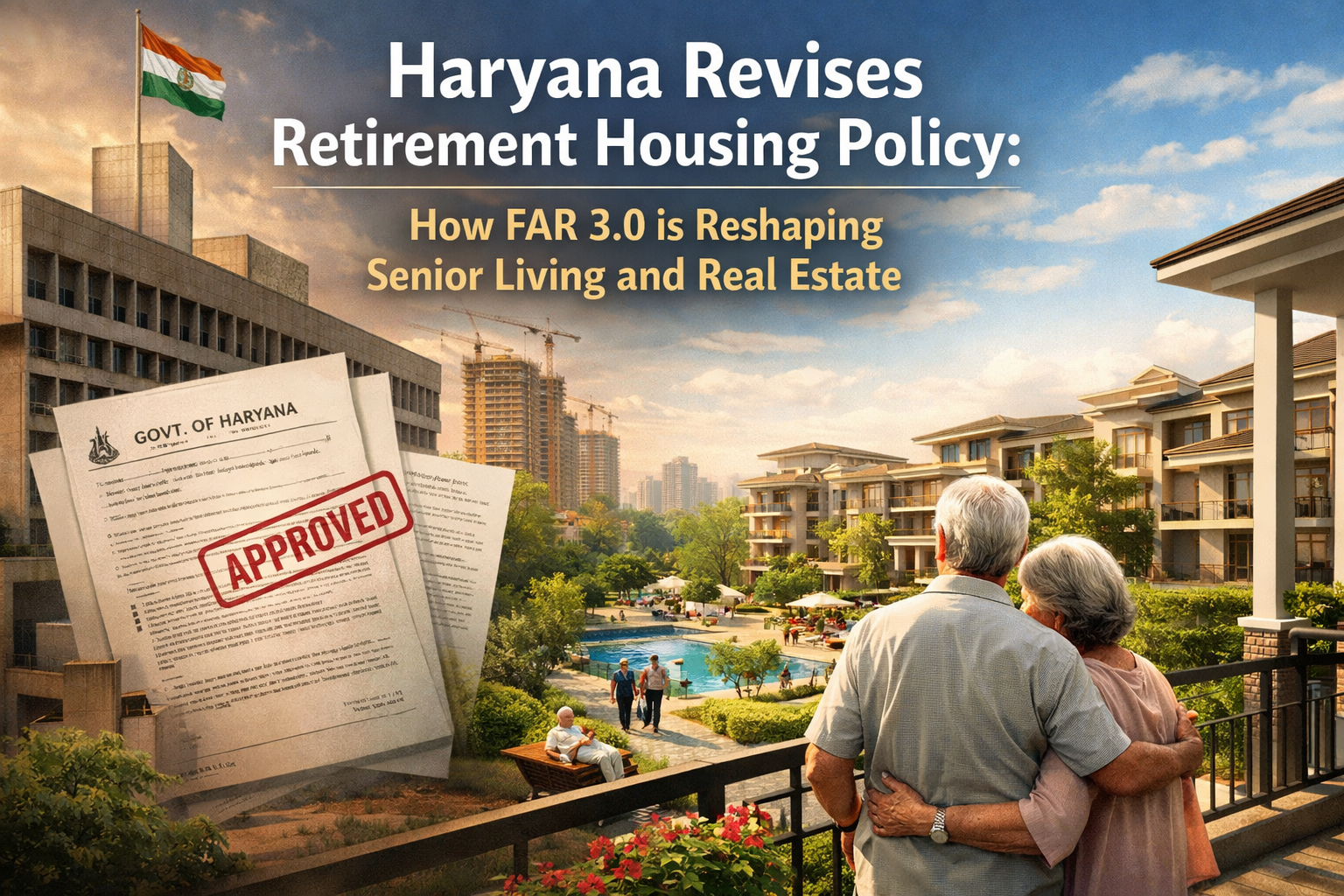
The demographic fabric of India is undergoing a profound transformation. With a rapidly growing elderly population and a decisive cultural shift toward nuclear family structures, the traditional support systems for senior citizens are evolving. This transition has triggered an unprecedented demand for specialized, organized, and deeply integrated senior living communities. Recognizing this pressing societal need and the specific lifestyle requirements of the ageing population, the Haryana government has introduced a landmark regulatory update that is poised to fundamentally alter the regional real estate landscape.
The state cabinet recently approved a crucial amendment to the Retirement Housing Policy, strategically increasing the permissible Floor Area Ratio for retirement housing colonies. By raising the maximum limit from 2.25 to a generous 3.0 through the utilization of Transferable Development Rights, the administration has directly addressed the most significant bottleneck stalling the growth of this sector: project viability. This is not merely a minor bureaucratic adjustment; it is a powerful catalyst that will unlock massive potential for real estate developers and dramatically expand the options available to homebuyers seeking premium, supportive environments for their golden years.
To truly grasp the magnitude of this policy change, it is essential to understand the mechanics of the real estate metrics involved. Floor Area Ratio is the primary formula that dictates exactly how much total constructed area a developer is legally permitted to build on a specific plot of land. Under the previous guidelines, a FAR of 2.25 meant that the total built-up area could be 2.25 times the size of the land parcel. While functional for standard residential projects, this cap severely restricted developers trying to build specialized retirement communities, which inherently require expansive common areas, wider corridors, and extensive ground-level amenities.
The newly amended policy pushes this boundary up to 3.0. This substantial increase in vertical development potential is facilitated through the Transferable Development Rights framework. TDR is an advanced urban planning tool that allows a landowner or developer to essentially purchase or transfer unused development potential from one geographical zone to another. By integrating the FAR hike with the existing TDR policy of 2021, the government has provided developers with a legal, structured pathway to maximize their construction footprint without having to acquire additional, prohibitively expensive land.
The immediate and most profound impact of this policy revision will be felt within the boardrooms of real estate development firms. Historically, the senior living segment in high-value markets like Gurugram has been viewed as a niche, highly challenging asset class. The core issue has always been the fundamental unit economics of land acquisition.
When a developer acquires a premium land parcel in the National Capital Region, the upfront capital expenditure is staggering. To justify that investment, the traditional playbook has been to launch ultra-luxury condominiums or high-density commercial spaces. Senior living projects, by their very design, are highly capital-intensive to build and operate. They require non-saleable infrastructure such as 24/7 medical centers, wheelchair-accessible ramps, specialized dining halls, and dedicated wellness zones. Under the old FAR restrictions, allocating space to these essential amenities meant sacrificing saleable residential units, deeply eroding the project's profit margins.
The leap to a 3.0 FAR completely changes this financial equation. By allowing developers to build significantly more on the exact same piece of land, the proportional cost of land per residential unit drops dramatically. Builders can now construct additional floors to house the required residential apartments, freeing up massive amounts of lower-level and ground space to design the lavish, integrated support systems that senior residents genuinely require. This improved feasibility means that constructing retirement housing is no longer a financial compromise; it is now a highly attractive, commercially viable venture.
As the profit margins stabilize and align with other premium residential categories, the market will inevitably witness a surge in institutional capital entering the space. Large-scale, organized developers who previously hesitated to enter the senior living market will now view it as a sustainable, scalable component of their long-term urban portfolios.
For decades, the concept of retirement housing in India was heavily stigmatized, often associated with bare-bones facilities or isolated old-age homes. Today, the modern homebuyer views senior living through a completely different lens. Families are actively seeking out vibrant, secure, and medically equipped communities—not as a last resort, but as a conscious, planned lifestyle choice to ensure dignity, independence, and an elevated quality of life for aging parents.
Prior to this amendment, families searching for such communities in the NCR faced a severe supply shortage. The few premium options available were often priced out of reach for the broader middle and upper-middle classes due to the constrained supply and high land costs. The increase in permissible FAR directly benefits the consumer by triggering a robust pipeline of new, credible supply.
With developers empowered to build larger, more comprehensive projects, buyers can expect a dramatic expansion in the variety of available homes. This means a wider spectrum of pricing models, architectural styles, and service tiers entering the market. Instead of settling for a retrofitted standard apartment, seniors will have access to purpose-built environments engineered specifically for their stage of life.
The true value of the 3.0 FAR allowance lies in what developers can actually do with the extra space. Retirement housing requires an architectural approach that prioritizes accessibility and holistic well-being over sheer density.
With the increased floor area, future projects in Haryana will feature entirely barrier-free designs. This translates to wider doorways, zero-step entries, anti-slip flooring, and specialized bathroom fixtures that prevent falls and accommodate mobility aids. But the enhancements go far beyond the four walls of the apartment.
The extra built-up area will allow developers to dedicate entire floors to comprehensive healthcare ecosystems. Buyers can expect to see integrated clinics, physiotherapy centers, pharmacies, and 24-hour emergency response stations located directly within the residential complex. Furthermore, modern senior living places a massive emphasis on mental health and social engagement to combat the isolation often experienced by the elderly. The new regulatory environment gives architects the freedom to design expansive clubhouses, hobby rooms, yoga studios, and communal dining areas that foster a deep sense of community and active aging.
For families, investing in these specialized communities offers profound peace of mind. Knowing that their loved ones are residing in a highly secure environment, surrounded by peers, with immediate access to professional medical care and daily lifestyle support, is an invaluable proposition.
One of the most critical takeaways from the Haryana government's policy update is the clear ideological shift in how retirement housing is categorized by state planners. By actively amending the Haryana Development and Regulation of Urban Areas Act to accommodate these higher densities, the administration is signaling that senior living is no longer a fringe luxury sector. It is now recognized as essential social infrastructure.
Just as a thriving city requires adequate schools, hospitals, and commercial districts, it must also possess the specialized housing required to support its aging demographic in a dignified manner. As cities like Gurugram, Faridabad, and Panchkula continue to expand, the integration of these planned senior communities will become a standard benchmark of comprehensive urban development.
This policy ensures that senior communities are not pushed to the distant, disconnected outskirts of the city where land is cheap but medical infrastructure is absent. By making it financially viable to build within prime, established urban zones, the government ensures that seniors remain connected to the broader city fabric, close to major multi-specialty hospitals, retail centers, and their extended families.
The ripple effects of the FAR 3.0 policy will become highly visible across the Haryana real estate market over the next few development cycles. Industry watchers anticipate a flurry of new project announcements and land acquisitions specifically targeted at the senior demographic in the coming quarters.
As the market matures, we will likely see specialized real estate developers partnering directly with established healthcare providers and hospitality operators to manage the complex daily operations of these massive communities. The success of these future projects will not just depend on the quality of the brick-and-mortar construction, but on the rigorous maintenance of service standards, medical care, and community management.
Furthermore, this progressive move by the Haryana cabinet establishes a powerful precedent. As the success of these newly scaled projects becomes apparent, it is highly probable that other states grappling with similar demographic shifts and high urban land costs will look to Haryana’s framework as a model for their own urban planning regulations.
The decision to raise the Floor Area Ratio for retirement housing is a rare instance of a regulatory change perfectly aligning with both commercial market realities and a deep human need. It bridges the gap between the high cost of urban development and the societal obligation to care for the elderly. For developers, it is a green light to innovate and scale in an untapped market. For homebuyers, it is the promise of secure, vibrant, and thoughtfully designed communities that will redefine what it means to age gracefully in India. As the first wave of these new, high-density senior living projects moves from the drawing board to construction, the real estate sector stands on the cusp of a highly organized, deeply empathetic new era of residential development.
