Published On:
May 21, 2026
Updated On:
May 21, 2026
The Haryana government has introduced a revolutionary digital auto-mutation system that automatically updates property records within a 7-day window. Integrated with the state’s WEB-HALRIS platform, this game-changing digital reform is designed to eliminate bureaucratic delays, clear massive pending backlogs, and actively prevent property fraud like double registration across the real estate sector.
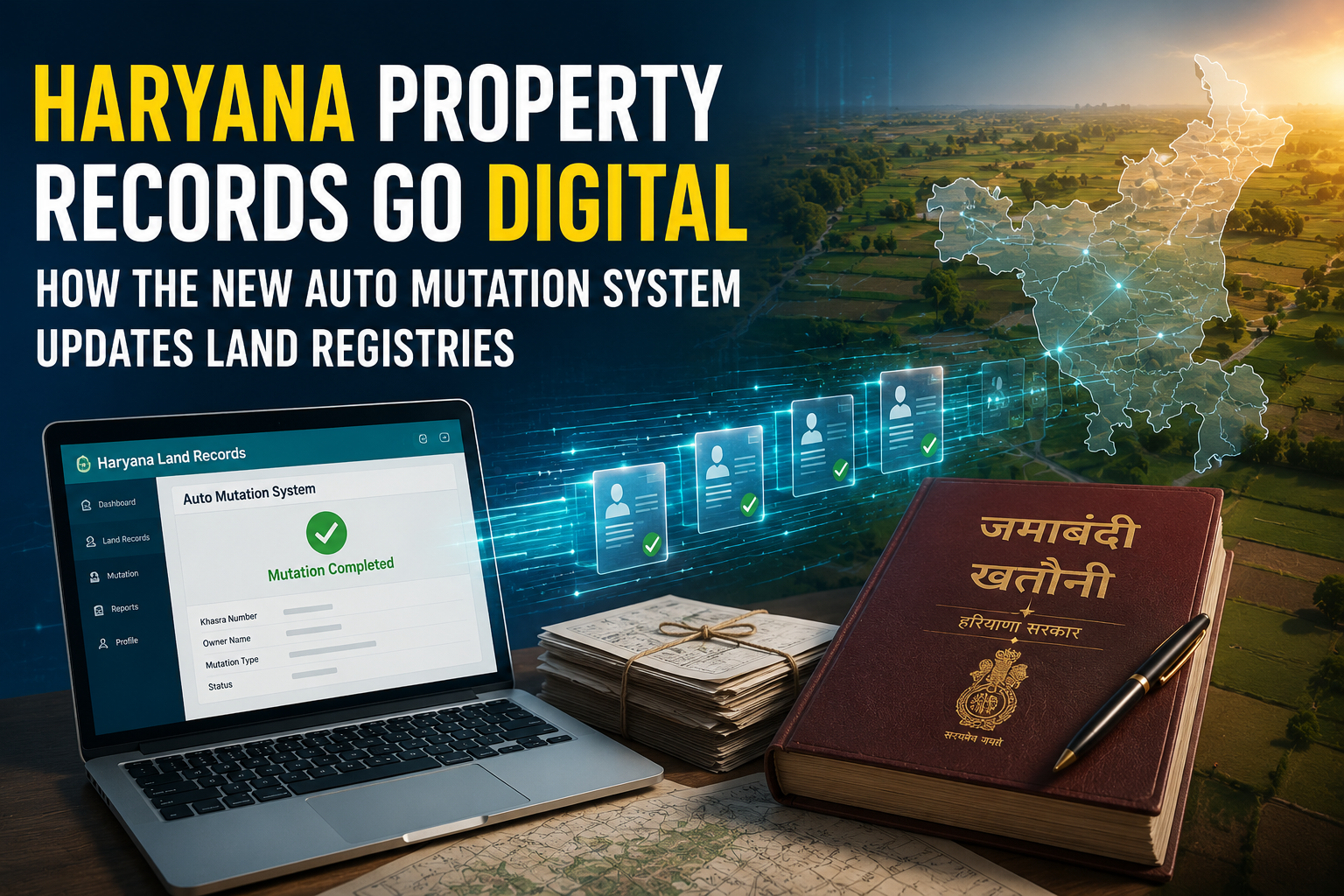
Purchasing a home or investing in a plot of land is widely considered one of the most significant financial milestones a person can achieve. However, for property buyers in Haryana, this monumental life event has historically been accompanied by an immense amount of administrative stress and endless bureaucratic hurdles. The root cause of this anxiety was rarely the purchase itself, but rather the notoriously complex internal process known as property mutation.
For decades, the system operated in a disjointed manner. A buyer would successfully register their property at the sub-registrar office, pay the required stamp duty, and walk away with a registered sale deed. However, the legal journey did not end there. Buyers then had to embark on a secondary, highly frustrating mission to get their name officially entered into the state’s land revenue records. This manual mutation process meant chasing officials for months, carrying physical files from one desk to another, and often dealing with a broken system that demanded immense patience.
Thankfully, those days of administrative fatigue are swiftly becoming a thing of the past. The Haryana administration has officially rolled out a transformative online auto-mutation system. This digital pivot is a breath of fresh air for citizens and investors who are tired of archaic red tape. More than just a minor software update, this initiative represents a complete structural makeover of how land administration functions in the state. By seamlessly bridging the gap between property registration and revenue record updates, the government is ensuring that real estate transactions are smoother, faster, and infinitely more secure.
The Launch of the Automated Digital Mutation Era
To fully appreciate the magnitude of this reform, one must look at the grey zone that existed between registering a deed and executing the final mutation. In the traditional setup, these two critical steps were entirely disconnected. The manual handover of data was slow, prone to human error, and alarmingly susceptible to corruption.
The new digital framework, which was initially tested as a pilot project in regions like Manesar and Naraingarh before its broader rollout, fundamentally changes the mechanics of land governance. It functions by directly linking the local registration office, known as the Tehsil, to the central state revenue records. The moment a buyer signs their registration papers and the biometric verification is completed, the digital wheels are immediately set into motion.
There is no longer a need to make a dozen separate visits to the local Patwari just to check if a file has moved. Instead, the entire workflow is managed through the WEB-HALRIS system, a sophisticated software architecture designed to handle complex land registry data in real time. This integration ensures that the transfer of ownership is recorded instantaneously on the backend, effectively cutting out the manual middleman that previously bottlenecked the entire property sector.
Key Features Powering the Digital Transition
The absolute best part about the newly launched auto-mutation portal is its citizen-centric design. The system is engineered to be as hands-off as possible for the common buyer, relying on automated triggers rather than manual applications.
The process kicks off automatically. The second a sale deed is registered and formalized at the sub-registrar office, the system generates a mutation request on its own. Property buyers are no longer burdened with the task of filling out separate physical applications or tracking down revenue officers to initiate the paperwork. The integration takes care of the preliminary steps seamlessly.
Following the trigger, the system implements a strict 7-day public notice window for all standard property sales. This public notice is published to allow any concerned parties to raise legal objections if they feel the sale is illegitimate. If the week passes without any red flags or disputes being filed, the mutation is automatically approved and certified on the eighth day.
For property transfers that do not involve a direct sale—such as land passing down through a will or family inheritance—the system provides a slightly longer 15-day window. This extended timeframe is specifically designed to allow distant family members or legal heirs adequate time to review the transfer and chime in if there is a familial dispute over the inheritance. If no objections arise, the title is updated automatically on the sixteenth day.
Throughout this entire process, buyers are never left in the dark. The backend software is programmed to send real-time SMS alerts directly to the registered mobile numbers of the involved parties. From the moment the mutation is initiated to the exact second it is finalized, users receive step-by-step notifications. Furthermore, the entire journey can be tracked visually via the state’s digital land records portal.
Core Objectives Behind the E-Mutation Initiative
The launch of this platform was driven by several urgent administrative necessities. The state recognized that the existing manual framework was unsustainable for a rapidly growing real estate market.
The primary objective was the complete eradication of the systemic bribe culture. When citizens are forced to physically meet with officials to push their paperwork forward, it inevitably creates a breeding ground for under-the-table demands and unauthorized payments. By digitizing the workflow and removing human discretion from standard approvals, the opportunity for corruption is effectively eliminated. The software processes files based on chronological order and strict timelines, ignoring any outside influence.
Another massive challenge the government aimed to solve was the sheer volume of pending administrative work. Prior to this digital rollout, Haryana was burdened with a staggering backlog of over 1.3 lakh pending property mutations, with major urban centers like Gurugram alone accounting for tens of thousands of unresolved cases. The automated system is designed to act as a powerful vacuum, clearing out this massive pile of old, pending files while ensuring that new registrations do not add to the congestion.
Additionally, the state wanted to guarantee absolute data synchronization. In the past, manual data entry often led to typographical errors, mismatched names, or lost files between the registration office and the revenue department. The automated flow ensures a 100 percent match between the registered sale deed and the final property tax records.
Massive Benefits for Haryana Property Buyers
For anyone looking to invest in Haryana’s booming real estate market, this technological upgrade serves as a powerful shield for their investment. The most immediate benefit is the preservation of time and sanity. Buyers no longer have to sacrifice their weekends waiting in long, chaotic queues at government offices. The process that once took months of physical legwork now happens quietly in the background over a single week.
Beyond sheer convenience, this digital shift has massive financial implications, particularly when it comes to securing home loans. Financial institutions and housing finance companies are notoriously strict about property documentation. They require clear, updated mutation records before approving loan disbursements or allowing property refinancing. Because the digital system updates these records within seven days, the entire home loan processing timeline receives a massive speed boost, providing critical liquidity to the real estate market.
Transparency is another massive win for the public. The digitization of land records places everything on a publicly accessible ledger. Buyers, sellers, and investors can verify the legal standing and mutation status of a plot of land from the comfort of their living rooms. This democratization of information ensures that there are no hidden surprises when entering into a high-value real estate transaction.
Furthermore, the automation officially marks the end of the line for unauthorized fixers and middlemen. In the past, buyers often felt compelled to hire expensive agents simply to navigate the labyrinth of revenue offices. Today, those intermediaries are entirely obsolete. The digital infrastructure follows pre-programmed logic, entirely bypassing the need for paid "facilitators."
Cracking Down on Real Estate Fraud
While the convenience and speed of the new system are highly commendable, its true value lies in its ability to crush real estate fraud. For years, scammers heavily exploited the manual delays in the mutation process to execute sophisticated property crimes.
The most devastating of these was the "double registration" scam. Under the old system, a fraudster could legally sell a residential plot to an unsuspecting buyer on a Monday. Because it took upwards of three to six months for the revenue records to actually reflect this change in ownership, the fraudster’s name remained on the official government documents. Taking advantage of this administrative lag, they would take those same documents and sell the exact same plot to a second buyer just days later. By the time the administration caught up, the scammer had disappeared with two sets of payments, leaving multiple families financially ruined and trapped in endless litigation.
The automated system slams this window of opportunity completely shut through an instant blocking mechanism. The very millisecond a sale deed is officially registered, the WEB-HALRIS system flags that specific property in the central database. The seller’s name is immediately marked as transitioning out of ownership. This digital lockdown makes it technologically impossible for the seller to attempt a second fraudulent registration using the old title papers.
Moreover, the system enforces a strict verified ownership protocol. The software will not even generate a token for a new sale deed registration if the person claiming to be the seller does not perfectly match the current ownership details held in the digital database. This pre-verification stops fraudulent transactions before they can even be initiated.
The 7-day public notice window also serves as a brilliant deterrent against illegal land sales. By making the pending mutation publicly visible, the system actively invites accountability. If someone is attempting to quietly sell a disputed piece of family land, or property currently tied up in court litigation, the rightful stakeholders have a guaranteed window to step in and halt the transfer before it becomes legally binding.
Future Roadmap and Market Impact
Following the successful execution in targeted pilot zones, the administration is aggressively expanding the automated infrastructure across every single Tehsil in the state. Major urban hubs that see incredibly high volumes of real estate transactions are being prioritized to stabilize their booming property markets. To support this massive transition, the state has actively deployed newly trained personnel to oversee the digital rollout and ensure that any rare, complex cases requiring manual intervention are resolved within strict, multi-day deadlines.
Market analysts are viewing this development as a watershed moment for northern India’s real estate sector. The introduction of instantaneous, digital property administration places Haryana on par with highly digitized tech-forward states that have implemented similar near-simultaneous registration models.
This level of transparency is exactly what institutional investors, major commercial developers, and non-resident Indian buyers look for when allocating capital. By empowering the common citizen to perform comprehensive due diligence through online portals, and ensuring that property taxes and registration fees flow directly and transparently into the state exchequer, Haryana is actively boosting the overall valuation and trustworthiness of its real estate market.
A New Era of Digital Real Estate Governance
The real estate landscape in Haryana is finally catching up with the technological expectations of the 21st century. By fully transitioning the property mutation process from a dusty, manual chore to an automated, digital workflow, the state has delivered a masterclass in modern governance.
This bold move toward comprehensive digitization protects ordinary homebuyers from fraudulent sharks while significantly lowering the barrier to entry for clean, stress-free property investments. While it may take a brief period for every rural sub-office to completely adapt to the new digital rhythm, the foundational infrastructure is remarkably solid. For anyone looking to invest in properties across the state’s rapidly expanding economic corridors, this new system offers something money traditionally couldn’t buy: absolute peace of mind. Buying a home is no longer a gamble against hidden scams or endless paperwork; it is a secure, swift, and entirely transparent process.
