Published On:
April 14, 2026
Updated On:
April 14, 2026
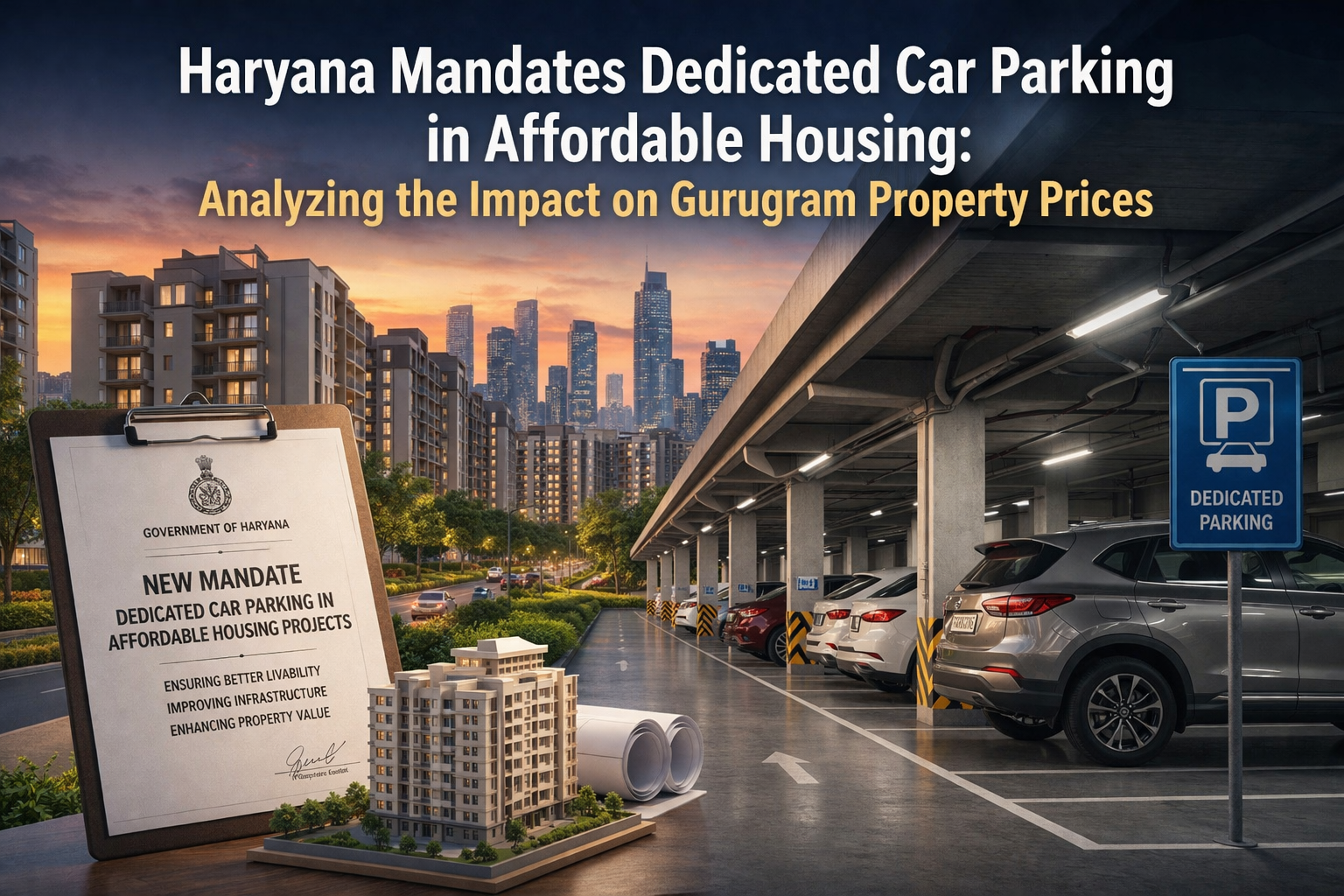
The Haryana government has amended its 2013 Affordable Housing Policy, mandating one dedicated car parking space per flat and raising the Gurugram price cap to ₹5,575 per square foot. While this policy upgrade permanently resolves chronic parking disputes and vastly improves community liveability, the mandatory parking charge—fixed at 10% of the apartment cost—will inevitably raise the financial barrier for entry-level homebuyers.
For nearly a decade, the affordable housing sector in Haryana operated with a significant, highly visible structural blind spot. While the state successfully delivered thousands of low-cost apartments to first-time homebuyers, the underlying policy largely ignored the reality of modern urban mobility. As the middle class expanded and vehicle ownership surged, the absence of mandated car parking transformed these high-density residential societies into chaotic battlegrounds over street space.
Recognizing that basic liveability requires more than just four walls, the Haryana government has officially intervened. Through a comprehensive amendment to the 2013 Affordable Housing Policy formalized in early April 2026, the Department of Town and Country Planning has entirely rewritten the rules of residential development. Real estate developers are now legally mandated to provide one dedicated car parking space for every single dwelling unit.
This regulatory shift, paired with a simultaneous increase in the permissible selling price of these flats, represents the most significant overhaul of the state's affordable housing framework in years. By analyzing the specific mechanics of this amendment, the mathematical impact on flat prices, and the broader real estate market trends, we can understand exactly how this mandate will reshape the future of urban living in cities like Gurugram.
To understand the necessity of this mandate, one must look at the original parameters of the Haryana Affordable Housing Policy introduced in 2013. The primary objective of the original framework was sheer volume and aggressive cost control. To keep apartment prices low, the policy heavily restricted project sizes, mandated fixed carpet area rates, and allowed developers to build at incredibly high densities.
However, the provision of dedicated car parking was deliberately left to the discretion of the developer. Building underground basements or multi-level stilt parking is incredibly capital-intensive, involving massive excavation, concrete pouring, and specialized ventilation systems. Given the razor-thin profit margins dictated by the government's price caps, developers naturally opted out of building extensive parking infrastructure.
The resulting fallout on the ground was severe. Buyers moved into densely packed high-rises only to find zero space for their vehicles. Cars spilled out of the society gates, clogging adjacent sector roads, blocking emergency fire tenders, and causing daily disputes among residents.
The recent amendment directly addresses this urban planning failure. Under the new guidelines, every single flat must be allotted one Equivalent Car Space. To enforce absolute transparency and protect the buyer from future manipulation, developers are now required to clearly mark and assign these specific parking slots during the initial building plan approval stage. Furthermore, if a developer manages to extract extra parking spaces through efficient design, these surplus slots must be strictly designated for visitor parking or two-wheelers, ensuring the entire community benefits from the layout.
While the inclusion of mandatory parking drastically improves the quality of life, it fundamentally alters the financial mathematics of purchasing an affordable home. The state government recognizes that builders cannot absorb the heavy construction costs of basements without adjusting the revenue model. Consequently, the amendment includes a direct revision of the maximum allotment rates.
In highly sought-after urban markets like Gurugram, the government has officially increased the price cap from ₹5,000 to ₹5,575 per square foot of carpet area. Additionally, developers are permitted to charge ₹1,300 per square foot for balcony space, strictly capped at a maximum of ₹1.3 lakh per flat.
However, the most critical financial change is the cost of the parking itself. The policy explicitly fixes the cost of the mandated car parking space at exactly 10% of the total flat price.
When you run the numbers on a standard residential unit, the impact on affordability becomes starkly evident. Previously, a standard 600-square-foot affordable apartment in Gurugram, factoring in the older base rate and balcony charges, would cost a homebuyer roughly ₹31 lakh.
Under the revised 2026 metrics, the base cost of that exact same 600-square-foot apartment immediately jumps to approximately ₹35 to ₹36 lakh. Once you apply the mandatory 10% parking surcharge, the buyer must shell out an additional ₹3.5 to ₹3.6 lakh. This pushes the total acquisition cost perilously close to the ₹40 lakh threshold. For the target demographic of the affordable housing scheme—typically lower-middle-income families heavily reliant on highly leveraged housing loans—a sudden ₹9 lakh jump in the overall ticket size represents a massive financial barrier.
Implementing a structural mandate on a blank piece of land is straightforward. Enforcing it on a project that is already halfway out of the ground presents a massive logistical and legal challenge. The state government has laid out highly specific transition rules for projects that are currently caught in the development pipeline.
If an affordable housing project has already obtained its final Occupation Certificate, it is completely exempt from the new mandate. The structural reality of a finished building simply cannot be altered.
However, for projects that have secured their licenses and have approved building plans but are still under construction, the developers are facing a complex regulatory hurdle. To legally alter the building plan to include the newly mandated basements or stilt parking, the builder must obtain formal, written consent from at least two-thirds of the existing allottees.
Securing this consensus is proving to be a highly friction-heavy process. A residential society is a diverse demographic mix. Allottees who do not own cars, or who stretched their finances to the absolute limit just to afford the base price of the flat, are naturally fiercely opposing the plan, refusing to pay the extra 10% surcharge. Conversely, buyers who own vehicles are aggressively campaigning for the amendment to be implemented to secure a safe parking spot. This dynamic is currently creating significant administrative delays as developers attempt to negotiate with highly polarized buyer groups to reach the required two-thirds majority.
The debate over the pricing impact of the parking mandate is occurring against the backdrop of a severe supply crunch in the affordable housing sector. Market data tracking residential sales across major Indian metropolitan areas indicates a sharp, continuous decline in the availability of budget homes.
Recent real estate industry reports highlighting the first quarter of 2026 reveal that housing sales in the sub-₹50 lakh category witnessed the steepest year-on-year decline across the entire market, dropping by a staggering 23 percent.
This drop is not driven by a lack of consumer demand; the demand for entry-level housing in India is practically infinite. The decline is entirely supply-side driven. Over the past few years, the skyrocketing costs of raw materials—specifically steel and cement—combined with increasingly expensive land acquisition in cities like Gurugram, have completely eroded the profit margins of affordable housing projects.
Consequently, tier-one developers have almost entirely abandoned the affordable segment, pivoting their capital and resources toward the highly lucrative luxury and ultra-luxury sectors, where price elasticity allows them to pass construction costs directly to the buyer without suppressing demand. While the recent hike to ₹5,575 per square foot slightly improves the margin for affordable developers, market analysts note that it is barely enough to keep pace with current construction inflation, let alone incentivize a massive return to the segment.
If the state wants to mandate structural improvements like dedicated parking while simultaneously ensuring that the apartments remain financially accessible to the working class, experts argue that direct fiscal intervention is urgently required. The burden of absorbing these new costs cannot rest entirely on the shoulders of the end-user.
To offset the financial shock of the 10% parking surcharge, industry consensus points strongly toward the revival of crucial central government subsidies. The most impactful measure would be the immediate reintroduction of the Credit-Linked Subsidy Scheme under the Pradhan Mantri Awas Yojana for the Economically Weaker Sections and Lower Income Groups. When active, this scheme provided direct upfront interest subsidies of up to ₹1.8 lakh, directly reducing the principal loan amount for the buyer. Reinstating this subsidy would effectively neutralize the new cost of the parking space, keeping the monthly EMI manageable for the homebuyer.
Furthermore, to solve the supply-side crisis and pull developers back into the affordable housing ecosystem, the government needs to rethink its corporate taxation strategy. Reintroducing the 100% tax holiday benefit that developers previously enjoyed under Section 80-IBA of the Finance Act of 2016 would be a massive catalyst. This specific provision provided major tax relief on the sheer profits earned exclusively from developing and building affordable housing projects. By completely untaxing the profits, the government can instantly make affordable housing a highly attractive, high-yield asset class for massive institutional developers, thereby flooding the market with much-needed new inventory.
The integration of mandatory car parking marks a clear maturity in the evolution of Haryana's urban planning. The state is fundamentally acknowledging that the definition of affordable housing must evolve beyond merely providing cheap shelter; it must encompass a dignified, functional, and conflict-free living environment.
In the immediate short term, the market will undoubtedly experience a period of friction. Buyers will have to recalibrate their budgets to accommodate the ₹40 lakh reality of a Gurugram affordable flat, and developers will have to navigate the complex administrative task of retrofitting parking into their ongoing approved plans.
However, the long-term outlook for the sector is significantly stronger. By legally mandating clear, designated parking slots, the government has permanently eliminated one of the largest sources of litigation, resident friction, and civic breakdown within these massive housing societies. A well-planned society with adequate parking retains its structural integrity and property value far better over a twenty-year horizon than a society permanently choked by haphazard street parking.
Ultimately, this policy amendment forces a necessary balancing act between absolute financial accessibility and necessary urban liveability. As the real estate market digests these new structural costs and price caps, the focus must now urgently shift to securing the financial subsidies necessary to ensure that the dream of homeownership, complete with a secure place to park, remains firmly within the grasp of the common citizen.
