Published On:
February 17, 2026
Updated On:
February 17, 2026
Gurugram is set to construct a massive double-decker structure featuring a flyover on the first level and a metro line on the second along Old Delhi Road, aiming to resolve chronic traffic congestion and seamlessly connect Old and New Gurugram. This engineering marvel will not only streamline daily commutes but also trigger a significant real estate boom in sectors like Palam Vihar and Sector 21.
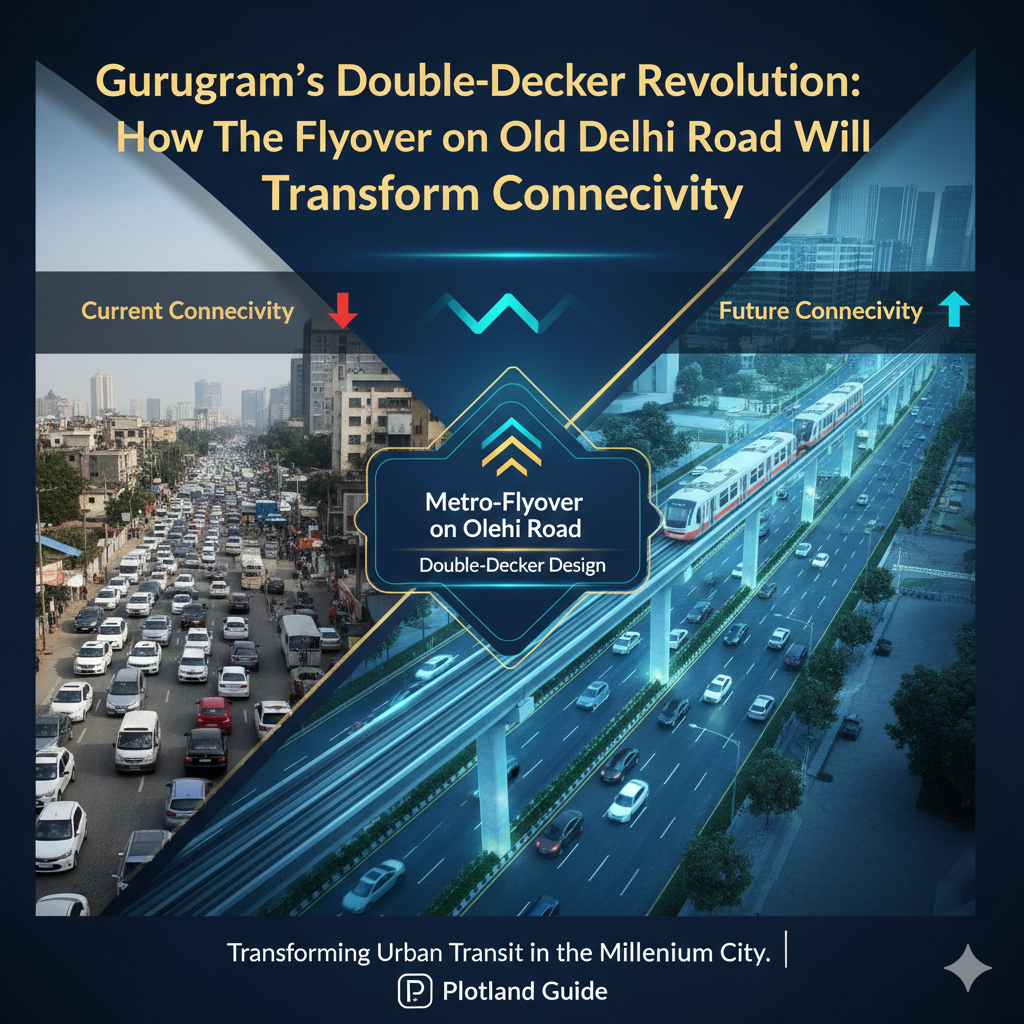
For years, the residents of Gurugram have navigated a tale of two cities. On one side lies the gleaming skyline of Cyber City and Golf Course Road, characterized by wide avenues and rapid transit. On the other side sits Old Gurugram, a bustling, historically rich, but infrastructure-starved region that has often felt disconnected from the rapid modernization of its southern counterpart. The Old Delhi Road, a critical arterial lifeline connecting the city to the national capital, has long been a symbol of this disparity, plagued by perennial traffic snarls and bottlenecks.
However, a transformative solution is finally taking shape on the horizon. In a move that promises to redraw the transit map of the Millennium City, authorities have greenlit an ambitious double-decker infrastructure project. This engineering marvel will feature a flyover for vehicular traffic on the first level and a metro corridor on the second level, running along the Old Delhi Road. This project is not just about concrete and steel; it is about bridging the gap between the old and the new, promising a future where commuting across Gurugram is no longer a daily battle but a seamless experience.
To understand the magnitude of this project, one must appreciate the engineering complexity and the spatial efficiency it represents. In dense urban environments like Old Gurugram, land is a scarce resource. Acquiring land for widening roads or building separate corridors for metros and flyovers often leads to prolonged legal battles, displacement, and exorbitant costs. The double-decker model solves this problem through vertical expansion rather than horizontal.
The structure will effectively create a three-tier transportation system. The ground level will remain dedicated to local traffic, service lanes, and non-motorized transport, ensuring that residents and local businesses retain easy access. The first level will host a vehicular flyover, designed to cater to through-traffic that wants to bypass the local congestion points. This allows commuters traveling from the Delhi border toward the inner sectors of Gurugram to glide over the chaotic intersections below.
The crowning glory of this structure is the second level, which will carry the metro rail. This elevated corridor is a crucial part of the much-anticipated metro expansion that aims to connect the Millennium City Centre to Cyber City, effectively closing the loop of the metro network in Gurugram. By stacking these utilities, the administration is maximizing the utility of the existing Old Delhi Road corridor without necessitating massive demolition of existing properties.
Old Delhi Road is more than just a street; it is an economic spine. It hosts major industrial units, including the sprawling Maruti Suzuki plant, alongside dense residential pockets like Palam Vihar, Sector 21, Sector 22, and Sector 23. For decades, the volume of traffic here has far exceeded the road's carrying capacity. Rush hour typically sees gridlocks that stretch for kilometers, leading to lost productivity and rising pollution levels.
The introduction of the flyover component is expected to act as a pressure release valve. By segregating the long-distance traffic from the local traffic, the friction that causes jams—such as vehicles stopping for turns, local buses picking up passengers, or pedestrians crossing—is significantly reduced for the vehicles on the flyover. Traffic studies conducted during the feasibility stages of such projects suggest that grade separation can reduce travel time by nearly half during peak hours.
For the daily commuter driving from Palam Vihar to Cyber Hub, this means the end of the stop-and-go nightmare. The drive, which currently can take upwards of 45 minutes during peak morning hours, could potentially be slashed to a manageable 15 to 20 minutes. This efficiency is vital for the overall economic health of the district, ensuring that goods and workforce mobility are unhindered.
While the flyover solves the immediate pain of road congestion, the metro corridor on the upper deck is the strategic game-changer for long-term urban mobility. This section is a pivotal component of the larger Gurugram Metro expansion plan approved by the Union Cabinet.
The proposed route aims to link the existing HUDA City Centre (now Millennium City Centre) with Cyber City, passing through Subhash Chowk, Hero Honda Chowk, and the crucial sectors of Old Gurugram. The double-decker section on Old Delhi Road specifically addresses the connectivity needs of Palam Vihar and the adjacent sectors.
Currently, residents in these areas are geographically close to the commercial hubs but transit-distant due to the lack of a reliable metro link. They often rely on personal vehicles or shared cabs to reach the nearest Yellow Line station or Rapid Metro station. The new metro line will bring the station to their doorstep.
This integration serves a dual purpose. First, it provides a green, affordable, and reliable public transport alternative, encouraging people to leave their cars at home. Second, it integrates Old Gurugram into the wider National Capital Region (NCR) transit network. A resident of Sector 23 will soon be able to board a train near their home and travel seamlessly to Central Delhi, Noida, or the airport without battling road traffic.
Infrastructure is the primary driver of real estate valuation, and this double-decker project is poised to trigger a significant re-rating of property prices in the vicinity. Historically, real estate markets in Palam Vihar, Sector 21, 22, and 23 have traded at a discount compared to the New Gurugram sectors or Golf Course Extension Road, primarily due to connectivity perceptions and aging infrastructure.
With the announcement and subsequent construction of this project, that discount gap is expected to narrow rapidly.
Homeowners in these sectors are sitting on a potential goldmine. As connectivity improves, the desirability of these established neighborhoods will skyrocket. Unlike the developing sectors in New Gurugram, these areas already possess mature social infrastructure—schools, hospitals, markets, and parks. The addition of a metro line removes the final hurdle for many homebuyers who previously avoided the area due to commute concerns. We can expect a surge in demand for both resale properties and new builder-floor developments. Rental yields are also likely to witness an upward trajectory as working professionals from Cyber City and Udyog Vihar seek affordable accommodation within a short metro ride from their offices.
The Old Delhi Road is already a commercial hub, but the improved accessibility will attract a new wave of investment. Transit-Oriented Development (TOD) becomes a viable reality with the metro corridor. We are likely to see the redevelopment of older commercial complexes into modern office spaces and retail high-streets. The footfall generated by metro stations typically invigorates the local micro-economy, benefiting shop owners, restaurants, and service providers in the catchment area.
The realization of such a complex infrastructure project requires seamless coordination between multiple agencies. The Gurugram Metropolitan Development Authority (GMDA) and the Haryana Mass Rapid Transport Corporation (HMRTC) have been working in tandem to bring this vision to life. Technical consultancy firms like RITES have been instrumental in conducting the geotechnical investigations and feasibility studies to ensure the structural integrity of the double-decker design.
The decision to adopt the double-decker model was not immediate. It came after extensive deliberation regarding land availability and utility shifting. There were initial concerns regarding the alignment near the Maruti plant and the residential sectors. However, the consensus on the double-decker approach highlights a maturity in urban planning, prioritizing minimal displacement and maximum utility. The approval of the design and the subsequent tendering processes mark a shift from planning to execution, signaling to the citizens that the government is serious about upgrading the city's backbone.
While the project paints a promising picture of the future, the construction phase will undoubtedly present challenges. Building heavy infrastructure on an already busy arterial road is akin to performing open-heart surgery while the patient is awake. Residents and commuters should brace for a period of disruption. Traffic diversions, dust pollution, and noise are inevitable byproducts of such massive civil works.
The administration will need to implement rigorous traffic management plans to minimize inconvenience. This includes creating adequate service lanes, ensuring clear signage, and potentially restricting heavy vehicle movement during peak construction hours. Furthermore, the timely shifting of utilities—underground power cables, water pipelines, and sewage networks—is often the biggest cause of delay in Indian infrastructure projects. Proactive management of these utility shifts will be critical to meeting the project deadlines.
Another aspect to watch is the environmental management during construction. Gurugram already battles with air quality issues, and construction activities must adhere to strict dust mitigation norms, including the use of anti-smog guns and barricading, to ensure the health of the local population is not compromised.
The Old Delhi Road double-decker project is more than just a local upgrade; it serves as a template for urban renewal across India. As cities grow denser, the luxury of sprawling horizontal infrastructure diminishes. The vertical integration of transport modes is the future of smart cities.
By successfully executing this project, Gurugram is setting a precedent. It demonstrates that established, congested parts of a city need not be left behind in the race for modernization. It proves that with innovative engineering and political will, retrofitting modern transit solutions into older urban fabrics is not only possible but highly beneficial.
The double-decker flyover and metro corridor on Old Delhi Road represent a watershed moment for Gurugram. It is a decisive step toward healing the connectivity fracture that has long divided the city. For the weary commuter stuck in the gridlock of Palam Vihar, it offers the promise of reclaiming hours of lost time. For the investor, it signals a lucrative horizon of asset appreciation. And for the city as a whole, it reinforces Gurugram’s status as a premier economic hub that is willing to invest in its future.
As the pillars rise and the tracks are laid, the Old Delhi Road is set to transform from a bottleneck into a lifeline. The journey from the old city to the new corporate glass towers is about to get a lot shorter, bringing the community closer together and driving the next phase of growth for the Millennium City. The dust of construction will eventually settle, revealing a modern, efficient, and connected Gurugram that moves at the speed of its aspirations.
