Published On:
April 23, 2026
Updated On:
April 23, 2026
The upcoming network of flyovers and dedicated service roads on the Gurugram stretch of the Delhi-Jaipur Highway is set to permanently eliminate massive traffic bottlenecks. By successfully separating local commuters from heavy inter-state transit, this infrastructure overhaul will drastically cut travel times and trigger a significant appreciation in surrounding real estate values.
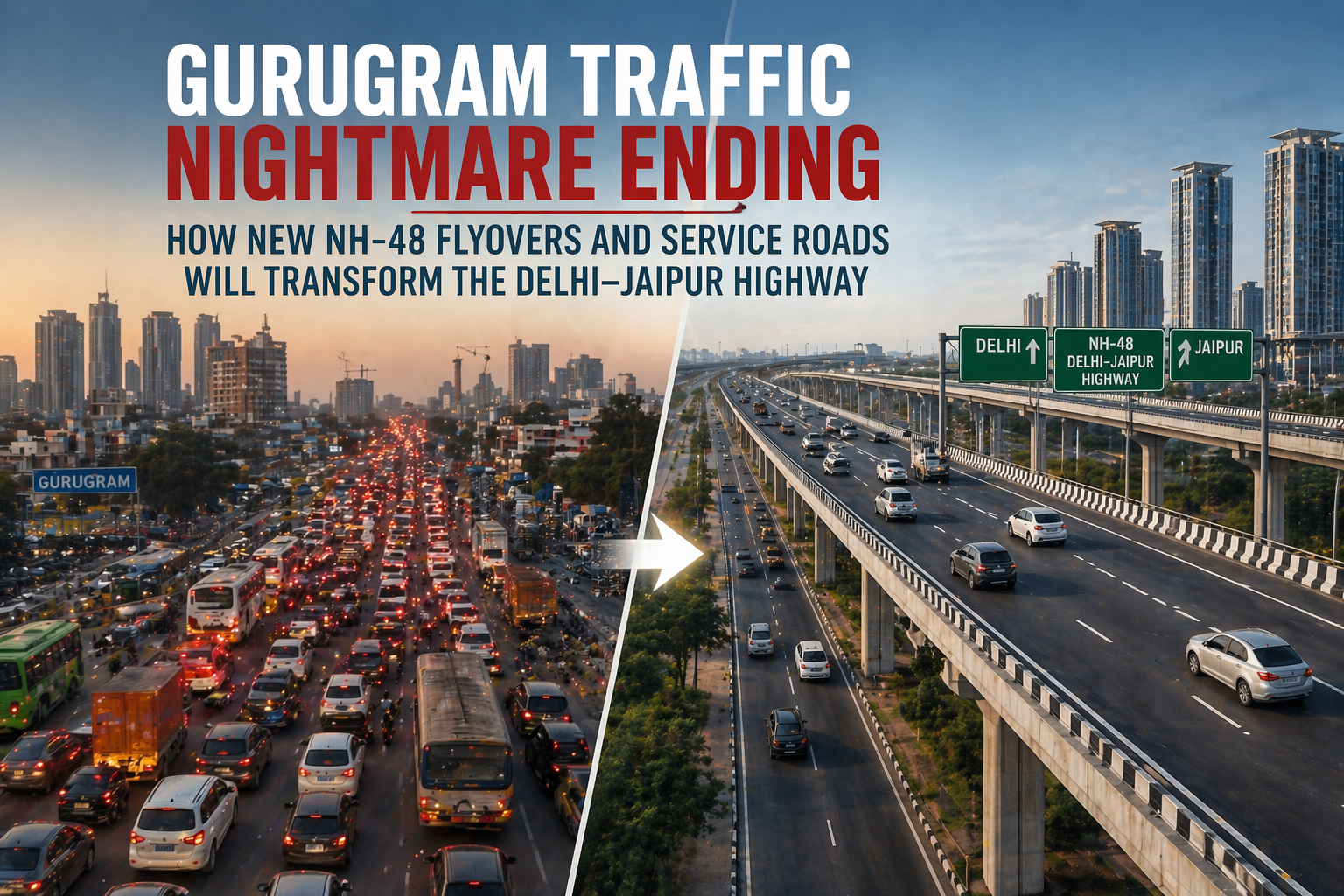
Anyone who has ever commuted through the National Capital Region understands the sheer frustration of driving on the Gurugram stretch of the Delhi-Jaipur Highway. Officially known as National Highway 48, this massive arterial road is the primary lifeline connecting the political capital of Delhi with the booming industrial and cultural hubs of Rajasthan. However, over the past decade, the rapid urbanization of Gurugram has turned this crucial highway into one of the most stressful driving experiences in the country.
For the thousands of corporate employees, industrial workers, and logistics drivers who navigate this route daily, long, agonizing traffic jams have become the accepted norm. The slow, creeping movement of vehicles and the sheer chaos during peak morning and evening hours mentally exhaust commuters before they even reach their offices. What was originally designed as a high-speed corridor has devolved into a massive parking lot, where a minor vehicle breakdown or a sudden merging of traffic can trigger a gridlock stretching for several kilometers. Fortunately, after years of temporary fixes and inadequate traffic management strategies, a permanent and highly structural solution is finally being implemented to break this endless cycle of congestion.
Why the Gurugram Stretch Reached a Breaking Point
To comprehend the massive scale of the upcoming infrastructure overhaul, it is absolutely essential to first understand why the Gurugram stretch of NH-48 failed to handle the regional growth. The root of the problem lies in the catastrophic blending of two completely different types of vehicular movement. Every single day, heavy, inter-state freight trucks traveling from Delhi to Jaipur are forced to share the exact same lanes with localized traffic moving between residential sectors, shopping malls, and corporate parks within Gurugram.
Furthermore, the rapid expansion of massive employment hubs like Cyber City, Udyog Vihar, and the Industrial Model Township in Manesar has exponentially increased the volume of daily commuters. Thousands of personal cars and corporate cabs flood the highway simultaneously during office rush hours. The situation is further aggravated by extremely poor merging points and sudden, unpredictable bottlenecks where wide multi-lane roads suddenly narrow down. Additionally, the complete absence of fully functional service lanes in critical areas forces local residents to enter the main highway even if they only need to travel a few hundred meters down the road. This constant entering and exiting of local traffic severely disrupts the momentum of the high-speed highway lanes, resulting in the dreaded stop-and-go traffic pattern that plagues the city today.
The Master Plan: Unveiling the New Flyovers and Service Roads
Recognizing that minor road widening and traffic light management are no longer viable solutions, the administration has finalized an aggressive blueprint to physically alter the landscape of the highway. The core philosophy of this new master plan is brilliantly straightforward yet incredibly impactful: permanently segregate the local city traffic from the long-distance highway commuters.
To achieve this, urban planners are rolling out a comprehensive network of strategically placed flyovers and extensive, continuous service roads. The primary objective is to allow inter-state travelers and heavy logistics vehicles to drive straight through the Gurugram borders without ever having to stop at a local traffic signal or navigate around slowing city cars. By elevating the main highway traffic over the most congested junctions, the ground-level roads are instantly freed up for the exclusive use of local residents and short-distance commuters. This vertical separation of traffic is the only proven method to solve congestion in highly dense urban corridors.
Decoding the Infrastructure Upgrades at Key Junctions
The sheer engineering scale of this project becomes apparent when looking at the specific locations targeted for immediate development. The route between major commercial landmarks and the IMT Manesar industrial zone is notoriously difficult to navigate. Two major intersections in this specific belt have been identified as the primary culprits behind the massive traffic delays: Dadi Sati Chowk and Shaheed Rao Ranjit Singh Chowk.
The state government has already fast-tracked the approvals for a massive new flyover at Dadi Sati Chowk. With an estimated capital injection of roughly 40 crore rupees, the detailed project report has been completed, and the tendering process is actively underway. Once built, this structure will completely bypass the chaotic ground-level merging that currently paralyzes the intersection.
Simultaneously, rigorous feasibility surveys and engineering assessments are being conducted for an additional flyover at the heavily burdened Shaheed Rao Ranjit Singh Chowk. This particular junction bears the brunt of the heavy industrial traffic moving in and out of the Manesar manufacturing belt. By ensuring that these two major choke points are transformed into seamless, signal-free elevated corridors, the authorities are guaranteeing that the agonizing daily commute to the industrial township will be cut down drastically.
How Service Roads Will Revolutionize Local Gurugram Transit
While the massive concrete flyovers tend to dominate the headlines, the true unsung heroes of this entire infrastructure master plan are the proposed service roads. The project outline mandates the construction of nearly six kilometers of dedicated, high-quality service lanes running perfectly parallel to the main three-lane highway.
The importance of these service roads cannot be overstated. Currently, because the existing service lanes are either broken, heavily encroached upon, or completely non-existent, local vehicles are left with no choice but to merge onto the high-speed NH-48 lanes. With the introduction of continuous, well-paved service roads, local two-wheelers, auto-rickshaws, and private cars will never have to interact with the heavy freight trucks.
These dedicated local lanes will provide incredibly smooth and safe access to the numerous residential sectors, bustling commercial markets, and corporate parks situated right along the highway. They will feature scientifically designed entry and exit ramps, ensuring that when a vehicle finally does need to merge onto the main highway, it can do so seamlessly without causing sudden braking and dangerous disruptions to the fast-moving traffic behind it. By keeping the local hustle and bustle confined entirely to the service roads, the main carriageway can finally function as the rapid transit express route it was always intended to be.
The Ripple Effect on Gurugram Real Estate and Property Values
In the dynamic world of real estate, there is an ironclad rule: world-class infrastructure directly fuels aggressive property appreciation. The announcement and subsequent execution of these massive highway upgrades are already sending incredibly positive shockwaves through the Gurugram real estate market.
Historically, while the areas directly adjoining the Delhi-Jaipur Highway offered excellent commercial potential, many prospective home buyers and corporate tenants hesitated to invest heavily due to the horrific daily commute. The fear of spending hours trapped in gridlock actively depressed rental yields and capital appreciation in certain micro-markets along the route. However, with the promise of a signal-free, smoothly flowing highway, this narrative is flipping completely.
The residential sectors that flank the NH-48 corridor, particularly those near the upcoming flyover zones and the newly planned service roads, are suddenly becoming highly lucrative investment hotspots. Improved connectivity means that corporate professionals working in Cyber City or Manesar can live slightly further down the highway without sacrificing their personal time to traffic. This newly discovered convenience is guaranteed to drive up the demand for both premium and affordable housing options in the vicinity. Real estate analysts confidently project that while prices will not multiply overnight, the long-term capital appreciation and the surge in high-paying rental tenants will make these sectors some of the best-performing assets in the entire National Capital Region over the next decade.
What This Means for Corporate Hubs and the Logistics Industry
Beyond the undeniable benefits to the daily office-goer, the economic implications of a decongested Delhi-Jaipur Highway are absolutely staggering. Gurugram is not just a residential paradise; it is one of the most powerful corporate and industrial engines in the country. The region hosts the headquarters of countless multinational corporations, massive IT parks, and an enormous manufacturing ecosystem in Manesar.
For the logistics and supply chain industry, time is quite literally money. Every single hour that a freight truck spends idling in a traffic jam at a Gurugram intersection translates to massive fuel wastage, delayed supply chains, and increased operational costs. By allowing these heavy transport vehicles to bypass local city traffic via the new flyovers, the efficiency of freight movement between Delhi and Rajasthan will skyrocket. The smooth transit of raw materials and finished goods will heavily bolster the profit margins of the manufacturing units situated in the industrial township.
Furthermore, multinational corporations heavily factor in employee quality of life when deciding where to establish their regional offices. A city plagued by chronic gridlock struggles to attract and retain top-tier professional talent. By fundamentally fixing the primary commuting artery, Gurugram will further solidify its reputation as the premier corporate destination in India, attracting even more global investment and highly skilled professionals to the city.
The Environmental and Psychological Perks of Decongestion
The impact of this massive road project extends far beyond economics and real estate; it deeply touches the environment and the mental well-being of the citizens. The environmental degradation caused by thousands of vehicles idling in traffic jams every single day is immense. Engines running at extremely low speeds, constantly accelerating and braking, emit a massive volume of harmful pollutants and greenhouse gases into the atmosphere. By enabling continuous, uninterrupted vehicle movement, the new infrastructure will drastically reduce the per-vehicle emission rates, contributing to a noticeably cleaner and healthier air quality index for the entire city.
Equally important is the profound psychological relief this will bring to the residents. The chronic stress associated with unpredictable travel times, the anxiety of missing important morning meetings, and the sheer exhaustion of fighting through chaotic intersections takes a heavy toll on the local population. Transforming a grueling, unpredictable daily battle into a smooth, predictable, and remarkably faster journey will dramatically improve the overall quality of life and happiness index of the millions of people who call this city home.
Overcoming Execution Hurdles and Ensuring Timely Delivery
While the blueprints for the flyovers and service roads look absolutely flawless on paper, the true test of this infrastructure initiative lies entirely in its on-ground execution. The residents of the National Capital Region are rightfully cautious, having witnessed numerous ambitious public works projects fall victim to massive delays, bureaucratic red tape, and poor inter-agency coordination in the past.
Constructing massive elevated structures directly over one of the busiest operational highways in the country is an incredibly complex civil engineering challenge. It requires meticulous traffic diversion planning, round-the-clock construction schedules, and absolute precision to ensure that the ongoing commute is not completely paralyzed while the concrete is being poured. The success of this project hinges completely on the seamless collaboration between the local municipal authorities, the state government, and the national highway agencies.
Furthermore, the design of these structures must be forward-thinking. It is not enough to simply solve the traffic volume of today; the engineering must account for the explosive, exponential vehicular growth that Gurugram will undoubtedly experience over the next twenty years. If executed with strict adherence to deadlines and uncompromising quality control, this project will serve as a textbook example of world-class urban management.
A New Era of Seamless Connectivity for the Millennium City
The relentless traffic jams on the Delhi-Jaipur Highway have held Gurugram back from realizing its absolute full potential for far too long. The daily struggles of the commuters, the massive financial losses incurred by the logistics sector, and the stagnation of specific real estate pockets have all been direct consequences of a severely outdated road network.
The decisive move to construct new flyovers and expansive, dedicated service roads marks the beginning of a highly anticipated new era for the Millennium City. By finally isolating the heavy inter-state transit from the daily local hustle, the authorities are not just pouring concrete and laying asphalt; they are actively engineering a significantly better future for the region. As the construction equipment rolls in and the massive pillars begin to rise, the citizens of Gurugram can finally look forward to a reality where their daily commute is defined by high-speed efficiency rather than endless, frustrating gridlock.
