Published On:
April 27, 2026
Updated On:
April 27, 2026
The upcoming construction of strategic flyovers and dedicated service roads along the Delhi-Jaipur Highway in Gurugram promises to untangle years of gridlock, offering a massive reprieve to daily commuters while driving robust demand in the surrounding real estate markets.
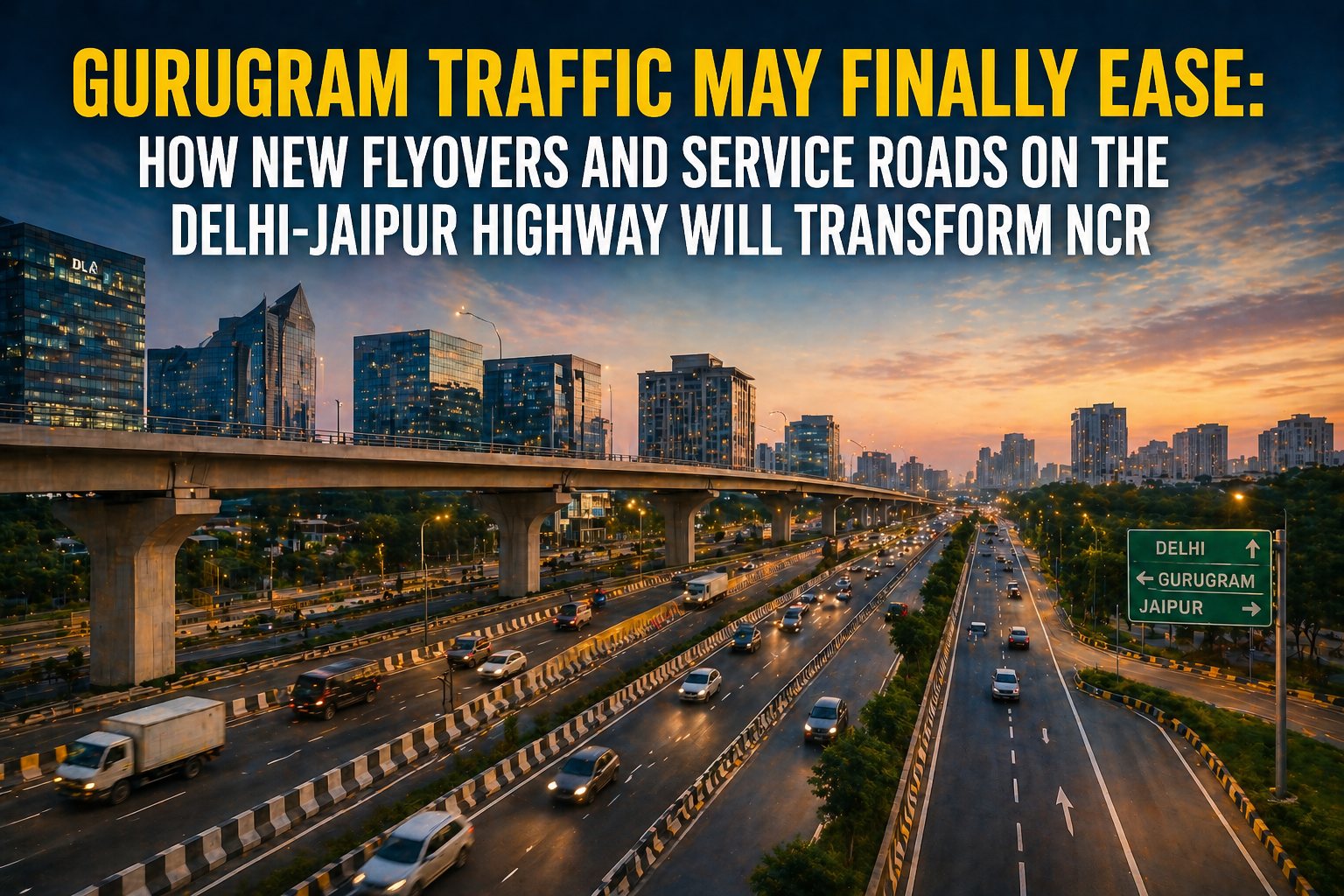
Anyone who has navigated the Millennium City during peak hours knows that its towering skyscrapers and world-class corporate parks are often overshadowed by one glaring issue: the relentless traffic. For years, the daily commute along the Delhi-Jaipur Highway, officially known as NH-48, has been a grueling test of patience for thousands of office-goers, residents, and logistics drivers. The stretch cutting through Gurugram is notorious for transforming short geographical distances into hour-long sagas of stop-and-go driving.
However, a highly anticipated infrastructure overhaul is officially on the horizon, promising to fundamentally rewrite the rules of transit in the region. Urban planners and highway authorities have unveiled a comprehensive blueprint to construct a series of strategic flyovers and dedicated service roads along the most congested bottlenecks of NH-48. This is not merely a patchwork repair job; it is a structural redesign aimed at separating high-speed transit from local neighborhood movement. For daily commuters longing for a predictable drive and real estate investors looking for the next big value jump, this project represents the most significant development in Gurugram’s recent infrastructure history.
To appreciate the scale of the upcoming solutions, one must first understand how the traffic situation on the Delhi-Jaipur Highway reached such a critical breaking point. Gurugram's evolution from a sleepy suburb into a global corporate powerhouse happened at breakneck speed. The city’s infrastructure, particularly its primary arterial roads, struggled to keep pace with the exploding population and the sheer volume of daily vehicular influx from neighboring Delhi and broader Haryana.
The core of the problem lies in the dual nature of NH-48. On one hand, it functions as a major national corridor connecting the capital city to the industrial belts of Rajasthan and beyond, carrying massive fleets of heavy commercial trucks and interstate buses. On the other hand, it serves as the primary local street for Gurugram’s most densely populated commercial hubs, including Cyber City and Udyog Vihar.
This functional overlap created a logistical nightmare. Because of severely lacking infrastructure at the ground level, high-speed highway traffic and localized commuter traffic were forced to share the exact same lanes. The merging points became scenes of daily chaos. Vehicles trying to exit the highway into local sectors would aggressively cut across lanes, while local traffic trying to enter the highway would create massive bottlenecks. A single broken-down vehicle or a minor fender-bender during the morning office rush was enough to trigger a ripple effect of congestion stretching for kilometers. The resulting gridlock not only drained countless productive hours from the workforce but also led to heightened localized pollution and sheer commuter exhaustion.
The primary weapon against this chronic congestion is a strategic deployment of new flyovers at the most critical intersections along the Gurugram stretch. The underlying engineering philosophy is simple but highly effective: vertical separation of traffic. By elevating the through-traffic, the highway can finally function as it was originally intended—a high-speed transit corridor.
These upcoming flyovers are meticulously designed to tackle the specific friction points that have haunted drivers for years. When heavy interstate trucks and long-distance travelers can sail over the busy intersections, the surface-level roads are instantly freed up. The immediate result is a drastic reduction in the need for traffic signals and stoppage points on the main carriageway. Instead of braking every few minutes to navigate a chaotic junction, vehicles will maintain a steady, uninterrupted flow.
Furthermore, these elevated structures will streamline the movement of traffic turning into the city's major commercial and residential arteries. By providing designated, elevated ramps and loops, the chaotic crisscrossing of vehicles that currently defines Gurugram's intersections will be eliminated. The focus is entirely on keeping the momentum going. For the average driver, this means the frustrating phenomenon of sitting through multiple red light cycles at a single crossing will become a relic of the past.
While massive concrete flyovers often capture the public's imagination and dominate the headlines, the true unsung heroes of this infrastructure master plan are the service roads. In urban planning, a highway is only as effective as the service lanes running parallel to it. Unfortunately, the service road network along the Gurugram stretch of NH-48 has historically been fragmented, poorly maintained, or in some sectors, entirely nonexistent.
The current project aims to rectify this by building broad, continuous, and highly functional service roads. The importance of this cannot be overstated. When local residents want to drive to a nearby grocery store, or office workers need to hop between different corporate blocks in Udyog Vihar, they currently have no choice but to enter the main highway, drive a short distance, and then exit. This unnecessary localized movement adds thousands of cars to the highway lanes every hour.
By establishing a robust service road network, local traffic will be entirely contained within the peripheral lanes. Residents will have smooth, direct access to nearby sectors, markets, and colonies without ever needing to merge with the high-speed interstate traffic. Additionally, these service roads will provide heavily structured entry and exit points. Rather than vehicles abruptly forcing their way onto the main carriageway, designated slip roads will allow drivers to accelerate safely and merge seamlessly, neutralizing one of the primary causes of sudden highway braking and rear-end collisions.
The real-world implications of this project are massive, particularly for the hundreds of thousands of professionals who navigate the Delhi-Gurugram border every day. The corporate hubs surrounding NH-48 are the economic engines of the region, housing countless multinational corporations, tech giants, and financial institutions. However, the prestige of working in these cutting-edge offices is often heavily diluted by the mental toll of reaching them.
If the blueprint translates accurately to the asphalt, the daily office commute is set for a dramatic transformation. The immediate benefit will be the restoration of predictability. Currently, a commuter might budget forty-five minutes for a trip, only to find themselves stuck for two hours due to an unforeseen bottleneck at a major merging point. The combination of flyovers bypassing the chaos and service roads handling the localized volume will create a highly stabilized traffic environment.
Less stop-and-go driving naturally translates to significantly reduced fuel consumption, putting money back into the pockets of daily drivers. More importantly, it reclaims time. Shaving even twenty to thirty minutes off a one-way commute yields hundreds of hours of reclaimed personal time annually. The ripple effect on workforce productivity, mental well-being, and overall quality of life for the residents of the National Capital Region will be profound.
Infrastructure and real estate share a deeply symbiotic relationship. In the property market, the value of concrete and glass is inextricably linked to the asphalt that leads to it. Whenever a major transit bottleneck is permanently resolved, the intrinsic value of the surrounding micro-markets experiences a significant and immediate upward trajectory. As the heavy machinery rolls in to begin the foundation work along NH-48, the Gurugram property market is already adjusting its forecasts.
For decades, the sheer density of traffic acted as a subtle deterrent for some homebuyers looking at specific pockets near the highway. Even premium luxury localities suffered when residents realized they would be trapped in a sea of cars the moment they exited their gated communities. The promise of a rapid, signal-free commute changes this equation entirely. The prospect of living in a neighborhood with instantaneous, high-speed access to both the heart of Delhi and the expanding commercial corridors of New Gurugram is an incredibly attractive proposition.
We are already witnessing heightened interest from both end-users and investors looking to secure a footprint in the residential sectors flanking the highway before the flyovers become fully operational and the inevitable price correction takes place. Office workers inherently prefer housing that minimizes their commute. As connectivity improves, the rental demand in these adjacent sectors is expected to surge. Landlords possessing properties near the newly upgraded junctions will likely command a premium as corporate professionals actively seek out homes that offer a stress-free drive to work.
Furthermore, the commercial real estate landscape is bound to reap substantial rewards. Ground-level retail spaces, boutique storefronts, and local neighborhood markets often suffer when the roads in front of them are perpetually gridlocked. The noise, pollution, and lack of parking discourage foot traffic. By pushing the heavy transit vehicles onto the main highway and organizing local movement onto the service roads, the commercial environment becomes far more conducive to leisurely shopping and dining. Small and medium businesses situated along these stretches are likely to see a notable increase in organic customer engagement.
While the blueprints paint a picture of an urban utopia, seasoned residents of the National Capital Region know that the true test lies in the execution. Constructing multi-lane elevated corridors and expansive service roads in the middle of one of the country's most densely populated and active transit zones is an incredibly complex logistical challenge.
The success of the project hinges heavily on seamless coordination between various state and central agencies, aggressive timeline management, and forward-thinking design. Historically, some infrastructure projects in the region have suffered from design flaws that simply shifted a bottleneck from one intersection to the next rather than eliminating it entirely. The authorities spearheading the NH-48 upgrades are operating under intense public scrutiny to ensure these new structures are future-proofed, taking into account the projected vehicular growth of Gurugram over the next two decades.
During the construction phase, there will inevitably be temporary traffic diversions, lane closures, and modified transit routes. The patience of the local populace will undoubtedly be tested. However, a comprehensive traffic management plan is essential to ensure that the daily disruption is kept to an absolute minimum while the heavy machinery operates. For the residents and daily commuters, the temporary inconveniences posed by cranes and barricades represent the final, necessary hurdle before achieving a truly modernized, world-class transit experience.
The aggressive push to overhaul the Delhi-Jaipur Highway through these strategic flyovers and service roads represents a definitive maturation in Gurugram’s urban planning philosophy. It moves away from reactionary, short-term patching and embraces a long-term vision designed to handle the inevitable vehicular load of a rapidly expanding metropolis.
This project is a powerful testament to the fact that resolving urban congestion requires multi-dimensional thinking. By untangling the localized movement from the interstate transit, Gurugram is reclaiming its surface spaces. The result will be a city sector that moves faster, breathes easier, and offers an exponentially higher quality of life. As the foundational pillars of these massive structures begin to rise, they carry with them the promise of a revitalized Millennium City—one where the dream of a smooth, signal-free commute finally becomes an everyday reality, simultaneously driving the local real estate market to unprecedented new heights.
